

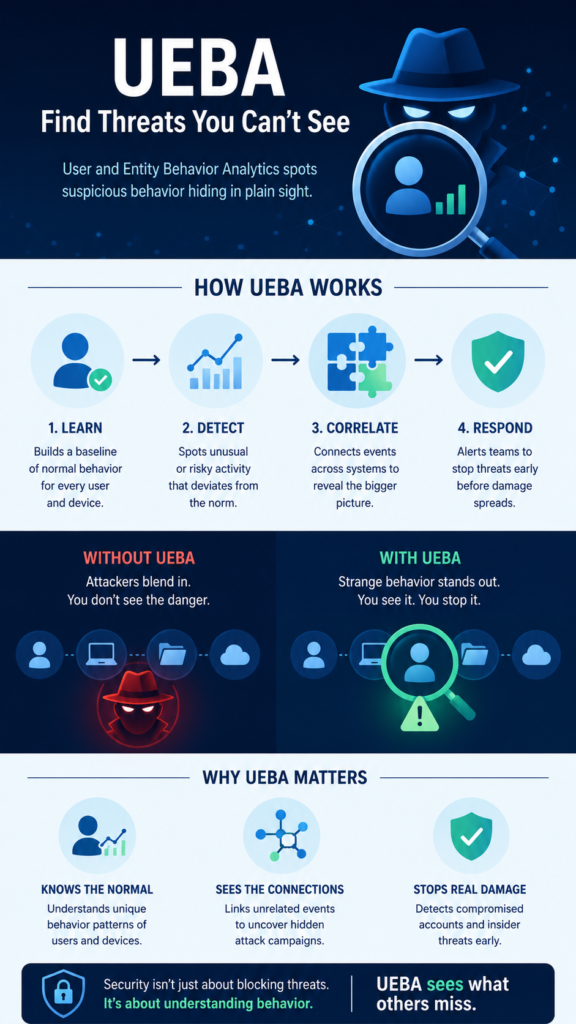
Traditional security tools are good at blocking known threats, but many modern attacks look like normal user activity. User and Entity Behavior Analytics UEBA helps security teams find these hidden risks by analyzing how people and devices normally behave.
Combined with Network Threat Detection, it reveals suspicious actions that other security tools often overlook. Instead of reacting after damage is done, organizations can investigate unusual behavior much earlier. Keep reading to learn how UEBA uncovers invisible threats.
How UEBA Stays One Step Ahead
Hidden attacks rarely stand out on their own. Here are the main reasons UEBA has become an essential part of modern cybersecurity.
- UEBA builds a behavioral baseline for every user and device to spot subtle anomalies.
- It connects unrelated events across systems to reveal hidden attack campaigns.
- The focus shifts from just blocking malware to stopping compromised insider actions.
How Does UEBA Detect Insider Threats and Anomalies?
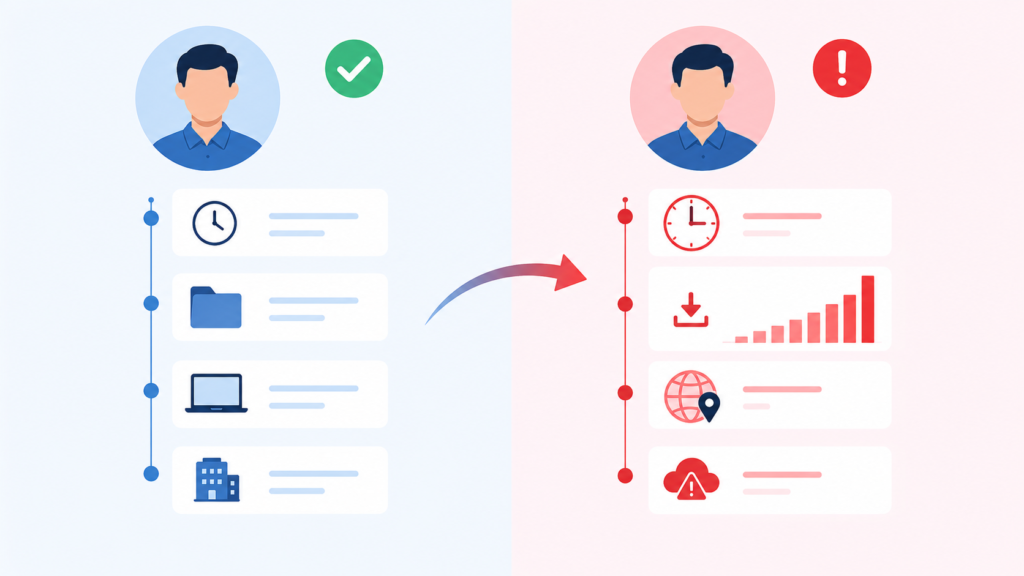
It starts by forgetting what a “threat” looks like. Instead, it learns what you look like. Every day, it watches. It sees that Sarah logs in from her home office at 8:15, accesses the project management tool, and transfers files to the marketing share.
It sees that the financial server only communicates with three specific workstations. This becomes the baseline, a detailed map of normal.
An anomaly isn’t a single wrong action. It’s a story told in data points. When Sarah’s credentials are used to log in from a foreign country at midnight, and immediately start querying the HR database she’s never touched, that’s a story.
UEBA connects these dots. It scores the risk, weighing the rarity of the login location against the sensitivity of the data accessed.
The detection process focuses on sequences:
- Impossible travel (logging in from two cities hours apart).
- Access aggregation (touching multiple unrelated sensitive systems quickly).
- Data hoarding (unusually large downloads or prints).
- Behavioral velocity (acting far faster than the user’s typical pace).
What’s the Difference Between UEBA and Traditional Security Monitoring?
Think of it as the difference between a guard checking IDs and a neighbor who knows everyone’s habits. Traditional monitoring is rules-based. It’s built on “if this, then that” logic. If a known malware signature appears, then block it. If someone tries to access port 22 on a sensitive server, then alert. It’s looking for a specific list of bad things.
“As Microsoft Sentinel ingests data from connected sources, UEBA applies: Behavioral modeling to detect deviations; Peer group analysis and blast radius evaluation to assess the impact of anomalous activity. UEBA assigns risk scores to anomalous behaviors… helping security teams identify threats such as compromised accounts, insider attacks, and lateral movement.” Microsoft Learn
UEBA asks a different question: “Is this normal for this specific person or machine?” It’s context-aware. A system admin logging into a server at 3 a.m. might be normal during a patch window. An accountant doing it is not. Traditional tools see only the login event. UEBA sees the identity, the time, the history, and the surrounding actions.
This is why traditional tools fail against modern threats. A hacker with stolen credentials looks, to a firewall or intrusion detection system, like a legitimate user. Their actions use allowed protocols and tools. There’s no signature to block, no rule to trigger. The breach happens in the blind spot between the rules.
How Do You Establish a Baseline for User and Entity Behavior?
Credits: Geekus Maximus
You don’t define it. You observe it. The establishing baseline is a living profile built over a learning period, typically 30 to 90 days. It’s not a single “normal” setting but a range of acceptable activities for each entity. For a user, it includes login times and locations, typical volumes of data accessed or emailed, regular network destinations, and common applications used.
The key is granularity. A baseline isn’t just for “users.” It’s for this specific user, and that specific server. The marketing team’s file server has a different traffic pattern than the engineering build server. UEBA models these individually. We always start with the richest source of truth for this: Network Threat Detection.
This period requires patience. You will see false positives as the system learns the quirks of your environment, the monthly financial close that causes a data spike, the developer who works odd hours. This tuning phase is critical. You’re not just installing software, you’re teaching it the culture of your organization.
What Machine Learning Algorithms Power UEBA Systems?
The magic isn’t in a single algorithm, but in an ensemble. UEBA systems use unsupervised, supervised, and sometimes semi-supervised machine learning to work together.
Unsupervised learning is the workhorse. It clusters data without pre-labeled examples to find what’s normal. It might group all similar login events, and then flag the ones that fall outside any cluster as outliers.
Supervised learning comes in for specific, known threats. You can train a model with examples of past insider theft or brute-force attacks to recognize those patterns more acutely. But the real strength is in the combination. The system uses statistical analysis to calculate the probability of an event, like a login from a new country.
Then it uses peer group analysis. If every other person in the finance department accesses the billing system daily, and one person suddenly stops, that’s an anomaly worth noting, even though no “rule” was broken.
What Are Common UEBA Use Cases, Like Fraud Detection?
Beyond catching hackers, UEBA’s behavioral lens is powerful for operational risks. Fraud detection is a prime example. In a financial setting, UEBA can model a teller’s or accountant’s normal transaction patterns, amounts, frequencies, types, and times.
A deviation, like suddenly processing large, round-number transactions just below reporting thresholds, gets flagged. We’ve seen it identify fraudulent wire transfer attempts because the initiating employee’s behavior, speed of navigation, hesitation between steps, deviated sharply from their muscle-memory pattern captured in the baseline.
Other critical use cases include:
- Compromised Account Identification: Spotting when a legitimate user’s credentials are used by an attacker, evidenced by a sudden shift in technical behavior (typing rhythm, access patterns).
- Lateral Movement Detection: Seeing a single entity probe or access multiple unrelated systems in a short time, a classic attacker technique.
- Data Exfiltration Prevention: Flagging unusual outbound data volumes or transfers to unauthorized cloud storage.
- Rogue Device or Software Discovery: Identifying unauthorized devices or shadow IT applications by their unique network behavior, which doesn’t match any approved baseline.
How Does Integrating UEBA Data with SIEM and NDR Work?
UEBA shouldn’t be another siloed dashboard. Its true value is as an intelligence engine for your existing security infrastructure. The most powerful integration is with your Security Information and Event Management (SIEM) system. UEBA feeds its high-fidelity, risk-scored alerts into the SIEM.
This turns the SIEM’s flood of raw logs into a prioritized investigation queue. Instead of 10,000 low-level events, your analyst sees one consolidated UEBA alert: “High risk: Possible account compromise for user jsmith.”
The integration with Network Detection and Response (NDR) is even more symbiotic. We view NDR as the foundational data source. NDR provides the ground truth of network flows and packets. UEBA consumes this rich data to build more accurate behavioral models. In turn, UEBA can enrich NDR alerts with identity context.
| Integration Point | Benefit to Your Team |
| SIEM | Prioritizes alerts, reduces noise, provides user/entity context for log events. |
| NDR | Uses network truth for accurate baselines, adds identity to network alerts. |
| SOAR | Automates response playbooks (like disabling a user) based on UEBA risk scores. |
| Ticketing | Creates investigation cases with linked evidence for your workflow. |
What Are the Key UEBA Deployment Considerations and Tuning Challenges?
Deployment is a process, not a project. The first decision is scope. Don’t boil the ocean. Start with your crown jewels, privileged users (IT admins, executives), critical servers (databases, file shares), and sensitive data repositories. Phasing the rollout lets you manage the tuning load.
Data quality is your biggest make-or-break factor. Garbage in, garbage out. You must ensure reliable log feeds from your core systems: identity (Active Directory, Okta), endpoints (EDR), applications, and network. This is where we emphasize starting with Network Threat Detection data.
Then comes the tuning, the real work. The first month will have false positives. The system is learning, and you’re learning what “normal” truly means for your business. You’ll need to adjust sensitivity, create exceptions for known benign anomalies (like scheduled bulk data jobs), and define what risk score truly warrants an urgent alert.
This phase requires a partnership between your security team and the technology. It’s not automatic.
How Should You Evaluate UEBA Vendor Solutions and Features?
Look beyond the marketing. Start with data ingestion. Can the solution easily consume logs from your specific mix of on-premises systems, cloud services (Azure, AWS, Google Cloud), and SaaS apps (Office 365, Salesforce)? Flexibility here is crucial.
“User and Entity Behavior Analytics (UEBA), a behavior-based cybersecurity paradigm that establishes multidimensional behavioral baselines for users, machines, and processes… employs machine learning techniques to detect deviations from these baselines, capturing both abrupt and subtle anomalies.” – IEEE Xplore
Evaluate the analytics. Ask how they establish baselines. Do they use peer group analysis? Can they handle the concept of “concept drift,” where normal slowly changes over time? Request a demonstration using anonymized data from your own environment, if possible. See the types of anomalies it finds.
Key feature checklist should include:
- Out-of-the-box Use Cases: Pre-built models for common threats like insider risk, compromised accounts, and data exfiltration.
- Investigation Workbench: Tools to easily explore the timeline and linked evidence around an alert.
- Scalability: The ability to handle your data volume without performance loss.
- Integration APIs: Robust ways to push alerts and pull data from other systems.
- Deployment Model: Whether SaaS, on-prem, or hybrid fits your compliance and latency needs.
Consider the vendor’s expertise. Do they understand the operational reality of a security team? Can they provide guidance on your specific tuning challenges? The best tool is useless without the knowledge to operationalize it.
What Are the Privacy Implications of UEBA Monitoring?
This is the essential conversation. Monitoring employee behavior, even for security, walks a fine line. The key is intent and transparency. UEBA should be configured for security anomaly detection, not employee surveillance.
It looks for patterns and deviations, not content. It might flag that an employee is printing an abnormal number of documents, but it should not be capturing or analyzing the text of those documents.
Legal and HR teams must be involved from the start. You need clear, written policies communicated to all employees. These policies should state what data is collected, how it’s used solely for security purposes, who has access, and how long it’s retained. In many regions, this is not just good practice, it’s a legal requirement under regulations like GDPR.
We advise anonymizing data where possible during the baseline phase. The system can learn that “User_1234” has a certain pattern without initially tying it to a named individual until a high-risk alert warrants investigation. This balances security needs with privacy preservation. The goal is to build trust, not a surveillance state.
How Is UEBA Adapted for Cloud Security Monitoring?

The cloud changes the game. Your traditional network perimeter is gone. Users, data, and applications live outside your direct control. UEBA becomes even more critical here. It shifts from monitoring a physical network to monitoring identities and cloud service interactions.
In cloud environments like AWS or Azure, the “entities” change. They are not just users and servers, but also cloud roles, resource groups, storage buckets, and serverless functions. UEBA must baseline these.
What is normal API call volume for this Lambda function? What cloud storage buckets does this developer role normally access? An anomaly might be a cloud admin role suddenly creating new virtual machines in an unusual region, or a storage bucket that is normally private starting to see massive external download traffic.
Cloud UEBA solutions integrate directly with cloud providers’ native logs (like AWS CloudTrail, Azure Activity Log). They model the complex web of permissions and interactions.
The principle remains the same: learn the normal behavior of every identity and resource in your cloud estate, so you can spot when something acts out of character, whether it’s a compromised cloud access key or a misconfigured, publicly exposed database.
FAQ
Does UEBA replace my existing security tools like a firewall?
No, not at all. Think of it as a complementary layer. Your firewall is the lock on the door. UEBA is the motion sensor inside the house. You need both. The firewall blocks the obvious bulk attacks, while UEBA finds the threat that picked the lock or came in through an open window.
Is UEBA only for large enterprises with big security teams?
It’s true that large companies pioneered it, but the technology has evolved. Modern cloud-based UEBA solutions are more accessible and manageable. For smaller teams, the benefit is actually greater, it automates the constant monitoring a small team can’t physically do, acting as a force multiplier.
How does UEBA handle user privacy concerns?
A well-implemented UEBA system is configured for security monitoring, not employee surveillance. It looks for behavioral anomalies, not specific content.
It might flag that an employee is printing an unusual volume of documents, but it shouldn’t be capturing or reading the text of those documents. Clear communication of these boundaries with staff is crucial.
What’s the biggest mistake teams make when starting with UEBA?
The most common mistake is “set it and forget it.” UEBA is not a magic box. It requires initial tuning and ongoing oversight. If you don’t review its alerts, provide feedback on false positives, and adjust its models to your changing business, its effectiveness will plummet. It’s a tool for an active, engaged security team.
Making User and Entity Behavior Analytics Your Silent Partner
User and Entity Behavior Analytics (UEBA) shifts security from reactive alerts to a deep understanding of your network’s normal rhythm. By focusing on behavioral anomalies rather than just known threats, you catch sophisticated attacks early during their critical “dwell time.”
NetworkThreatDetection.com empowers SOC teams and CISOs with real-time threat modeling, automated risk analysis, and visual attack path simulations mapped to frameworks like MITRE ATT&CK. Ready to expose your blind spots? Strengthen your defenses and join today.
References
- https://learn.microsoft.com/en-us/azure/sentinel/identify-threats-with-entity-behavior-analytics
- https://ieeexplore.ieee.org/document/11272798
Related Articles
- https://networkthreatdetection.com/how-ueba-detects-insider-threats-anomalies/
- https://networkthreatdetection.com/ueba-vs-traditional-security-monitoring/
- https://networkthreatdetection.com/establishing-baseline-user-entity-behavior/
- https://networkthreatdetection.com/machine-learning-algorithms-ueba-systems/
- https://networkthreatdetection.com/common-ueba-use-cases-examples-fraud-detection/
- https://networkthreatdetection.com/integrating-ueba-data-siem-ndr/
- https://networkthreatdetection.com/ueba-deployment-considerations-tuning-challenges/
- https://networkthreatdetection.com/evaluating-ueba-vendor-solutions-features/
- https://networkthreatdetection.com/privacy-implications-ueba-monitoring/
- https://networkthreatdetection.com/ueba-for-cloud-security-monitoring/