
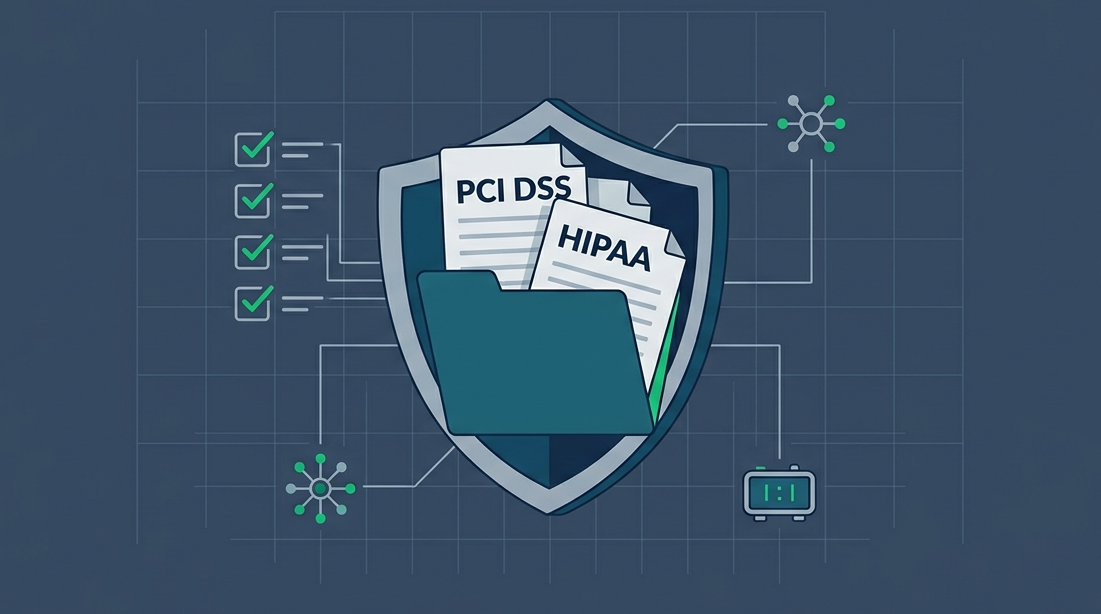
Audits can quickly become overwhelming when compliance data is spread across multiple systems and security tools. Organizations subject to PCI DSS and HIPAA requirements often spend countless hours gathering logs, validating records, and preparing evidence for auditors. This is where SIEM compliance reporting features PCI HIPAAbecome essential.
By automating report generation, centralizing audit evidence, and supporting continuous compliance monitoring, a SIEM reduces manual effort while improving accuracy. When combined with effective Network Threat Detection, these features help organizations stay both secure and audit-ready throughout the year. Keep reading.
Centralized Audit Trails and Evidence Storage
During an audit, the ability to quickly locate historical records is critical. SIEM platforms centralize logs, alerts, user activities, and security events into a single searchable repository.
- Automated report generation is non-negotiable for proving continuous compliance.
- Pre-built templates for PCI DSS and HIPAA cut setup time from weeks to hours.
- A centralized audit trail within the SIEM itself is your ultimate evidence locker.
Why Does Manual Compliance Reporting Feel Like a Trap?

You’ve been there. The audit notification arrives, and suddenly your team is spending nights and weekends in spreadsheets and log files. It’s a frantic search for evidence that should already be organized. The process is fragile, one misplaced filter away from missing a critical event.
“What these requirements share is not just the obligation to log — it is the obligation to log at a specific level of detail, with specific attribution, in a format that cannot be altered after the fact… The compliance requirement is not the presence of logs — it is logs of a specific type: operation-level, data-specific, attribution-complete, and tamper-evident.” — Kiteworks
This manual method creates what one CISO called a “compliance debt,” where the effort to prove you’re secure often overshadows actually being secure. It’s unsustainable, and auditors can smell the disorganization. They look for consistency, for a narrative. Scattered files and manually compiled reports tell a story of chaos, not control.
What Core SIEM Reporting Features Are Essential for Audits?
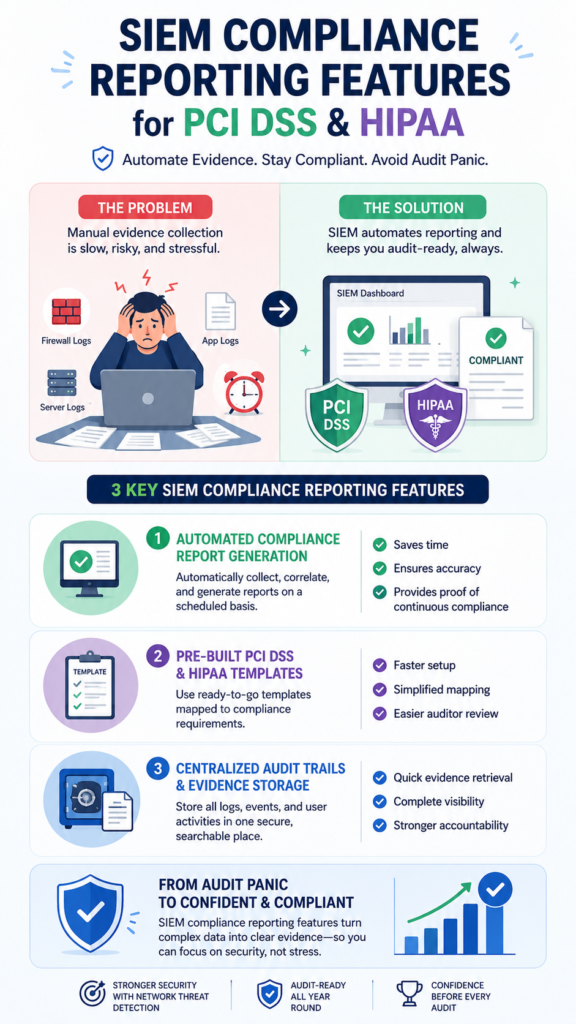
A system built for compliance does more than just store logs. It structures them into evidence. Organizations looking to future-proof this process often deploy next-generation SIEM capabilities to automate threat detection alongside standard tracking. Think of it as your digital forensics lab, already organized for the inspector’s visit.
First, automated and scheduled reports. This is the cornerstone. You configure a report once, say, a weekly summary of all administrator activity or failed login attempts, and it runs itself, delivering a timestamped PDF to a designated folder. This proves continuous monitoring, not just a last-minute scramble. It shows the auditor you’re always watching.
Second, pre-built compliance templates. A mature SIEM comes with report packs mapped directly to control requirements. For PCI DSS, you’ll find templates for Requirement 10 (tracking access to cardholder data) and Requirement 11 (regularly testing security systems).
For HIPAA, there are templates for the Audit Controls standard (§164.312(b)). These templates aren’t guesses, they’re built from years of audit experience and tell you exactly what data to collect for each rule. They turn a philosophical standard into a technical query.
Essential features include:
- Customizable Dashboards: Utilizing intuitive SIEM dashboards to achieve real-time views and effective security monitoring visualization of key compliance metrics.
- Drill-Down Capability: Click any chart element to see the raw log events behind it.
- Tamper-Evident Logging: Reports should be digitally signed or stored in a write-once format to prove their integrity.
How Do Pre-Built Templates for PCI DSS and HIPAA Speed Up Your Process?
Credits: 906 Technologies
Starting from a blank page is the enemy of efficiency. Pre-built templates provide the outline. For PCI DSS Requirement 10.2.3, which demands audit trails of all individual access to cardholder data, a template will already have the correct data sources linked, your Active Directory, database servers, and file systems.
It’s similar with HIPAA’s Technical Safeguards. The template for “Information System Activity Review” (§164.308(a)(1)(ii)(D)) will be pre-configured to correlate login events with access to electronic protected health information (ePHI) databases. This cuts setup time from potentially weeks of engineering effort to a few hours of configuration.
It’s the difference between building a car from scratch and simply turning the key. One senior security analyst told me, “The first time I used a HIPAA template, I had a draft report for my CISO in one afternoon. Before that, it was a two-week project of writing queries and hoping I got it right.”
Where Does Network Threat Detection Fit Into Your Compliance Evidence?
This is where compliance meets actual security. Network Threat Detection observes the raw flow of traffic across your environment. For compliance, it provides an unbiased, foundational layer of evidence. While endpoint logs can be disabled or manipulated, network traffic is harder to hide. It acts as a verification source.
Consider a PCI DSS audit. You must show that critical systems in your cardholder data environment (CDE) are isolated from general corporate networks. A Network Threat Detection module can automatically generate a map of traffic flows, visually proving that segmentation is in place and operational.
For HIPAA, you need to monitor for unauthorized exfiltration of ePHI. Network detection can baseline normal data transfer levels and flag anomalous outbound spikes that might indicate a data breach, directly supporting the Audit Controls and Integrity controls (§164.312(c)).
We position it as the first option for evidence because it’s objective. It doesn’t rely on an agent’s health. It sees what actually happened on the wire, providing a corroborating story that makes your other log-based evidence stronger and more credible to an auditor.
Can a SIEM’s Own Audit Trail Strengthen Your Compliance Position?
Absolutely. This is a meta-feature often overlooked. The system itself becomes a subject of the audit. Who accessed the platform? What reports did they run? Did anyone try to delete or alter log data? A robust security information event management (SIEM) platform maintains its own immutable audit trail of all user interactions within the environment.
“Out-of-the-box compliance reports for PCI DSS, HIPAA, FISMA, GDPR, SOX, ISO27001, and more… provide evidence for your adherence to requirements stated out in the compliances simplifying your security auditing.” — ManageEngine Log360
This trail proves the integrity of your entire compliance process. It shows the auditor that your evidence-generating machine is itself secure and accountable.
You can produce a report showing that only authorized personnel generated the compliance reports, that no evidence was tampered with post-collection, and that all access followed the principle of least privilege. It closes the loop, making the SIEM a trusted source, not just a tool.
What Should You Look for in Reporting Flexibility and Customization?
While templates are vital, your environment is unique. The ability to customize is what makes the system yours. You need a SIEM that allows you to modify existing templates or build new reports from scratch without needing a PhD in query languages.
Look for a drag-and-drop report builder or intuitive query wizard. You should be able to add data sources, like a new cloud application, to an existing PCI report in minutes. Customization also means formatting, being able to brand reports with your company logo and deliver them in multiple formats (PDF, CSV, HTML) to different stakeholders.
The finance team might want a CSV for their records, while the auditor requires a signed PDF. The system should accommodate both without extra work.
| Requirement | Static Report | Interactive Dashboard |
| Best For | Formal audit submission, scheduled executive summaries. | Real-time monitoring, internal investigations, trend analysis. |
| Evidence Type | Definitive, point-in-time snapshot. | Exploratory, shows ongoing state. |
| Auditor Preference | Required for official evidence packets. | Excellent for demonstrating active control during walkthroughs. |
How Does Automated Evidence Collection Build a Continuous Compliance Culture?
The goal is to bake compliance into daily operations, not treat it as a quarterly fire drill. Automated reporting flips the script. Instead of reacting to an audit, you’re continuously producing the artifacts. This shifts your team’s mindset.
Security engineers start to design systems with logging and reporting in mind from the start, knowing the SIEM will handle the proof. It becomes part of the workflow, not an interruption.
This creates a culture where compliance is a byproduct of good security hygiene. You’re always ready. When an auditor does arrive, you provide a curated portal of scheduled reports, dashboards, and audit trails.
The conversation changes from “Can you prove this?” to “Let us show you how we ensure this every day.” It’s a position of strength, built on automation.
Which Log Sources Are Most Critical for PCI and HIPAA Reports?
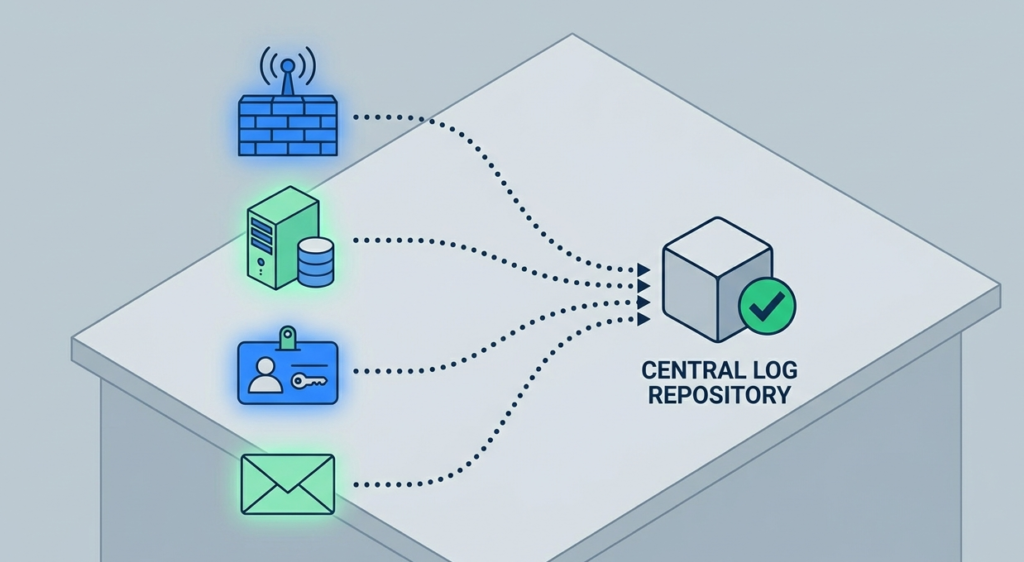
Your reports are only as good as the data you feed them. For PCI DSS, focus is key. You need logs from every system that touches cardholder data. This includes:
- Firewalls and routers segmenting the CDE.
- All servers within the CDE (Windows event logs, Linux syslog).
- Database servers storing cardholder data.
- Application logs from payment processing software.
- Intrusion detection/prevention systems (IDS/IPS).
- Anti-virus and file integrity monitoring (FIM) tools.
For HIPAA, the scope broadens to any system handling ePHI. Critical sources are:
- Electronic Health Record (EHR) system audit logs.
- Identity and Access Management (IAM) systems.
- File servers and cloud storage (like SharePoint, S3 buckets) containing ePHI.
- Email servers for communication monitoring.
- Endpoint security logs on workstations and mobile devices accessing patient data.
- Physical access control systems for data centers.
The common thread is completeness. An auditor will test to see if you’re collecting from all relevant systems. Missing a key server can invalidate months of other work.
FAQ
Can a SIEM automatically fulfill all our audit requirements?
No, and be wary of any that claim they can. A SIEM automates the evidence collection for technical controls. It provides the data logs, reports, and trails. The interpretation of that data against the standard, the policies and procedures, and the human oversight elements still require your expertise. The SIEM gives you the bricks, but you’re still the builder.
How long must we retain compliance reports and logs?
This varies by regulation. PCI DSS requires a minimum of one year of retention, with at least three months of immediate availability for analysis.
HIPAA doesn’t specify a universal timeframe, but a six-year retention period is a common standard derived from various state and federal rules. Always check with your legal counsel, but your SIEM should be configured to retain raw log data and generated reports for your required period.
Is cloud-native SIEM better for compliance reporting than on-premise?
It can be, especially for agility. Cloud-native SIEMs often simplify the ingestion of logs from other cloud services (AWS, Azure, SaaS apps), which is a growing part of modern environments.
They can also scale storage for long-term retention more easily. The core reporting features should be identical. The choice often comes down to where your critical data lives and your organization’s cloud strategy.
What’s the biggest mistake teams make with SIEM compliance reporting?
They set it and forget it. The most common mistake is building beautiful reports during implementation and never validating them again. Systems change, new applications are added, log formats evolve.
A report that was accurate in January might be missing critical data by June. You must schedule regular reviews, quarterly at a minimum, to verify your reports are still capturing all required events and that the data aligns with your current infrastructure.
Turning Audit Fear into Operational Routine
Automating your SIEM compliance reporting changes the game from chaotic audit prep to a calm, defensible routine. By mapping your first high-priority requirement to an automated schedule, you replace panic with constant visibility.
Ready to add that layer of network-verified truth to your defenses? Move beyond the stress of manual proof and build a sustainable, proactive security posture today. Streamline your compliance and strengthen your network defenses now.
References
- https://www.kiteworks.com/regulatory-compliance/ai-agent-audit-trail-siem-integration/
- https://www.manageengine.com/au/log-management/it-compliance-reporting-software.html