
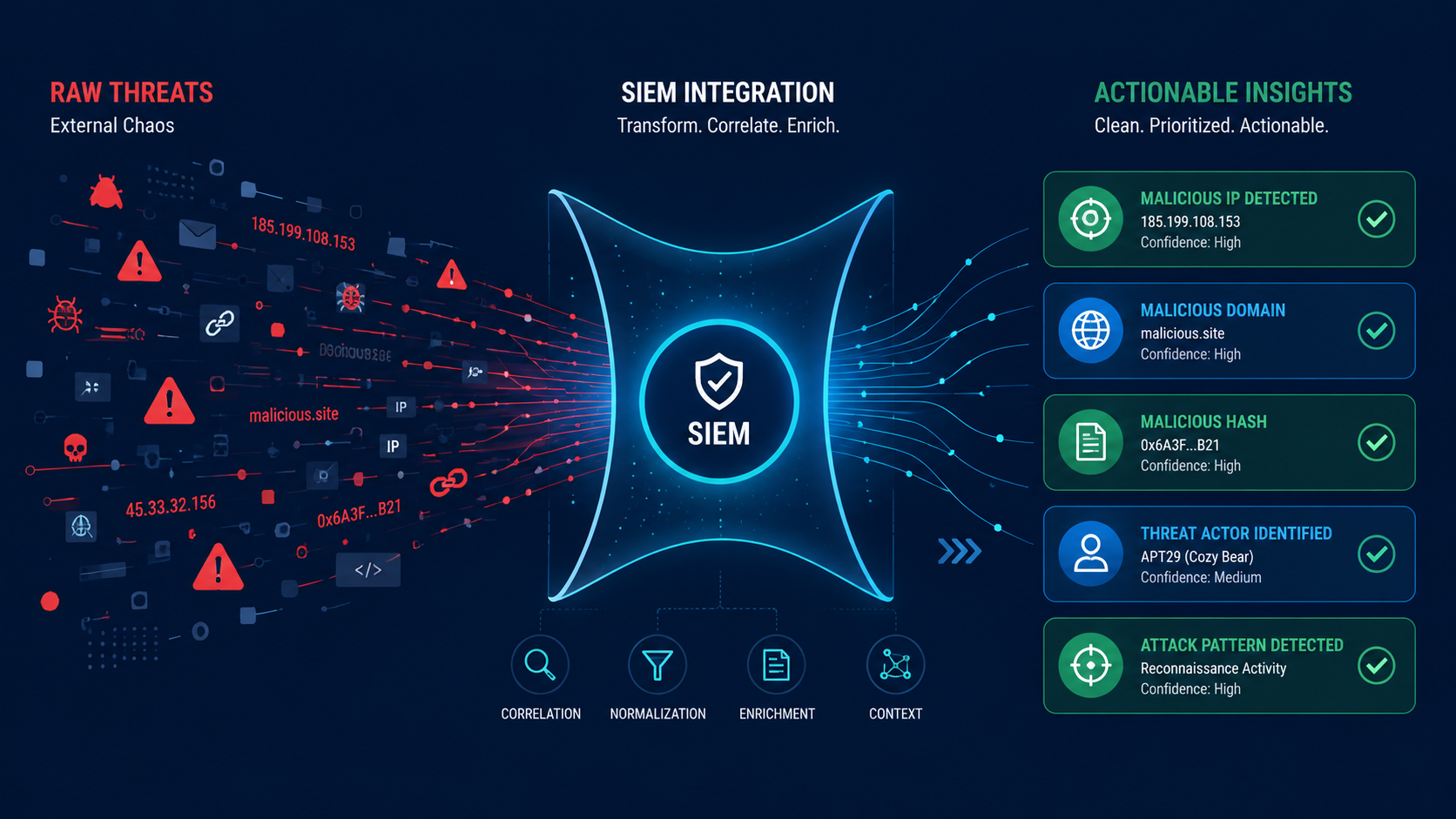
Integrating threat intelligence SIEM platform capabilities helps security teams detect known threats faster and respond with greater confidence. Instead of treating threat intelligence as separate reports or isolated data feeds, organizations can connect it directly to their SIEM to create real-time, actionable alerts.
This approach strengthens Network Threat Detection by adding external threat context to internal security events. The result is better visibility, faster investigations, and a more proactive defense strategy against emerging cyber threats.
Why This Integration Changes Everything
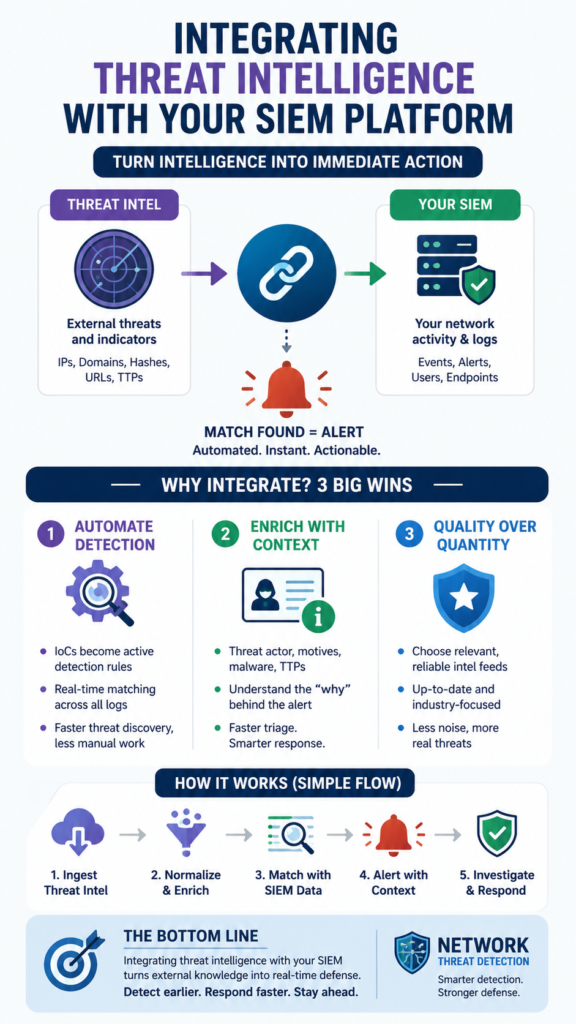
Here are three major benefits organizations gain when they connect threat intelligence directly to their SIEM platform:
- Integration turns static threat feeds into active detection rules that automatically alert on matches.
- Context is king; enriched alerts with threat actor motives and techniques cut investigation time in half.
- Quality of intelligence sources matters far more than quantity; choose feeds relevant to your industry.
Why Does Unintegrated Threat Intelligence Create More Work?

It’s a common scene. An analyst gets a daily or weekly threat intelligence report, a PDF or email listing hundreds of new IPs, domains, and file hashes tied to active campaigns. They then manually log into various security tools, the firewall, the DNS filter, the SIEM, to search for these indicators.
“Security analysts often use external threat intelligence platforms to check suspicious IP addresses manually. This results in longer response times and a greater likelihood of human error… [Our] proposed integration framework correlates the functionality of an external threat intelligence platform with a SIEM system to automatically validate suspicious IP addresses without the need for manual checking. Tests demonstrated that the proposed framework shortens the threat validation time by up to 97.7%, compared to manual processes. Additionally, the system reduces false positives by capitalizing on contextual threat intelligence, thus allowing SOC teams to prioritize critical alerts.” – Alhuzali & Alshareef
It’s tedious, slow, and prone to human error. By the time they finish checking yesterday’s list, a new one has arrived. This process creates “alert fatigue” for the intelligence itself. Valuable warnings get buried in an inbox or a SharePoint folder, never operationalized.
The gap between knowing a threat exists and actually looking for it in your environment can be days, which is more than enough time for an attacker to do their work.
What Are the Core Methods for Integrating Intelligence into a SIEM?
Credits: ThreatConnect
There are two primary paths, and the best choice depends on your SIEM’s capabilities and your team’s comfort level.
The first, and most common, is via a Threat Intelligence Platform (TIP) or direct feed. Most modern security information event management systems support ingesting structured threat feeds in formats like STIX/TAXII.
The second method is for more mature teams: creating custom correlation rules based on Tactics, Techniques, and Procedures (TTPs). Instead of just matching a bad IP, you write rules that look for the behavior described in an intelligence report.
For example, if a report details a phishing campaign that drops a specific PowerShell script, you can create a rule alerting on that script’s execution, regardless of the initial delivery IP. This catches variations of the same attack.
How Does Integrated Intelligence Transform Generic Alerts into Actionable Incidents?
Without context, an alert is just noise. A SIEM might flag “connection to suspicious IP.” An analyst has to stop, open a browser, and research that IP. Is it a known command-and-control server? Part of a botnet? Or just an obscure but legitimate web service?
Integrated threat intelligence provides that context at the moment of alerting. The alert pops up, already annotated: “IP 192.0.2.1 – High Confidence – Associated with TA505 phishing campaign targeting financial sector – IoC Type: C2 Server.” Suddenly, the analyst knows the severity, the likely threat actor, and their motive.
The investigation starts ten steps ahead. This enrichment is the difference between a five-minute triage and a one-hour forensic deep dive. It allows a team to prioritize ruthlessly, focusing on confirmed malicious activity over anomalous but benign events.
Why is Enrichment the Most Critical Step in the Process?
Matching an IP is the start, not the finish. Enrichment adds the layers of “who, why, and how” that make an alert truly actionable. A good integration will pull in data from multiple sources to build a profile around the matched indicator.
Think of it like a detective’s case file. The initial match is a fingerprint. Enrichment adds the suspect’s name, known associates, previous modus operandi, and last seen location. For a security alert, this means pulling in data like the associated malware family, the threat actor group (e.g., APT29), the campaign name, and the targeted industries.
The best integrations do this automatically, appending this data to the alert as it’s created. This turns your SIEM from a simple matching engine into an intelligence hub.
We’ve seen teams using Network Threat Detection find that enriching raw flow data with this threat context immediately classifies traffic as “benign,” “suspicious,” or “malicious,” letting them focus on what truly matters.
What Types of Threat Intelligence Feeds Should You Prioritize?
Not all intelligence is created equal. Subscribing to fifty generic feeds will drown you in irrelevant data. The key is relevance.
Prioritize these three tiers:
- Strategic Intelligence: Broad trends and threat actor motivations. This helps leadership understand risk.
- Tactical Intelligence: The IoCs – the hashes, IPs, and domains. This is the primary fuel for automated SIEM matching.
- Operational Intelligence: The TTPs – the detailed behaviors and techniques. This is for building advanced detection rules.
For most organizations, start with one or two high-quality commercial or industry-specific feeds (like FS-ISAC for finance or H-ISAC for healthcare).
This layer of architecture is highly dependent on choosing right SIEM solution built to handle diverse feeds, so ensure your vendor supports direct ingestion before subscribing. Supplement these with trusted open-source feeds.
The goal is to get intelligence that applies to your sector, technology stack, and geographic region. A feed full of indicators for attacks on oil rig control systems is useless if you’re a software company.
How Do You Measure the Effectiveness of Your Integration?
If you can’t measure it, you can’t improve it. Moving threat intel from a PDF to your SIEM is step one. Step two is tracking its impact.
Key metrics to watch include the “Intel Alert Ratio.” What percentage of your high-severity SIEM alerts are now generated by integrated threat intelligence matches? A rising ratio shows your integration is working.
Also, track the “Time to Context.” How long does it take an analyst to understand a threat intelligence-based alert versus a generic anomaly alert? The goal is to drive that time down to near zero through automation and enrichment. Finally, measure false positive rates.
What Are the Common Pitfalls and How Do You Avoid Them?
Enthusiasm for integration can lead to operational headaches if you’re not careful.
The biggest pitfall is “feed fatigue.” You connect too many low-quality feeds, and your SIEM is flooded with stale or irrelevant IoCs. This creates alert storms and can actually degrade performance. Start small. Connect one feed, tune the rules, measure the results, then consider adding another.
Another is poor tuning. Not every IoC from a feed deserves a high-severity alert. An IP associated with adware might be a “low” priority, while one tied to ransomware is “critical.”
Security teams must align these alerts with their broader internal frameworks, ensuring that critical compliance reporting obligations for frameworks like PCI and HIPAA are met while keeping standard threat alerts properly prioritized.
Finally, there’s the stale data problem. IoCs have a short shelf life. Attackers rotate domains and IPs. Your integration must support automated updating and, crucially, the expiration of old indicators.
| Integration Stage | Basic (Checklist) | Advanced (Strategic) |
| Data Ingest | Automated feed ingestion (STIX/TAXII). | Blends multiple feeds, internal telemetry, and TIP data. |
| Alert Creation | Simple matching on IoCs (IP, hash, domain). | Behavioral detection based on reported TTPs and techniques. |
| Enrichment | Appends basic threat actor name and confidence. | Provides full campaign context, MITRE ATT&CK mapping, and recommended actions. |
| Outcome | Faster detection of known-bad indicators. | Proactive hunting for threat actor behaviors across the environment. |
How Does This Integration Enable Proactive Threat Hunting?
With integrated intelligence, threat hunting shifts from a fishing expedition to a guided search. Instead of wondering where to look, hunters start with a hypothesis derived from fresh intelligence. A report on a new credential-theft technique used by a specific actor gives them a precise playbook.
“Bringing threat intelligence management and SIEM together in a unified platform is a game changer. We’ve already seen the value of deeply enriched advanced analytics and detection in our SIEM environment—but coupling that with integrated threat curation, prioritization, and response should help customers move even faster. It means fewer swivel-chair investigations, more accurate triage, and greater confidence that security analysts are working with the most relevant threats. This kind of integration has the potential to accelerate the ability to detect, respond, and stay ahead.” – Marcel Jonker
They can then use the SIEM’s search capabilities to look for that specific sequence of events across historical data. Did any user exhibit this behavior last week? The integration makes this possible because the SIEM isn’t just storing logs, it’s storing them in a way that’s queryable against known malicious patterns.
It turns the hunter from someone sifting through sand to someone using a metal detector tuned for a specific type of ore. This proactive searching often uncovers hidden compromises that never triggered a standard alert, catching attackers in the early stages of their operation.
FAQ
Do we need a separate Threat Intelligence Platform (TIP) to do this?
Not necessarily. Many modern SIEMs have built-in capabilities to ingest and manage threat feeds directly.
A TIP becomes valuable when you’re aggregating a very large number of feeds, need to perform complex analysis and deduplication on the intelligence before sending it to the SIEM, or want to share curated intelligence with other tools in your stack (like firewalls or endpoint protection).
How often should threat intelligence feeds update in our SIEM?
It depends on the feed and the threat landscape. For high-fidelity commercial feeds tracking active campaigns, updates should happen at least daily, if not multiple times a day. Some critical feeds can push updates in near real-time.
For more strategic or open-source feeds, a daily or weekly pull might be sufficient. The key is to align the update frequency with the volatility of the indicators. IP addresses and domains used in phishing change very quickly, while malware family TTPs evolve more slowly.
Can we use open-source threat intelligence feeds effectively?
Absolutely. Open-source intelligence (OSINT) feeds like AlienVault OTX, Abuse.ch, or CISA’s Automated Indicator Sharing (AIS) are valuable and free. The challenge is curation. They can be noisy and require more tuning to filter out irrelevant or low-quality indicators.
A best practice is to use OSINT feeds to supplement a core, high-quality commercial feed. This gives you broad coverage with a trusted foundation. Always validate the reputation of an OSINT source before integrating it.
How do we handle “false positives” from threat intelligence matches?
This is a tuning exercise. First, check the confidence score of the IoC. A “low” confidence match might be set to log-only, while a “high” confidence match creates an alert. Second, add context from your environment. For example, if an IP is flagged as malicious but it’s a cloud service IP used by your legitimate marketing team, you can create an exception list.
Third, work with your intelligence provider. Good providers welcome feedback on false positives and will adjust their scoring. The goal is a feedback loop that continuously improves the quality of your alerts.
Making Intelligence an Active Member of Your Security Team
Integrating threat intelligence with your SIEM gives your data memory and purpose, moving security operations from generic alerts to targeted adversary hunting. The true value lies in saved investigative time and proactive defense. By connecting a relevant feed, every alert tells a story.
Ready to make external knowledge a core part of your defense? Network Threat Detection streamlines vulnerability management with visual attack path simulations, CVE mapping, and real-time threat modeling. To transform your SOC and eliminate blind spots, explore features and join the platform today.
References
- https://doi.org/10.32985/ijeces.17.2.1
- https://www.securityinfowatch.com/cybersecurity/press-release/55296528/securonix-securonix-announces-acquisition-of-threatquotient