
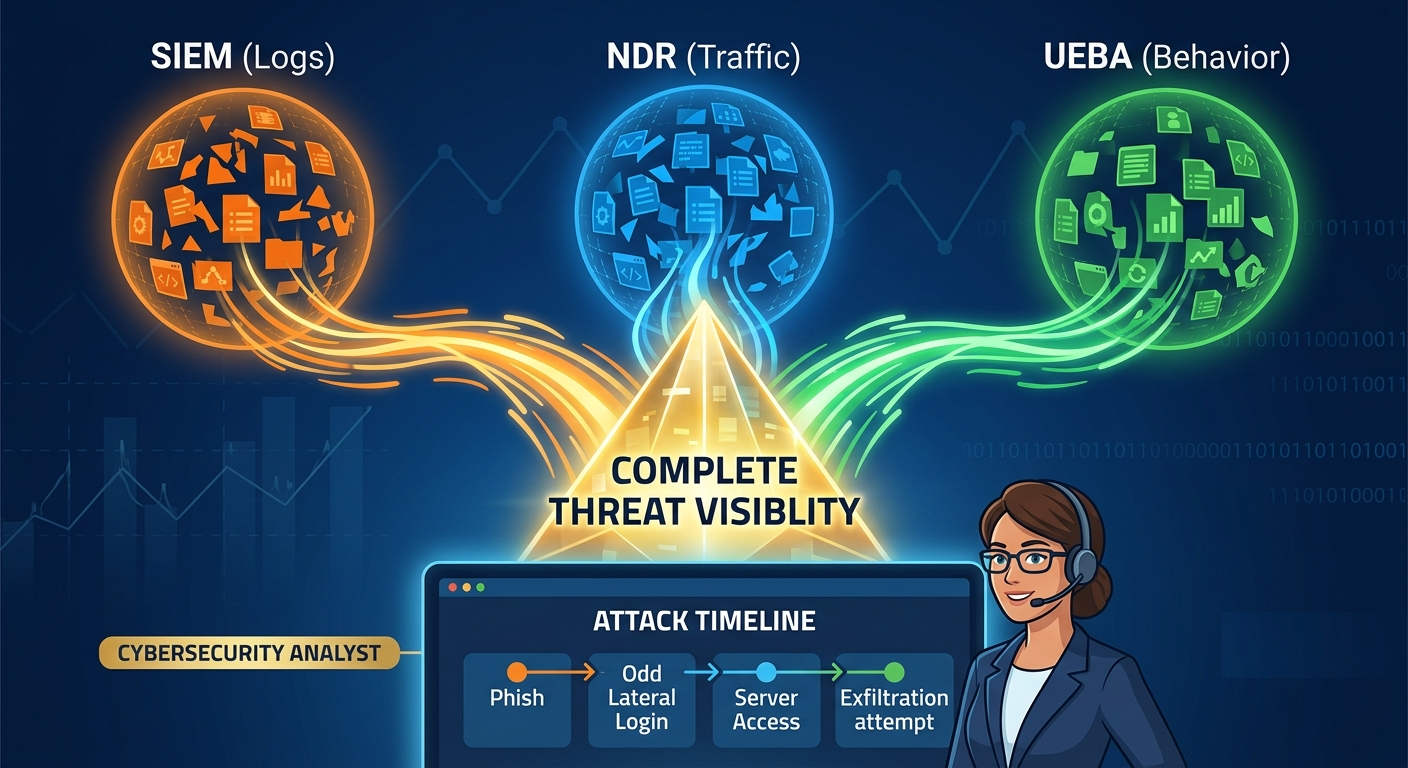
Your security tools see parts of an attack, but never the whole picture. The SIEM collects the logs, the NDR watches the packets, and the UEBA spots odd behavior. When these systems operate alone, your team is left manually connecting dots during a high-stakes crisis.
By integrating ueba data siem ndr capabilities, you transform these isolated alerts into a single, cohesive narrative. At Network Threat Detection, we believe in moving away from fragmented data collection and stepping into intelligent, context-driven response. Keep reading,
Beyond the Basics: Three Reality Checks for Modern Defense
Before diving into the integration mechanics, a brief look at how these tools actually interact reveals why a unified approach changes the game for an analyst on the line.
- Integration creates context: UEBA’s risk scores tell your SIEM which logs matter, and NDR data shows the network impact of behavioral anomalies.
- It automates the investigative workflow, enriching alerts with data from all sources to slash “time to understand.”
- This layered approach is your best defense against multi-stage attacks that use legitimate tools and credentials.
Why Keep Them Separate? The Cost of Siloed Security
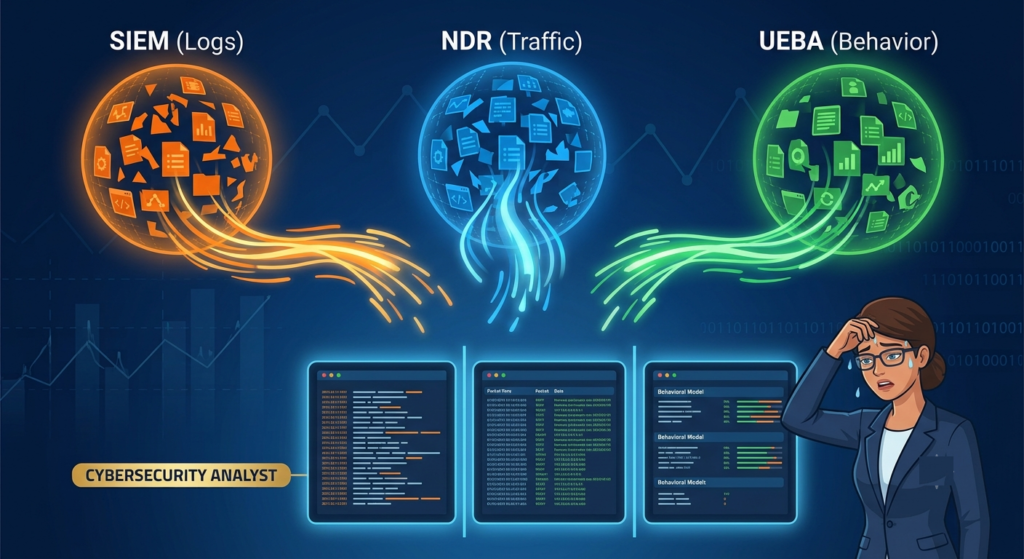
It’s a familiar scene. An alert pops in the SIEM: “Multiple failed logins for user Admin-JSmith.” At the same time, the NDR flags “unusual outbound data flow from server SRV-APP02.” In another pane, the UEBA console highlights “user J. Smith exhibiting anomalous data access patterns.”
“UEBA identifies unusual actions performed by users, devices, and applications. NDR provides insight into the network activity surrounding those behaviors… By correlating behavioral anomalies with network activity, organizations can improve threat detection accuracy, accelerate investigations, and gain deeper visibility into attacks that may otherwise remain hidden within normal network traffic.” – Vehere
Three consoles, three analysts, three separate investigations begin. The connection, that a compromised admin account is being used to exfiltrate data from a specific server, might take hours or days to piece together. By then, the damage is done. Siloed tools create blind spots and drain manpower.
The SIEM doesn’t know about the network traffic, the NDR doesn’t understand user intent, and the UEBA lacks the raw forensic evidence. Keeping them separate means you’re always reacting, always behind.
What Does a SIEM Gain from UEBA Integration?
A SIEM’s greatest weakness is also its strength: it collects everything. That volume creates noise. Integrating UEBA transforms that noise into a prioritized signal.
Instead of just a log entry, the SIEM event for “User JSmith accesses file server” can be enriched with a UEBA risk score. Leveraging specialized user and entity behavior analytics allows you to evaluate if JSmith’s behavior is actually normal. If the score is low, the event is suppressed or logged quietly.
We’ve configured our systems so UEBA acts as the brain, telling the SIEM, “Pay attention to this sequence of logs right now.” This pushes high-fidelity, behaviorally-informed alerts directly into the SOC’s primary workflow. It means analysts stop sifting and start investigating real threats from minute one.
How Does NDR Data Make UEBA Insights Actionable?
UEBA is brilliant at saying “this user is acting strangely.” By running advanced machine learning algorithms within UEBA systems, security platforms can baseline normal user trends to accurately spot anomalies. NDR then provides the “so what,” answering the critical question: what is that strange behavior causing on the network?
A UEBA alert about anomalous privileged user activity is concerning. When that alert is automatically enriched with NDR data showing a new, persistent data flow from that user’s system to an unknown external IP address, it becomes urgent. The NDR evidence moves the alert from a potential policy violation to a confirmed data exfiltration event.
In our Network Threat Detection practice, we use this integration constantly. The UEBA identifies the suspicious entity, and the NDR provides the network-level proof of impact, the lateral movement, the command-and-control callbacks, the data transfer.
This combination allows for automated, precise response actions, like segmenting that specific host, because the confidence level is so high.
What’s the Technical Flow of This Integration?
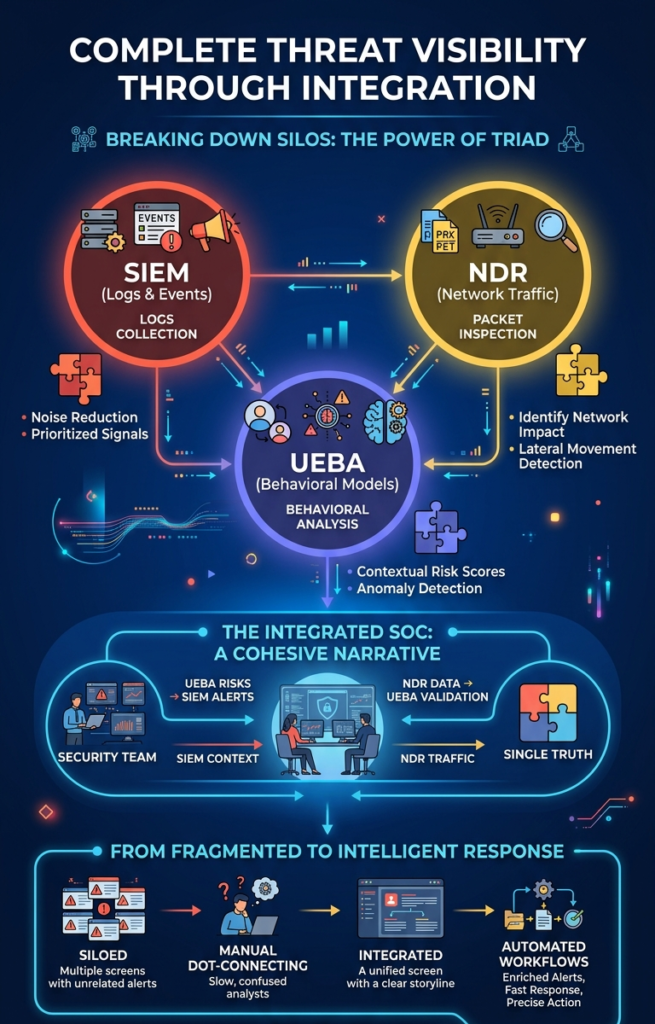
Credits: Protech Future
It’s about bidirectional communication, not a one-way dump. Think of it as a continuous conversation between systems.
- Data Ingestion: The SIEM remains the central log aggregator. NDR sends metadata about network flows, sessions, and protocols. UEBA analyzes user/entity behavior from these and other logs.
- Context Sharing: When UEBA calculates a high risk score for an entity (IP, user, host), it pushes this context to the SIEM and NDR. This can be via APIs or syslog.
- Alert Enrichment: The SIEM correlates incoming logs with this risk context. A login event becomes a “High-Risk Login.” The NDR tags network sessions involving that high-risk entity.
- Orchestrated Response: Enriched alerts can trigger automated playbooks. A high-risk UEBA score plus suspicious NDR traffic might automatically isolate a host via the network firewall, all logged in the SIEM.
| Tool | Primary Data | What It Gains from Integration |
| SIEM | Logs, Events | Behavioral context to prioritize alerts and reduce false positives. |
| UEBA | Behavioral Models | Network evidence (from NDR) and forensic logs (from SIEM) to validate anomalies. |
| NDR | Network Traffic | Behavioral risk scores to focus on the most suspicious network sessions. |
Where Should You Start the Integration Process?
Boiling the ocean leads to failure. Start with a single, high-value use case where the pain of silos is acute. Evaluating common UEBA use cases like fraud detection, insider threats, or credential compromise can help you map out immediate wins.
Begin by connecting just a few data sources:
- Feed Active Directory logs (via SIEM) to UEBA to model user behavior.
- Feed core network flow data (from NDR) to both the SIEM and UEBA.
- Configure the UEBA to send high-risk user/host scores back to the SIEM as a custom field.
This creates a simple but powerful loop: UEBA identifies a potentially compromised user account, tags them as high-risk in the SIEM, and the NDR is instructed to deeply inspect all traffic from that user’s device. You solve one problem completely before expanding.
We often start with Network Threat Detection as the foundational layer because it provides an objective, hard-to-evade view of all entity communication, which makes calibrating the UEBA’s behavioral models more reliable.
What Are the Common Pitfalls and How Do You Avoid Them?
Integration projects stall for human reasons, not technical ones. The first pitfall is ownership. Is the network team, the SOC, or the security engineering team driving? A cross-functional working group is essential.
The second is data quality. UEBA is only as good as its data. If your SIEM isn’t getting clean, parsed logs from critical systems, the behavioral models will be garbage. Start by ensuring your core identity (AD, Okta) and network data is accurate and complete.
“The integration combines SIEM, UEBA, and automated workflows with NDR capability. This unified solution will centralise visibility, accelerate threat detection, and streamline investigation processes across cloud-based environments.” – Wikipedia
Third is alert fatigue from misconfiguration. If you configure the integration to send every UEBA anomaly as a critical SIEM alert, you’ve just made the noise problem worse. The goal is to raise the bar. Only push high-confidence, high-risk scores that warrant immediate attention. Tune aggressively.
Can This Integrated Approach Catch Modern Ransomware?
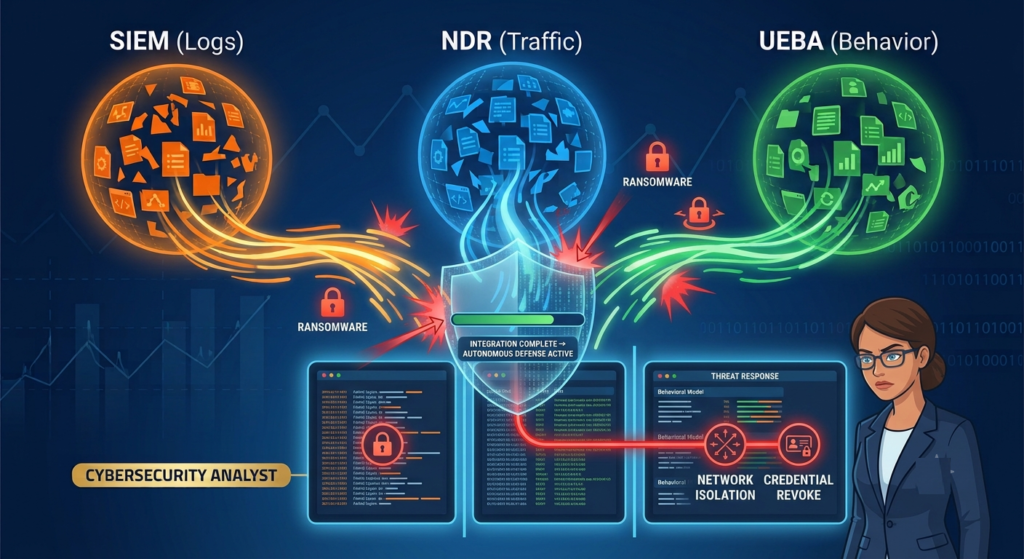
This is where the triad shines. Modern ransomware often starts with a phishing email (logged in SIEM). Credentials are stolen, and the attacker behaves oddly (flagged by UEBA). They move laterally, using tools like PsExec (anomalous network protocols spotted by NDR).
Finally, they encrypt data, causing massive outbound SMB or RDP traffic (spiked volume detected by NDR).
Individually, each signal might be weak. The SIEM sees a login. UEBA sees slightly odd after-hours activity. NDR sees an increase in PsExec traffic. But integrated, they tell a terrifyingly clear story: “A compromised account is using administrative tools to move laterally, likely staging for ransomware.”
The integrated system can correlate these weak signals across layers into a single, high-severity alert with a timeline and supporting evidence from all three sources, enabling a response before the encryption starts.
FAQ
Do I need to replace my current SIEM or NDR?
Almost certainly not. Most modern SIEMs (Splunk, Sentinel, etc.) and NDR platforms have open APIs for this exact purpose. The integration work involves configuration and piping data, not ripping and replacing.
How does this affect performance and cost?
It can reduce cost. By making your SIEM alerts more accurate, you reduce the volume of data needing long-term storage and analyst investigation time. The primary cost is initial engineering effort to set up the integrations and data pipelines.
Who on my team needs to manage this?
You need a blend: a security analyst who understands the use cases, a systems engineer familiar with your SIEM, and a network engineer who understands the NDR data. It’s a collaborative, ongoing process.
Is real-time integration possible, or is there latency?
For automated response actions, near-real-time is achievable (seconds). For comprehensive alert enrichment and correlation, a delay of a minute or two is typical and acceptable. The goal isn’t nanosecond speed, it’s providing complete context before an analyst opens the ticket.
Building Your Security Central Nervous System
Integrating UEBA, SIEM, and NDR shifts your SOC from a disjointed reaction to a fully coordinated defense, allowing your team to make better security decisions much faster. Start small by connecting just two systems to prove the value first.
To truly eliminate your blind spots, back this integration with automated risk analysis and real-time threat modeling. Explore Network Threat Detection to run visual attack path simulations and confidently strengthen your defenses.
References
- https://vehere.com/glossary/what-is-ueba-user-and-entity-behavior-analytics/
- https://en.wikipedia.org/wiki/User_behavior_analytics