

If your security team is drowning in alerts, you already know the problem. The promise of User and Entity Behavior Analytics (UEBA) is to find real threats within that chaos, but that promise relies heavily on the underlying tech. Without the right machine learning algorithms UEBA systems are just flashy dashboards.
By integrating advanced machine learning algorithms, UEBA systems allow modern solutions like Network Threat Detection to learn what “normal” looks like for every user and device, transforming your defense from reactive to proactive. Keep reading to see the engine making it possible.
What You’ll Learn Today
Before diving into the technical mechanics, here is a quick snapshot of how machine learning shifts the paradigm in modern cybersecurity:
- Machine learning provides the continuous, adaptive learning that turns raw logs into a baseline of “normal” behavior.
- Different algorithms have different strengths; ensemble methods that combine them catch more sophisticated attacks.
- The ultimate goal is high-fidelity alerts that your team can act on immediately, reducing investigation time from hours to minutes.
What’s the Core Job of Machine Learning in a UEBA System?
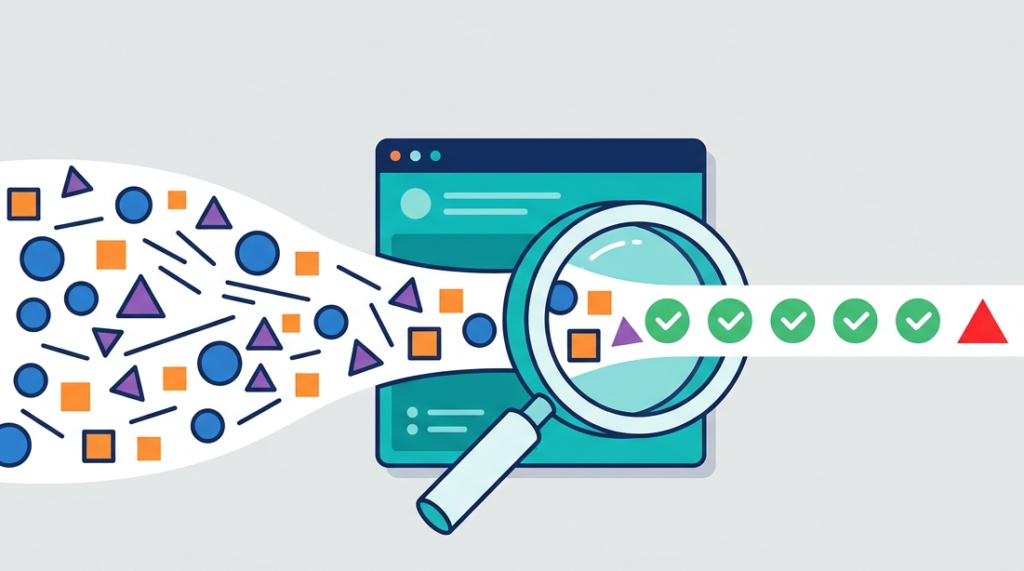
Think of your network. Thousands of events, logins, file accesses, and data transfers happen every minute. A human can’t watch it all. Rules can flag obvious things, like a login from another country, but they’re rigid. They miss the clever stuff, the insider slowly siphoning data or the compromised account behaving just slightly “off.”
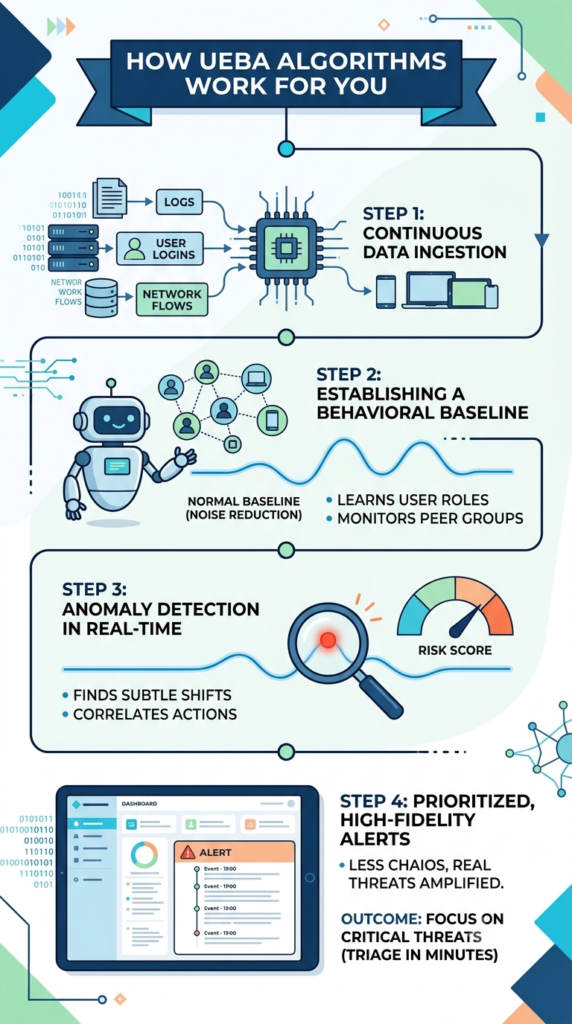
That’s the core job. Machine learning algorithms build a living, breathing model of normal behavior for every user and server (the “entities”). Modern defense relies on dynamic user and entity behavior analytics ueba to look beyond single actions, analyzing sequences, patterns, and relationships over time.
Is it normal for this accountant to access the R&D server at 2 AM? For this server to start sending gigabytes to an unknown external IP? The algorithms learn, so they know.
Their primary output isn’t just another alert, it’s a prioritized list of genuine anomalies with a calculated risk score. This shifts your team’s work from sifting logs to investigating credible leads.
Which Algorithms Are Best for Spotting Sneaky Threats?
Not all machine learning is the same for this task. You need models that excel at finding needles in haystacks, the rare, malicious event hiding in massive amounts of benign data.
Unsupervised learning is crucial early on. It finds patterns and clusters in your data without being told what to look for. It can group users with similar roles, spotting the one finance user whose behavior cluster is suddenly different from all peers.
“Machine learning (ML) involves data-driven algorithms that support the decision-making process of SOC analysts in detecting network intrusions… A UEBA engine can greatly benefit from unsupervised learning algorithms because any substantial deviation from normal behavior in common communication patterns can represent a potential attack.” – Frontiers in Data Science
Supervised learning then kicks in, using past confirmed incidents (like known phishing compromises) to teach the system what malicious patterns look like. But the real magic often happens with semi-supervised and ensemble methods.
These combine models to cover each other’s blind spots. One algorithm might be great at spotting spikes in data volume (an indicator of exfiltration), while another is tuned for detecting subtle timing anomalies in login sequences (like credential stuffing). By using them together, the system’s accuracy improves dramatically.
How Does This Actually Stop an Attack in Progress?
Let’s walk through a real scenario. An employee’s credentials are phished. The attacker logs in from a new country, but they use a VPN common for that region, so a simple geo-blocking rule might not fire. They move slowly, accessing files typical for that user’s role to avoid suspicion.
Here’s where the algorithms work in concert:
- The login itself, while from a new location, is assessed in context. Has this user ever logged in from this ISP or autonomous system before? No.
- The sequence of actions is analyzed. The user typically accesses File A, then B, then C. The attacker goes for C immediately.
- The timing is off. The user is normally active 9-to-5 local time. This session is at an abnormal hour, even for the attacker’s timezone.
Individually, these are minor. Together, they form a high-risk anomaly. The UEBA system correlates these signals from different algorithms, generates a high-risk score, and can automatically initiate a response.
In our Network Threat Detection practice, we’ve configured automated playbooks that, upon such a score, will temporarily restrict that account’s access to sensitive data repositories or force a step-up authentication, containing the threat before major damage is done.
Can You Trust the Alerts, or Is It Just More Noise?
Credits: Databricks
This is the billion-dollar question. A system that cries wolf is worse than useless; it breeds alert fatigue. The sophistication of the algorithms directly dictates the fidelity of the output.
Good UEBA systems use context enrichment and peer group analysis. An action isn’t judged in isolation. Downloading a large file might be normal for an engineer but highly anomalous for a marketing intern. The algorithms understand these roles. They also calculate a risk score that compounds over time.
A single weird event might get a low score. That same event, followed by an attempt to escalate privileges and access a sensitive database, rockets the score up.
We measure success by the “time to triage.” Before, an analyst might spend an hour parsing logs for one alert. Now, the alert comes with a narrative: “High-risk anomaly: User X deviated from peer group by accessing financial records after anomalous login from new infrastructure.”
The investigation starts halfway done. The table below shows a simplified view of how different activities contribute to a composite risk score.
| Activity Type | Baseline Risk | With Contextual Anomaly | Composite Score Impact |
| Normal File Access | Low | N/A | +5 |
| After-Hours Access | Medium | From new country/IP | +25 |
| Bulk Data Download | High | By non-typical user role | +50 |
| Privilege Escalation Attempt | Critical | Following suspicious login | +75 |
What’s the First Step to Making This Work for Your Organization?
Implementation is where theory meets reality. The biggest mistake is trying to boil the ocean. You don’t start by feeding the system every log from every application. You start with a critical, well-understood data source that has a high signal-to-noise ratio for identity and access.
For most, that’s Active Directory or LDAP logs combined with network flow data (like NetFlow or IPFIX). This gives the algorithms a rich view of who is logging in, from where, and what they’re talking to on the network. It’s the foundation.
From our experience, prioritizing the process of establishing baseline user entity behavior via Network Threat Detection provides the cleanest starting point.
You see the patterns of machines and users talking to each other, which becomes the “normal” canvas. Once the models are stable and providing accurate detections here, you layer on data from endpoints, cloud services, and applications. This phased approach builds confidence and demonstrates value quickly, without overwhelming your team or the system.
Why Isn’t a Rules-Based System Good Enough Anymore?
Rules are static. They are brilliant for catching known-bad indicators: a specific malware hash, a call to a command-and-control server domain you’ve blacklisted.
However, mapping out ueba vs traditional security monitoring reveals that static thresholds are hopeless against the unknown, the novel, or the “living-off-the-land” attack that uses legitimate tools for malicious purposes.
“User and Entity Behaviour Analytics (UEBA) is a broad branch of data analytics that attempts to build a normal behavioural profile in order to detect anomalous events. Among the techniques used to detect anomalies, Deep Autoencoders constitute one of the most promising deep learning models on UEBA tasks, allowing explainable detection of security incidents that could lead to the leak of personal data, hijacking of systems, or access to sensitive business information.” – AIMS Mathematics
A rule can say “alert on login after business hours.” But what about the contractor who always works nights? You make an exception. Then what about the employee who legitimately logs in at night once a quarter for a maintenance task? Another exception. Soon, your rule has more exceptions than efficacy, or worse, you turn it off.
Machine learning algorithms solve this. They learn that the contractor’s nighttime logins are the baseline. They learn the quarterly maintenance pattern. They alert you only when the behavior truly breaks the established, personalized pattern for that specific entity. It’s dynamic, it’s personalized, and it scales in a way that rule management simply cannot.
How Do You Keep the Machine Learning Models from Getting Stale?
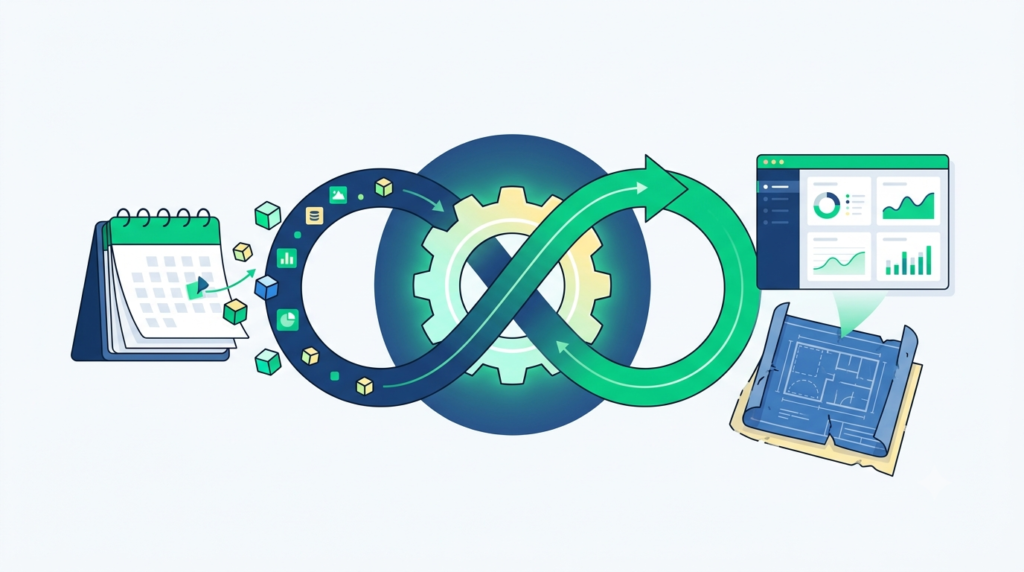
A model trained on last year’s data doesn’t understand this year’s business. People change roles. New applications are deployed. Work-from-home policies shift network traffic patterns. If the model isn’t updated, its “normal” baseline becomes outdated, and its alerts become meaningless, either missing real threats or flagging new, legitimate behaviors as malicious.
This requires continuous, automated retraining. The best systems don’t just run in production; they learn in production. They incorporate feedback loops. When an analyst investigates an alert and marks it as a “true positive” or “false positive,” that outcome is fed back into the model to refine its future calculations.
It’s a living system. We schedule full retraining cycles quarterly, but incremental learning happens daily. It’s about creating a system that evolves as fast as your business and the threat landscape do, without requiring a team of data scientists to constantly tweak it manually.
FAQ
How much historical data do we need to start?
You typically need a minimum of 30-90 days of consistent log data. This provides enough cycles (workdays, weekends) for the algorithms to establish a meaningful behavioral baseline for users and entities.
Does this replace our SIEM or firewall?
No, it enhances them. Think of it as a brain added to your existing tools. The SIEM collects the logs, the firewall blocks traffic, and the UEBA with ML analyzes the behavior within those logs to find what the other tools miss.
Is it resource-intensive to run?
Modern cloud-native systems handle the heavy computational load on their own infrastructure. The primary resource demand is on your side for data ingestion, ensuring logs are reliably sent to the platform, and for analyst time to review the high-quality alerts it generates.
Can it detect zero-day attacks?
Yes, but indirectly. It won’t know the signature of a new exploit. Instead, it will detect the anomalous behavior that results from the attack, the unusual process spawned, the strange network connection made, or the atypical data movement initiated by the compromised system.
The New Security Rhythm
Machine learning algorithms aren’t a magic box; they are the essential engine that transforms UEBA into an operational pivot point. They shift your team from frantic, reactive scrambles to measured, proactive investigations. The noise of a thousand daily events fades, while real threats are amplified with clear context.
Materially improve your defense by choosing intelligence designed to understand behavior. To streamline vulnerability management, map CVEs, and expose blind spots before attackers do, explore how Network Threat Detection delivers real-time threat modeling and automated risk analysis to confidently strengthen your perimeter.
References
- https://pmc.ncbi.nlm.nih.gov/articles/PMC11112065/
- https://browse-export.arxiv.org/pdf/2505.11542