
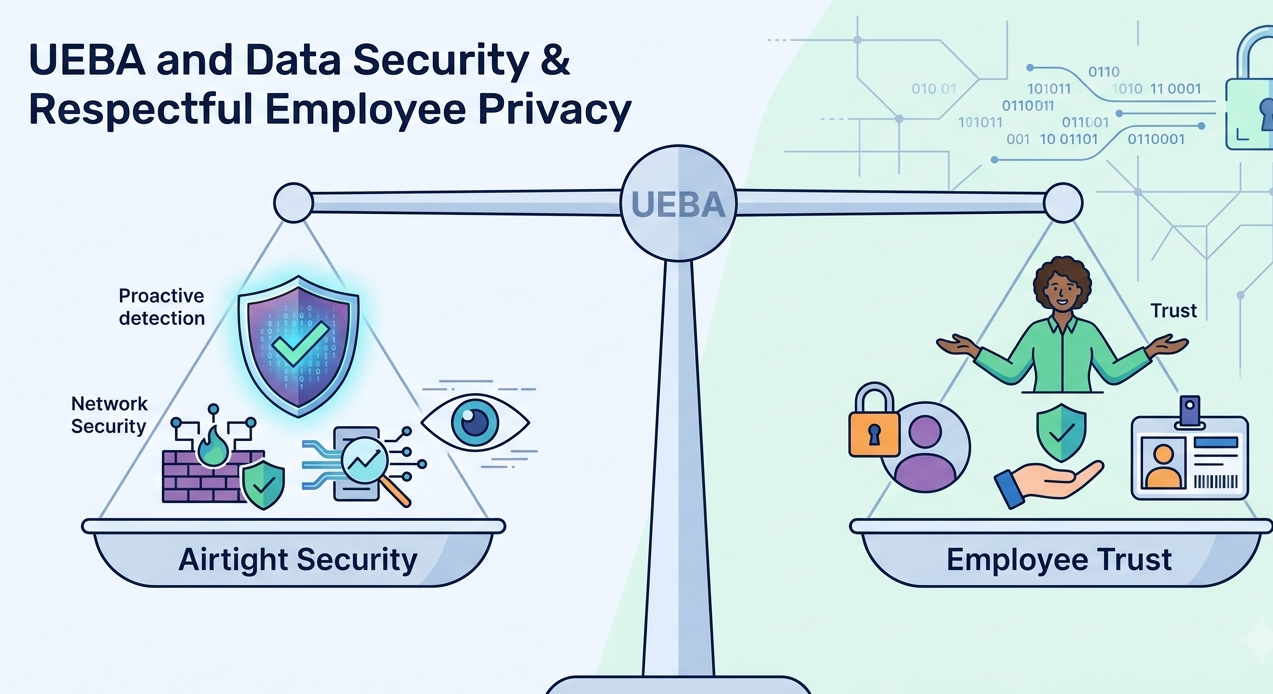
Privacy implications UEBA monitoring creates an undeniable tension between airtight corporate security and employee privacy. It works by tracking digital footprints, logins, file downloads, and network traffic, to spot anomalies. While this is indispensable for modern threat detection, tracking behavior inherently risks infringing on personal boundaries.
At Network Threat Detection, we have found that ignoring these privacy implications of UEBA monitoring doesn’t just damage employee morale, it introduces massive legal vulnerabilities. The goal isn’t to stop monitoring, but to build it on explicit ethical guardrails. Keep reading to learn how to walk this tightrope safely.
What to Keep in Mind Before You Monitor
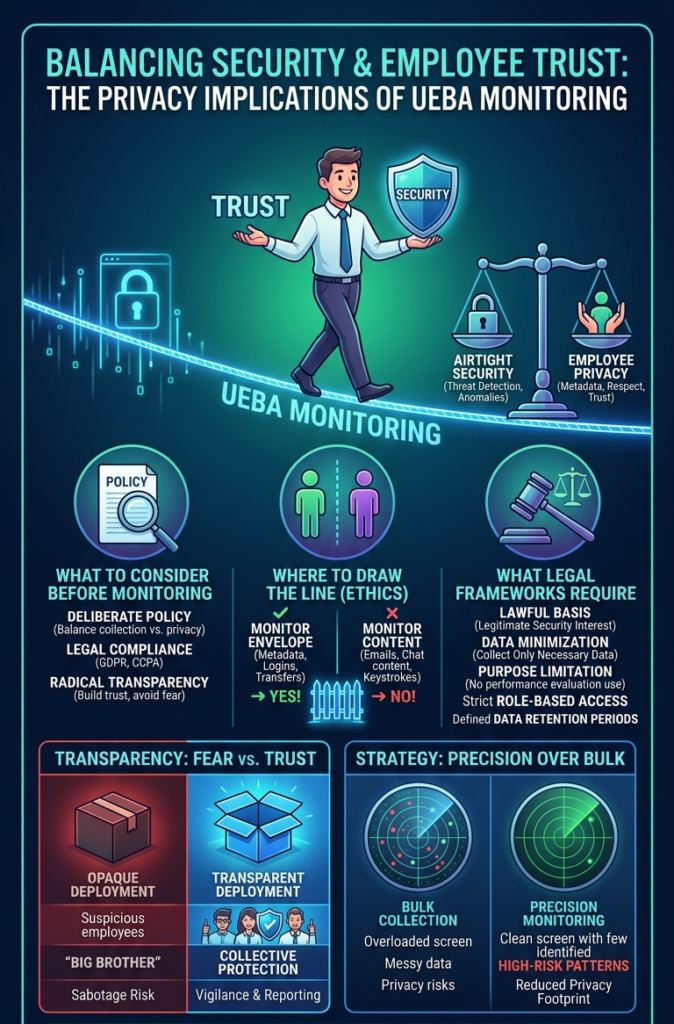
Implementing behavioral analytics requires looking past the dashboard metrics. Here are three core truths about navigating the privacy implications of UEBA monitoring responsibly:
- UEBA’s need for comprehensive data collection inherently conflicts with employee privacy expectations, requiring deliberate policy.
- Legal compliance (like GDPR, CCPA) is a baseline, not the finish line; ethical use demands more.
- Transparency with employees about what is monitored and why is critical for maintaining trust and avoiding a toxic culture.
Where Does UEBA Data Collection Cross a Privacy Line?
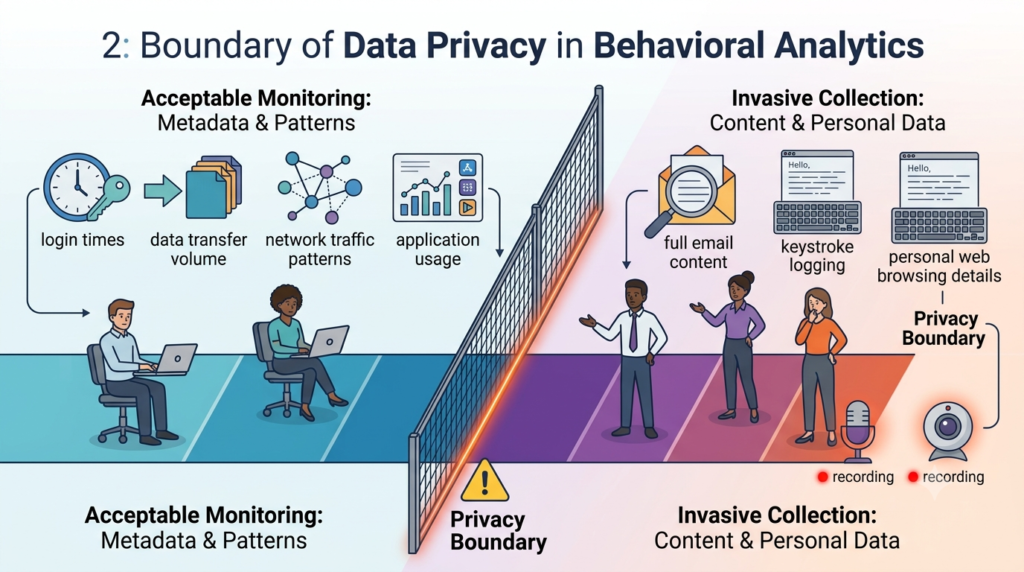
UEBA doesn’t work in half-measures. To build a comprehensive system around user and entity behavior analytics, it needs a continuous feed of data: who logs in, from where, what they access, what they transfer, and who they communicate with.
This is where the first ethical fence must be built. Collecting everything is technically easy, but legally and morally fraught.
From our standpoint, the approach matters. We focused on metadata and behavior patterns, not content. The system sees that an employee transferred 5GB of files to a personal cloud service at 2 a.m., but it doesn’t read the files. It notes a sudden spike in database queries from a junior accountant, but not the query results.
This principle, monitoring the envelope, not the letter, is crucial. It allows for effective threat detection (like data exfiltration or unauthorized access) while preserving a layer of content privacy. The most invasive risks often come from overzealous logging of web browsing, personal email, or keystroke dynamics without overwhelming justification.
What Legal Frameworks Govern This Monitoring?
You can’t talk about privacy without talking about the law. Regulations like the GDPR in Europe and the CCPA in California set hard boundaries. They establish principles like lawful basis, data minimization, and purpose limitation.
“[The report] explores software from Microsoft and formerly from Forcepoint, specifically SIEM and UEBA applications… The boundaries between information security, the protection of corporate information, fraud and theft prevention and the enforcement of compliance with regulatory requirements and organizational policies are becoming blurred… [The software] is capable of monitoring everything that employees do or say. It can monitor their behavior and flag them for further scrutiny by their bosses.” – Varonis
For UEBA, this means you must define a clear, legitimate interest for monitoring (i.e., security threat detection). You must collect only the data necessary for that purpose. And you cannot use it for unrelated purposes, like performance evaluation.
In practice, this shapes everything.
- Employee Notification: A legal requirement in many jurisdictions. Employees must be informed that monitoring occurs, its scope, and its purpose.
- Data Retention: You cannot keep behavioral data forever. Policies must define retention periods (e.g., 90 days for raw logs, 12 months for aggregated risk scores) and secure deletion protocols.
- Access Controls: Who can see the raw data? Strict role-based access is non-negotiable, often limiting unfiltered access to a small, vetted security team.
Ignoring these isn’t just a compliance failure, it’s a blueprint for severe fines and reputational damage. The law provides the minimum floor for your privacy program.
How Does Transparency Build Trust Instead of Fear?
A stealth deployment is a ticking cultural bomb. When evaluating initial ueba deployment considerations, the human impact must be weighed just as heavily as technical configuration. When employees inevitably discover they’re being profiled by a “black box” AI, trust evaporates. We learned that transparency is the only antidote.
During our rollout, we held open forums. We explained that the tool wasn’t there to track productivity or personal slack chats. Its job was to spot the digital equivalent of someone sneaking through the office after hours with a bulging briefcase, behaviors indicative of a compromised account or a malicious insider.
This transparency had a surprising effect. It turned suspicion into a shared understanding. Employees became more aware of security hygiene, knowing their normal behavior was the baseline protecting them. The table below contrasts a opaque vs. transparent deployment approach.
| Aspect | Opaque, Fear-Based Deployment | Transparent, Trust-Based Deployment |
| Communication | Hidden, discovered by rumor. | Proactive, clear, and ongoing. |
| Employee Perception | “Big Brother” surveillance. | A necessary tool for collective protection. |
| Security Outcome | Fear, non-compliance, possible sabotage. | Vigilance, reporting of suspicious activity. |
| Legal Risk | High (violates notice requirements). | Mitigated (demonstrates good faith). |
Can You Achieve Security Without Invasive Monitoring?
This is the core challenge. The good news is, yes. Effective security doesn’t require reading every email. It requires smart, focused monitoring. The technical implementation is key. We found that starting with Network Threat Detection provided a strong, less intrusive foundation.
By analyzing netflow and metadata, we could detect lateral movement, data exfiltration, and beaconing to command servers, major threat indicators, without ever inspecting personal web traffic or application content.
The strategy involves layering controls. When engineering defenses and evaluating ueba vendor solutions, teams should prioritize tools that inherently support a balanced framework:
- Technical controls that respect privacy by design (metadata analysis, anonymization for non-security teams).
- Administrative controls like strict data access policies and audit logs of who queries the UEBA.
- Cultural controls fostered by transparency.
The goal is precision, not bulk collection. You tune the UEBA to look for high-risk behavioral patterns, not to catalog every single action. This reduces the privacy footprint while increasing the signal-to-noise ratio for your security team, making them more effective.
What Are the Risks of Getting the Balance Wrong?
Credits: Databricks
The consequences of misaligned UEBA privacy practices are severe and multi-faceted. Legally, it invites regulatory investigations and massive fines under GDPR, CCPA, or industry-specific rules. Financially, these fines can reach millions, not counting litigation costs.
The cultural damage is deeper and longer-lasting. A perception of pervasive surveillance kills morale, fosters resentment, and can lead to increased turnover, especially among top talent who value autonomy. It creates an “us vs. them” dynamic with the security team.
Operationally, a tool that is seen as illegitimate will be undermined. Employees may find ways to bypass monitoring, use unsanctioned apps, or simply not report suspicious activity, believing the security team is the adversary. This weakens your entire security posture, making the expensive tool counterproductive.
How Should You Structure an Ethical UEBA Policy?
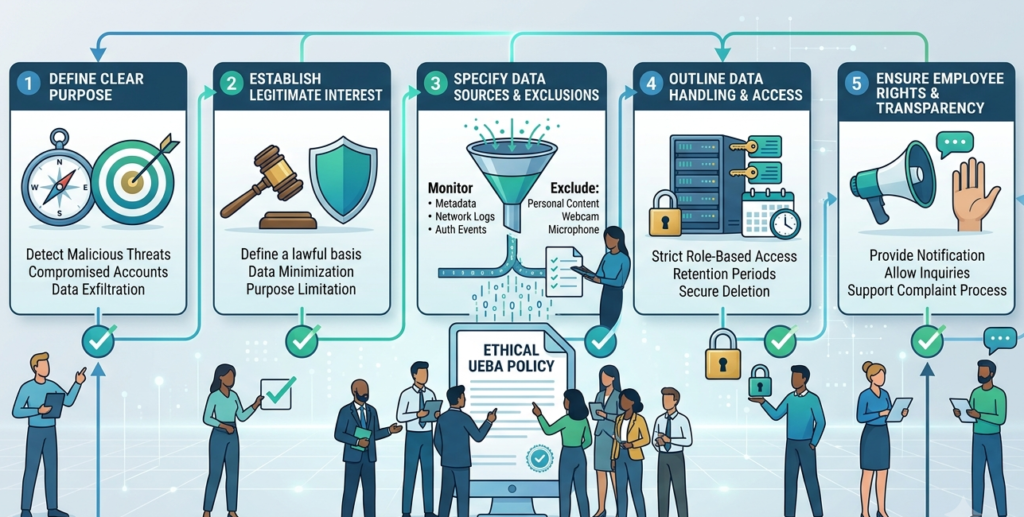
Your policy is the concrete manifestation of your principles. It shouldn’t be a copy-pasted legal document. It must be a living, accessible guide. Start by forming a cross-functional team, security, legal, HR, and employee representatives. This ensures all perspectives are considered.
“User and Entity Behavior Analytics (UEBA) relies on extensive behavioral data collection to detect anomalies, which raises privacy and regulatory concerns under laws such as the General Data Protection Regulation (GDPR), Health Insurance Portability and Accountability Act (HIPAA), and California Consumer Privacy Act (CCPA)… organizations must navigate challenges related to data minimization, user consent, cross-border data transfers, and retention policies to ensure compliance while maintaining cybersecurity effectiveness.” – Expert Insights
The policy must clearly state:
- The Purpose: Specifically, “detecting malicious insider threats, compromised accounts, and data exfiltration.”
- The Scope: What data sources are included (e.g., network logs, authentication events) and, importantly, what are excluded (e.g., personal webcam, microphone, non-work website content).
- Data Handling: Who can access data, under what conditions, retention periods, and deletion procedures.
- Employee Rights: How employees can inquire about their data, submit complaints, or request review.
This policy must be communicated before deployment and be easily accessible. It’s your social contract for security.
FAQ
Do employees have a “reasonable expectation of privacy” at work with UEBA?
Generally, courts have found a lower expectation of privacy on company-owned devices and networks. However, “reasonable” is key. UEBA monitoring focused on security-specific metadata is more likely to be seen as reasonable than tools that read personal emails or track location off-hours.
How does anonymization work in UEBA if it needs to track specific users?
Full anonymization for the security team isn’t possible, as they need to investigate specific accounts. However, privacy can be protected for other uses. For instance, risk reports for management might show “a user in Finance Department” instead of a name, and data used for model training can often be aggregated or pseudonymized.
Can UEBA data be used in employee termination or disciplinary actions?
This is a legal minefield. The policy must strictly limit data use to security incident investigation. Using UEBA data for performance management likely violates purpose limitation principles, breaches employee trust, and could be challenged in court. Always involve HR and Legal.
What’s the first step to auditing our current UEBA for privacy risks?
Conduct a data inventory. Map exactly what data your UEBA collects, from where, where it’s stored, who has access, and how long it’s kept. Then, measure this against your stated privacy policy and relevant regulations. Gaps you find are your immediate action items.
Navigating the UEBA Privacy Landscape
Implementing UEBA monitoring is an exercise in responsible power. The technology’s deep visibility makes it both essential for security and perilous for privacy. The path forward is to embrace it with clear eyes and strong principles, starting with network-level detection, grounding operations in legal compliance, and fostering radical transparency.
To see how automated risk analysis can strengthen your security without compromising trust, explore Network Threat Detection to explore their proactive platform today.
References
- https://www.varonis.com/blog/ueba-buyers-guide
- https://expertinsights.com/data-security-and-privacy/top-user-and-entity-behavior-analytics-solutions