
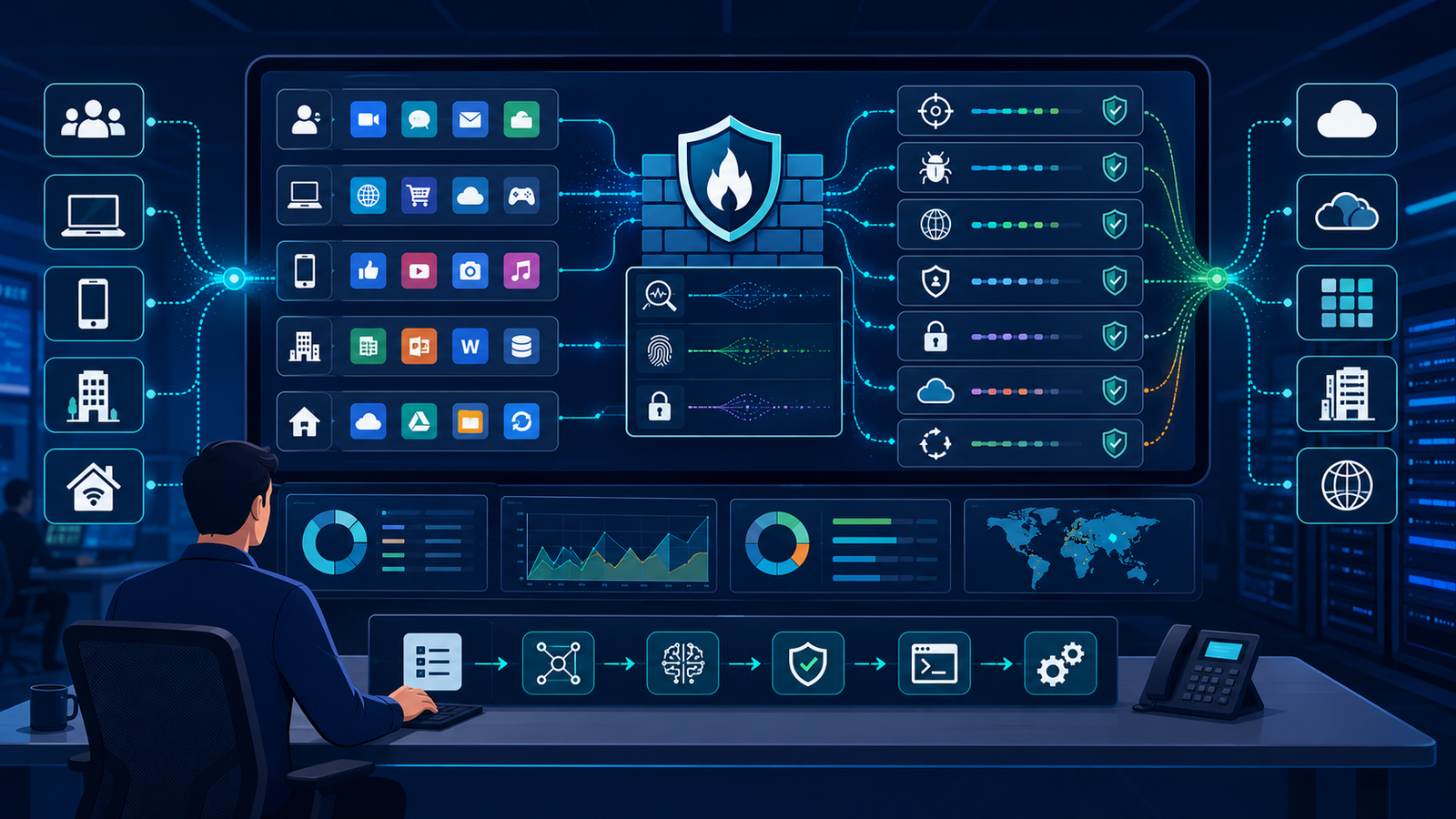
It is a quiet morning, yet your network is buzzing, do you know what is actually running? Without visibility, high-bandwidth streaming or unauthorized data transfers easily slip past legacy defenses. Incorporating advanced application awareness control NGFW capabilities changes everything by illuminating every active program.
Supported by robust Network Threat Detection, modern firewalls convert invisible digital traffic into actionable insights. This single feature transforms security from a restrictive barrier into an operational asset. Keep reading to explore how granular application control revolutionizes network management.
Transforming Network Control into Business Strategy
Understanding how application-level control reshapes your network is essential for balancing rock-solid security with peak operational performance. Here is a quick breakdown of why this feature is critical for modern enterprises:
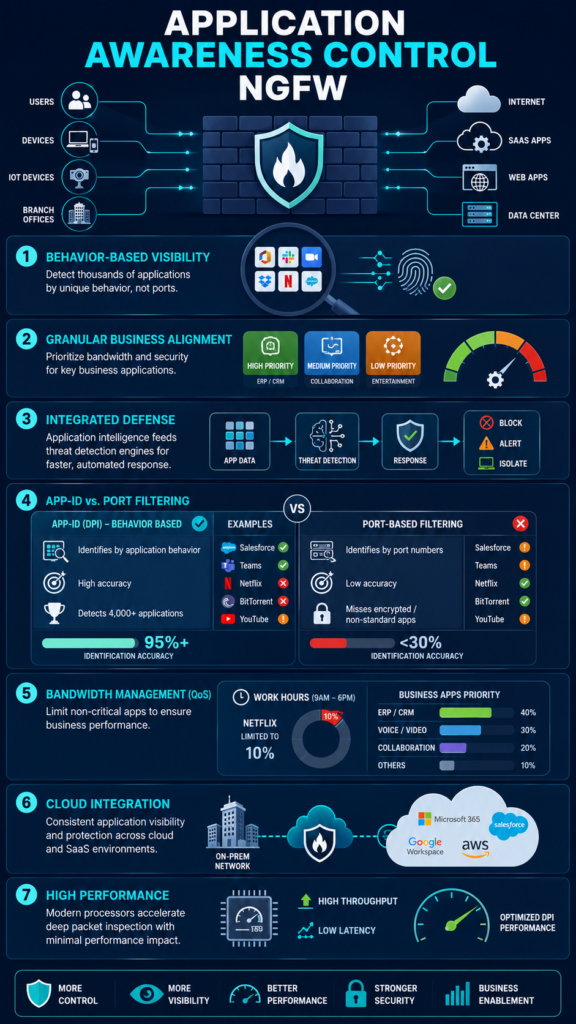
- Behavior-Based Visibility: Identifies thousands of applications based on real-time behavior rather than easily spoofed port numbers, exposing hidden risks instantly.
- Granular Business Alignment: Fine-tunes bandwidth, security policies, and compliance parameters at the application level to keep critical operations prioritized.
- Integrated Defense Foundation: Serves as the bedrock for enterprise security by feeding precise app data directly into advanced threat detection and automated response engines.
What Exactly Is Application Awareness in an NGFW?
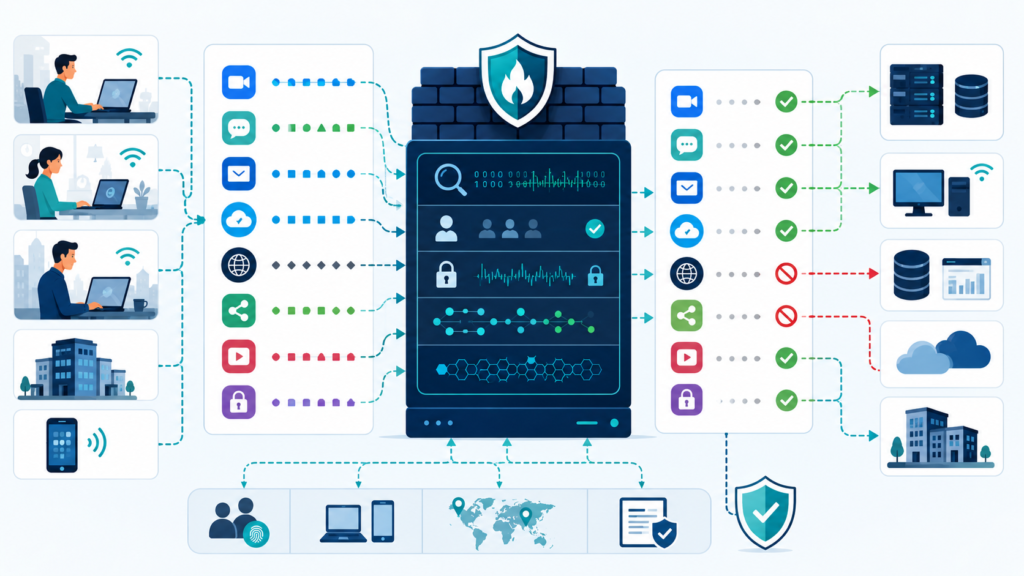
Think of your network traffic as a river. A traditional firewall stands on the bank, checking the type of boat (the port) and its flag (the protocol). When deploying modern next-generation firewalls, An NGFW with application awareness gets in the water. It examines the boat’s unique shape, the engine sound, the cargo, and the crew’s uniforms.
“Next-generation firewalls are application-aware, meaning they know their unique signatures and can discriminate between various applications on the same port. This enables prepaid, more granular policy enforcement and protection against multiple threats, including malware, data breaches and unauthorized access.” – IEEE Xplore
Technically, it uses deep packet inspection (DPI) and behavioral analysis to identify applications based on their unique signatures and communication patterns. This means it can tell the difference between Facebook, Facebook Chat, and Facebook Video, even though they all use port 443 (HTTPS).
It can spot when someone is trying to tunnel a file transfer through what looks like standard web traffic. This level of insight is foundational. You can’ t control what you can’ t see, and for years, networks were full of invisible applications.
How Does Application Control Go Beyond Simple Blocking?
Control is where the philosophy shifts. It’ s not just about saying “no.” It’ s about intelligent management. Once you see all the applications, you can create nuanced policies. You might allow Salesforce for the sales team but block its large report exports during business hours to conserve bandwidth.
You could permit SSH for your sysadmins but restrict it to specific management servers. This granularity is powerful. It prevents “shadow IT” by making approved tools work reliably, so employees don’ t seek risky alternatives. It enforces compliance by ensuring regulated data only travels via encrypted, approved channels.
Most importantly, it turns IT from a department of “no” into a service that ensures critical business applications have the resources and security they need to perform.
Why Is This Crucial for Modern Network Threat Detection?
We see this every day. Threats don’ t travel as themselves anymore. They hide inside applications. A malware download might come through a compromised ad on a news website. Data exfiltration might use a cloud storage sync tool. Without application awareness, these are just “web traffic.”
“Hackers have realized that traditional firewalls do a good job of mitigating connection-based attacks.” – SC Media
Our approach with network threat detection relies on this deep visibility. By understanding the baseline of normal application behavior for your organization, the system can spot anomalies. If an accounting app suddenly starts communicating with a server in a foreign country, that’ s a flag.
If a normally chatty social media app goes silent and starts sending large, encrypted packets, that’ s another. Application awareness provides the context that makes threat detection intelligent. It’ s the difference between “unusual traffic on port 80” and “malware disguised as Google Drive is attempting to call home.”
Can You Really Manage Bandwidth with a Firewall?
Credits: syncbricks
Absolutely, and it’ s one of the most immediate benefits. Network congestion often comes from a handful of applications. Without control, you’ re left throttling entire internet connections, hurting productivity. With application control, you can surgically manage the problem.
Create policies like: “Limit Netflix and YouTube to 10% of total bandwidth during work hours.” Or, “Give priority to Zoom and Microsoft Teams for video calls.” This is called Quality of Service (QoS) at the application level.
It ensures that your ERP system or VoIP phones get the smooth performance they need, while non-critical apps don’ t hog the pipe. It’ s a direct boost to operational efficiency and user satisfaction, all managed from the same console where you set security rules.
What’s the Difference Between App-ID and Port-Based Filtering?
This is the core technical shift. Port-based filtering is like sorting mail only by the size of the envelope. App-ID is like reading the return address, the postmark, and even the letter inside.
| Method | How It Works | Limitation | Example |
| Port-Based | Allows/denies traffic based on TCP/UDP port number (e.g., port 80 = HTTP). | Easily evaded. Apps can use non-standard ports or tunnel through allowed ports (like HTTPS). | Blocking port 21 to stop FTP, but FTP can easily move to port 80. |
| App-ID (NGFW) | Uses DPI and behavioral analysis to identify the application itself, regardless of port. | Requires more processing power, but modern hardware handles it. | Identifying and blocking “Facebook Games” even when it runs on port 443, while allowing “Facebook Workplace.” |
The old method is brittle and blind. App-ID is resilient and insightful. It future-proofs your security because policies are based on the what, not the how.
How Does This Affect User Experience and Productivity?
The right application control policy should be invisible to the good user and a barrier only to the bad action. When done well, it improves the user experience. By guaranteeing bandwidth for critical apps, you make them faster and more reliable.
By blocking malicious or non-compliant apps, you protect users from themselves, preventing malware infections or accidental data leaks. The key is communication and smart policy design. Don’ t just block “social media,” understand that marketing might need LinkedIn.
Don’ t ban all file sharing, provide a secure, company-approved alternative. This balance turns IT from a police force into a support team, fostering trust and adoption of secure practices.
What Are the Common Pitfalls in Implementing Application Control?
Jumping in without a plan is the biggest mistake. Here’ s what to avoid:
- Going Too Strict Too Fast: Deploy in “monitor-only” mode first. See what apps are actually running. You’ ll likely be surprised.
- Ignoring Business Needs: IT shouldn’ t make these decisions in a vacuum. Talk to department heads. What apps do they need to do their jobs?
- Set-and-Forget: The application landscape changes weekly. New apps emerge, old ones update their signatures. Regular policy reviews are mandatory.
- Overblocking Without Explanation: If you block an app, have a reason and a secure alternative ready. Transparency prevents workarounds.
Successful implementation is a process, not a one-time event. It starts with visibility, moves to understanding, and culminates in intelligent, collaborative control.
How Does Cloud Adoption Change the Game?
The perimeter is gone. Your applications live in SaaS platforms like Salesforce, Office 365, and AWS. The firewall rules must extend its awareness and control there. This means it needs to understand sanctioned SaaS app usage and spot anomalies within them, like a user downloading the entire customer database from Salesforce to a personal IP address.
Modern NGFWs integrate with cloud access security brokers (CASB) functionality or have direct APIs into cloud platforms. The principle remains the same: see the application, understand its legitimate use, and control misuse. But the battlefield has moved from your data center to the internet itself.
Is the Performance Impact Manageable?
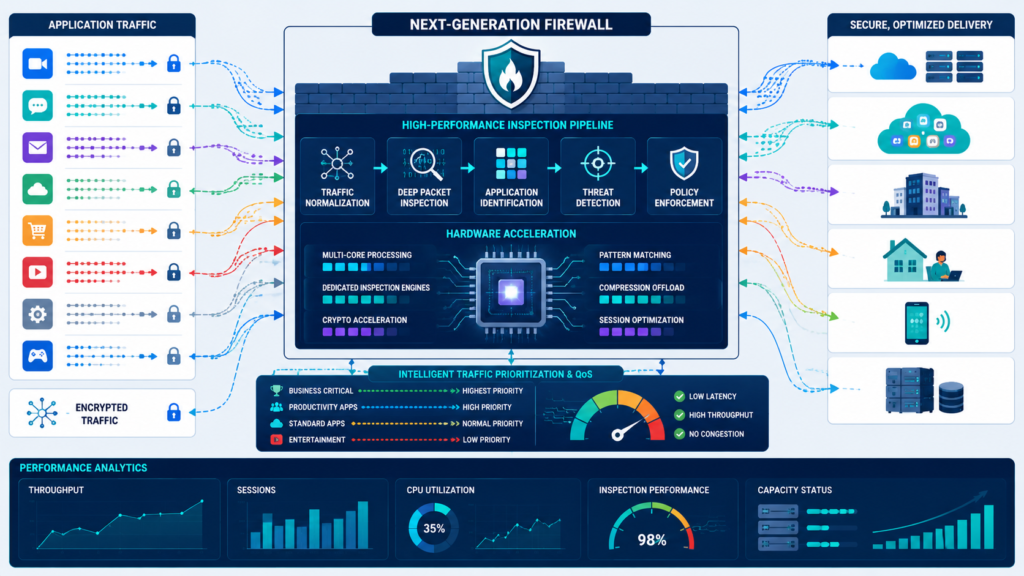
It’ s a valid concern. DPI is computationally expensive. Five years ago, turning on all features could halve a firewall’ s throughput. Today, dedicated security processors and software optimizations have narrowed the gap. The real answer lies in strategic deployment. You don’ t need to inspect every packet at the deepest level.
Use full application control and threat inspection for traffic entering from the internet or heading to sensitive servers. For trusted internal traffic, a lighter touch might suffice.
Always size your firewall based on its throughput with all the features you need enabled. The marginal performance cost is a small price for the immense gain in security and operational insight.
FAQ
Doesn’t application control violate employee privacy?
It can be a sensitive area, but it’ s about the company network, not personal devices. Policies should be clear, communicated, and legally compliant. The focus is on protecting company data and resources, not monitoring personal activity. Many controls are about resource management (bandwidth) and threat prevention, not content surveillance.
Can’t users just use a VPN to bypass these controls?
A personal VPN encrypts traffic, making it appear as a single, unknown application to the firewall. This is a challenge. Mitigation involves policies that block known consumer VPN services at the App-ID level and educational efforts about the security risks of using unauthorized VPNs on the corporate network.
Do we need separate web filtering if we have application control?
There’ s overlap, but they can be complementary. Application control is great at managing specific apps (like Spotify or Dropbox). Traditional URL filtering is better for granular web content policing (like blocking categories of websites).
Many NGFWs bundle both capabilities, allowing you to block “Social Networking” as a category and specifically control the Facebook app’s features.
How often do application signatures need updating?
Continuously. New apps and updates are released daily. A good NGFW vendor provides signature updates multiple times a day, automatically. This is a critical part of your vendor evaluation. An outdated application database renders the whole system much less effective.
Integrating Application Awareness into Your Security Posture
Application awareness and control is not a feature you toggle on. It’s a new way of seeing your network. It moves security from a static, perimeter-based model to a dynamic, identity- and content-aware model. The firewall becomes a central nervous system for your digital business, sensing the health and purpose of every data flow.
Ready to gain deep network visibility and uncover hidden vulnerabilities before attackers do? Discover visual attack path simulations and schedule a demo at Network Threat Detection today.
References
- https://ieeexplore.ieee.org/abstract/document/10956381/keywords#keywords
- https://www.scworld.com/news/protect-the-network-and-boost-productivity