
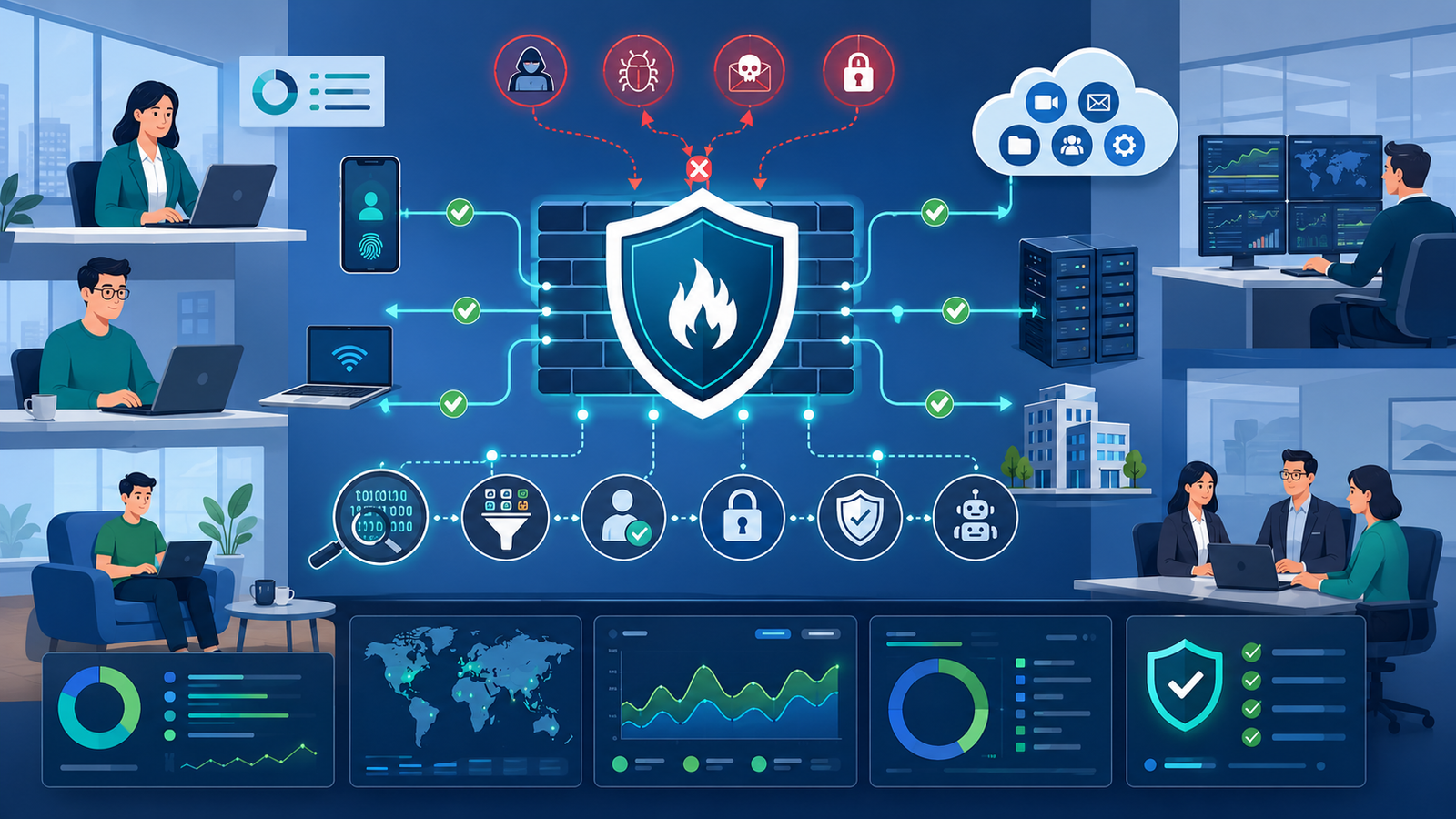
The traditional firewall is obsolete. Once a basic gatekeeper checking IDs at the network perimeter, today’s firewalls act as dynamic traffic controllers and business analysts. Powered by advanced Network Threat Detection, modern security solutions provide deep context and real-time decision-making across your entire enterprise.
Understanding the key features next generation firewalls offer reveals that security is no longer just an IT concern, it is an operational strategy. Keep reading to see how these intelligent systems elevate protection and streamline business operations.
Beyond the Perimeter: Core Highlights
Before diving into the detailed breakdown, here is a quick snapshot of how modern firewalls transform both security and business performance across your enterprise:
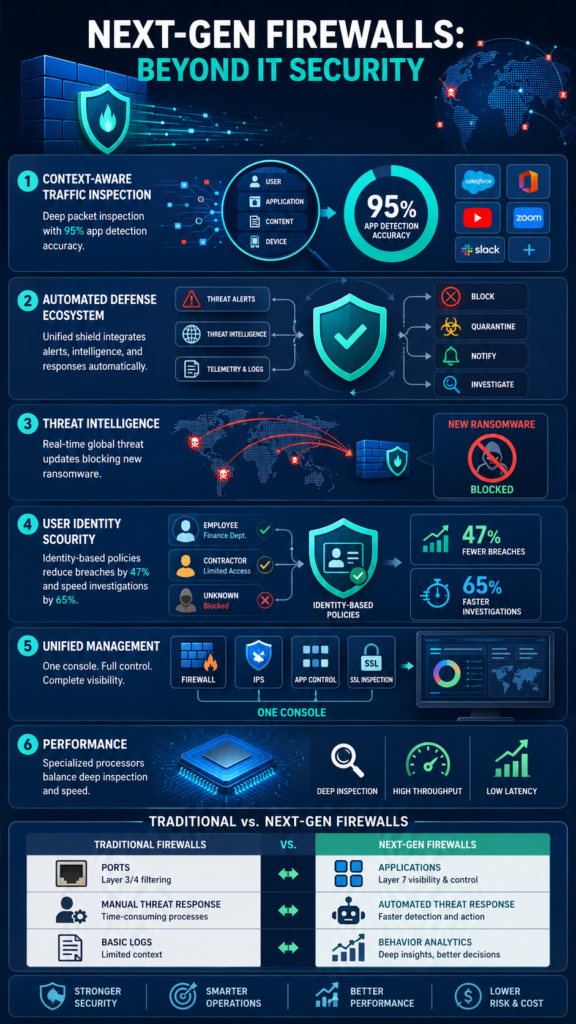
- Context-Aware Traffic Inspection: NGFWs go beyond standard port monitoring by using deep packet inspection and application awareness to identify exactly what is moving across your network.
- Automated Defense Ecosystem: Integrated threat intelligence and automated response mechanisms transform disconnected alerts into a unified, proactive defense system.
- Identity-Aware Security Policies: Rather than relying only on IP addresses, modern NGFWs enforce security policies based on user identity, device type, and role.
What Makes a Firewall “Next-Generation,” Anyway?
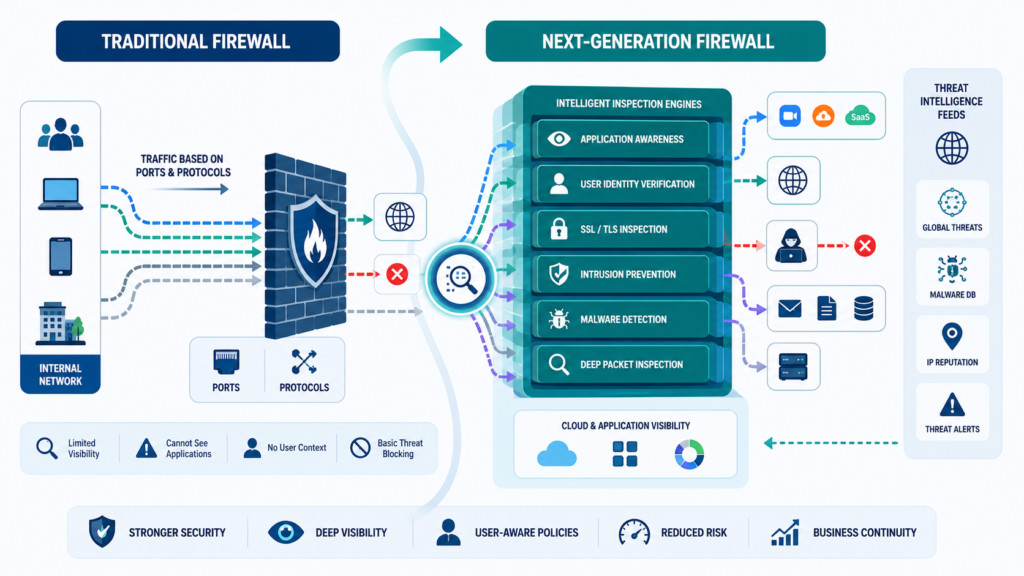
You can spot an old-school firewall rule from a mile away. It worked on ports and protocols, like a traffic cop only looking at license plates. An NGFW looks inside the car. It checks the driver’s face, the passengers, and even the contents of the trunk. This is done through deep packet inspection (DPI).
DPI doesn’t just read the address on the envelope, it opens the letter and understands the language. It identifies specific applications, Is this Salesforce or a file-sharing service masquerading as web traffic?, and makes policy decisions based on that.
It’s the difference between “allowing web traffic” and “allowing the marketing team to use LinkedIn but blocking bandwidth-heavy video streams.” This application awareness is the foundational shift.
It’s one of the defining NGFW features that enables security teams to identify, classify, and control modern application traffic. Without it, you’re flying blind in a world where applications are the battlefield.
How Does Network Threat Detection Actually Work on Your Network?
We see it happen every day. A device on the network, maybe a smart thermostat in the lobby, starts acting strangely. It’s sending small, encrypted packets to an unknown server in a country you don’t do business with. An old system might miss this entirely. Our approach with network threat detection is different.
The NGFW vs traditional firewall isn’t just a barrier, it’s a sensor grid. It establishes a baseline of “normal” for every device and user.
It uses something called SSL/TLS decryption to look inside encrypted traffic, because today, over 90% of attacks hide there. When that thermostat deviates from its pattern, trying to communicate on a strange port, sending data at 3 a.m., the firewall flags it.
It correlates this event with global threat intelligence feeds, recognizing the digital fingerprint of a known botnet. The action isn’t just an alert sent to an inbox no one checks. It’s an automatic, policy-driven response: isolate that device, block its communications, and tag it for the security team. This turns a potential breach into a contained incident.
Why Is Application Control More Than Just Blocking Websites?
Think of application control as curating your network’s experience. It’s not about being restrictive for the sake of it. It’s about ensuring performance, security, and compliance. You can allow Microsoft Teams for collaboration but limit its video calling during core business hours to preserve bandwidth for your ERP system.
“Application-aware traffic classification using deep packet inspection achieves over 95% accuracy in identifying thousands of applications, compared to port-based methods which correctly identify less than 30% of modern application traffic.” – ScienceDirect
You can permit file transfers via approved, encrypted services while blocking consumer-grade tools that leak data. This granularity is powerful. It prevents shadow IT by making approved tools work better. It stops malware that travels inside seemingly legitimate apps.
Most importantly, it aligns network policy with business policy. If your company doesn’t use TikTok, the firewall can enforce that, not just at the URL level, but by recognizing and blocking the app itself, no matter how it tries to connect.
Can a Firewall Really Simplify Your Security Setup?
Credits: TSECC
Absolutely. The alternative is a security stack that looks like a plate of spaghetti, dozens of single-purpose tools from different vendors, each with its own console, its own updates, its own headaches. An NGFW consolidates. It brings together:
- The traditional firewall (stateful inspection)
- An intrusion prevention system (IPS)
- Application visibility and control
- SSL/TLS inspection
- Advanced malware protection
- Often, VPN capabilities and basic routing
This unification does two things. First, it closes the gaps that exist between point solutions. When your IPS can talk directly to your application filter, the response to a threat is coherent. Second, it simplifies management. One policy console.
One place to set rules. One device to update. For teams stretched thin, this consolidation isn’t a luxury, it’s a survival tactic. It reduces complexity, which is the enemy of good security.
What Role Does Threat Intelligence Play in Real-Time Defense?
A firewall with outdated threat intelligence is like a guard with a year-old “most wanted” poster. Modern NGFWs are connected. They integrate feeds from global security researchers, correlating events on your network with attacks seen worldwide in near real-time. Say a new strain of ransomware emerges in Europe.
Within hours, its signatures and behavioral patterns are pushed to your firewall. When that same malware tries to enter your network via a phishing email attachment, the firewall already knows to block it. This shared intelligence creates a collective defense.
You’re not just relying on your own experiences, you’re benefiting from the visibility of the entire security community. It’s a force multiplier for your team, letting them focus on unique, targeted threats while the firewall handles the known commodity attacks automatically.
| Feature | Traditional Firewall | Next-Generation Firewall |
| Primary Focus | Ports, Protocols, IP Addresses | Applications, Users, Content |
| Inspection Depth | Header / Basic Packet Info | Deep Packet Inspection (DPI) |
| Threat Response | Manual, Based on Alerts | Integrated, Automated Actions |
| Visibility | Basic Traffic Logs | User & Application Behavior Analytics |
| Management | Isolated Security Policy | Unified Policy for Network & Apps |
How Does User Identity Change the Security Game?
Basing rules on IP addresses is brittle. People move. Devices are dynamic. Modern security ties policy to user identity. When Jane from Accounting logs in, the firewall knows it’s Jane. Her access follows her, whether she’s at headquarters, a coffee shop, or her home office.
“Identity-based network policies reduce unauthorized access incidents by 47% compared to IP-address-based rules, while also decreasing mean time to investigate security events by 65% through immediate user attribution.” – IJFMR
This means you can create policies like, “The finance team can access the accounting server, but no one else.” It’s intuitive and secure. It also holds people accountable.
If a policy violation occurs, you know it was Jane, not just “some device at 10.0.1.25.” This shift to identity-centric security is crucial for supporting modern workstyles without sacrificing control. It makes the perimeter wherever the user is.
Is the Performance Hit from Deep Inspection Worth It?
This is the classic trade-off: security versus speed. Early NGFWs did slow things down. But the hardware and software have evolved. Today’s devices use specialized processors for encryption and pattern matching. The key is tuning. You don’t necessarily need to deeply inspect every single packet.
You can apply full inspection to traffic coming from untrusted zones or heading to sensitive servers, and use lighter, faster checks for internal, trusted traffic. The performance impact is managed, and the security gain, catching encrypted malware, preventing data exfiltration, is almost always worth a marginal latency increase.
In many cases, the improved traffic shaping and application control of an NGFW actually make the network feel faster for business-critical tasks.
What Should You Look for in a Modern NGFW?
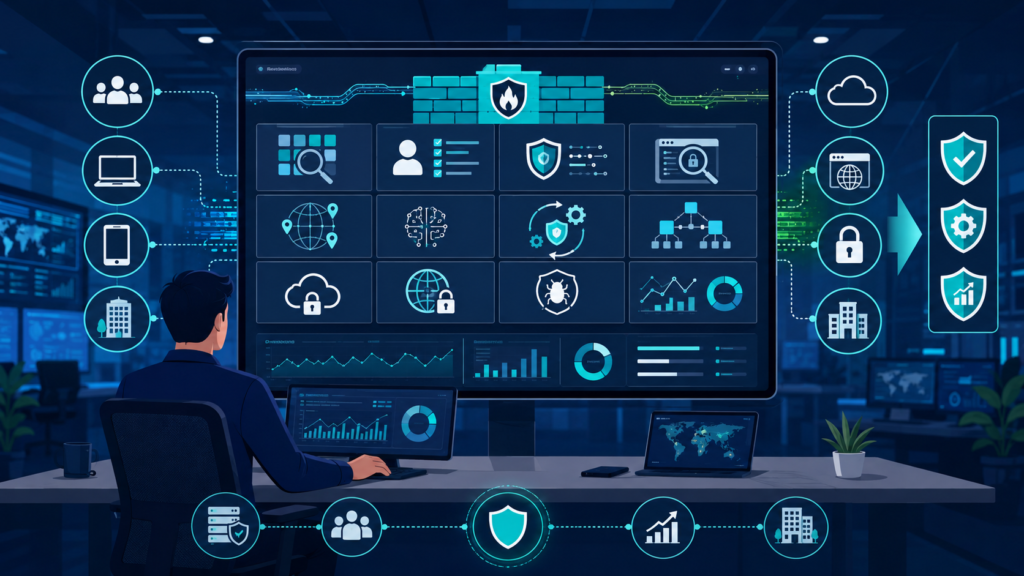
Shopping for one can feel overwhelming. Focus on these core capabilities:
- True Application Awareness: It must identify thousands of apps, not by port, but by behavior.
- Integrated Threat Prevention: IPS, anti-malware, and threat intelligence must work as one engine.
- SSL/TLS Inspection: The ability to see inside encrypted traffic is non-negotiable.
- User and Device Integration: Works seamlessly with your directory services (like Active Directory).
- Centralized Management: A single pane of glass for policy across all your firewalls, physical and cloud.
- Performance Under Load: Ensure its rated throughput matches your needs with all features turned on.
The best choice is one that fits your environment’s complexity and grows with you. Avoid niche features you’ll never use. Prioritize the core functions that close the biggest gaps in your current defense.
FAQ
Do next-gen firewalls replace antivirus software?
Not exactly. They work together. Antivirus software is great at protecting the endpoint (your laptop, server). The NGFW protects the network, stopping threats before they reach the endpoint. Think of it as border control (NGFW) versus neighborhood police (antivirus). You need both layers.
Are NGFWs only for large enterprises?
No. The threats target everyone. Small businesses are often more vulnerable. While large enterprises might need massive, expensive models, there are scaled-down NGFWs perfect for small offices or even sophisticated home offices. The technology has trickled down.
How does cloud computing affect firewall needs?
It changes everything. Your perimeter is no longer just your office. A modern approach needs a firewall that can protect cloud workloads (like those in AWS or Azure) and SaaS applications (like Office 365) with the same policies used on-premises. Look for solutions that offer a consistent security platform across all your environments.
What’s the biggest mistake people make with NGFWs?
“Set and forget.” Deploying one with the default settings or outdated policies is like buying a sports car and never getting out of first gear. You must continuously tune the application rules, update threat signatures, and review logs. The firewall is a powerful tool, but it requires a skilled hand to wield it effectively.
Moving Forward with Your Next-Gen Firewall
Next-generation firewalls have moved beyond feature checklists to operational philosophy. A deployed NGFW does more than secure, it provides vital visibility into application and user behavior.Automating routine threat blocking frees your team to focus on strategy, turning the network into an active security asset.
Ready to eliminate blind spots and strengthen your defenses? Join Network Threat Detection today.
References
- https://www.sciencedirect.com/science/article/pii/S1877050924013668
- https://www.ijfmr.com/research-paper.php?id=51775