
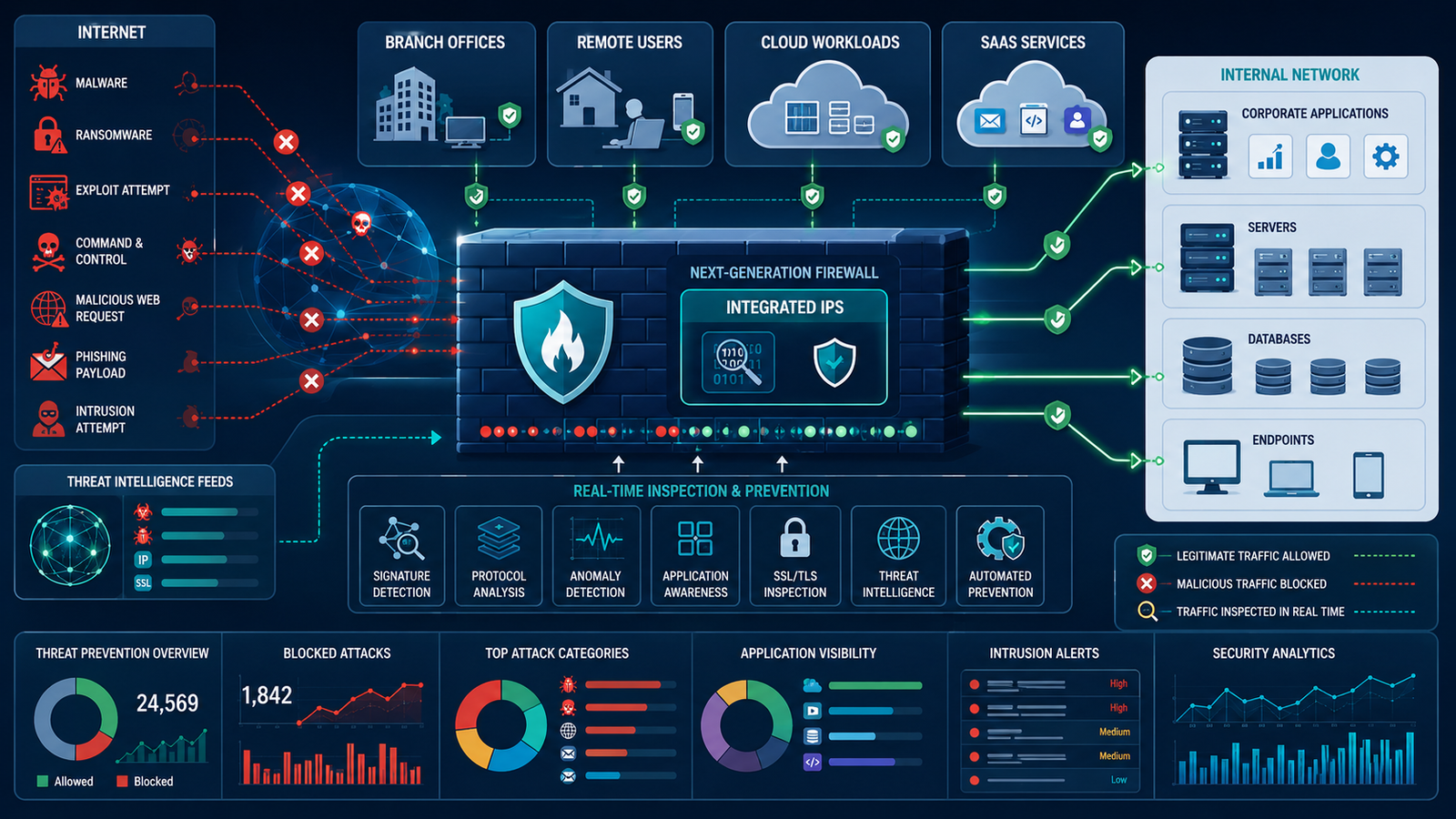
Passive monitoring is no longer enough when cyber threats move at hyper-speed. Implementing an integrated intrusion prevention system IPS provides the active defense required to intercept and block attacks before they exploit network vulnerabilities.
Enhanced by robust Network Threat Detection, this always-on guardian automatically evaluates incoming traffic against real-time intelligence. Keep reading to learn how integrated IPS transforms threat management into active defense.
Shielding Your Digital Assets: Key Highlights
Before exploring the technical mechanics, here is how an integrated IPS elevates real-time defense across your entire infrastructure:
- Real-Time Automated Neutralization: Moves past passive threat logging by actively intercepting and dropping malicious packets before they reach sensitive assets.
- Unified Defensive Architecture: Seamlessly connects with firewalls and SIEM platforms to build an automated, synchronized response across your entire digital landscape.
- Balanced Operational Accuracy: Precise tuning ensures strict protection against sophisticated exploits without disrupting critical, legitimate business communications.
Why Is a Standalone IPS No Longer Enough?
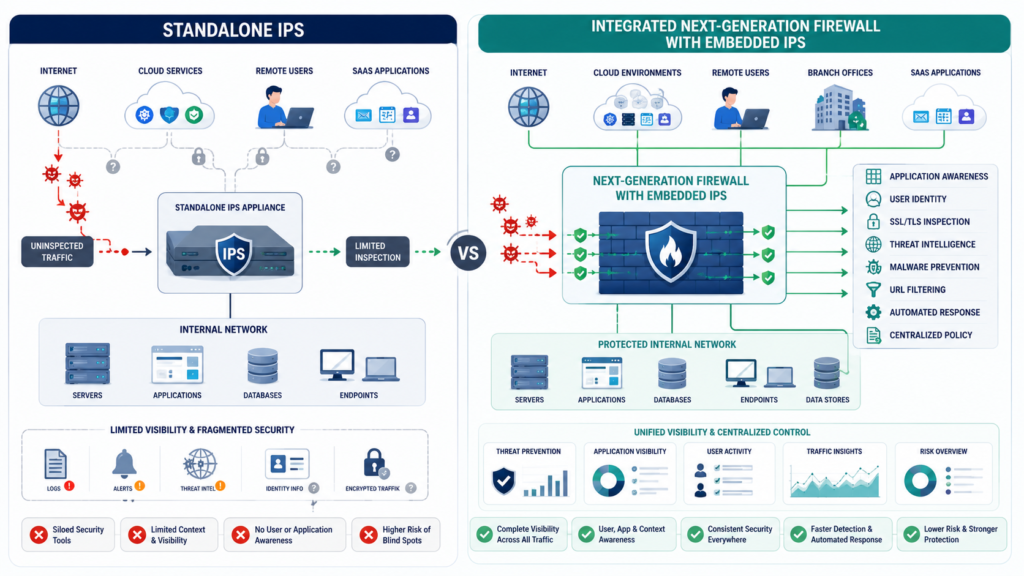
The digital landscape changed. Attackers got smarter, and their tools got faster. A standalone IPS, the kind that sits in a rack and does its own thing, struggles to keep up. It operates in a vacuum.
It sees a packet, checks its rules, and makes a decision. But it doesn’t know if that packet is part of a larger campaign that started with a phishing email an hour ago. It doesn’t know if the internal system it’s trying to protect is already compromised.
I remember a client years ago, they had a top-of-the-line standalone IPS. It was logging alerts like crazy, mostly for scanning activity they considered “noise.” Then one quiet Tuesday afternoon, it blocked what looked like another scan. But this one was different. The source was internal.
The IPS did its job and stopped the outbound connection attempt. What it couldn’t do was tell the key features firewall to isolate that infected workstation, or alert the SOC that a lateral movement attempt had just been made from their finance department. The incident was contained, but manually.
It took human analysts precious minutes to piece together what the machines, if they were talking, could have seen instantly.An integrated system closes that loop. An integrated system closes that loop. When the IPS detects a threat, it can instruct next generation firewalls
How Does an Integrated IPS Actually Work?
It works by being part of the conversation. Instead of being a mute bouncer at the door, it’s in the security operations center with a headset on. Technically, it’s still deployed inline, meaning all network traffic passes through it.
It analyzes this traffic using a combination of signature-based detection (matching known attack patterns) and increasingly, behavioral analysis (spotting anomalies that indicate new or unknown threats).
“This dual approach is critical for achieving what academic research has validated. For instance, a project from the University of Coimbra, deploying an IPS to protect an industrial PLC, demonstrated that a well-tuned inline IPS can block 100% of critical attacks while maintaining a false positive rate as low as 0.3% after proper tuning .” – Github
Here’s the integrated part: when it identifies a threat, it doesn’t just log it. It acts. It can:
- Drop the malicious packets.
- Reset the connection.
- Block the offending IP address.
And crucially, it can share that “decision” with other systems. For instance, if it blocks an attack originating from a specific external IP, it can automatically push a rule to the perimeter firewall to block all future traffic from that source.
This turns a one-time event into a persistent policy, saving analyst time and hardening your defenses automatically.
The core benefit is real-time prevention. Unlike its cousin, the Intrusion Detection System (IDS), which only alerts, the IPS stops the attack dead in its tracks. It’s the difference between a smoke alarm and a fire sprinkler. One tells you there’s a problem, the other tries to put it out before it spreads.
What Are the Tangible Benefits for Your Business?
The value proposition is straightforward: reduced risk and operational efficiency. First, by blocking attacks proactively, you directly lower the likelihood of a successful breach.
This means less downtime, less data loss, and less reputational damage. The financial impact of a prevented attack is incalculable, but always positive.
Second, it reduces alert fatigue for your security team. A well-tuned, integrated IPS suppresses false positives and only escalates genuine, high-fidelity threats. It automates the mundane blocking tasks, freeing your analysts to focus on hunting for sophisticated threats that might slip through.
We seen teams go from drowning in thousands of low-priority IPS alerts a day to managing a handful of high-confidence incidents. The morale and productivity shift is palpable.
Finally, integration fosters a stronger security posture. Your tools are no longer working at cross-purposes. The left hand knows what the right hand is doing. This coordinated defense makes your network a harder target, which in itself is a deterrent.
| Benefit | Standalone IPS | Integrated IPS |
| Threat Response | Generates an alert for manual review. | Automatically blocks the threat and can notify other systems. |
| Operational Overhead | High; requires manual correlation and response. | Lower; automates response and shares intelligence across the stack. |
| Security Posture | Creates a single point of detection. | Contributes to a layered, automated defense ecosystem. |
| Visibility | Limited to network traffic analysis. | Contextual, enriched by data from endpoints, cloud, and identity systems. |
What Should You Look for in a Modern IPS Solution?
Credits: CBT Nuggets
The checklist has evolved. It’s not just about raw throughput and signature count anymore. You need to think about how it fits.
Look for deep integration capabilities. Can it easily share data with your existing firewall, SIEM, and endpoint protection platforms? Open APIs and support for common protocols like syslog or vendor-specific frameworks are key. The goal is a cohesive security fabric, not a collection of best-of-breeds that don’t talk.
Advanced detection methods are non-negotiable. Sure, you need signature-based detection for known threats. But you also need robust anomaly-based detection that uses machine learning to spot deviations from normal baselines. This is how you catch zero-day attacks and novel malware that hasn’t been cataloged yet.
Performance and scalability matter in a real way. The IPS must handle your network’s peak traffic loads without becoming a bottleneck.
Nothing is worse than deploying a security tool that degrades the user experience and user identity so much that the business pressures you to turn it off. Look for solutions that offer hardware, virtual, and cloud-native form factors to match your environment.
And don’t forget manageability. The interface should be clear, reporting should be actionable, and policy tuning should be intuitive. A powerful IPS that’s too complex to configure correctly is a liability. It will either block legitimate traffic (causing outages) or miss real threats (creating risk).
How Do You Implement and Tune an IPS Without Breaking Things?
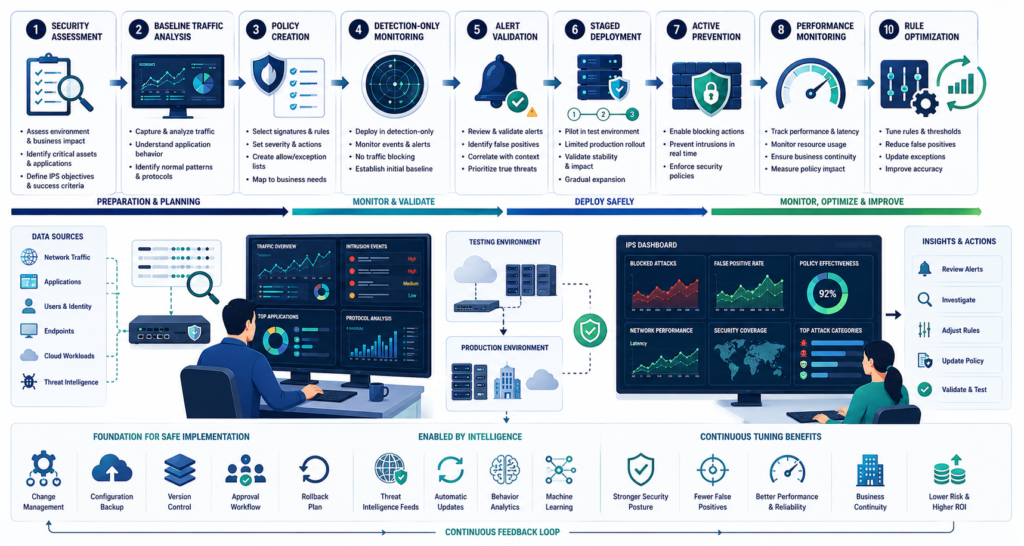
The golden rule: start in monitoring mode. Every vendor says this, and every time I’ve seen someone skip it, they’ve regretted it. Deploy the IPS so it can see all the traffic and generate alerts, but not block anything.
Let it learn your network’s unique rhythm for a week or two. You’ll be shocked at what it finds, usually a mix of legitimate but odd-looking traffic and some low-and-slow scanning you never knew about.
Then, begin building a whitelist. This is a list of known-good traffic that should never be blocked. It includes things like:
- Internal system communications between specific servers.
- Traffic from your vulnerability scanner.
- Certain SaaS application traffic that might use non-standard ports.
After the whitelist is solid, you can start enabling blocking policies, but do it gradually. Start with the most critical threats, known exploits, command-and-control callbacks, ransomware signatures. Create a phased rollout plan. Maybe you start blocking only on your DMZ segment, then move to internal user segments, and finally to sensitive data center networks.
“Research published in the 2024 Cyber Research Conference – Ireland (IEEE) highlights that the strategic placement of an IPS within a network architecture significantly influences both security effectiveness and network performance, affecting factors like latency, throughput, and visibility, #cybersecurity #networksecurity #cyberrci2024 #research #tudublin | Tania Malik” – Linkedin
Tuning is never a one-time event. It’s an ongoing process. Review the blocked events daily at first, then weekly. Are you blocking legitimate business applications? Adjust the rules. Is a particular threat signature generating a huge number of false positives? Tune its sensitivity. The goal is a high signal-to-noise ratio.
FAQ
What’s the difference between an IDS and an IPS?
An Intrusion Detection System (IDS) is a monitoring tool. It watches traffic, identifies suspicious activity, and sends an alert. It’s passive. An Intrusion Prevention System (IPS) is active. It’s placed inline and can automatically block or prevent the identified threat. Think of IDS as an alarm, IPS as an alarm with an automatic lock.
Does an IPS replace a firewall?
No, they work together. A firewall is a gatekeeper, enforcing access control policies (allow/deny) based on rules like IP addresses and ports. An IPS is a deep inspector, looking inside the allowed traffic for malicious content or behavior. You need both for a layered defense.
Can an IPS slow down my network?
It can, if it’s underpowered for your traffic load or poorly configured. This is why performance specifications and proper sizing are critical. A modern, well-integrated IPS from a reputable vendor is designed for high-throughput inspection with minimal latency. The security benefit far outweighs the negligible performance impact in a correctly deployed scenario.
How do you handle encrypted traffic with an IPS?
This is a major challenge. To inspect encrypted traffic (like HTTPS), the IPS needs to perform SSL/TLS decryption. This involves using a decryption key to temporarily unencrypt the traffic, inspect it, and then re-encrypt it. It requires careful planning around privacy, compliance, and performance, but it’s essential, as most modern malware hides its communications in encrypted channels.
Making Integrated Prevention Your New Normal
The journey from a collection of security tools to an integrated defense system starts with the intrusion prevention system. It’s the component that embodies the shift from watching to doing.
By choosing a solution designed for integration, you’re not just buying a product, you’re investing in a force multiplier for your entire security team.
It turns the overwhelming flood of network data into decisive, protective action. Start viewing it not as a cost, but as the operational engine of your active defense. Join Network Threat Detection to streamline vulnerability management, expose blind spots, and strengthen your business’s continuity.
References
- https://github.com/J0aoDias/ics-security-modicon-m340
- https://www.linkedin.com/posts/tania-malik-65251413_cybersecurity-networksecurity-cyberrci2024-activity-7259361027778105345-cavg