

Cybersecurity starts with visibility. The importance asset inventory security monitoring lies in knowing exactly what devices, systems, and applications exist across your environment before you can protect them.
Without a complete, real-time inventory, security teams waste time investigating unknown assets while real threats go unnoticed. Combined with Network Threat Detection, an accurate asset inventory provides the context needed to identify, prioritize, and respond to risks faster. Keep reading.
Why Asset Inventory Is the Foundation of Security Monitoring
Before diving deeper, here are the main points to remember about the importance of asset inventory in security monitoring:
- Eliminate security blind spots by continuously discovering and tracking every connected asset.
- Prioritize threats with confidence using asset context to separate critical incidents from low-risk events.
- Strengthen proactive defense by identifying unmanaged devices and addressing vulnerabilities before attackers can exploit them.
What Is a Security Asset Inventory, Really?
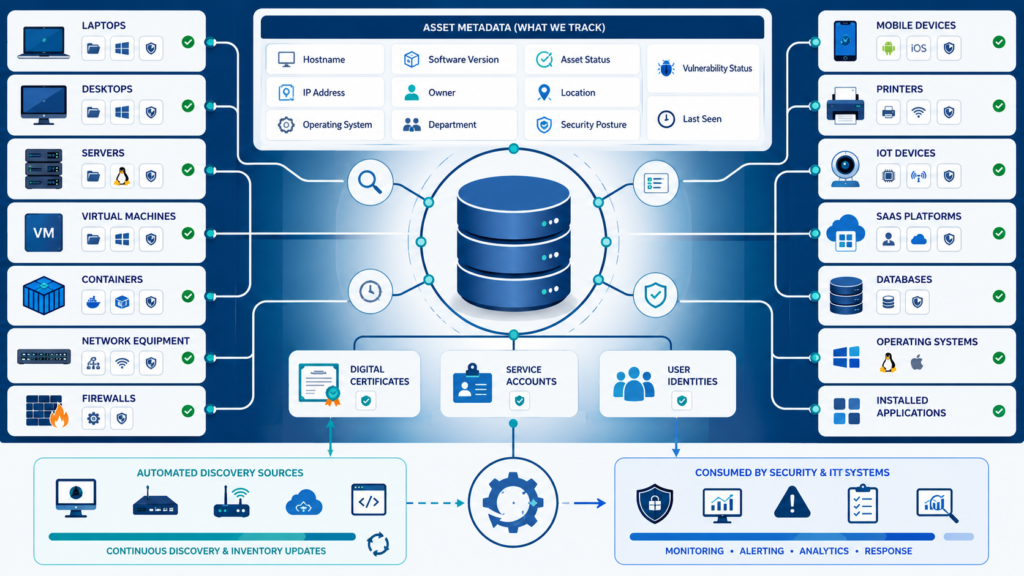
It’s not a spreadsheet. Anyone who thinks it is has already lost. A security asset inventory is a dynamic, real-time system of record for every piece of technology that connects to your environment. We’re talking servers, laptops, phones, IoT sensors, network switches, cloud instances, and even those shadow IT applications a department spun up without telling you.
Each entry isn’t just a name and IP. It’s context: what software it runs, its patch level, who owns it, what business function it supports, and how it connects to other assets. Think of it less like a list and more like the nervous system of your digital body. It’s the thing that feels where everything is and what it’s doing at any given moment.
When we do Network Threat Detection, this inventory is the “who” and “what” that gives the “alert” its meaning. It turns a detection event from “something happened” into “this critical server is talking to a known bad IP.”
Why Do Most Companies Get This So Wrong?
They treat it as a project, not a process. They do a big scan once a quarter, export a massive CSV file, and call it done. Two days later, a developer spins up five new cloud containers, a marketing person plugs in a demo device, and the inventory is obsolete.
“The dangers of treating asset data as a static truth are well-documented. A 2026 study published in the Journal of Cybersecurity and Privacy notes that traditional asset discovery methods ‘implicitly conflate raw discovery data with the declared inventory status,’ which ‘conceals ambiguity, restricts auditability, and complicates the analysis of asset identity over time’. This means that a spreadsheet from last quarter is not just out-of-date, it can be actively misleading, creating a false sense of security about your actual attack surface.” – MDPI
The other mistake is siloing. The network team has one list, the security team another, and IT operations a third. None talk to each other. So when a vulnerability scanner finds a flaw on 192.168.1.105, three departments spend an hour arguing over who owns it and what it does. That’s an hour an attacker wouldn’t waste.
We learned this the hard way early on, responding to an incident where the initial point of entry was an old test server everyone thought had been decommissioned. It wasn’t on anyone’s list, so it never got patched. It was a ghost door left wide open.
How Does a Good Inventory Shrink Your Attack Surface?
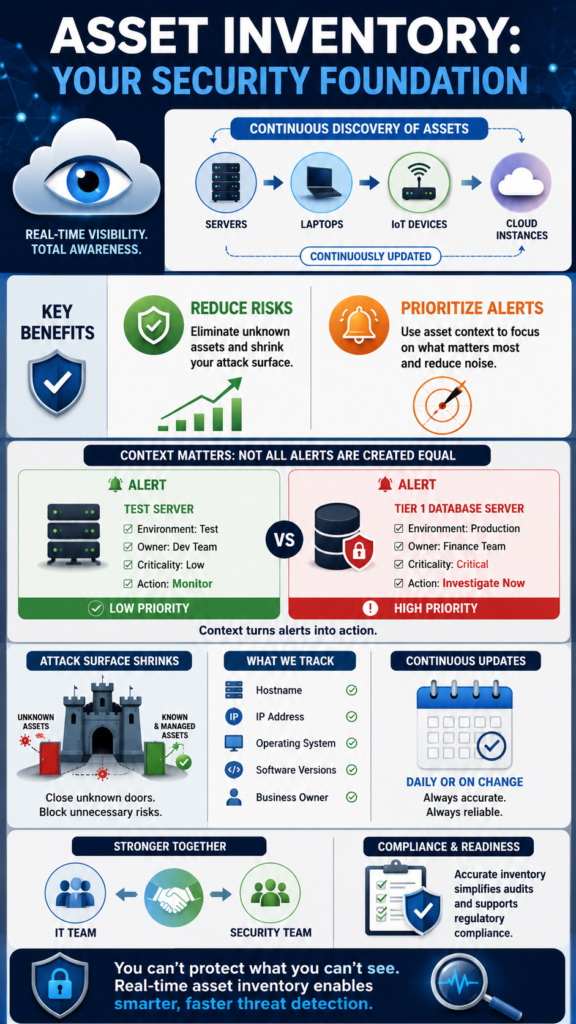
By making the unknown, known. Attackers love assets you’ve forgotten about. They’re unmonitored, unpatched, and often have weak credentials. A continuous discovery process hunts for these ghosts automatically. When you find an unauthorized device, you have a choice: bring it under management or disconnect it.
Either way, you’ve just closed a door. Furthermore, inventory lets you prioritize ruthlessly. You can’t patch everything at once. But if you know that Asset A is a public-facing web server handling customer data, and Asset B is an internal printer, you know where to focus your fire.
This is the core of risk-based vulnerability management. It’s not about finding all flaws; it’s about fixing the right ones first. Your inventory provides the asset management and vulnerability context needed to determine what “right” means.
- Eliminates Shadow IT: Finds and governs unauthorized devices and software.
- Enables Prioritization: Focuses security efforts on critical, high-value targets.
- Accelerates Response: Immediately identifies impacted assets during an incident.
- Supports Compliance: Provides evidence of control for audits and regulations.
Without this, you’re spraying security resources everywhere, hoping something sticks. With it, you’re a surgeon, not a gardener with a hose.
What Should a Modern Inventory Actually Track?
Credits: CYBRIXEN
The basics are non-negotiable: hostname, IP/MAC address, operating system, and device type. But that’s just the start. To be useful for security, it needs layers of context.
What applications are installed? What services are running? What network segments is it on? Most importantly, who is the business owner? That’s the person who can say, “Yes, this is needed,” or “Turn it “off ”.
“This requirement for comprehensive, contextual data is not optional, it is a recognized security mandate. The U.S. Cybersecurity and Infrastructure Security Agency (CISA) emphasizes that organizations must ‘develop an organization-wide understanding of the asset management lifecycle’ and that a complete inventory ‘includes every piece of hardware, software, and firmware that processes, stores, or transmits data’. Without this level of detail, security teams cannot accurately assess risk or respond effectively to incidents, no matter how sophisticated their detection tools may be.” – CISA
You also need to track relationships. How does this web server talk to that database? Understanding these data flows is critical for mapping attack paths. We integrate this inventory data directly into our security workflows. For example, when our Network Threat Detection flags suspicious traffic, it doesn’t just show an IP.
It shows the asset name, owner, and criticality, so the analyst knows instantly if they’re looking at a compromised corporate server or an employee’s personal tablet.
| Inventory Data Point | Why It Matters for Security |
| Business Owner | Determines who can authorize changes or decommissioning. |
| Asset Criticality (Tier) | Dictates patching SLAs, monitoring depth, and incident response priority. |
| Installed Software & Versions | Enables vulnerability scanning and license compliance. |
| Open Ports & Services | Reveals unnecessary exposure and potential entry points. |
| Network Location/Segment | Informs firewall policy and lateral movement analysis. |
How Does This Turn Alerts Into Action?
Not all security alerts deserve the same level of attention. An alert becomes far more valuable when it is combined with asset context, allowing analysts to understand the potential business impact before responding.
For example, two alerts may arrive at the same time:
- Multiple failed login attempts on a low-priority test server.
- An outbound connection to a suspicious domain from a critical customer database server.
Although both events may appear equally important in a basic SIEM, an up-to-date asset inventory quickly reveals which system is more valuable to the organization. This context enables security teams to prioritize the alert involving the critical asset and respond faster to the highest-risk incident.
By integrating asset inventory with detection systems, organizations improve alert triage, reduce investigation time, and focus resources where they have the greatest impact. Instead of treating every alert equally, analysts can immediately identify which incidents pose the most significant risk to the business.
Can You Build an Inventory Without Breaking the Bank?
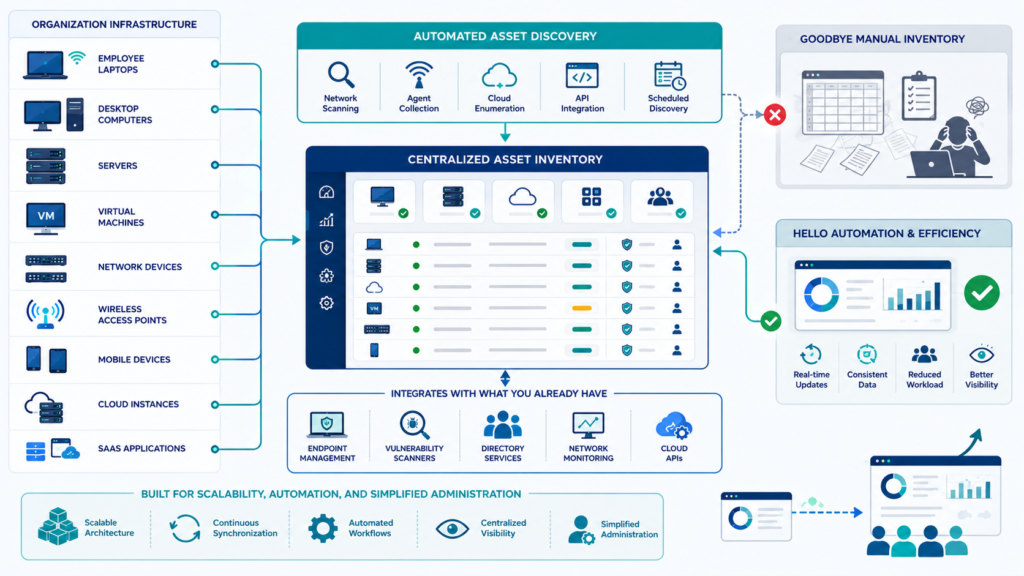
Yes, and you should start simple. You don’t need a six-figure platform on day one. Begin by combining data you already have. Pull device lists from your Active Directory, Microsoft Endpoint Manager, or MDM. Use a free, credentialed network scanner like Lansweeper (Community Edition) or Open-AudIT to discover what’s connected.
Export data from your cloud providers (AWS EC2, Azure VM inventory). Merge these into a single, shared spreadsheet or a simple internal wiki. The key is to make it visible and start the conversation about ownership. Assign an owner to every entry, even if it’s “IT Team – Unclassified.” This manual process is painful, but it exposes the gaps.
Once you’ve proven the value, then invest in tools that support automating asset discovery and correlation. The goal is a living system, not a perfect one.
FAQ
Isn’t this just an IT operations problem, not a security one?
It’s a shared problem with security consequences. IT owns the lifecycle, but security depends on the accuracy of the data to assess risk, investigate incidents, and enforce policy. Security must be a primary stakeholder and consumer of the inventory.
How often does an inventory need to be updated?
Continuously. Modern environments change by the minute. Automated discovery tools should scan daily at a minimum. Any significant change, a new cloud deployment, a major patch cycle, should trigger an update. Static inventories are worse than useless; they’re misleading.
What about software-as-a-service (SaaS) applications?
They’re absolutely assets. They hold your data and represent an access point. Your inventory should include SaaS apps, their business owners, the level of data they handle, and how users authenticate to them (SSO, personal logins).
We have a lot of legacy systems that can’t be scanned. What then?
Document them manually as “unmanaged assets.” Note their criticality, owner, and network location. The fact that they’re un-scannable is a huge risk in itself, and documenting it formally creates a business case to replace, isolate, or decommission them.
The Unshakeable Foundation
A complete asset inventory is the foundation of every effective security program. It transforms uncertainty into visibility, enabling faster detection, smarter prioritization, and stronger incident response. Start by documenting one subnet, cloud project, or business unit, you’ll quickly uncover hidden risks and close critical blind spots.
Ready to improve your security visibility? See how NetworkThreatDetection.com helps teams strengthen defenses: Join Network Threat Detection
References
- https://www.mdpi.com/2624-800X/6/2/67
- https://www.cisa.gov/resources-tools/resources/foundations-ot-cybersecurity-asset-inventory-guidance-owners-and-operators