
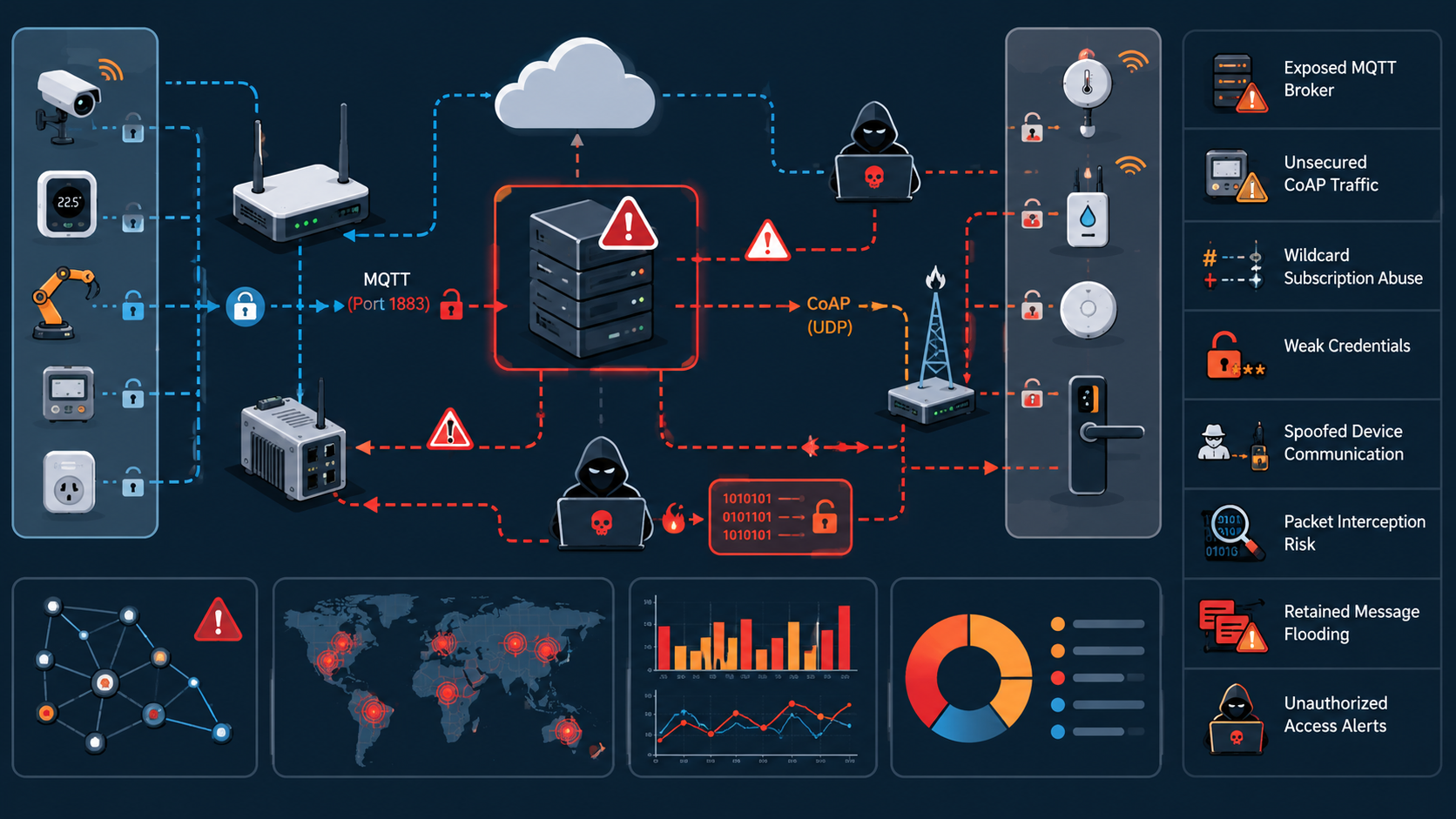
Securing IoT communication protocols MQTT CoAP starts with eliminating common security gaps that attackers exploit every day. In most assessments, the highest risks come from exposed MQTT brokers, shared device credentials, weak access controls, and certificates that remain unchanged for years.
We still encounter plaintext MQTT traffic on port 1883 across industrial and smart building environments where security was added after deployment. At Network Threat Detection, we regularly see these issues create unnecessary exposure. Keep reading to learn the practices that reduce IoT risk in production environments.
Quick Reads: MQTT and CoAP Security Fixes That Matter
Most IoT security failures come from weak setup and poor maintenance, not advanced attacks. These fixes help reduce exposure, improve visibility, and keep devices stable in production.
- Use TLS for MQTT and DTLS or OSCORE for CoAP to protect data in transit and reduce interception risks.
- Replace shared passwords with unique identities, strict ACLs, and controlled topic permissions to limit unauthorized access.
- Monitor brokers, gateways, and device traffic continuously so teams can detect unusual behavior before outages or attacks spread.
What Security Risks Affect MQTT and CoAP Deployments?
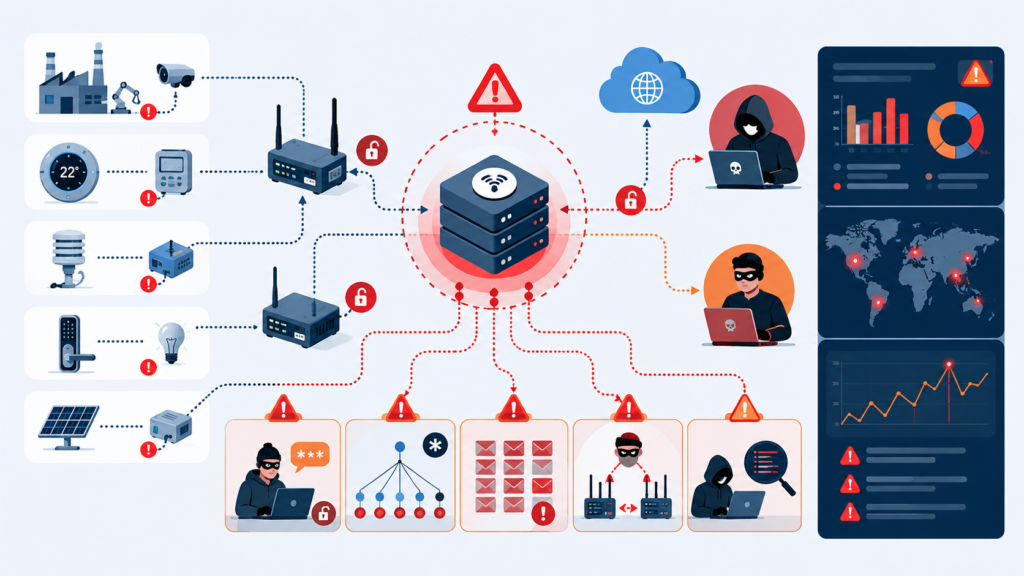
Common threats include eavesdropping, broker hijacking, and denial-of-service attacks. Many teams don’t realize how exposed their devices are once they leave the lab.
Research from IIoT World shows exposed MQTT brokers still leak data because operators disable authentication for troubleshooting and forget to turn it back on. We’ve seen this “operational drift” in smart building projects. Temporary fixes become permanent. Debug ports stay open. Old devices run without updated certificates.
Attackers often target constrained devices. Memory limits can weaken TLS, and cheap hardware might crash under encryption loads. In larger environments, the broader security challenges of monitoring IoT devices become harder once thousands of distributed endpoints start communicating across gateways and cloud brokers.
Here are the most common risks we find:
- Eavesdropping on plaintext MQTT traffic (port 1883).
- Spoofing attacks against unauthenticated CoAP endpoints.
- Broker exhaustion from abused retained messages.
- Device takeover from reused or weak credentials.
- Topic hijacking through unrestricted wildcard subscriptions like #.
| Vulnerability | MQTT Impact | CoAP Impact | Our Recommended Mitigation |
| Plaintext traffic | Full topic interception | Packet sniffing | Enforce TLS/DTLS; block plaintext ports. |
| Wildcard abuse | Unauthorized data access | Less common | Implement strict topic Access Control Lists (ACLs). |
| UDP spoofing | Limited | High risk of fake commands | Use DTLS with mutual authentication. |
| Weak identities | Full device impersonation | Resource theft | Use unique client certificates or hardware-backed keys. |
These weaknesses rarely work alone. Most attacks chain several missteps together across brokers, gateways, and device firmware.
How Does MQTT Security Work in IoT Systems?
MQTT security layers encryption, authentication, and authorization onto the publish/subscribe model. It starts with MQTT over TLS (port 8883). This protects data between devices and brokers. We always recommend pairing this with network monitoring. Encryption hides content, but monitoring can spot unusual behavior.
Why TLS isn’t a magic fix: Plaintext MQTT on port 1883 is still far too common. In assessments, we often find missing certificate validation. An attacker can use a self-signed certificate to intercept traffic. Hardening means enforcing TLS 1.2+, validating broker hostnames, and actually rotating certificates before they expire.
Authentication proves a device is who it claims to be. Authorization controls what it can do. A secure setup gives devices only the access they need. For example, a temperature sensor might only be allowed to publish to sensors/building1/temp. It shouldn’t be able to subscribe to sensors/# or publish to command topics.
We’ve seen real problems with wildcards. One client entered “retained message hell” after an unrestricted subscription caused a flood of old data to crash their dashboard. Proper ACLs prevent this. Strong visibility also depends on continuously analyzing IoT device telemetry data to identify before they escalate into outages.
How Is CoAP Secured in Constrained IoT Networks?
CoAP uses UDP, which is efficient but fragile. Security relies on DTLS (like TLS for UDP) or OSCORE, which encrypts the message payload itself. This is a key difference. DTLS secures the connection between two points.
OSCORE secures the message, even if it passes through multiple gateways. For smart city networks with many hops, OSCORE is often the better choice.
The hardware struggle: Cheap, battery-powered sensors often struggle with DTLS. The encryption handshake uses too much power and memory. We’ve seen deployments where devices crashed or batteries died quickly.
Many teams then offload DTLS to a gateway, but this concentrates risk. If the gateway is compromised, all traffic behind it is exposed. CoAP also uses a REST-like model with GET, PUT, and POST commands. Authorization must control these actions.
A light sensor might only be allowed to respond to GET requests for its reading. It should never accept a PUT command to update its own firmware. Using lightweight OAuth tokens can manage these permissions effectively. Many organizations now combine these controls with broader IoT device security best practices to reduce long-term operational risk.
MQTT vs CoAP Security: Which Is Easier?
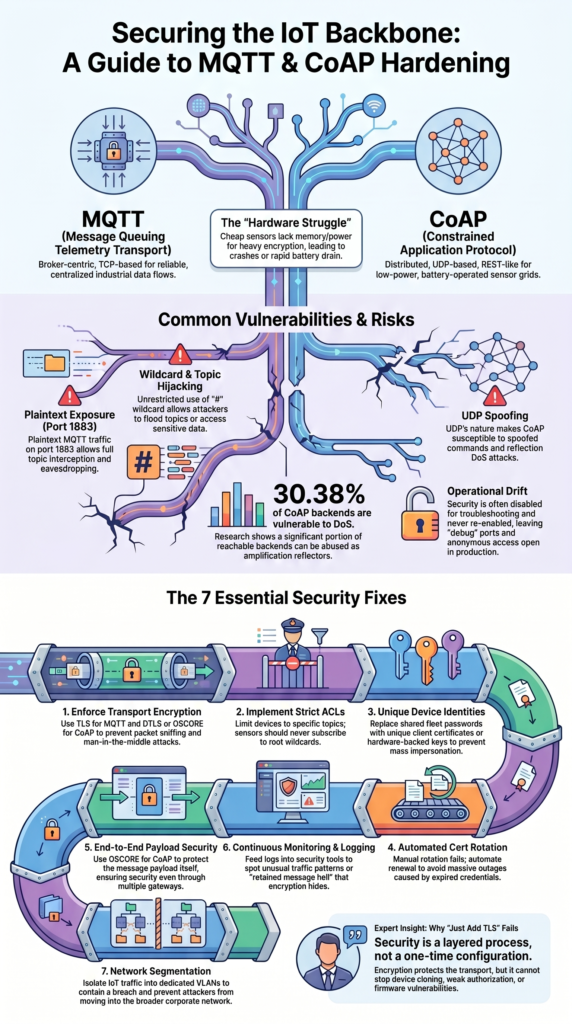
MQTT is often easier to manage centrally because the broker is a control point. You can update ACLs, revoke access, and monitor traffic from one place. CoAP is more distributed and lightweight, but that adds complexity. You have to manage security across many individual devices and gateways.
As noted by ACM Digital Library
“Although MQTT is a lightweight protocol it uses TLS for encryption but the implementation of TLS is left to the developer, thus creating different levels of security for different implementations. CoAP uses DTLS for securing the communication over UDP; however, the security of this approach can be limited by the constraints of the IoT devices and therefore may not be as secure in high threat environments.” – ACM Digital Library
| Security Factor | MQTT | CoAP |
| Encryption | TLS (TCP-based) | DTLS or OSCORE (UDP-based) |
| Key Management | Centered on the broker | Distributed across devices/gateways |
| Visibility | High (traffic flows through broker) | Lower (requires gateway logging) |
| Best For | Reliable, centralized data flows | Low-power, distributed sensor networks |
In our experience, MQTT fits better for industrial control and telemetry where you need reliable delivery. CoAP is excellent for battery-powered sensor grids. The “easier” choice depends on your network layout and what your devices can actually handle.
What Are the Most Common Misconfigurations?
Credits: HiveMQ
The biggest failures are simple oversights, not complex attacks. We consistently find disabled authentication, shared keys, and expired certificates.
Insights from Netidee indicate
“Authentication is often optional in IoT deployments, and many systems omit it. Examples from the study include MQTT brokers that support wildcard topic subscriptions… We found that 30.38% of reachable CoAP backends were vulnerable to DoS attacks, and a large portion could be abused as amplification reflectors.” – Netidee
The most dangerous mistakes we see are:
- Leaving anonymous MQTT access enabled in production.
- Using the same pre-shared key across an entire fleet of CoAP devices.
- Forgetting to set up automatic certificate rotation, leading to mass outages.
- Leaving broker management dashboards exposed to the internet.
- Allowing unrestricted wildcard subscriptions.
Expired certificates cause major outages. One client had 20,000 smart meters go offline at once because their two-year certificate expired and no renewal process existed. The fix took days.
How Should Enterprises Secure These Protocols at Scale?
Large IoT environments need automation from the start. Manual certificate handling and device onboarding quickly become impossible once deployments reach thousands of endpoints. We usually encourage organizations to focus on identity management before scaling infrastructure further.
Strong device identity starts during manufacturing or first boot provisioning. Every device should receive a unique identity tied to secure key storage instead of shared fleet credentials. Hardware-backed storage adds another layer of protection against credential extraction.
Enterprises also need visibility across gateways, brokers, APIs, and edge devices. Threat monitoring helps detect unusual behavior early, especially in distributed industrial environments where attackers may stay hidden for long periods.
A layered enterprise model often includes:
- Automated certificate enrollment
- Device attestation
- Segmented IoT VLANs
- Gateway security controls
- Continuous log collection
- Centralized policy enforcement
- Key expiration monitoring
Monitoring remains one of the most overlooked controls. Many attacks first appear as unusual traffic patterns rather than obvious compromise alerts. We have seen retained message floods and device impersonation attempts continue unnoticed for weeks because logging pipelines were incomplete.
Strong IoT operations also depend on disciplined maintenance. Expired certificates, outdated firmware, and unmanaged gateways still create major risks even when encryption and authentication appear correctly configured.
Why “just add TLS” fails in real IoT environments
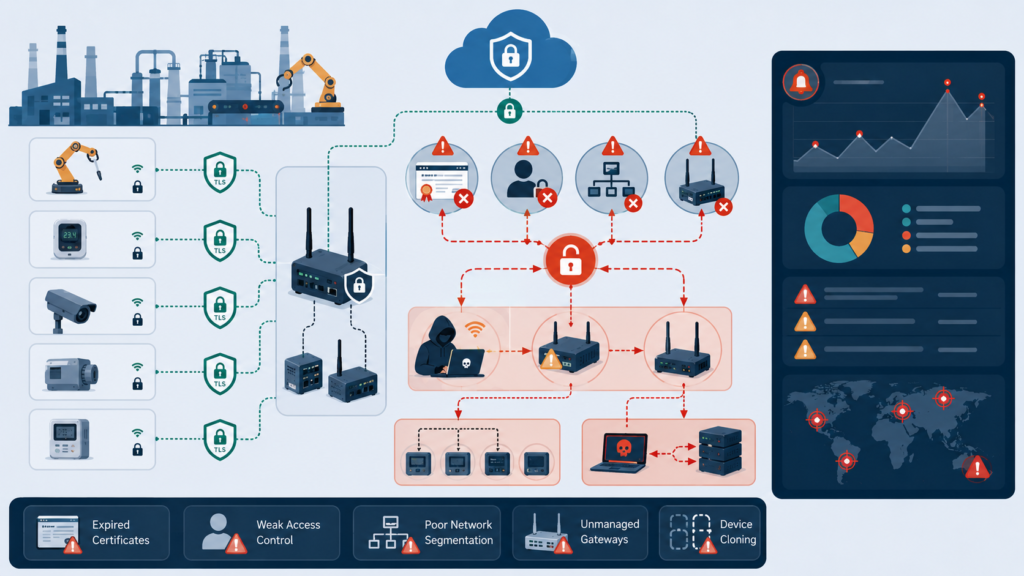
“Just add TLS” fails in real life because it ignores identity, authorization, and operational upkeep. Security is a layered process, not a one-time configuration. Many IoT teams learn this after deployments reach production scale.
We often hear engineers say encryption was enabled, yet the environment still failed during an incident review. Usually the real problem sits elsewhere. Wildcard ACLs remain open. Certificates never rotate. Devices share credentials across entire fleets. Attackers only need one weak point to move further inside the network.
Operational problems also appear during scaling. Teams manually rotate PSKs until synchronization errors break production systems. In other cases, one firewall mistake exposes a broker publicly and traffic floods begin within hours.
Several environments struggled because devices validated encryption poorly. Some embedded systems accepted invalid certificates or skipped hostname verification entirely. That left supposedly secure channels vulnerable to interception.
TLS also cannot stop:
- Device cloning
- Weak authorization
- Firmware vulnerabilities
- Misconfigured gateways
- Anonymous access
- Poor segmentation
Strong security comes from layered controls working together. Encryption protects transport, but identity, monitoring, segmentation, firmware security, and operational discipline still determine whether the deployment survives real-world attacks.
FAQ
How does MQTT over TLS improve IoT protocol encryption?
MQTT over TLS protects data sent between devices and brokers by encrypting network traffic on the MQTT port 8883. This helps reduce man-in-the-middle IoT attacks and packet sniffing.
Strong MQTT security also requires client certificates, MQTT setups, proper topic access control, and regular certificate rotation MQTT processes. Without these protections, attackers may still gain access through weak permissions or exposed broker connections.
Why is DTLS for CoAP difficult on constrained IoT devices?
DTLS for CoAP can be difficult for low-power devices because encryption uses extra memory, battery power, and processing capacity. Some organizations experience battery impact DTLS problems or heap crashes ESP32 devices during long communication sessions.
CoAP security also becomes weaker when devices reuse PSK DTLS CoAP credentials or depend too heavily on gateway offloading TLS services. Strong key management IoT practices help improve both stability and security.
What causes wildcard topic vulnerabilities in MQTT brokers?
Wildcard topic vulnerabilities happen when administrators allow devices to subscribe to large topic groups without proper restrictions. Attackers can abuse retained message attacks or publish subscribe security weaknesses to collect sensitive data from multiple devices.
MQTT broker hardening should include topic hierarchy ACLs, anonymous access disable settings, and rate limiting MQTT controls. Audit logging brokers systems also help teams detect unusual topic activity before it creates larger security problems.
How does the OSCORE protocol support end-to-end CoAP security?
OSCORE protocol protects the message payload itself instead of only protecting the device connection. This approach supports end-to-end CoAP security even when messages pass through proxies or edge gateways.
Unlike hop-by-hop security methods, OSCORE helps reduce data exposure inside smart city CoAP security environments. Many teams also use CoAP resource authorization and OAuth2 CoAP tokens to control device permissions and block unauthorized actions across distributed IoT networks.
Why do enterprises combine network segmentation IoT with MQTT security?
Large organizations separate IoT traffic into isolated network zones because one compromised device can affect many systems quickly. Network segmentation IoT strategies improve OT network security and reduce IIoT protocol risks during attacks.
Security teams also use SIEM IoT logging, anomaly detection brokers tools, and incident response IoT planning to monitor suspicious behavior. Strong segmentation helps contain device impersonation prevention failures before attackers can move deeper into operational environments.
Secure IoT Systems Without Slowing Everything Down
When MQTT and CoAP security is handled badly, devices start lagging, batteries drain faster, and teams end up fighting constant stability issues. That becomes expensive fast. Strong protection only works when it fits the limits of real IoT environments.
A simpler security model usually holds up better under pressure, and that’s where platforms like Network Threat Detection can help teams spot risks earlier. If you want clearer attack visibility and faster risk prioritization. Explore the real-time threat modeling platform built for modern security operations.
References
- https://dl.acm.org/doi/full/10.1145/3716554.3716830
- https://www.netidee.at/analyzing-and-understanding-internet-insecure-things/hidden-weak-spot-iot-insecure-backends