
SIEM platforms play a central role in modern security operations, but many organizations quickly discover that SIEM limitations challenges implementation issues can prevent them from delivering the visibility they promise.
Poor data quality, excessive alerts, and evolving attack techniques often leave security teams struggling to keep up. Understanding these obstacles is the first step toward building a stronger defense. Combined with a Network Threat Detection strategy, organizations can overcome critical blind spots and improve threat visibility across the network. Keep reading.
What You Should Know Before Blaming Your SIEM
No SIEM deployment is perfect. Understanding the most common limitations and implementation challenges helps security teams set realistic expectations and make better decisions.
- SIEM tools are inherently limited by poor data quality and a reliance on known-bad signatures.
- Implementation failures often stem from misaligned goals and a lack of ongoing tuning.
- Augmenting your SIEM with Network Threat Detection closes critical visibility gaps.
The Inherent Hurdles Every SIEM Faces

You see the sales demos. They show a dashboard lighting up, catching a hacker in real time. It looks effortless. The reality, once you own the tool, is different. The first challenge isn’t your setup. It’s in the design.
“Traditional SIEM solutions operate with a centralized architecture, storing all information in a central repository. This mechanism presents several challenges, including managing vast data volumes, experiencing performance bottlenecks, generating irrelevant alerts, and inaccurately correlating attributes. Furthermore, these solutions rely on human intervention to perform root cause analysis of anomalies or adverse events. This dependency can lead to errors due to insufficient information, misinformation, and biased interpretation.” – Vajpayee & Hossain
SIEMs are collectors and correlators. They serve as the backbone of modern security information event management (siem) strategies by taking in logs from your servers, firewalls, and endpoints. A log is simply a record of something that already happened, like a door closing.
This creates a fundamental data problem. If your logs are incomplete, delayed, or poorly formatted, your SIEM is forced to make decisions using unreliable information. Even the most advanced platform cannot detect threats it cannot see.
Data Gaps and Detection Limitations
Credits: One Identity
Another challenge is how SIEMs detect threats. Most platforms rely heavily on predefined rules and known indicators of compromise, such as suspicious IP addresses, malware hashes, or established attack patterns. This approach works well against threats that have already been identified.
The problem appears when attackers use new techniques, zero-day exploits, or legitimate tools already present in your environment. In these situations, traditional detection rules may not trigger at all. You can combat this blind spot by integrating threat intelligence into your platform, preventing sophisticated malicious activity from continuing unnoticed.
Common SIEM Data Shortfalls:
- Inconsistent log formats across devices
- Critical network traffic data omitted entirely
- Delayed log ingestion during peak attacks
We learned this lesson firsthand. One client believed their SIEM environment was fully monitored because server visibility was excellent. However, a cryptocurrency miner had been running on a developer’s workstation for months.
The endpoint was sending logs, but a key process-monitoring data source was never enabled. Without that information, the SIEM had nothing meaningful to correlate. The malicious activity remained invisible, and the workstation slowly consumed resources without detection.
When SIEM Goals Start in the Wrong Place
Understanding a SIEM’s limitations is one thing. Implementing it successfully is another challenge entirely. Many SIEM projects struggle not because of the technology itself, but because organizations struggle with picking the right siem solution vendor and establishing clear operational objectives from the very beginning.
“The report found that 50% of detection rule failures were linked to problems with log collection. When logs aren’t captured properly, it’s all too easy to miss critical events, leading to a dangerous lack of alerts, a false sense of security, and a failure to detect malicious activity… [I]n 2025, organizations were only detecting 1 out of 7 simulated attacks, showing a critical gap in threat detection and response.” – Picus Blue Report 2025
A common example is deploying a SIEM purely to satisfy compliance requirements. Leadership decides the organization needs a SIEM to pass audits, so the focus becomes checking a box rather than improving security visibility.
To avoid missing anything, teams often enable every default detection rule. The result is an overwhelming flood of alerts. Hundreds of high-priority notifications arrive each day, and most turn out to be false positives.
The Ongoing Challenge of SIEM Tuning
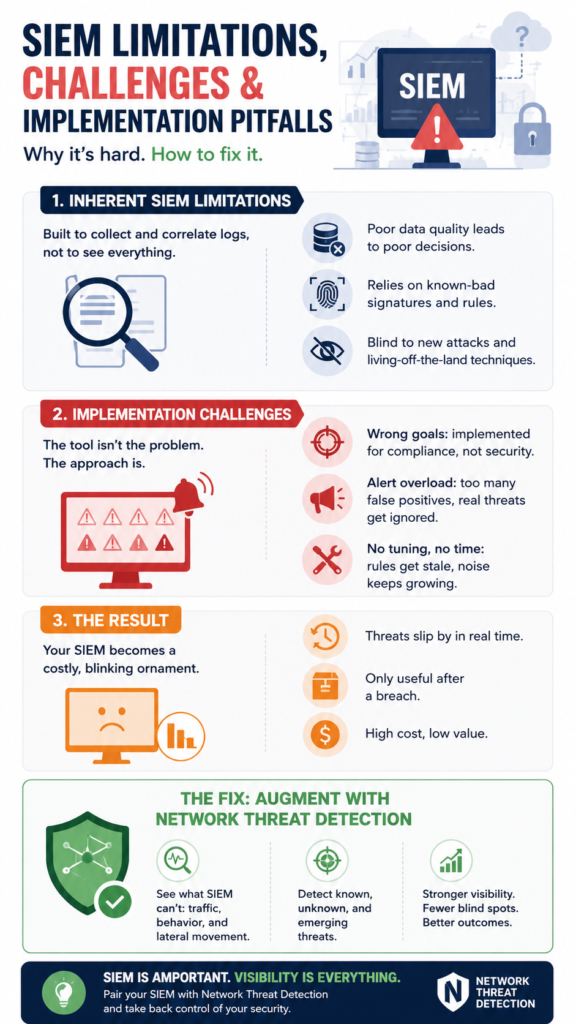
Even after deployment, the work is far from finished. A SIEM is not a set-and-forget appliance. It requires continuous tuning and maintenance to remain effective.
Organizations evolve constantly. New applications are deployed, infrastructure changes, employees adopt different workflows, and attackers develop new techniques. Detection rules that worked a few months ago may no longer reflect current risks.
Without dedicated time for analysts to:
- Refine detection rules
- Reduce false positives
- Suppress unnecessary alerts
- Develop new detection patterns
the SIEM gradually loses effectiveness.
As noise increases and rule quality declines, the platform shifts from being a proactive security tool to a reactive one. Instead of helping teams identify threats in progress, it becomes little more than a historical log archive used after an incident has already been discovered.
The Critical Gap: What Your SIEM Can’t See
Let’s talk about the blind spot. This is the most important part. Your SIEM ingests logs. Logs are generated by applications and systems. They are interpretations of activity. The raw, unmediated truth of what happens on your wire is network traffic. Most SIEMs never see it.
Think of it like investigating a crime in a city. Your SIEM has transcripts from phone calls (logs). It knows who called whom and for how long. What it doesn’t have is the video footage from the street cameras (network traffic).
It didn’t see the person casing the building, testing the door handles, or passing the stolen goods to a accomplice on the corner. That all happened outside the phone calls.
This is where Network Threat Detection comes in. It’s not a replacement for your SIEM. It’s the missing sense. It watches the raw traffic, every packet, every connection, every protocol. It looks for anomalies in behavior, not just known-bad lists.
Is a computer suddenly talking to a country it’s never contacted before? Is an internal server trying to spread laterally using a strange protocol? This is the activity that happens between the log entries.
A Practical Path Forward

This might sound bleak, but it’s just honest. Knowing the battlefield is the first step to winning. Your goal shouldn’t be a perfect SIEM. It should be an effective security operations capability. Here’s how you build it.
Start by redefining success. It’s not “compliance checked.” It’s “mean time to detect” lowered. It’s “analyst burnout” reduced. Get everyone, from the CISO to the newest analyst, aligned on those human-centric metrics.
Then, feed your SIEM better data. Conduct a log source audit. What’s missing? Prioritize getting network-derived metadata (NetFlow, Zeek logs) into the SIEM first. This bridges the visibility gap.
| Aspect | Traditional SIEM-Centric View | Augmented, Network-Informed View |
| Primary Data Source | System & Application Logs | Network Traffic Metadata + Curated Logs |
| Detection Focus | Known-bad signatures, compliance | Anomalous behavior, unknown threats |
| Alert Quality | High volume, low fidelity | Lower volume, high fidelity |
| Key Blind Spot | Network-level attacker movement | Less, as network provides baseline truth |
| Analyst Experience | Fatigue from false positives | Focused investigation of true leads |
Finally, build tuning into the workflow. Every Friday afternoon, review the week’s top alerts. Which were false? Why? Adjust one rule. This slow, steady maintenance is what keeps the system sharp. It turns a cost center into a defense that actually works.
FAQ
What’s the biggest budget mistake with a SIEM?
Underfunding the ongoing tuning and staffing. The license cost is just the entry fee. The real expense is the skilled people and time needed to make it valuable.
Can’t I just get better logs instead of adding network detection?
You should get better logs. But even perfect logs are a record of allowed events. Network detection sees the connection attempts that were blocked, the port scans, the data exfiltration attempts that never hit a log-generating system.
Is this too complex for a small team?
It’s actually more critical for a small team. You can’t afford alert fatigue. Starting with a focused network detection setup that feeds a few, critical alerts into a simple SIEM or even a ticketing system is a more powerful start than a fully loaded, untuned enterprise SIEM.
How do I convince management we need this change?
Don’t lead with technology. Lead with risk. Show them a sample of high-fidelity alerts your current setup missed (a demo from a vendor can help). Frame it as reducing business risk and increasing operational efficiency, not buying a new tool.
Moving Beyond SIEM Struggles
Moving beyond Security Information and Event Management (SIEM) struggles isn’t about abandoning the tool; it’s about giving it the eyes it lacks. By anchoring your defenses in actual network visibility, you transform chaotic noise into clear, actionable intelligence.
Stop fighting your own defenses. Ready to expose your blind spots and empower your SOC? Proactively defend your infrastructure with real-time threat modeling and automated risk analysis. Upgrade your network threat detection today.
References
- https://dl.acm.org/doi/full/10.1145/3716489.3728439
- https://thehackernews.com/2025/08/why-siem-rules-fail-and-how-to-fix-them.html