
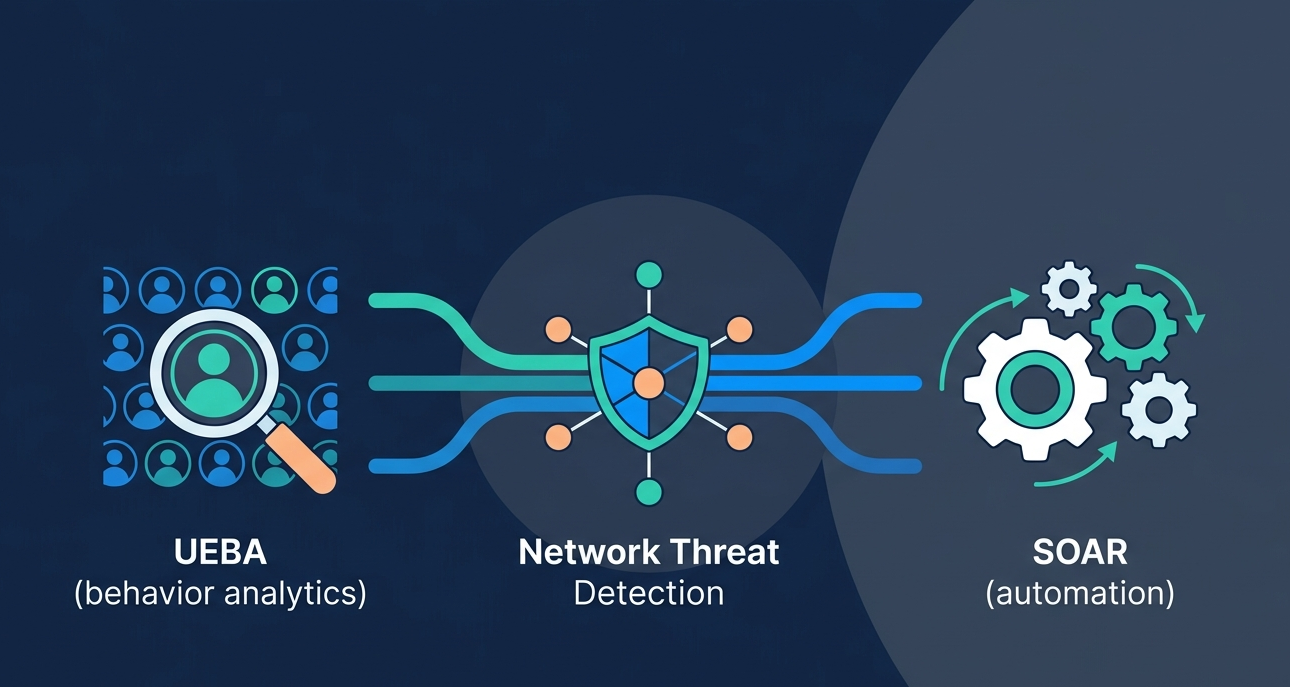
Many organizations invest in a next-generation SIEM expecting instant visibility and stronger security outcomes. Yet even with massive amounts of collected data, security teams often struggle to identify meaningful threats and respond quickly. The reason is simple: a SIEM alone is only part of the solution.
To unlock the full value of modern security operations, organizations need key next generation SIEM capabilities UEBA SOAR, and Network Threat Detection. Together, these capabilities provide the visibility, context, and automation required to turn security data into actionable intelligence. Keep reading.
The Missing Pieces of a Powerful SIEM
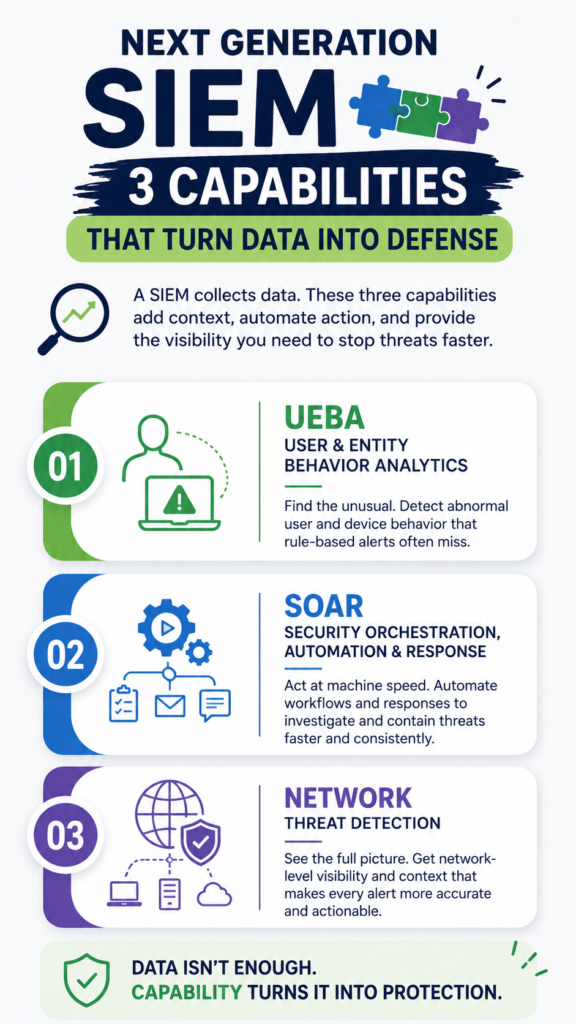
To move beyond alert overload and gain real security value, three essential capabilities must work together.
- Modern SIEMs need User and Entity Behavior Analytics (UEBA) to spot the stealthy, insider threats that rule-based alerts miss completely.
- Security Orchestration, Automation, and Response (SOAR) is the force multiplier that turns analyst decisions into consistent, rapid, and scalable actions.
- True network-level visibility, often called Network Threat Detection, provides the indispensable context that makes every other alert meaningful and actionable.
What Makes a SIEM “Next-Gen” Anyway?
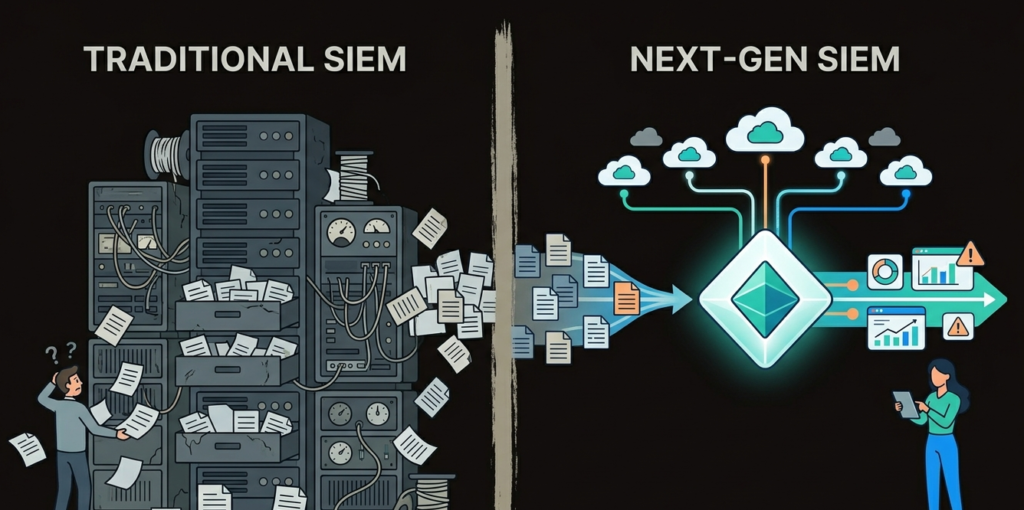
You hear the term thrown around a lot. Next-gen this, next-gen that. For a SIEM, it’s not just about storing more data faster. That’s just logistics. The process goes beyond simply collecting correlating security logs over a network. The generational shift is in understanding. Older systems waited for a known bad signature.
It looks for the story the data is telling, not just the keywords. This means moving beyond pre-written correlation rules. It involves applying machine learning to establish behavioral baselines for every user, host, and application in your environment.
When those baselines are violated, that’s your signal. It’s less about declaring something malicious immediately, and more about saying, “Hey, this activity is statistically weird for this entity. Look here first.” That shift from rules to reasoning is the starting line.
Can Your SIEM Spot the Insider Threat?
Credits: Fluency Security
This is where the rubber meets the road. Imagine an employee’s account starts downloading gigabytes of design files at 3 a.m. A rule might flag the large transfer, but what if it’s just a few megabytes more than usual, spread over a week? Rule-based systems often miss this. User and Entity Behavior Analytics, or UEBA, exists for this exact scenario.
“Next-Generation SIEMs are designed to be more adaptive, scalable, and intelligent. They not only collect and analyze security data but also understand the context of that data… By leveraging artificial intelligence and behavior-based analytics, Next-Generation SIEMs can detect both known and unknown threats, reduce false positives, and provide a more holistic view of an organization’s security posture.” – Security Boulevard
It learns. It knows that Sarah in marketing only accesses the customer database between 9 and 5, from her office IP. So when “Sarah” logs in from a new country at midnight and starts querying sensitive tables, UEBA doesn’t need a rule. It sees the profound deviation from Sarah’s normal pattern.
It’s looking for anomalies specific to the entity, not just generic bad actions. This capability transforms your SIEM from a watchman checking a list to a detective who knows everyone’s habits. It catches the slow leaks, the careful data hoarding, the compromised account being used subtly. Without UEBA, you’re blind to the threats that look almost normal.
Are You Automating Actions or Just Collecting Alerts?
Here’s a painful truth. Identifying a threat is only half the battle. The other half is doing something about it, fast, before the attacker achieves their goal. Continuous siem rule tuning alert management is vital here, because alert fatigue leads to slow, inconsistent, manual response.
You see an incident, you open ten tabs, you execute steps, you maybe forget one. Security Orchestration, Automation, and Response, or SOAR, addresses this directly. Think of it as your security playbook, but one that can execute itself.
When your UEBA module flags that anomalous download, the SOAR platform can be triggered automatically. It might do a sequence of things without waiting for a human:
- Quarantine the affected endpoint from the network.
- Disable the user’s account credentials immediately.
- Open a ticket in your IT service management system.
- Collect forensic artifacts from the host for later analysis.
- Send a formatted alert with all context to your analyst’s dashboard.
It turns a 30-minute manual process into a 30-second automated one. This isn’t about replacing people. It’s about empowering them to handle the complex, judgment-based investigations while the machine handles the repetitive, time-sensitive containment tasks. Your team’s expertise gets amplified.
Do You Have the Full Context to Decide?
Let’s talk about that suspicious outbound connection. An endpoint alert says a server is calling out to a known bad IP. Serious? Probably. But what if you could see that the server is a web proxy, and half your company is routing traffic through it to that same IP for a legitimate SaaS application? The endpoint alert, alone, is a false positive.
This is why Network Threat Detection is non-negotiable. We often think of it as the foundational layer of truth. It provides the context that makes every other data point make sense. Your SIEM might see a login. Your EDR might see a process execution.
But your network detection sees the conversation between them all. It shows you the lateral movement, the command-and-control callbacks, the data exfiltration streams that other tools can’t see.
It answers the critical questions: How did they get in? Where did they go? What did they take? Without this network-level visibility, you’re investigating a crime with only a fingerprint, no knowledge of the scene. You need the full picture.
How Do These Capabilities Work Together?
They shouldn’t be islands. In a mature setup, they’re a continuous cycle. When deploying modern security information event management siem systems, it often starts with Network Threat Detection identifying a beacon or a scan.
“A SOAR is a type of software platform that builds upon the collection, centralization, and analysis of log data… A SOAR automates some of the response to detected cyber security events and incidents. It does so by applying predefined ‘playbooks,’ which set certain actions to be taken when specific events occur, such as isolating the source of the event in the network.” – Australian Cyber Security Centre (ACSC)
Finally, SOAR kicks in. Based on the aggregated risk score and the type of threat, it executes a predefined playbook. Maybe it isolates the host, blocks the malicious IP at the firewall, and pages the on-call analyst with a complete dossier. One feeds the other. The network provides the initial signal and the forensic evidence.
UEBA determines the intent and scope by analyzing behavior. SOAR executes the response, closing the loop. This integrated flow is what turns a collection of tools into a security operations center that can actually operate.
What Should You Look for in a Platform?
You’re convinced you need these capabilities. The market is noisy. Look for a platform where these functions are built as a unified system, not bolted together. Deep integration is key. The UEBA models should be trained on the same data the SOAR platform acts upon. The network detection should feed directly into the same alert queue.
Ask about the data model. Is it open? Can you easily add context from other sources? Avoid black boxes. You need to understand why an anomaly was flagged. The system should explain its reasoning, showing you the baseline and the deviation.
Also, consider scale. Can the analytics engine handle your data volume without sampling? Sampling kills detection. And for SOAR, look at the library of pre-built integrations. Can it connect to your existing firewall, ticketing system, and cloud environments out of the box? The best platform reduces the time from idea to implementation.
FAQ
Isn’t UEBA just for catching malicious insiders?
No, that’s a common misconception. While it excels there, its primary function is spotting compromised entities. A hacked user account or an infected server will behave abnormally. UEBA catches that deviation, regardless of who’s at the keyboard.
Do we need SOAR if we have a small security team?
Absolutely, especially then. A small team is overwhelmed faster. SOAR automates the tedious, repetitive tasks, freeing your limited human experts to focus on the strategic, complex investigations that truly require their brainpower.
How is Network Threat Detection different from a firewall log?
Firewall logs tell you what was allowed or denied at a perimeter gate. Network Threat Detection analyzes the full conversation inside your network, the protocols, the timing, the payloads. It sees the lateral movement and data theft that firewalls, by design, permit.
Will implementing these capabilities require a huge professional services project?
It shouldn’t. A well-designed, modern platform emphasizes rapid time-to-value. Look for vendors that offer sensible default detections, pre-built correlations, and automated deployment. The goal is weeks to operational use, not years.
The New Security Operations Mandate
The era of passive SIEM is over. True security requires action: pairing log data with behavioral insights (UEBA), automated response (SOAR), and critical context from Network Threat Detection.
Ready to transform your security posture from a system of record into a system of action? Take control of your network threat defense today.
References
- https://securityboulevard.com/2024/08/what-is-a-next-gen-siem/
- https://www.cyber.gov.au/business-government/detecting-responding-to-threats/event-logging/implementing-siem-soar-platforms/implementing-siem-and-soar-platforms-executive-guidance?utm_campaign=siem-soar