

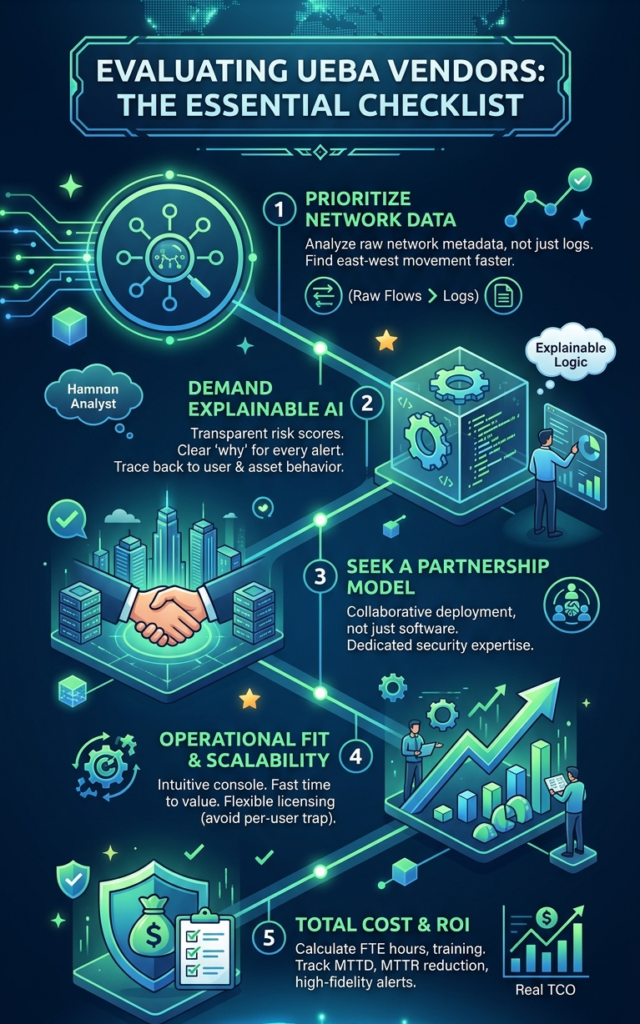
Choosing a UEBA vendor is tough. The brochures all sound the same, promising to stop every threat with AI magic. You’re left wondering which features actually matter for your team. The answer isn’t in a flashy demo; it’s in the gritty, practical details of how a solution works on your network.
This checklist, born from our own frustrating evaluations, strips away the hype. It focuses on what delivers real security value, starting with the foundational layer you can’t ignore: your Network Threat Detection capabilities. Keep reading to build your own evaluating ueba vendor solutions features. .
Inside the Toolkit: Quick Wins for Your Evaluation
Before diving into the full checklist, keep these high-impact priorities top of mind to immediately separate the contenders from the pretenders:
- Prioritize solutions that analyze raw network metadata over just log files for earlier, more reliable threat detection.
- Demand transparent, explainable AI where you can trace an alert back to the specific user and asset behavior that triggered it.
- Favor vendors who treat deployment as a collaborative partnership, not a one-time software drop.
What Core Detection Capabilities Should You Demand?
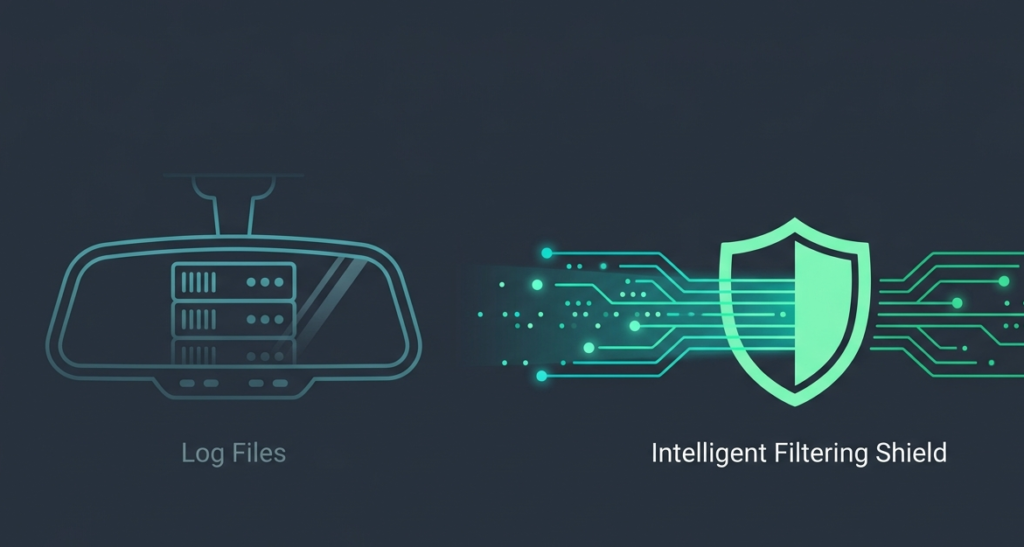
Look past the buzzwords. A tool’s core job is spotting malicious behavior others miss. Evaluating modern user and entity behavior analytics (UEBA) requires looking at the right data, in the right way. Many vendors lean heavily on log sources, firewall, VPN, Active Directory. That’s useful, but it’s a rear-view mirror.
We found that analyzing raw network flow and metadata provides a more immediate, unfiltered view of east-west traffic. It sees the lateral movement, the anomalous data transfers, the suspicious internal connections that never hit a log. A solution built with this as a primary data source, not an afterthought, gets you closer to real-time.
The detection logic needs to be robust. It should profile every user and asset, learning their normal patterns of access, timing, and data volume.
- Peer group analysis to flag outliers
- Sequential pattern spotting for multi-stage attacks
- Risk-scoring that accumulates across low-severity events
Without these, you’re just getting fancy threshold alerts.
How Does the AI Actually Work, and Can You Trust It?
“Machine learning” has become a security sales mantra. The crucial question isn’t if they use AI, but how. You need explainability.
When an alert fires, can your analyst see the “why”? Can they trace the risk score back to the specific deviation, a user accessing a server they never touch, at 3 a.m., from a new country, pulling gigabytes of data? If the system is a black box, your team will distrust it and alerts will go stale.
“Detecting interesting results with minimal noise is the goal of UEBA. Understand and evaluate what a risk engine does under the hood… [E]xplainability is key, cases must come with plenty of context on why a particular case has a particular risk score. A high-scoring case presented without tangible explanation is a hard sell for an analyst to act on.” – Teramind
We learned to ask for the model’s menu. A good vendor will detail the behavioral models they run. Do they have specific models for insider threat, compromised account, data exfiltration? The best ones combine unsupervised learning (finding unknown unknowns) with supervised, rule-based models for known TTPs.
This hybrid approach catches both the novel attack and the routine malware beacon. Ask how often models retrain and on what data. A static model decays in value as your network evolves.
Is the Deployment and Management Realistic for Your Team?
Consider the operational lift. Mapping out early UEBA deployment considerations and tuning challenges ensures a brilliant tool doesn’t become an 18-month tuning liability. Vendors often quote “rapid deployment,” but we prioritize solutions that emphasize a collaborative partnership model to lower the daily upkeep burden.
They should provide a dedicated security engineer, not just a platform admin, during rollout. This person helps translate your unique environment into the tool’s logic, ensuring the baselines are accurate from day one.
The management console must be intuitive. Analysts are already overloaded. If investigating a UEBA alert requires jumping between five screens and writing custom queries, it won’t get used. Look for a unified timeline that stitches user, asset, and network activity into a single narrative. The table below contrasts critical operational factors.
| Evaluation Factor | What to Look For | Red Flag |
| Time to Value | Clear 30/60/90 day plan with defined milestones. | Vague promises of “quick setup.” |
| Analyst Workflow | Alert investigation flows in one pane, with built-in context. | Requires constant manual correlation with other tools. |
| Tuning Requirements | Initial baseline is auto-configured; tuning is for fine-tuning. | Requires months of manual policy writing to be effective. |
| Support Model | Includes a security-focused customer success manager. | Tickets go to a general technical support queue. |
Can It Grow and Adapt With Your Organization?
Your security needs won’t stay static. The tool must scale in two ways: technically and functionally. Technically, it must handle your data volume without performance lag. Ask about data retention.
Can you keep a year’s worth of behavioral profiles for forensic hunting? Functionally, the platform should allow you to expand use cases. Maybe you start with threat detection, but later want to apply the models to your SaaS application logs or cloud IAM data.
A vendor’s roadmap is telling. Are they actively integrating new data sources? Do they release new behavioral models based on emerging attacker techniques? A stagnant product is a shrinking asset.
The architecture should be open, with well-documented APIs. Effectively integrating UEBA data with SIEM and NDR platforms lets you pull rich risk context forward and push triggers seamlessly for deeper analysis. It becomes a brain for your security ecosystem, not a silo.
What Does Total Cost of Ownership Really Look Like?
Credits: CyberSec Academy
The sticker price is just the start. The real cost is in people, time, and missed opportunities. Licensing models vary: per user, per asset, by data volume. Per-user pricing can become punitive as your organization grows.
Data volume pricing needs caps or predictable tiers to avoid surprise bills. We advocate for transparent, all-inclusive pricing where possible. It simplifies budgeting.
Calculate the hidden costs.
- How many FTE hours are needed for daily management?
- Will you need to hire specialized staff?
- What’s the cost of training and certification?
- Does integration require professional services?
A slightly more expensive tool that works out-of-the-box and needs less care can have a far lower TCO than a “budget” option that demands constant feeding.
How Do You Measure Its Success and ROI?
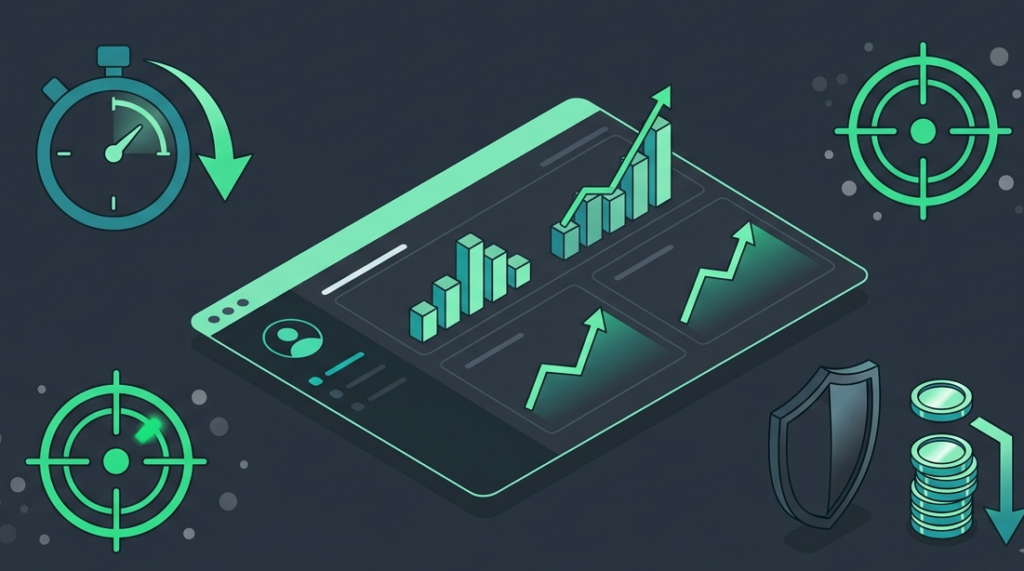
Proving value is paramount. Define success metrics before you sign. These shouldn’t just be vendor KPIs like “alerts generated.” Tie them to business outcomes.
Good starting points include: reduction in mean time to detect (MTTD) and mean time to respond (MTTR) for insider incidents, the percentage of high-fidelity alerts (low false positives), and an increase in automated response actions. Track how often the UEBA provides the critical context that closes an investigation.
“UEBA criteria is a multidimensional construct comprising six factors: 1) general capabilities; 2) use cases; 3) log reports for analysis of user behaviour; 4) profiling models; 5) alert reports; 6) integration with other solutions.” – Wikipedia
Build a quarterly review process with your vendor. They should help you analyze these metrics and show how their tool contributed. A true partner will work with you to adjust tuning and models to improve these numbers over time. The ROI becomes clear when you can quantify a prevented data breach or a significantly faster response to a contained incident.
FAQ
Why start evaluation with network detection?
Network traffic provides a continuous, high-fidelity signal of internal behavior. Logs can be manipulated or delayed, but raw network metadata offers a live, unbiased view of east-west movement, making it the most reliable foundation for detecting post-compromise activity.
Can a UEBA work without a SIEM?
Technically, yes, but it’s not ideal. A UEBA excels at finding subtle anomalies. A SIEM provides the broad event context. Integrating them allows the UEBA to enrich SIEM alerts with behavioral risk scores, creating a much more powerful detection and investigation pipeline.
How long does it take to see real results?
You should see initial alerts within the first two weeks as baselines establish. However, reaching a tuned, high-confidence state typically takes 90 to 120 days of collaborative work between your team and the vendor’s security engineers to refine models for your environment.
What’s the biggest mistake in evaluating vendors?
Getting dazzled by the demo environment. Insist on a proof-of-value (PoV) on a segment of your own production network. The only way to judge accuracy, noise levels, and operational fit is to see the tool work with your data, your users, and your team’s workflow.
Making Your Final UEBA Decision
Choosing a UEBA vendor isn’t about finding the shiniest product. It’s about finding a resilient partner that sees what you miss. You want a tool built on the reality of network traffic, powered by clear AI, and backed by a team invested in your success.
To proactively defend your network, leverage visual attack path simulations, automated risk analysis, and continuous intelligence. See how to eliminate blind spots and strengthen your security posture at Network Threat Detection Features.
References
- https://www.teramind.co/blog/ueba-tools/
- https://en.wikipedia.org/wiki/User_behavior_analytics