

Anomaly detection techniques in NTD is your digital smoke alarm. It doesn’t wait for a known fire, it sniffs out the first hint of smoke. We use it to find the strange, the unusual, the patterns in network traffic that just don’t fit.
This is the frontline against attacks that have no name or signature. It’s all about knowing your network’s heartbeat so well that a single skipped beat gets your attention. The real trick isn’t just finding anomalies, it’s knowing which ones matter. Keep reading to learn the techniques that separate real threats from harmless noise.
Key Takeaways
- Unsupervised methods find threats without a list of what to look for.
- A solid baseline of normal activity is your most important reference point.
- Tuning is the ongoing battle to reduce false alarms without missing real attacks.
Unsupervised Learning Anomaly Detection

This approach is like a security guard who doesn’t have a list of known criminals. Instead, they learn the daily routine of a building. They know who usually comes and goes, and at what times. Anyone or anything that breaks this routine stands out immediately especially in NTD Technologies & Methods work.
The anomalies are the data points that don’t belong to any common group. These are the outliers. In a network, this could be a user downloading a huge file at 3 AM when they usually only check email.
Or it could be a server suddenly communicating with an unknown external IP address. This technique is powerful because it can catch novel attacks, things never seen before. It’s proactive rather than reactive. The system flags what’s unusual and lets a human decide if it’s malicious.
Network Anomaly Detection Methods

There isn’t just one way to find something strange. Think of it like finding a lost dog. We might look for a specific breed, we might listen for a familiar bark, we might just notice a dog that looks scared and out of place.
Network anomaly detection methods are the different tools and strategies we use to spot problems. Some methods are simple, like setting a rule that flags any traffic over a certain size. Others are complex, using machine learning to model intricate behaviors.
This includes statistical profiling, where you model the average traffic flow. It also includes machine learning models like clustering, which groups similar connections together.
Another method is using algorithms like Isolation Forest, which quickly isolates unusual data points. The best security posture uses a combination of these methods, a layered defense that catches different types of threats.
You’ll typically encounter a few core categories of methods.
- Clustering Algorithms: Group similar network flows, with anomalies falling outside all groups.
- Nearest Neighbor Approaches: Flag points that have few or no close neighbors in the data.
- Dimensionality Reduction: Techniques like autoencoders that learn to compress and reconstruct normal data, failing on anomalies.
- Information Theoretic Methods: Look for changes in the complexity or entropy of the network data stream.
Each method has its strengths, and the choice often depends on the specific type of network data you’re analyzing and the kinds of threats you’re most concerned about.
Statistical Anomaly Detection Models
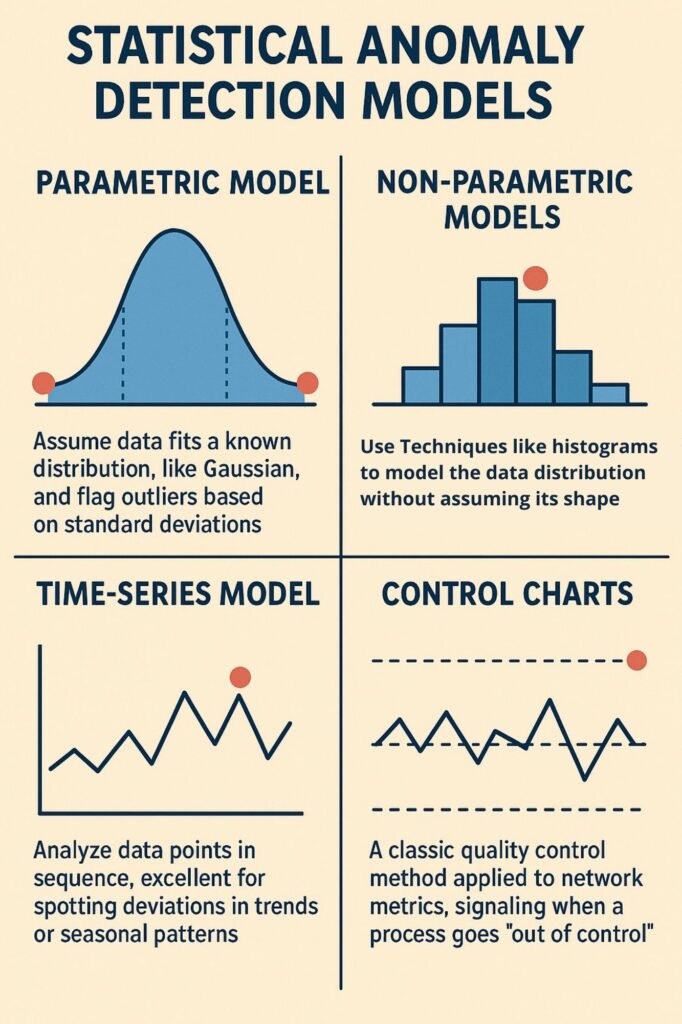
This is one of the oldest and most understandable approaches. Statistical anomaly detection models work by defining “normal” using math. They calculate the average, or mean, of a network metric, like the number of connections per minute from a single IP address.
It’s relatively easy to implement and explain. The downside is that it assumes network data follows a neat bell curve, which it often doesn’t. It also misses slow, gradual attacks that don’t create a sharp statistical spike but slowly change what “normal” looks like over time.
Several statistical models are commonly used in practice.
- Parametric Models: Assume data fits a known distribution, like Gaussian, and flag outliers based on standard deviations.
- Non-Parametric Models: Use techniques like histograms to model the data distribution without assuming its shape.
- Time-Series Models: Analyze data points in sequence, excellent for spotting deviations in trends or seasonal patterns.
- Control Charts: A classic quality control method applied to network metrics, signaling when a process goes “out of control.”
These models form a solid, interpretable foundation for many detection systems, even when more complex methods are layered on top.
Identifying Baseline Network Behavior
We can’t know what’s strange if you don’t first know what’s ordinary. Identifying baseline network behavior is the essential first step in any anomaly detection system. This is the process of learning the unique personality of your network.
It’s not a one-time task, it’s an ongoing process of observation. The baseline includes everything from typical bandwidth usage throughout the day to standard communication patterns between servers and workstations.
Building this baseline involves looking at several key areas.
- Volume Metrics: Bytes, packets, and connections per second, per hour, per day.
- Protocol Distribution: The typical mix of HTTP, DNS, SSH, and other protocols on your network.
- Communication Patterns: Which internal hosts talk to each other, and which talk to the internet.
- Temporal Cycles: The regular rhythms of business hours, weekends, and end-of-month processing.
This process creates a multidimensional picture of health, against which any deviation can be measured.
Challenges with Anomaly Detection Tuning
Getting an anomaly detection system to work well is harder than it sounds. The biggest of the challenges with anomaly detection tuning is the balance between sensitivity and noise.
Set the system to be too sensitive, and it will generate a flood of alerts for every minor fluctuation. This leads to alert fatigue, where security analysts start ignoring alerts because most are false positives. Set it too loosely, and real, subtle attacks will slip through unnoticed.
Tuning is not a “set it and forget it” task. Networks are dynamic. A new application, a company merger, or even a shift to remote work can completely change the baseline behavior.
The system must be constantly recalibrated. This requires deep knowledge of both the network environment and the detection algorithms.
Another challenge is the lack of labeled data, you rarely know for sure what is a true attack and what is just a strange but harmless event. This makes it difficult to objectively measure the system’s accuracy and improve it over time.
Detecting Unknown Network Threats
This is the superpower of anomaly detection. Signature-based systems are like a bouncer with a list of known troublemakers. They’re great at keeping out the people on the list, but useless against someone new.
Detecting unknown network threats is about having a bouncer who is an expert at reading body language. They can spot nervousness, aggression, or unusual behavior, even in someone they’ve never seen before. In cybersecurity, these are called zero-day attacks or novel malware.
Anomaly detection systems excel here because they aren’t looking for a specific pattern. They are looking for any pattern that deviates from the established normal.
Detecting Deviations from Normal Traffic
At its heart, anomaly detection is all about detecting deviations from normal traffic. A deviation is any change in the rhythm, volume, or direction of network packets. It’s the digital equivalent of your dog hiding under the bed for no reason, a subtle sign that something is wrong.
These deviations can be large and obvious, like a massive spike in traffic from a single IP. Or they can be small and sneaky, like a slow trickle of data being sent to a foreign country overnight.
The key is to monitor multiple dimensions of traffic, not just volume. This includes source and destination IPs, ports being used, protocols, packet sizes, and the timing of connections. A normal deviation might be an all-hands video meeting causing a bandwidth spike.
Threshold Based Alerting Limitations
Relying solely on simple thresholds is a common but flawed strategy. Threshold based alerting limitations become apparent quickly in a complex network.
For example, setting a rule to alert if any server uses more than 90% of its bandwidth sounds safe. But what if that server is a backup server that only runs at night and regularly hits 95% bandwidth during its job? (1) That’s a false positive every night.
Thresholds don’t understand context. They can’t tell the difference between a legitimate software update and a malware download, if both exceed the threshold. They are also vulnerable to slow attacks that intentionally stay just below the alerting line.
Unsupervised Learning Network Anomalies
Source: IBM Technology
This phrase brings the concepts together. Unsupervised learning network anomalies are the specific unusual events that unsupervised machine learning models flag. These are the incidents that have no known label, they are simply different.
Imagine a graph where most data points are grouped in a few tight clouds (2). The anomalies are the lonely points scattered far away from any cloud. These could be a server suddenly behaving like a client, a user accessing a system they never have before, or a protocol being used in an unusual way.
FAQs
What is the difference between anomaly detection and signature-based detection?
Signature-based detection looks for threats by matching them to known patterns, similar to checking a “wanted poster.” It works well for attacks that have been seen before, but it cannot detect new or unknown threats.
Anomaly detection learns what normal network behavior looks like and alerts when something unusual happens. This means it can catch new or unexpected threats. Using both methods together provides stronger security.
How long does it take to establish a reliable baseline?
A reliable baseline usually takes 30 to 90 days to develop. During this time, the system watches the network and learns normal routines such as weekly work cycles, end-of-month activity spikes, and seasonal changes. Smaller networks with simple patterns may reach a baseline sooner, while large and complex networks often need more time.
Can anomaly detection systems learn and adapt automatically?
Modern anomaly detection systems can update themselves using machine learning. They adjust as the network changes. However, full automation is not always safe. If an attacker changes behavior slowly over time, the system might start thinking the attack is normal. Because of this, it is still important for humans to review and supervise the system.
What types of attacks are hardest for anomaly detection to catch?
Slow and quiet attacks are the hardest to detect because they blend into normal traffic and do not create sudden changes. Insider threats are also difficult because the attacker already has access and may behave in ways that look normal to the system.
How do you reduce false positives without missing real threats?
Reducing false positives requires reviewing alerts and tuning the system over time. Analysts look at which alerts are real and which are harmless, then adjust the rules to improve accuracy. Adding context such as time, user identity, and past behavior helps the system make smarter decisions and reduces unnecessary alerts.
What network data sources are most valuable for anomaly detection?
NetFlow or IPFIX data helps show communication patterns across the network. DNS logs can reveal hidden communication or data theft attempts. Firewall logs show blocked connections and violations of security rules. Authentication logs can uncover account misuse and unusual movement inside the network.
How does machine learning improve anomaly detection accuracy?
Machine learning can find complex patterns that simple rules might miss. It can analyze many data points at once and learn the difference between harmless unusual activity and real threats. This helps reduce false positives and improves detection.
What skills do analysts need to work with anomaly detection systems?
Analysts need solid networking knowledge to understand traffic and normal communication behavior. Basic statistics help them understand risk scores and confidence levels. Knowledge of the company’s systems and business processes is also important so they can judge whether an alert is meaningful.
How do you handle seasonal or cyclical network behavior changes?
Networks may have regular changes throughout the year, such as heavy activity during holidays, different traffic patterns in schools during breaks, or spikes at the end of a month in financial companies. Time-aware baseline models help the system learn these patterns so it does not generate unnecessary alerts.
What metrics indicate your anomaly detection system is working effectively?
A good system will show a higher percentage of alerts that are real problems instead of false alarms. It will also help detect and respond to threats faster. Another sign of success is that the system can handle many different kinds of attacks and that the baseline remains stable without needing constant major changes.
Your Next Steps with Anomaly Detection Techniques in NTD
The goal of these techniques isn’t to build a perfect system that never makes a mistake. That’s impossible. The goal is to build a smart system that amplifies your intuition.
It handles the overwhelming volume of data and highlights the few events that deserve a human’s attention. Don’t just look for what you know is bad, learn what your good looks like, and we’’ll be ready for anything that isn’t.
NetworkThreatDetection gives cybersecurity teams real-time threat modeling, automated risk analysis, and continuously updated intelligence based on proven frameworks like MITRE ATT&CK, STRIDE, and PASTA.
References
- https://medium.com/@adnanmasood/deploying-llms-in-production-lessons-from-the-trenches-a742767be721
- https://www.researchgate.net/publication/239761771_Isolation-Based_Anomaly_Detection