
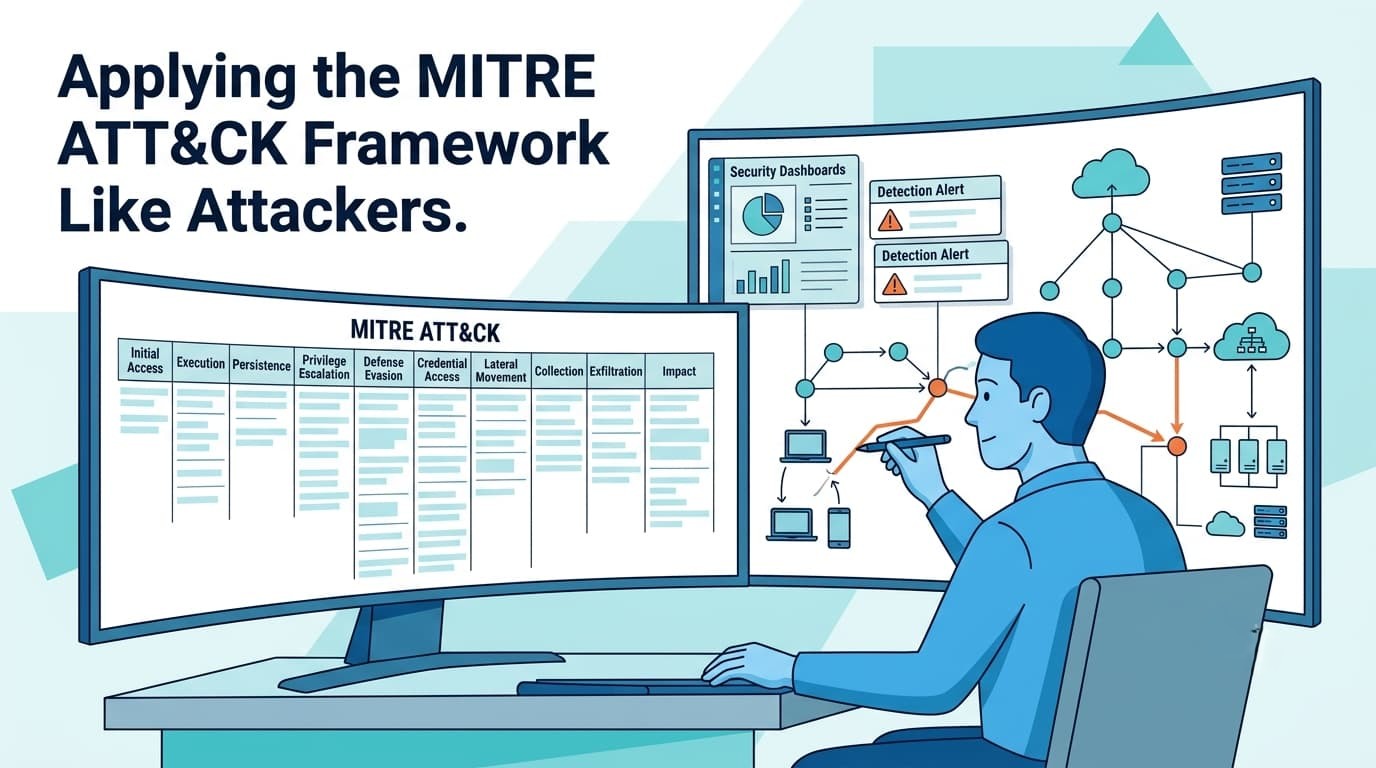
MITRE ATT&CK provides a shared language for cyber defense. It’s a framework that lets you view your network as an attacker would, turning general security concerns into concrete, actionable steps.
This approach helps you move from abstract theory to a practical, threat-informed security stance. Learn how to apply it to build a stronger defense for your network at Network Threat Detection.
ATT&CK in a Nutshell
- ATT&CK shifts security from chasing alerts to understanding adversarial behavior.
- Mapping your tools to the framework exposes critical, often hidden, coverage gaps.
- The real value comes from using ATT&CK actively for hunting, detection engineering, and testing.
Understanding MITRE ATT&CK Matrix Tactics Techniques
Here’s the thing: you need to grasp the basics, or you’re just rearranging icons on a screen. We’re talking about MITRE ATT&CK matrix tactics and techniques before moving into more advanced defensive work.
A tactic is what an adversary wants to do in the short term, think ‘Initial Access’ or ‘Persistence.’ A technique is how they do it, like using phishing or valid accounts.
According to MITRE ATT&CK: Design and Philosophy
“ATT&CK provides a common taxonomy for both offense and defense and has become a useful conceptual tool across many cyber security disciplines to convey threat intelligence, perform testing through red teaming or adversary emulation, and improve network and system defenses against intrusions.” – MITRE ATT&CK: Design and Philosophy
This framework’s real strength is its detail. Look at a broad technique like “Command and Scripting Interpreter.” ATT&CK splits it into sub-techniques: PowerShell, Windows Command Shell, and others. In our work building threat models, we’ve seen why this matters.
You can’t just hunt for “malicious activity.” But you can build a solid detection rule for something specific, like “PowerShell launched by a Word document to call out to the internet.”
The public matrix catalogs hundreds of these methods, drawn from actual attacks. Our job isn’t to memorize them all. It’s to figure out which ones are actually relevant for defending your specific network.
Mapping Security Controls ATT&CK Framework
You’ve got your security stack: EDR, SIEM, firewalls. The real question is, what are they actually doing for you? In our experience, few teams can answer that concretely. Mapping security controls across the ATT&CK framework forces you to ask, “Which specific adversary techniques can we handle?”
It’s a sobering exercise. You line up your tools against the ATT&CK matrix. That EDR might catch process injection, but can it spot a malicious scheduled task? Your SIEM analytics may look for strange logins, but do they correlate anomalous account use across different systems? We do this control-by-control with our clients:
- Prevention: Can we stop it? (e.g., blocking unauthorized software)
- Detection: Can we alert on it? (e.g., a rule for odd service installs)
- Visibility: Do we even collect the right logs to see it later?
The result is a defensive heatmap. You’ll see bright spots and blind spots. Perfection isn’t the goal, it’s knowing your gaps.
That missing detection for credential dumping might become your top priority, especially if ransomware groups targeting your sector use it constantly. This turns a technical hole into a clear business risk.
Using ATT&CK Threat Modeling Process
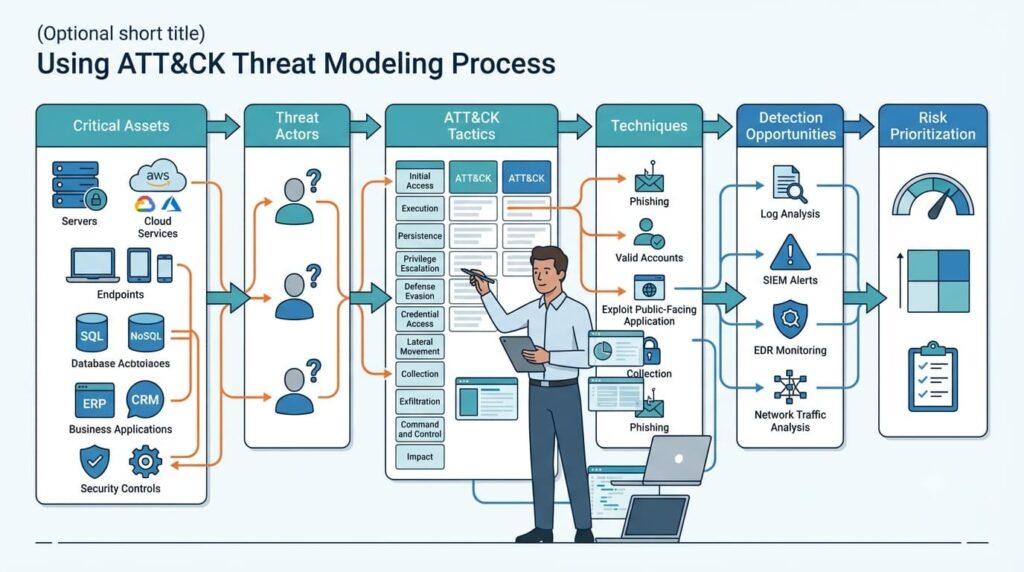
Many threat models are too abstract, just diagrams and theory. We use ATT&CK threat modeling to tie them to reality. You start by identifying your critical assets, your main databases, admin portals, and development systems. The next question is straightforward: who would want to attack these?
Look at threat intelligence for groups that target your sector. When I threat-model for our financial sector clients, we don’t guess at hypothetical scenarios. We look at active adversaries like FIN6 or Lazarus.
In our last tabletop exercise with a mid-sized banking client, we loaded FIN6’s profile into the ATT&CK Navigator.
Because FIN6 heavily relies on Spearphishing Attachment (T1566.001) for entry and PowerShell (T1059.001) for lateral movement, we bypassed general defense talk and focused our engineering budget directly on securing their internal administrative segments against WinRM and PowerShell remoting.
Lazarus tends to exploit software flaws. You create an ATT&CK Navigator layer for each group, highlighting their preferred methods.
Then, you overlay those layers. Look for overlaps. Several groups rely on PowerShell or living-off-the-land binaries, that’s a high-priority area for your defenses. Your threat model stops being a generic chart.
It becomes a specific, ranked list of behaviors you need to counter, directly linked to the adversaries most likely to come after you. This tells you exactly where to invest your limited resources.
How Does MITRE ATT&CK Help Generate Threat Hunting Hypotheses?
Threat hunting without a plan is just wandering through logs, it’s slow and often pointless. We use ATT&CK threat hunting hypothesis generation to build a focused hypothesis. Every technique in the framework poses a direct question about your network.
Consider “Remote Services.” An attacker might use RDP to move laterally. A solid hypothesis is specific: “An adversary is using RDP connections late at night to jump between our engineering workstations.”
In our experience, a generic alert for ‘unusual login’ produces endless false positives. By focusing the hunt on Remote Services: Remote Desktop Protocol (T1021.001), we narrow our telemetry scope to Windows Security Event ID 4624 (Successful Logon) where Logon Type is 10 (RDP).
In our hunt queries, we specifically filter out known corporate VPN subnets and regular business hours. What remains is a highly clean dataset showing external IP addresses initiating RDP sessions in the middle of the night, giving our analysts a warm lead to investigate immediately.
Here’s the process we follow with our tools:
- Start with a technique that’s likely in your environment.
- State the exact adversarial behavior you assume is happening.
- Pinpoint the specific logs or telemetry you’ll need.
- Build a search to find deviations from normal patterns.
You’re not chasing a known malicious file. You’re hunting for a known-bad pattern. Teams using this method report finding real threats more quickly. They move from guessing to focused investigation.
Evaluating Security Tool ATT&CK Coverage
Vendor claims about stopping advanced threats are everywhere. Evaluating security tool ATT&CK coverage provides a practical way to actually measure them. When we evaluate a new security platform, we ask for its ATT&CK coverage matrix. The overall percentage is just a start.
A vendor might advertise 90% coverage. You need to know what that means. Is it for prevention, or just detection? Does it include the specific techniques from your threat model? How does it handle the sub-techniques?
According to USENIX
“Most notably, many techniques are unrealizable as detection rules, and coverage of an ATT&CK technique does not consistently imply coverage of the same real-world threats” – USENIX
You can test it yourself. Use a tool like Atomic Red Team to simulate a technique, such as credential dumping. Does the platform alert? Can it block the action? Does it collect the right forensic data for your team?
This approach changes the buying conversation. It moves from features to concrete outcomes. The question stops being about dashboard design and becomes, “Can this tool see and stop the exact behaviors our adversaries use?” That’s how you choose tools that genuinely improve your security, instead of just adding another expensive screen to your wall.
How Do You Develop ATT&CK-Based Detection Rules?
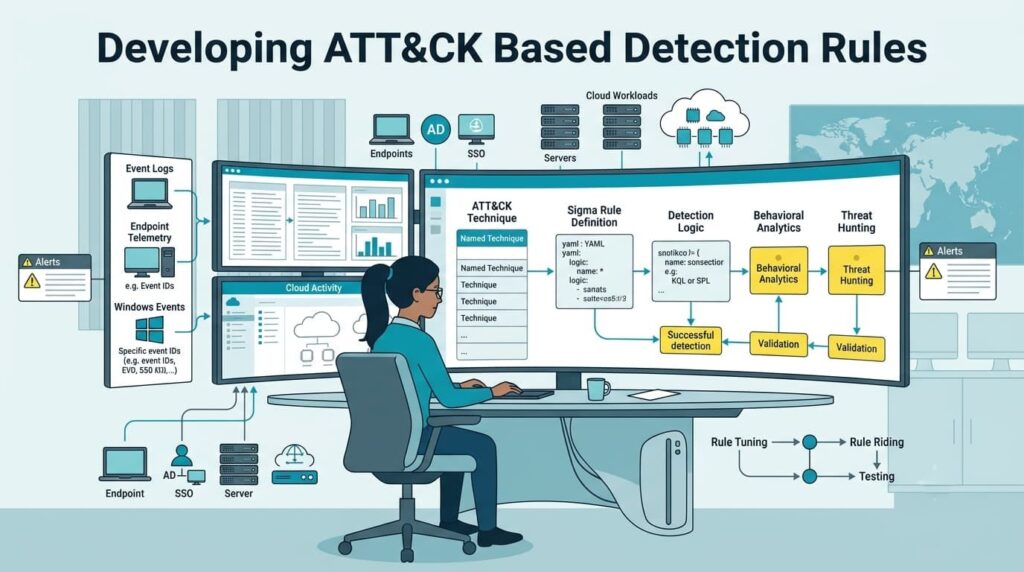
Here’s where theory becomes practice. Developing ATT&CK based detection rules turns your hypothesis into code. Old rules chased specific indicators, a bad file hash or a known malicious IP.
Those are simple for an attacker to change. Rules based on ATT&CK focus on behavior, which is much harder to alter without breaking their entire attack chain.
The process is straightforward but strict. We start by picking a high-priority technique, such as “Scheduled Task.” Next, we identify the exact logs needed, like Windows Event ID 4698. Then, we write the rule. It shouldn’t just flag any scheduled task.
It needs to be specific: “Alert on a scheduled task created by an unusual parent process, like a web browser.”
The final, critical phase is testing. We emulate the attack using a script to create a malicious task. Does the alert trigger? Is it actionable? We tune the rule to reduce false alarms, test it again, and then deploy it. This closes a defined gap. You’re not adding a generic guard; you’re posting a sentry trained to spot someone trying to sneak in a specific, unlikely way.
ATT&CK Navigator Tool Visualization Usage
Looking at endless spreadsheets of ATT&CK techniques is paralyzing. That’s where the ATT&CK Navigator tool comes in. It gives the framework a visual layer you can actually use.
You create separate layers for different aspects of your defense. One layer maps the threats relevant to you. Another shows your current detection coverage. A third outlines prevention capabilities. We load these into the Navigator for our clients.
The combined view becomes a strategic dashboard. Overlap between your threat layer and your detection layer is good. A threat with no corresponding coverage is a glaring red flag.
| Layer Type | What It Shows | Example |
| Threat Profile | Techniques used by likely adversaries | FIN6’s use of PowerShell |
| Detection Coverage | What your tools can currently alert on | EDR rules for T1059.001 |
| Prevention Capabilities | Where you can actively block techniques | App control blocking unauthorized scripts |
This visualization makes your security posture tangible. You can point to it and explain, “We’re weak here, and here’s the business risk.” It becomes a tool for clear communication, not just internal analysis.
MITRE ATT&CK Reconnaissance and Resource Development
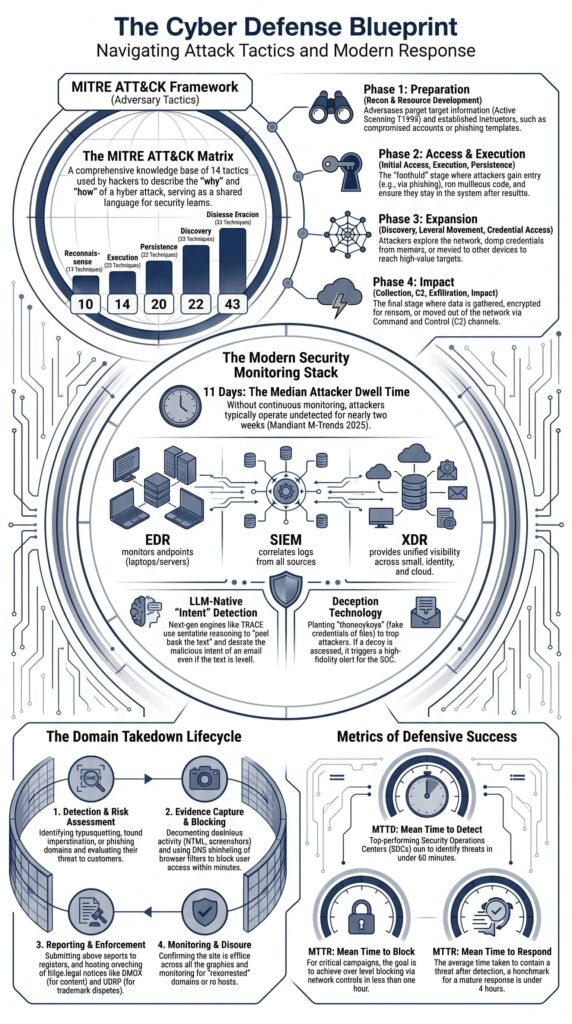
Most security focuses on the moment of breach. The first two tactics of the Enterprise Matrix reflect MITRE PRE-ATT&CK reconnaissance planning, forcing you to look earlier at what happens before the first phishing email is opened or the first flaw is exploited.
This covers steps like gathering employee info or setting up attack infrastructure.
Why does this matter? Spotting these early activities can stop an attack before it even reaches your network. In our work, we look for behaviors mapped to the Reconnaissance tactic, such as Active Scanning (T1595), or Resource Development behaviors like acquiring malicious domains to mimic your company’s brand.
Seeing domains registered to mimic your company’s is preparation. Monitoring for these signs, often using external intelligence feeds, enables a proactive defense. You can then tighten access, alert your staff, or work to take down spoofed sites.
You’re no longer just waiting for an explosion inside your building. You’re watching someone build the bomb in a warehouse across the city.
How Does the MITRE ICS ATT&CK Framework Improve OT Security?
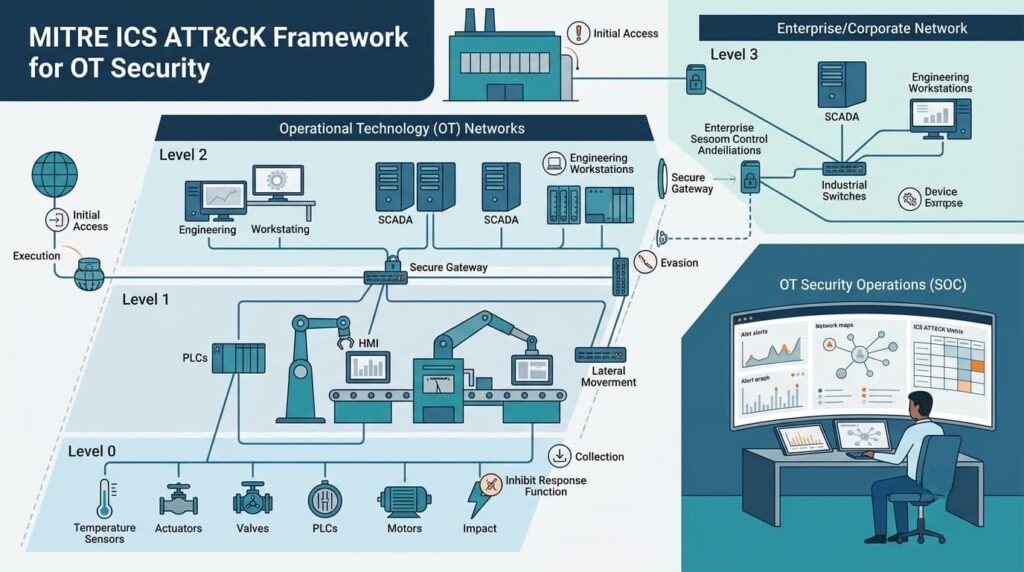
Industrial environments like factory floors and power grids run on operational technology, which is fundamentally different, making the MITRE ICS ATT&CK framework for OT security especially valuable. Attackers target these OT systems specifically. The ICS ATT&CK framework maps behaviors unique to these physical environments.
In our work auditing power generation facilities, I’ve seen that OT defense is a completely different beast. Attackers aren’t looking to exfiltrate databases; they are aiming to modify physical states.
When mapping your defenses to the ICS Matrix, you are looking to block very specific actions, such as an unauthorized system attempting to Modify Parameter (T0836) or Impair Defenses (T0828) by blocking safety-critical alarms.
For example, when we secure engineering workstations, our main goal is to prevent adversaries from silently rewriting Programmable Logic Controller (PLC) code to override physical safety thresholds.
Trying to use the standard Enterprise ATT&CK framework for an OT network doesn’t work, it’s like using a road map to pilot a submarine. You need the right tool. ICS ATT&CK provides it. It helps OT teams evaluate their unique defenses:
- Network segmentation between IT and OT zones
- Security of engineering workstations
- Protections for safety instrumented systems
They can map these controls against techniques used by groups like Xenotime. In our assessments, this framework creates a shared language between IT and OT security staff. It turns a communication barrier into a common plan for a shared problem.
ATT&CK Adversary Emulation Plans
Credits: HackerSploit
All your plans and maps mean nothing if they don’t function under pressure. ATT&CK adversary emulation plans turn adversary emulation into the audit. You pick a realistic attack chain, maybe from a recent report in your industry, and use safe tools to simulate it in your network.
The questions are direct. Does your scheduled task detection alert trigger? Can your EDR actually spot credential dumping? Does the alert reach an analyst quickly enough for them to act? This isn’t a broad penetration test. It’s a targeted check to validate one specific part of your defense.
The results are clear-cut. You don’t just assume a control works; you prove it. Or, you find it fails, and you can patch that hole before a real attacker does. We’ve seen this process transform static security configurations into a system that actually learns and adapts.
FAQs
What is the first step in applying the MITRE ATT&CK Framework?
Start by pinpointing your critical assets, key business processes, and the threats you face. Next, model how an attacker might target them.
Use the MITRE ATT&CK framework to map those specific adversary techniques to the matrix. This helps you map tactics, analyze your security coverage, and prioritize risks effectively.
How does ATT&CK mapping improve threat hunting?
Mapping to ATT&CK shifts a threat hunter’s focus from isolated alerts to how attackers actually behave. Analysts form a hypothesis, then dig into logs, endpoint data, and SIEM events. This method, using EDR analytics and behavioral detection, often catches attacks that signature-based tools miss.
How can I identify detection gaps with the MITRE matrix?
To find detection gaps, compare your current security tools and alerts against the MITRE ATT&CK matrix. This shows where your coverage is weak. Tools like the ATT&CK Navigator help visualize these gaps, making it easier to validate controls and prioritize which techniques to address.
Which ATT&CK matrix should I use for my environment?
No single ATT&CK matrix is right for everyone. The choice depends on what you’re protecting. Use the Enterprise matrix for standard IT networks. For industrial systems, use the ICS version. If your setup involves cloud, identity, or containers, you’ll need to map techniques from those specific areas to build a stronger, threat-informed defense.
How often should I update my ATT&CK mapping?
Keep your ATT&CK mapping current. Update it whenever your infrastructure, security tools, or major threats change, especially after an incident or a big tech upgrade. Regular reviews sharpen your detection, improve incident response, and make your red team and purple team exercises far more effective.
Start Small, Stay Ahead
Trying to cover everything at once can leave you stuck before you even begin. Start with one ATT&CK tactic, build one useful detection, then test what you’ve learned. That’s enough. Small wins build confidence and help your team understand how attackers really work instead of reacting after something goes wrong.
Applying this framework manually across hundreds of systems is a massive undertaking for any lean security team. When we design defenses, we prioritize automation to keep up with shifting adversary behaviors.
If you are looking to operationalize this without drowning in spreadsheets, tools that automate risk analysis and map attack paths in real-time can do the heavy lifting for you. We built our platform at Network Threat Detection to handle exactly this, allowing you to automatically visualize your gaps and prioritize your defensive engineering resources where they are needed most.
References
- https://www.cell.com/heliyon/fulltext/S2405-8440%2821%2900074-8
- https://arxiv.org/html/2506.11325v2
Related Articles
- https://networkthreatdetection.com/understanding-mitre-att&ck-matrix-tactics-techniques/
- https://networkthreatdetection.com/-mapping-security-controls-att&ck-framework/
- https://networkthreatdetection.com/using-att&ck-threat-modeling-process/
- https://networkthreatdetection.com/-att&ck-for-threat-hunting-hypothesis-generation/
- https://networkthreatdetection.com/evaluating-security-tool-att&ck-coverage/
- https://networkthreatdetection.com/developing-att&ck-based-detection-rules/
- https://networkthreatdetection.com/att&ck-navigator-tool-visualization-usage/
- https://networkthreatdetection.com/mitre-pre-att&ck-reconnaissance-planning/
- https://networkthreatdetection.com/mitre-ics-att&ck-framework-ot-security/
- https://networkthreatdetection.com/att&ck-adversary-emulation-plans/