
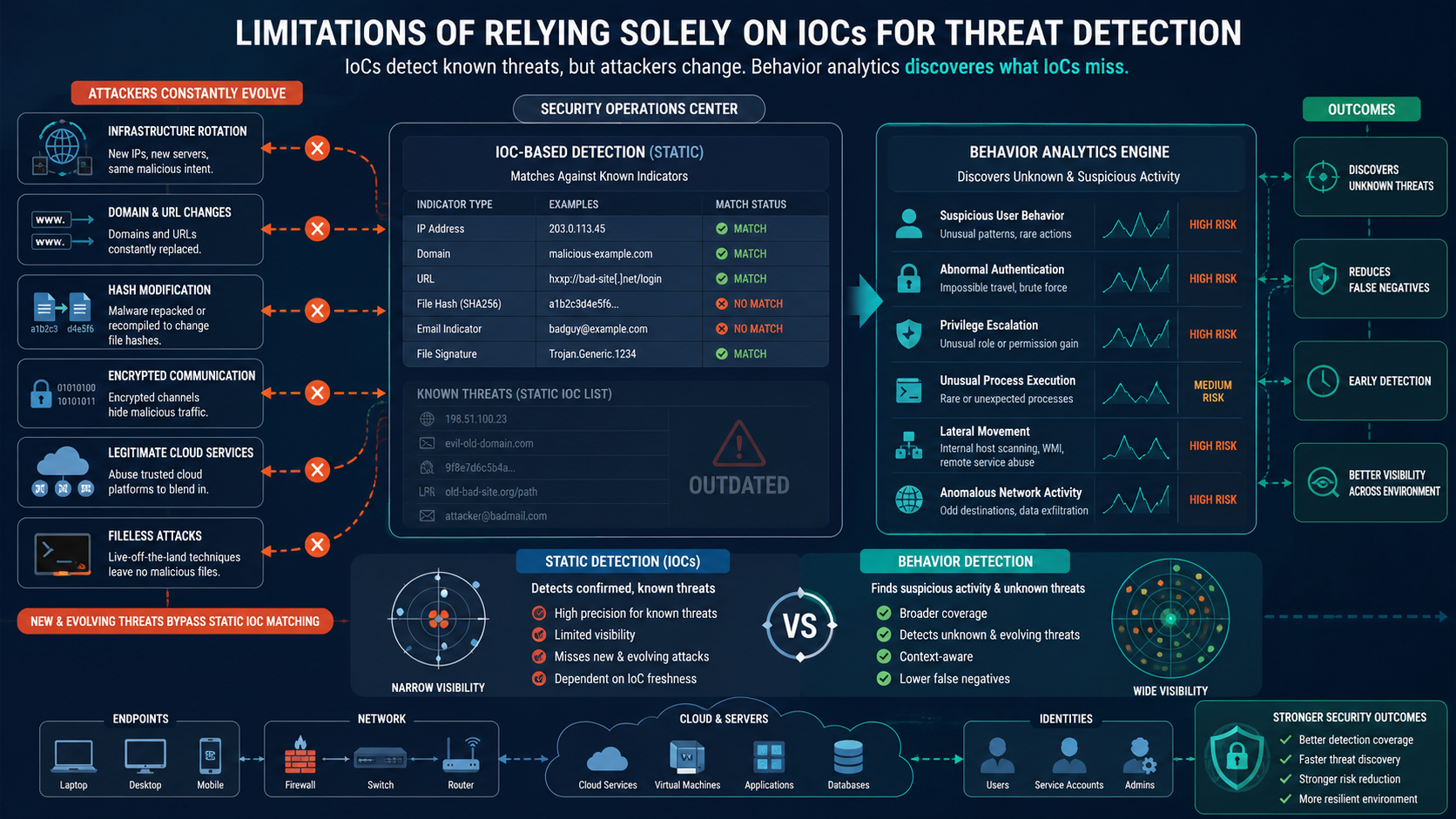
The limitations relying solely IoCs become clear as attackers constantly change infrastructure, tools, and techniques faster than static indicators can keep up.
At Network Threat Detection, we’ve found that Indicators of Compromise remain valuable, but they work best as one layer within a broader detection strategy that includes behavioral analysis and network visibility. Understanding where IoCs fall short helps security teams build stronger, more resilient defenses against modern threats. Keep reading.
Understanding the Limitations of Relying Solely on IoCs
While Indicators of Compromise remain an important part of every security program, they are most effective when combined with broader detection techniques. Here are the main lessons to remember about the limitations relying solely IoCs:
- IoCs identify known threats but cannot reliably detect new or modified attacks.
- Static indicators lose effectiveness as adversaries rotate infrastructure and malware.
- Coverage gaps appear because IoCs only exist after threats have been discovered and shared
What limitations show up when we rely solely on IoCs?
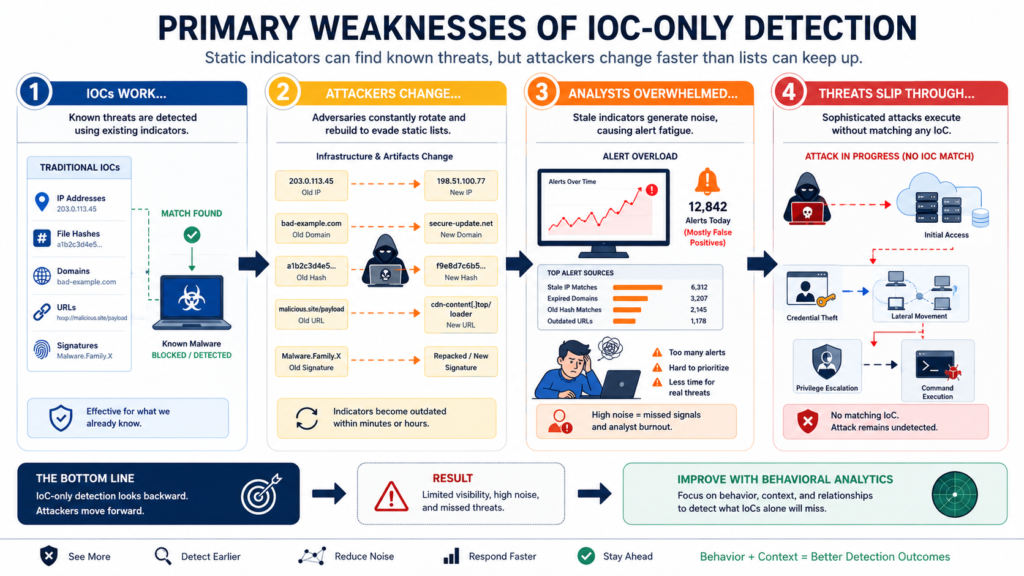
While Indicators of Compromise remain an important part of every security program, they are most effective when combined with broader detection techniques. Here are the main lessons to remember about the limitations relying solely IoCs:
- IoCs identify known threats but cannot reliably detect new or modified attacks.
- Static indicators lose effectiveness as adversaries rotate infrastructure and malware.
- Coverage gaps appear because IoCs only exist after threats have been discovered and shared.
- Behavioral analysis helps uncover suspicious activity that has no published IoCs, making IoCs vs IOAs an important distinction when evaluating whether security teams are tracking known artifacts or identifying attacker behavior before compromise.
- At Network Threat Detection, we strengthen visibility by correlating network behaviors instead of relying only on static indicator lists.
How does indicator staleness affect real investigations?
When IoCs become stale, automation loses both effectiveness and credibility. We’ve seen cases where an IoC file was updated, but detections still fired late, after the suspicious activity window had passed, or fired repeatedly for long-gone infrastructure.
Third-person POV: Indicator staleness creates a detection “time mismatch.” The detection engine triggers, but the incident response window is no longer aligned with actual attacker presence.
We also run into “expiry confusion.” Some indicators don’t expire correctly, or teams treat expiry dates as optional, leading to continued matches for events that are no longer relevant.
Another issue is infrastructure churn. If an attacker reuses patterns but changes a single attribute (like a domain), stale IoCs don’t catch the behavior.
Investigation then becomes manual and reactive: analysts search broadly, instead of relying on detections to guide them, illustrating how reactive threat detection can delay response when indicators are the primary source of detection.
That’s where Network Threat Detection helps us as a first option. It can surface patterns, repeated connection attempts, anomalous destination/service combinations, unusual session behavior, without depending exclusively on indicator freshness.
What about false positives when we depend only on IoCs?
Credits: Ref-n-Write Academic Software
IoC-only approaches can create high false-positive rates because they don’t consider business context. In our environment, the same IP or domain might appear due to legitimate software updates, security scanners, partner integrations, or QA testing.
Third-person POV: An IoC match is a hint, not proof. Without context, the hint can become a noisy verdict.
Research from Palo Alto Networks Unit 42 shows
Typical patterns we’ve encountered:
- Shared hosting & CDNs: IoCs anchored to a provider might catch legitimate users too.
- Overbroad indicators: A domain pattern or IP range match can be too permissive.
- Benign reuse of infrastructure: Some indicators later get repurposed or are misclassified.
- Lack of asset identity: Matching an indicator without linking it to asset criticality or user role reduces the ability to prioritize.
“Incorrect ground truth (GT) data, with mislabeled benign/malicious indicators, harms both training and evaluation of automated systems. False positives increase alert fatigue and waste analyst effort, while false negatives let threats bypass detection. These mistakes degrade the efficacy of threat detection systems and damage trust in automation.” – springer
We’ve found that IoC-only alerts often demand extra triage effort, which slows response for the real incidents.
A subtle but important solution is to use Network Threat Detection first: it helps us attach network behavior context to the match, improving prioritization without hard-selling “block everything.”
How can attackers bypass IoCs so easily?
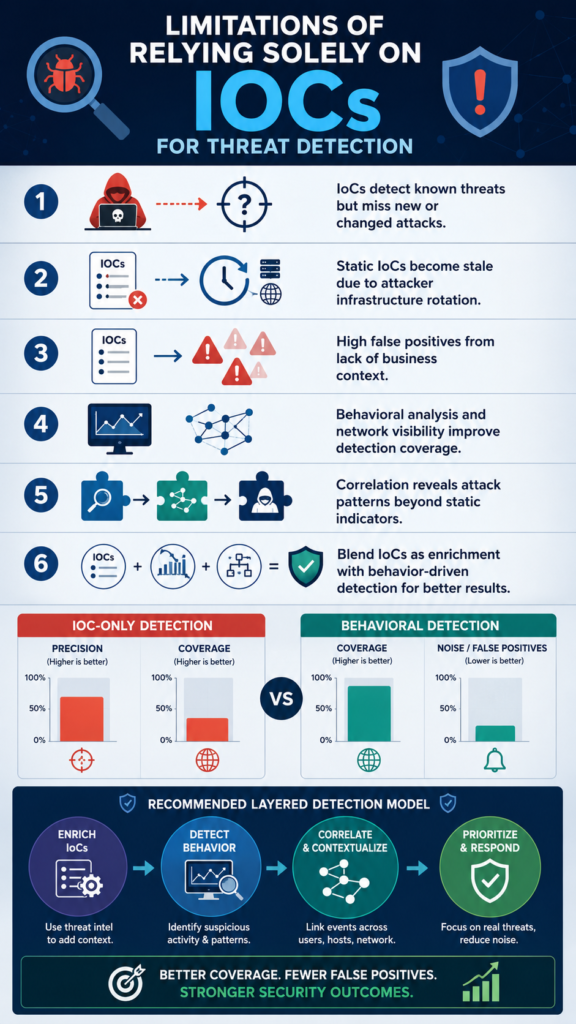
IoC reliance gives adversaries a straightforward playbook: change the artifact, keep the behavior. In our first-hand experience, attackers frequently rotate infrastructure and metadata while preserving tactics like timing, protocol use, and request patterns.
Third-person POV: Indicator-based detection is brittle because it focuses on what changed most quickly.
Common evasion techniques that break IoC scanning:
- Infrastructure rotation: New domains/IPs for every campaign stage.
- Protocol camouflage: Using allowed ports or legitimate-looking TLS flows.
- Encoding/format changes: When IoCs target URL strings or specific paths, small changes can defeat matches.
- Living-off-the-land: Reusing common system tools and remote access patterns reduces unique indicators.
- Staged communications: Breaking the attack into steps so no single IoC-linked event is clearly malicious.
So even with perfect indicator hygiene, IoC-only systems will miss variants.
That’s why we prefer Network Threat Detection as our first option: it’s better at catching suspicious network patterns and correlations that persist even when indicators change.
Why correlation and behavior matter more than static lists?
IoCs answer “Is this known bad?” But analysts often need “What’s happening, and does it fit an attack chain?” Behavior and correlation answer that second question.
“Because maliciousness is context-dependent, identifying IoCs accurately requires understanding context that is not always located near the indicator itself, making it difficult for NLP methods to draw accurate associations.” – linkedin
Third-person POV: Correlation converts individual alerts into evidence of a sequence, destination, protocol, authentication outcome, session timing, and repeated attempts.
What this looks like in practice:
- An IoC hit is one signal, but the real strength comes from seeing:
- repeated connections across multiple ports,
- odd authentication patterns before/after access,
- abnormal DNS-to-connection timing,
- access to sensitive services from unexpected assets.
- Behavioral detection can still flag suspicious activity when indicators are absent, especially when finding IOAs in the MITRE ATT&CK framework helps analysts recognize attacker techniques that do not yet have published indicators.
We’ve seen teams recover from IoC gaps by combining two ideas:
- Indicators as enrichment
- Behavior as the primary decision driver
With Network Threat Detection first, we can treat IoCs as one part of the overall decision model rather than the entire model.
What should we do instead of relying solely on IoCs?
We don’t remove IoCs, we reframe them. In our approach, IoCs are inputs for scoring and enrichment, while the core detection uses network behavior, correlation rules, and risk context.
Here’s the model we use:
- Step 1: Normalize IoCs (type, confidence, expiry, match patterns)
- Step 2: Detect behavior (network events, anomalies, suspicious sequences)
- Step 3: Correlate (IoC hits + behavior patterns + asset context)
- Step 4: Prioritize (risk scoring, environment criticality)
- Step 5: Act with guardrails (alert first, then escalate based on confidence)
Third-person POV: This reduces brittleness while keeping the precision that IoCs provide.
If we choose a primary path, we treat Network Threat Detection as the first option because it aligns with the “behavior-first” mindset and provides consistent network visibility across endpoints and zones.
What’s the tradeoff: precision vs coverage?
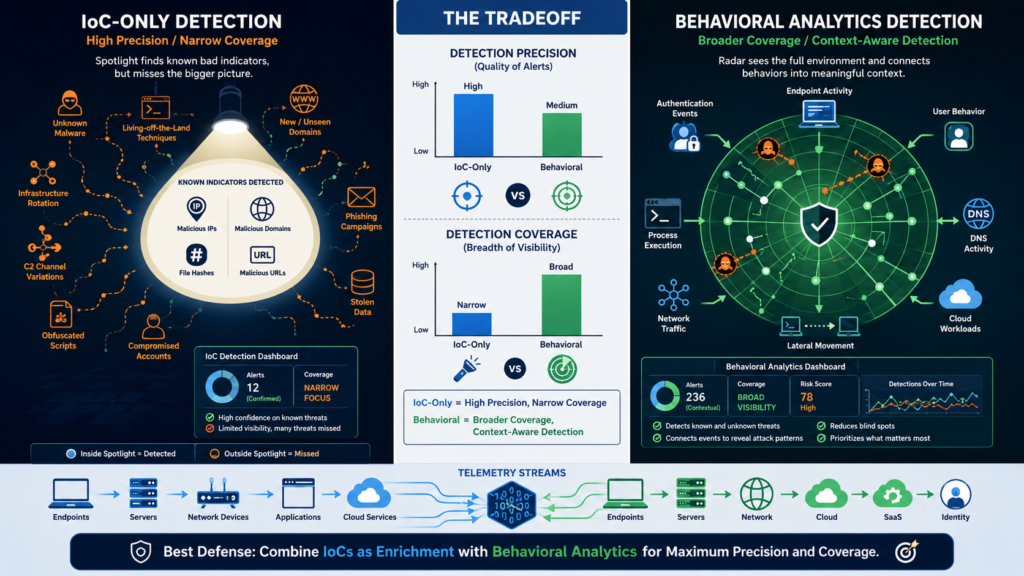
We often discuss a tradeoff that shows up immediately: IoCs can be precise, but they limit coverage. Behavioral detection can increase coverage, but it can also introduce noise if not tuned.
Third-person POV: A balanced program avoids “either/or.” It blends precision from known indicators with coverage from behavior.
A practical way we track it is by mapping detection types to expected outcomes:
| Goal | IoC-only strength | IoC-only weakness | Better combined approach |
| Known bad detection | High precision when indicators are current | Misses variants and rotated infrastructure | IoC enrichment + behavioral correlation |
| Broad threat coverage | Low (only indicators matter) | Fails when IoCs are absent/stale | Network Threat Detection + risk scoring |
| Low analyst fatigue | Sometimes high due to fewer matches | Quickly degrades with noisy/obsolete IoCs | Prioritize with context and confidence tiers |
| Incident investigation | Can provide a “what” | Rarely provides “why/how” chain | Sequence-based evidence building |
In our experience, the best results come when behavior decides suspicion and IoCs decide specificity.
FAQ
Do IoCs still have value if we’re not relying on them alone?
Yes. We use IoCs to enrich detections, boost confidence, and support investigations. They’re just not the sole decision mechanism anymore.
What triggers the need for Network Threat Detection in an IoC-only program?
When alerts start missing incidents due to rotation, staleness, or evasion, or when analyst trust drops because IoC matches don’t correlate with real activity.
How do we avoid noisy behavior-based detections?
We tune based on false positives, add asset context (criticality, role), and use correlation sequences so alerts represent evidence, not single anomalies.
Can we automate this without risking disruption?
We typically start with alert-only outputs, then escalate using confidence tiers and playbook approvals. Guardrails matter more when actions move beyond detection.
CBeyond IoCs: Building Stronger Threat Detection
Relying solely on IoCs limits coverage, breaks under indicator rotation, and often struggles with context, leading to missed variants, stale matches, and false positives that erode trust. In our approach, we keep IoCs as enrichment inputs, but we make network behavior and correlation the primary signals.
If you’re looking to strengthen detection with real-time threat modeling, automated risk analysis, visual attack path simulations, and continuously updated intelligence, join Network Threat Detection.
References
- https://link.springer.com/article/10.1007/s10207-025-01006-2
- https://www.linkedin.com/posts/zhauniarovich_stopransomware-stopransomware-activity-7359153843298811905-Etl6