
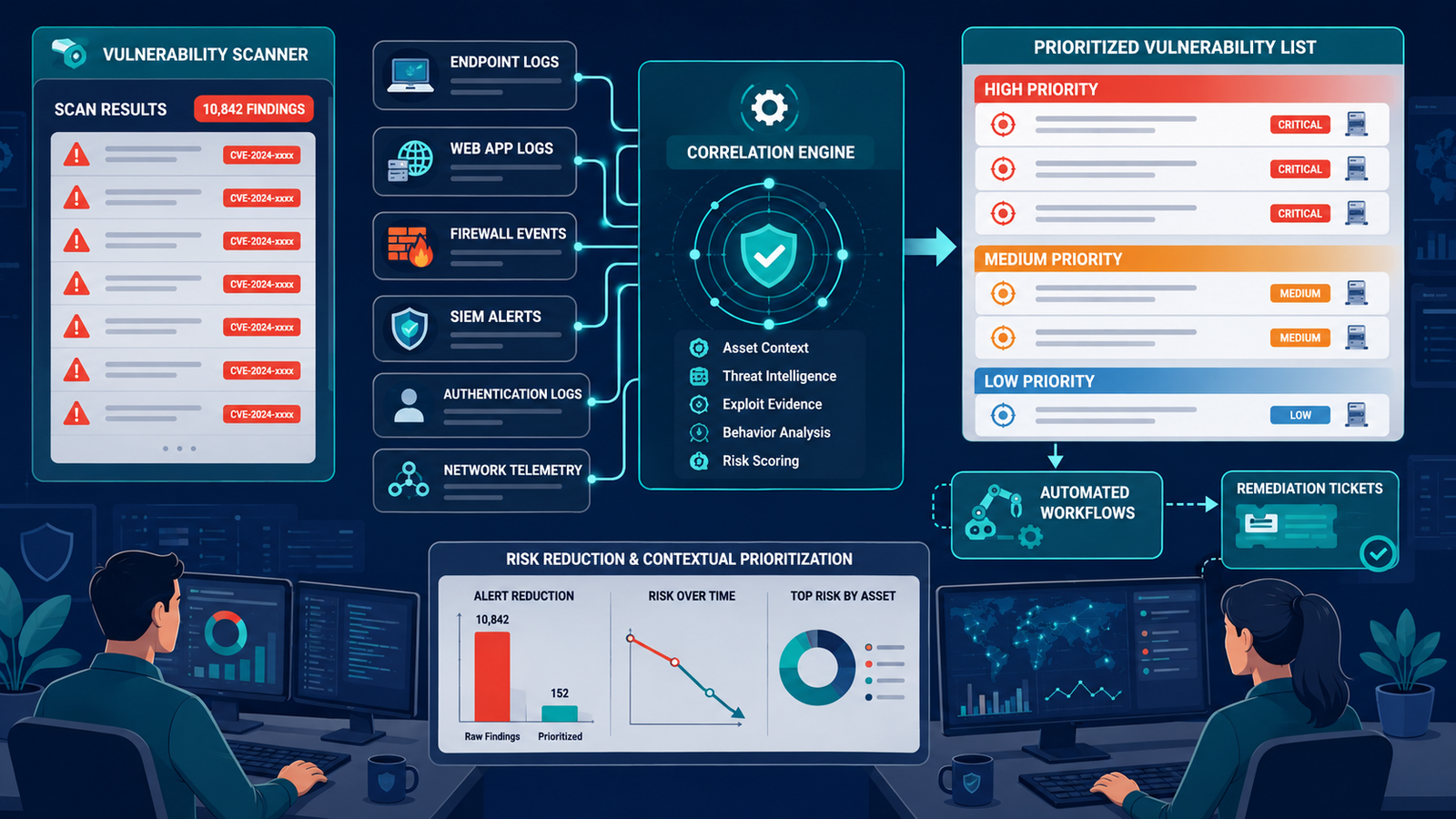
Vulnerability scanners identify thousands of potential weaknesses, but they rarely explain which ones deserve immediate attention. Correlating vulnerability scan data logs with security telemetry adds the context needed to separate routine findings from active threats.
At Network Threat Detection, we combine vulnerability intelligence with network evidence to help security teams focus on the risks that truly matter instead of chasing every alert. This approach improves prioritization, speeds remediation, and strengthens security operations. Keep reading.
Turn Vulnerability Data into Actionable Intelligence
Instead of treating every vulnerability equally, correlation reveals where attackers are actively probing or exploiting your environment. Here are the core ideas you’ll learn:
- Correlating vulnerability scan data logs transforms vulnerability findings into actionable security intelligence.
- Combining scan results with network and system logs helps identify vulnerabilities under active attack.
- Context-driven prioritization enables faster remediation while reducing unnecessary patching efforts.
Why Is Raw Vulnerability Data Misleading?
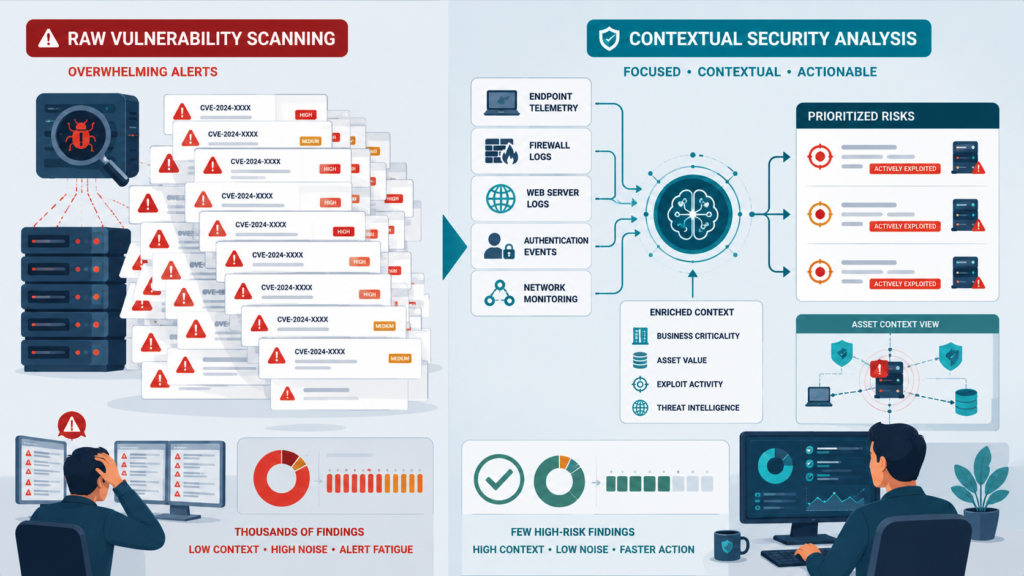
A scanner lives in a vacuum. It pokes at an asset, checks a database, and reports a flaw. It has no context. That critical vulnerability on Server A? It might be on an isolated test box that has no sensitive data and no network path to anything important.
That medium flaw on Server B? It might be on your public-facing web server that’s already showing signs of exploit attempts in the logs. The scanner can’t tell the difference. It assigns a CVSS score, a generic number based on theoretical exploitability, not your actual environment.
“NVD and CNA scores disagree in 34.1% of dual-assessed CVEs.” – Sciencedirect
This lack of context creates two dangerous outcomes. First, alert fatigue. Teams are buried under thousands of findings, so they either work on autopilot, prioritizing only the highest CVSS scores, or they become paralyzed, unable to act.
Second, and worse, it creates critical blind spots. You spend cycles patching theoretical high-risk systems while actual attackers are actively probing lower-scored vulnerabilities on more valuable targets. You’re securing the fortress walls while they’ve found a crack in the garden gate.
- It promotes patching based on theory, not actual threat.
- It overwhelms teams, leading to missed critical fixes.
- It ignores the live threat context of your unique network.
The raw data is necessary, but it’s not sufficient. It’s the “what.” You desperately need the “so what.”
What Log Sources Should You Correlate With Scans?
Think of your vulnerability scan as a map of all the cracks in your building. Correlation is the process of overlaying that map with security camera footage (your logs) to see which cracks someone is actually trying to squeeze through. The first and most powerful layer is your endpoint logs.
Windows Event Logs, Sysmon, or EDR telemetry can show you exploitation attempts, failed logins, suspicious process creation, or payload execution, that tie directly back to a known vulnerability on that host. This changes a finding from “CVE-2023-12345 present” to “CVE-2023-12345 present AND we see exploit patterns in the logs.”
Next, look to your web and application logs. If your scan found a SQL injection flaw in a web app, your WAF or application server logs are gold. Are there inbound requests containing classic SQL injection strings? Correlation here doesn’t just confirm risk; it confirms active targeting. This tells you to drop everything and fix that app, right now.
But to see the whole attack chain, you need a broader network view. This is where feeding your vulnerability context into Network Threat Detection creates a seismic shift in understanding, especially when it’s aligned with consistent asset management.
We configured our systems to tag any network traffic originating from or destined for an IP with a known critical vulnerability. Suddenly, routine scanning traffic from an external IP wasn’t just “probe.” It was “probe targeting our Citrix server with CVE-2023-3519.” Internal lateral movement attempts weren’t just “anomalous.”
How Does Correlation Change Your Patching Strategy?
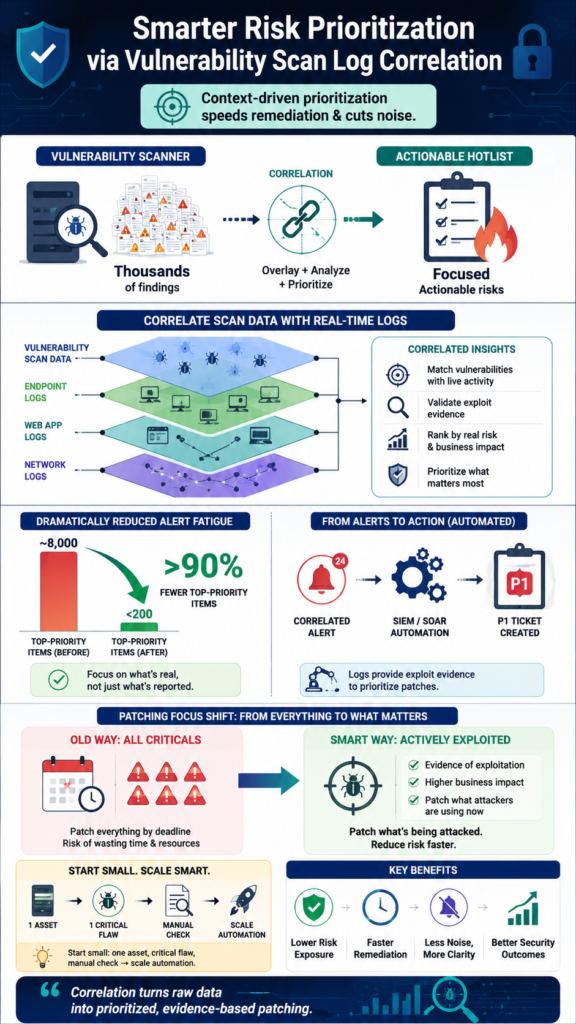
It transforms it from a theoretical exercise into a tactical mission. Instead of a massive, sorted list, you get a short, hot list. Your patching cadence is no longer driven solely by vendor severity or compliance calendars. It’s driven by evidence of in-the-wild exploitation inside your own network.
You move from a “patch all criticals by Friday” mindset to a “patch the five vulnerabilities we are actively being hunted for today” mindset.
“Five large organizations reduced top-priority items by over 90% (from ~8,000 to <200) without compromising security outcomes.” – Zenodo
This evidence-based prioritization also makes it easier to gain support from operations teams. Rather than relying only on vendor severity ratings, security teams can demonstrate actual exploit attempts targeting a specific vulnerability on a specific asset, making the need for remediation much more compelling.
To operationalize this strategy:
- Prioritize vulnerabilities that show evidence of active exploitation.
- Use SIEM or SOAR automation to correlate vulnerability data with attack activity.
- Automatically escalate high-risk cases, such as when a vulnerable asset is also experiencing exploit attempts.
By combining vulnerability intelligence with real attack telemetry, organizations reduce investigation time, improve remediation priorities, and respond more quickly to the threats that matter most.
What Does a Basic Correlation Workflow Look Like?
Credits:Leo OnTech
Start small. Don’t try to correlate every CVE with every log source on day one. You’ll drown. Pick one high-value asset type, like your public-facing web servers, and one critical vulnerability class, such as remote code execution flaws Automating asset discovery.
Export your scan results for those servers, focusing on those CVEs. Then, query your web server logs and WAF logs for the past 7 days for known exploit patterns related to those specific CVE IDs.
You’re looking for a match. Does the IP with the vulnerability have logs showing someone trying to exploit it? Use a simple table to track your manual investigation. This hands-on process, though slow, teaches you what data you have, where it lives, and what a true positive looks like.
| Asset | Critical Vulnerability (CVE) | Relevant Log Source | Evidence of Exploit Attempt? | Action |
| WEB-PROD-01 | CVE-2021-44228 (Log4Shell) | Application Logs | YES – JNDI lookup strings observed | IMMEDIATE PATCH |
| DB-INTERNAL-05 | CVE-2022-22965 (Spring4Shell) | Network Traffic Logs | No | Schedule within next patch cycle |
| FILE-DEV-12 | CVE-2021-34527 (PrintNightmare) | Windows Event Logs | YES – Spooler service errors & remote calls | Isolate & Patch |
This manual correlation is the proof of concept. It proves the value. Once you have a few wins, you scale with automation. The goal is to build a pipeline: new vulnerability scan results are automatically ingested, and a job runs to check key log sources for related exploit activity over the last 24-48 hours.
Findings with correlated evidence are tagged and prioritized automatically in your ticketing system.
What Are the Biggest Challenges and How Do You Overcome Them?
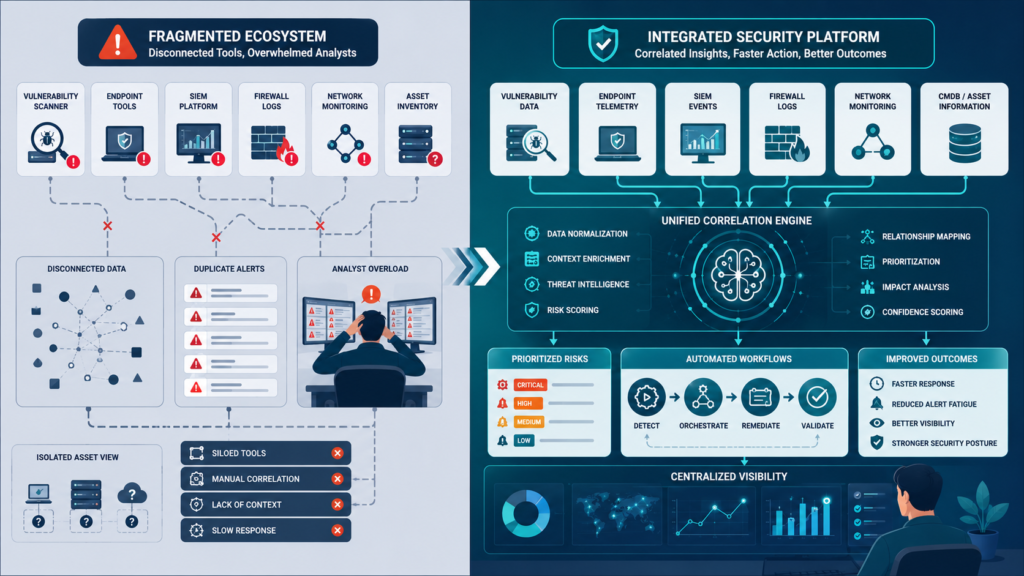
Integrating vulnerability and security data comes with several practical challenges. One of the biggest is ensuring that different tools identify the same asset consistently. Vulnerability scanners, log sources, and cloud platforms may all use different identifiers, making a CMDB or configuration management system valuable for linking them together.
Other key challenges include:
- Data alignment: Use a common asset identifier, such as information from a CMDB, to correlate data across tools.
- Log retention and performance: Ensure your SIEM or security data lake stores enough historical data and can search it efficiently.
- Analyst skills: Train security analysts to work with SIEM queries or SQL so they can investigate and correlate data effectively.
Addressing these challenges creates a stronger foundation for accurate threat detection and faster incident response. With reliable asset mapping, accessible log data, and skilled analysts, organizations can turn large volumes of security data into meaningful, actionable insights.
FAQ
We don’t have a SIEM or big data lake. Can we still do this?
Yes, start manually and small. Use exports from your vulnerability scanner and the built-in search tools in your log sources (like Windows Event Viewer or cloud logging consoles). Focus on your crown jewel assets. The process will be slow, but it will prove the value and help you build a case for the tools needed to scale.
Doesn’t this just tell us what’s already being attacked? Isn’t that too late
It’s about stopping the breach, not just the initial exploit. Many vulnerabilities are used in multi-stage attacks. Correlation can reveal the initial compromise vector *after* you detect later-stage activity (like lateral movement).
This lets you root out the initial point of entry and prevent re-infection. It’s also a powerful early warning; probing for a vulnerability often happens before a full exploit.
How do we handle vulnerabilities with no known exploit patterns yet?
You can’t correlate what you can’t detect. For these, you fall back on traditional risk scoring based on asset criticality and CVSS. However, you can monitor for generic suspicious activity (unusual outbound connections, new service installs) on hosts with these new vulnerabilities, as they may be the first targets for a novel exploit.
This seems like a lot of work. Is the ROI really there?
The return is measured in reduced risk and efficient use of time. Instead of your team spending 80% of their week triaging and prioritizing scan data, they spend 20% reviewing a pre-correlated hotlist. The rest of their time is freed for proactive work. The ROI is a more secure environment and a team that isn’t burned out on alert fatigue.
From Vulnerability Lists to Actionable Intelligence
Correlating vulnerability scan data with logs isn’t a niche advanced technique. It’s the bare minimum for modern threat-informed vulnerability management. It stops you from working on theoretical problems and starts you working on real ones. It changes the narrative with your operations teams from “you must patch” to “we are under attack here, and here is the proof.”
See how our platform strengthens threat-informed vulnerability management by joining a personalized demo: Join Network Threat Detection
References
- https://www.sciencedirect.com/science/article/abs/pii/S0167404826001549
- https://zenodo-rdm.web.cern.ch/records/17710860