
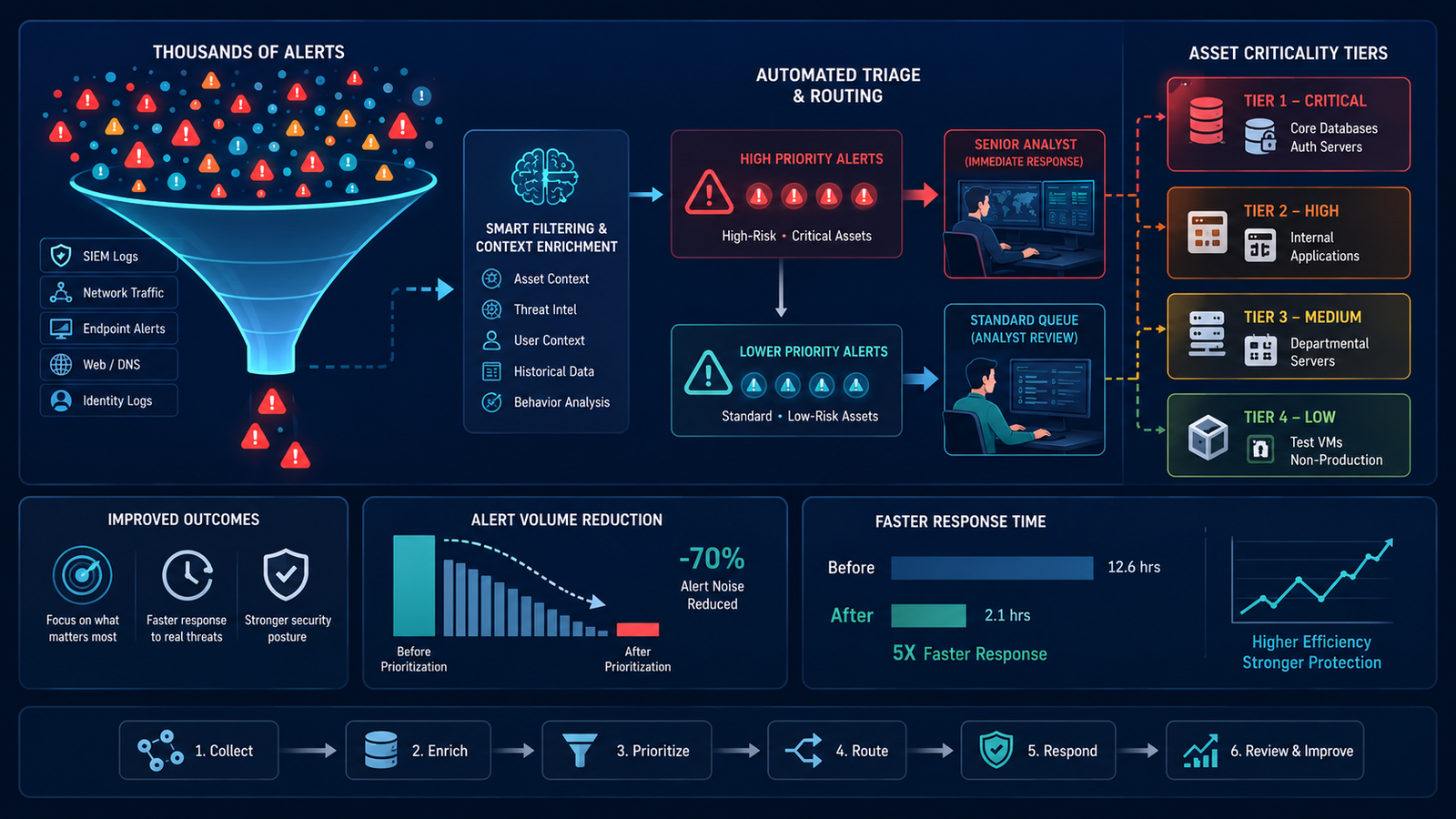
Security teams face thousands of alerts every day, but not every alert deserves the same level of attention. Prioritizing alerts based asset criticality helps analysts focus on the systems that matter most, reducing alert fatigue while improving response times.
Combined with an effective Network Threat Detection strategy, this approach ensures critical threats are investigated first, allowing organizations to protect their most valuable assets without overwhelming their security operations. Keep reading to discover how this strategy transforms modern SOC performance.
Prioritizing Alerts Based on Asset Criticality
Prioritizing alerts based on asset criticality helps security teams focus on the most important threats instead of getting overwhelmed by endless notifications. Here are the key points to remember:
- Focus on What Matters Most: Identify and rank critical business assets to reduce unnecessary alert noise and improve visibility.
- Respond Smarter, Not Harder: Apply a tiered alert response strategy to investigate high-risk incidents first and minimize analyst fatigue.
- Keep Priorities Current: Regularly review asset criticality to ensure your alert prioritization aligns with changing business needs and evolving cyber risks.
Why Does Alert Overload Cripple Security Teams?
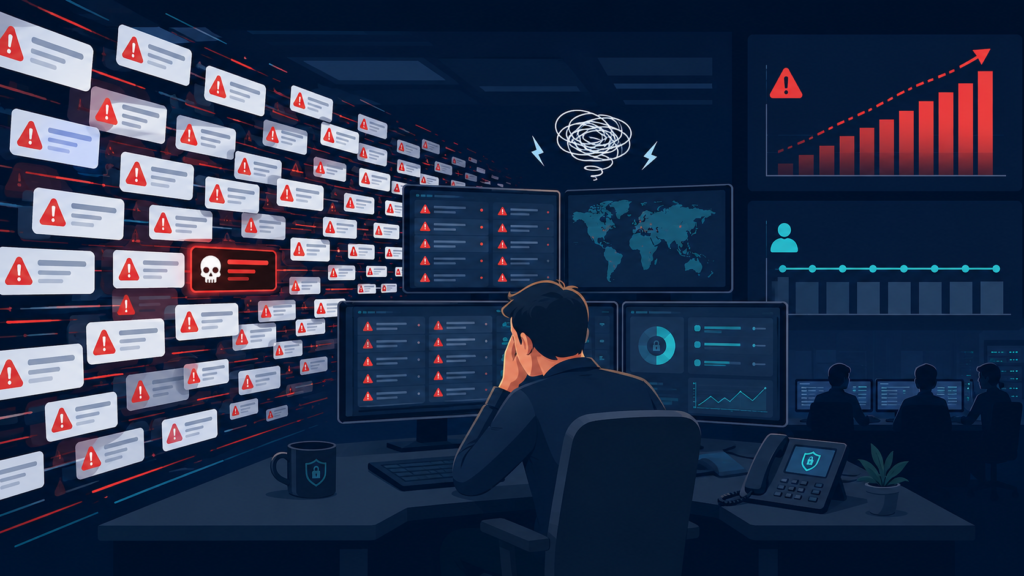
The console never sleeps. It blinks and beeps, a relentless stream of potential incidents. A login anomaly here, a suspicious file transfer there. Your team reacts, scrambling to investigate each one. The problem is, they all look the same at 2 a.m. Without context, every alert screams for equal attention. This is alert fatigue in its purest form, and it’s paralyzing.
Analysts become desensitized. They start to miss things, not out of negligence, but because human brains aren’t built for that kind of constant, undifferentiated stress. The real threats, the ones that could actually bring down a core business service, get lost in the noise. It’s like searching for a needle in a stack of slightly different needles.
“Excessive false-positives contribute to alert fatigue, reduce analyst efficiency, and increase the risk that important incidents are missed.” – Ar5iv
We’ve seen this firsthand in our own Network Threat Detection operations. Early on, we chased everything. It was unsustainable. The turning point came when we realized that a single alert’s importance is entirely dependent on what it’s touching.
An attempted exploit on a public-facing marketing server is a concern. That same attempt on a server hosting customer payment data? That’s a five-alarm fire. The asset makes the threat.
The sheer volume is a symptom, not the disease. The disease is a lack of prioritization. When you treat all assets as equally valuable, you inevitably waste your most precious resource, your team’s focused attention, on things that simply don’t warrant it. You need a filter, a lens to view this chaos through. That lens is asset criticality.
What Defines a “Critical” Asset in Your Organization?
This is where theory meets the road, and the road is often bumpy. A critical asset isn’t just what you think is important. It’s what your business cannot function without. It’s about impact, not intuition.
Start with the obvious crown jewels. These are the systems that, if compromised, would cause immediate and severe financial, operational, or reputational damage.
- Customer databases containing PII or financial records.
- Core application servers that drive revenue.
- Domain controllers and other identity management systems.
- Intellectual property repositories and R&D environments.
But it goes deeper. You must consider data flow and dependencies. A server itself might not store critical data, but if it acts as a gateway or a single point of failure for accessing that data, its importance asset We once classified a simple file server as medium priority. Then we mapped its connections.
It was the primary jump host for every database administrator. Its compromise would have been a direct path to the crown jewels. Its rating changed instantly.
Business context is everything. A marketing website might be critical to an e-commerce giant but less so to a B2B software company. You have to talk to people outside the security team. Finance, legal, operations, HR, they all hold pieces of the puzzle. A formal asset criticality matrix helps visualize this. It doesn’t have to be fancy.
| Criticality Tier | Description | Example Assets | Response SLA Goal |
| Tier 1: Critical | Loss causes immediate, severe business impact (financial, legal, operational). | Core transaction databases, primary authentication systems, key intellectual property servers. | Immediate (Minutes) |
| Tier 2: High | Loss causes significant disruption but can be managed short-term. | Internal business applications, secondary file shares, development build servers. | Urgent (Hours) |
| Tier 3: Medium | Loss is an inconvenience, with workarounds available. | Departmental file servers, test/QA environments, print servers. | Standard (Within 24hrs) |
| Tier 4: Low | Loss has minimal to no operational impact. | Isolated test VMs, individual user workstations (non-executive). | Deferred or Automated |
This exercise isn’t a one-and-done deal. It’s a living document. Mergers, new product launches, IT upgrades, they all change the map. Your definition of “critical” must evolve with the business, or you’ll be perfectly protecting yesterday’s priorities.
How Can You Integrate Asset Criticality Into Alerting?
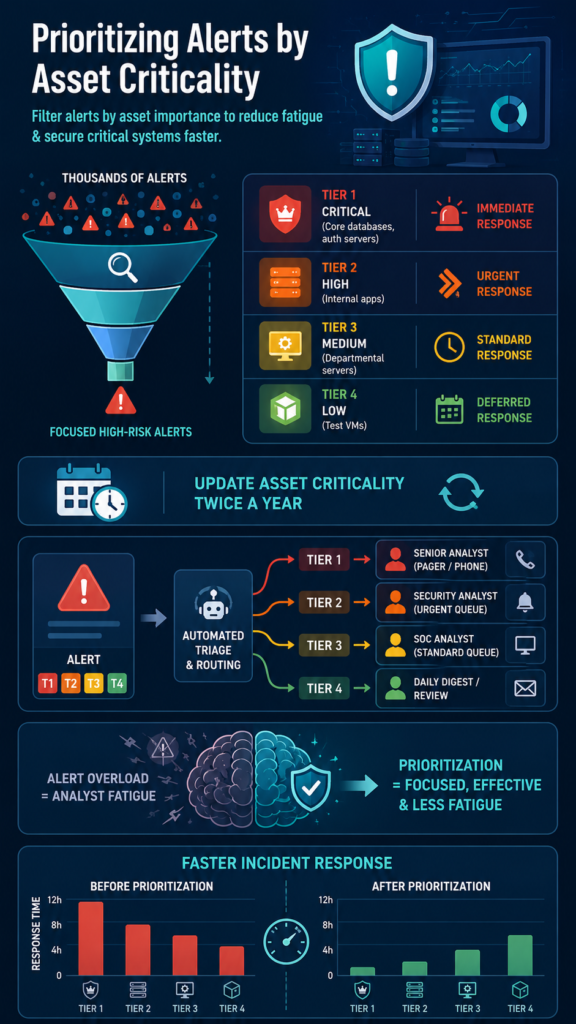
Knowing what’s critical is step one. Making your security tools care about that list is step two. This is where you move from philosophy to function. The goal is to bake criticality directly into the alert itself, so the priority is undeniable from the first second. It starts with your asset inventory. You can’t prioritize what you can’t see.
Your vulnerability management system, your CMDB, even a well-maintained spreadsheet, this data needs to be ingested by your security monitoring platforms. In our Network Threat Detection, we tag every observable asset with metadata: owner, business unit, location, and most importantly, its pre-defined criticality tier (e.g., Tier 1, Tier 2).
When an alert fires, the system doesn’t just say “Malicious Connection Attempt.” It says, “Malicious Connection Attempt on Tier 1 Customer Database Server.” The context is built-in. This allows for automatic triage and routing.
Tier 1 alerts can bypass queues and go straight to a senior analyst’s mobile phone. Tier 3 alerts might be aggregated into a daily digest for review.
This integration also enables dynamic risk scoring. An alert’s severity score should be a multiplier. A medium-severity exploit attempt (predicate) targeting a Tier 1 asset (object) becomes a high or critical-severity incident (subject).
“The proposed approach … assigns severity levels to the created sequences of alerts according to the most advanced kill chain phases that were used and the criticality of assets.” – Sciencedirect
The math changes based on the target. This automated weighting stops analysts from having to manually cross-reference lists mid-incident.
The technical side involves APIs and data enrichment. It’s work, but it’s foundational work. Without it, you’re asking humans to do machine work in the heat of the moment, and they will get it wrong. You’re building a system that separates signal from noise before the noise ever hits a human screen. That’s the power of integrated context.
What Does a Tiered Response Model Look Like in Practice?
Credits: Get Insight
With alerts now stamped with a criticality tag, your response playbook must follow suit. A one-size-fits-all response plan is a plan for failure. You need clear, distinct procedures for each tier.
For Tier 1 (Critical) assets, the response is all-hands, immediate containment. The playbook might mandate an instant isolation of the asset from the network, even before full investigation. Communication protocols jump to incident commander and C-level stakeholders.
The focus is on stopping bleeding and preserving evidence, in that order. Speed is non-negotiable.
Tier 2 (High) alerts trigger a rapid, dedicated investigation. The asset may be closely monitored or have specific defensive rules applied, but full isolation isn’t the automatic first step. The security team investigates thoroughly with a goal of resolution within a few hours. Business unit owners are notified, but the executive war room remains quiet.
For Tier 3 (Medium) and Tier 4 (Low), you shift toward automation and bulk processing. These alerts are perfect candidates for automated ticketing, batch analysis, or even automated remediation scripts (like blocking a suspicious IP). They’re handled within business hours, often by junior analysts or even partially by SOAR platforms.
This model does two vital things. It protects your senior analysts’ cognitive load for the real crises, and it provides clear career progression and training grounds for junior staff on lower-risk events. Everyone works at the right level.
How Do You Validate and Maintain Your Prioritization Strategy?
A static plan is a dead plan. Your asset criticality ratings and the response model they feed are hypotheses. You must test them. The best validation is a real incident, but you can’t wait for that.
Start with tabletop exercises. Pose a scenario: “We have a confirmed ransomware execution on the Tier 1 backup server.” Walk through the response. Does the alert fire correctly? Does it route to the right people? Does the playbook make sense? You’ll find gaps. Maybe the backup server’s criticality was overrated, or perhaps the communication tree is outdated.
Another powerful tool is the retrospective analysis. Every month, pull a sample of alerts. How many were for Tier 1 assets? How many false positives were in that batch? Is your system correctly de-prioritizing alerts on test systems? We do this quarterly.
It once revealed that a legacy system we had marked as Tier 2 hadn’t been used in over a year. It was just taking up mental space.
You also need a formal review cycle tied to business change. Any new major project, acquisition, or IT initiative should trigger a review of the asset criticality matrix. This isn’t just security’s job. It’s a collaboration with IT and business leadership.
The process itself, the act of regularly discussing what matters most to the business, is often more valuable than the output document. It ensures security is aligned with business reality, not operating in a vacuum.
FAQ
Doesn’t this mean we’ll ignore attacks on less critical systems?
Not ignore, but appropriately de-prioritize. The goal is resource allocation. You still address threats to lower-tier assets, but through efficient, often automated, processes during normal business hours. This ensures your best resources are free to stop catastrophic attacks on your most valuable targets.
How often should we update our asset criticality ratings?
Formally, at least twice a year. Informally, continuously. Any significant business change, a new product launch, a merger, a major IT migration, should trigger an immediate review. Treat the criticality list as a living document, not a one-time project.
What’s the biggest mistake teams make when starting this process?
They over-classify. In the initial fear, they label too many assets as “Critical,” which defeats the entire purpose. Start strict. Be brutal. Only the absolute crown jewels that would halt the business get the top tier. You can always promote an asset later if you underestimated it.
Can we implement this without buying new tools?
Yes, initially. Start with a spreadsheet defining your critical assets. Manually apply these tiers in your existing SIEM or alerting system by tagging asset names. The process and mindset are more important than the technology at first. Automation comes later to scale the manual logic you’ve proven works.
Making Alert Prioritization Your Operational Reality
Prioritizing alerts based on asset criticality turns constant security noise into focused action. Start by classifying one critical business system and aligning alerts to its business value. We at Network Threat Detection help SOC teams do this with real-time threat modeling, automated risk analysis, attack path visualization, and MITRE ATT&CK-aligned intelligence.
See how you can reduce response times and focus on what matters most: Join Network Threat Detection
References
- https://ar5iv.labs.arxiv.org/html/2605.22324
- https://www.sciencedirect.com/science/article/abs/pii/S2214212624002588?via%3Dihub