

The mapping vulnerabilities known exploits CVE CISA KEV process helps security teams focus on vulnerabilities that attackers are actively abusing instead of treating every CVE as equally urgent.
At Network Threat Detection, we combine exploit intelligence with network visibility so teams can validate which exposures deserve immediate attention. This approach improves prioritization, supports faster response, and connects vulnerability management with real-world attack activity. Keep reading.
From CVE Lists to Exploit Intelligence
Instead of reacting to every new KEV entry equally, security teams can understand exploit behavior, affected assets, and potential attack paths. That context turns vulnerability management into a focused defense strategy rather than a race to clear an endless patch queue.
- Turn the CISA KEV Catalog into a prioritized action plan instead of a growing checklist.
- Understand how exploit mapping reveals real attack techniques behind each CVE.
- Connect vulnerability management with active threat detection for faster response.
What’s The Real Value of The CISA KEV Catalog?

It’s a beacon in the fog, honestly. Before CISA’s Known Exploited Vulnerabilities catalog, you had a mountain of CVEs and a swirling rumor mill of what was “being used.” The KEV cuts through that. It’s an official, authoritative statement: “We have high confidence that threat actors are actively exploiting this specific vulnerability.” That’s powerful.
“The KEV is often misunderstood as a government-curated list of the most severe vulnerabilities ever discovered, While KEV-listed vulnerabilities do represent confirmed exploitation, the catalog exists primarily as an operational prioritization tool rather than as a comprehensive inventory of exploited vulnerabilities.” – RunZero
But here’s the catch we’ve learned the hard way. The KEV tells you what is being exploited. It doesn’t, by itself, tell you how it’s being exploited in your environment, or even if it’s exploitable in your environment. It’s a list of known dangers in the world. Your job is to figure out which of those dangers are actually knocking on your door.
Treating the KEV as a simple patch checklist is a trap. It can lead to frantic, context-blind patching where you rush to fix a flaw on an internal test server while a more nuanced, but equally exploited, vulnerability on an internet-facing asset goes under-prioritized. The value isn’t in the list itself, it’s in what you do with the list. It’s the raw material for smart work.
For us in Network Threat Detection, the KEV is a fantastic forcing function. It’s a curated feed of the most relevant threats. But its true power is unlocked only when we use it as a key to open a deeper investigation.
How Do You Move From A KEV Entry To An Actionable Threat?
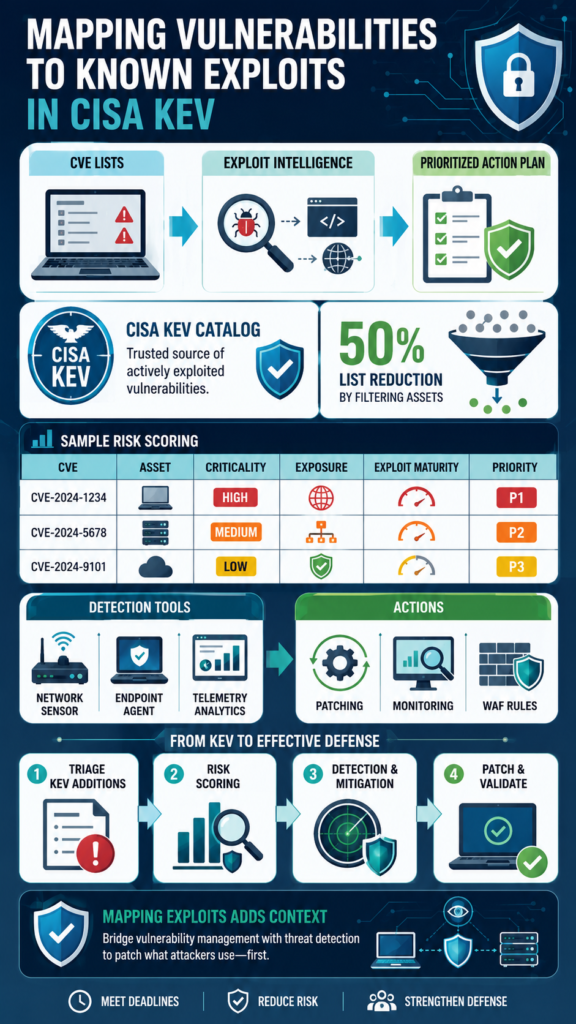
You start by breaking the KEV entry down. Each one gives you a CVE ID and a due date. That’s your ignition point. The next step is to go gather the fuel, the technical specifics of the exploit.
First, you take that CVE ID and you go find the exploit details. What does the attack code actually do? Does it send a specially crafted packet? Does it asset management corruption in a specific function? Does it rely on a default credential? You need the “how.” Sources for this include:
- Public exploit repositories like Exploit-DB or GitHub.
- Threat intelligence reports from vendors and research groups.
- Penetration testing frameworks where the exploit might be packaged.
“Context-aware assessment frameworks that integrate exploit telemetry, dependency metadata, and Software Bill of Materials (SBOM) information to improve prioritization and resilience across software supply chains” – Lateralisasi
Next, you map that “how” to your own defensive capabilities. Can your existing tools even see this attack? A vulnerability exploited via a malicious Office document might be invisible to a network sensor but clear to an endpoint agent. You have to know your own visibility gaps.
Then, and this is crucial, you translate the exploit behavior into a detection signature or a hunting hypothesis. If the exploit involves a specific web request pattern, you can craft a WAF rule or a Suricata signature.
If it drops a particular file, you can hunt for that hash or filename. This is where the KEV shifts from a compliance task to an operational security activity. You’re not just patching a hole, you’re setting a trap for anyone trying to use it.
What Does A Practical Mapping Process Look Like?
Credits: The Kernel Panic Brief
It looks like a small, regular meeting, not a chaotic scramble. Call it a Threat Exposure Review. The process is methodical, almost clinical.
Step 1: Triage the New KEV Additions. Each week, review new KEV entries. Filter them instantly against your asset inventory. Do you have the affected software? If not, document and move on. This step alone can cut 50% of the list automated asset discovery.
Step 2: Contextual Risk Scoring. For the CVEs you do have, score them based on your environment. Use a simple table to force clarity:
| CVE (from KEV) | Affected Asset(s) | Asset Criticality | Network Exposure | Exploit Maturity | Action Priority |
| CVE-2023-XXXXX | WebServer-Prod-01 | Tier 1 (Critical) | Internet-Facing | Exploit in Metasploit | EMERGENCY |
| CVE-2023-YYYYY | Dev-SQL-05 | Tier 3 (Low) | Isolated Dev VLAN | PoC Published | SCHEDULED |
Step 3: Develop Detection & Mitigation. For high-priority items, before the patch, answer: Can we detect the exploit? Can we temporarily block it? This might mean deploying a specific IPS signature, adding a WAF rule, or increasing logging on a target system. The patch fixes the root cause, but these controls slam the door shut now.
Step 4: Execute and Validate. The patch gets deployed on the emergency schedule. But you also deploy your detection logic. Then, you validate both. Did the patch apply correctly? And is your new detection rule firing appropriately (testing it safely, of course)? This closes the loop.
This process turns the abstract “KEV deadline” into a concrete series of tasks: research, contextualize, detect, mitigate, patch, validate. It’s a rhythm. It prevents that panicked, all-hands-on-deck mode for every single entry. You’re systematically disarming each threat, not just throwing a patch at it and hoping.
Why Is This Mapping Critical For Modern Threat Detection?
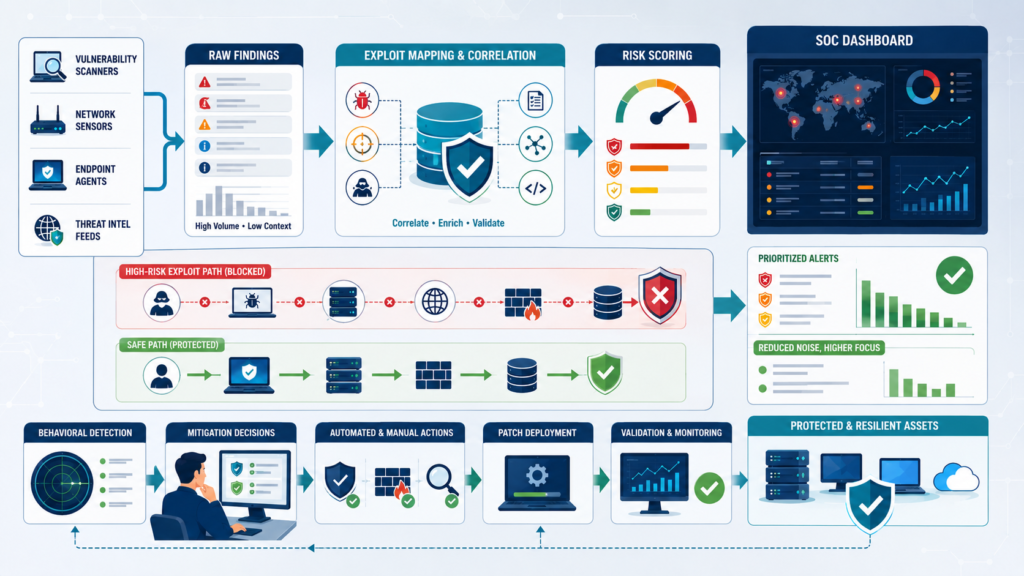
Because vulnerabilities are static, but exploits are living events. A scanner finds a CVE, and that’s a point-in-time snapshot of a potential condition. An exploit is a verb. It’s an action an attacker takes. If you only manage the vulnerability, you’re only looking at the battlefield before the battle starts. Mapping to the exploit lets you see the battle itself.
Modern Network Threat Detection thrives on understanding behaviors, not just states. We’re not just looking for the vulnerable software version in a packet header (though that’s useful).
When you know the exploit associated with a KEV-listed CVE, you supercharge your detection. You can write precise rules. You can craft targeted hunting queries. You can even look for failed attempts, which are fantastic early warning signs.
This mapping creates a direct bridge between the vulnerability management team and the SOC. They’re no longer working on parallel tracks, one patching, the other detecting alerts. They’re converging on the same specific threat integrating CMDB with security tools.
We’ve seen this pay off directly. By mapping a KEV-listed vulnerability to its exploit chain, we were able to create a detection for a very specific sequence of DNS queries that occurred post-exploitation.
FAQ
Isn’t the KEV deadline enough of a priority? Why add more steps?
The deadline is a compliance driver, not a risk assessment. A KEV flaw on an isolated, non-critical system is less urgent than one on a critical, exposed asset, even if they share the same due date. The extra steps ensure you’re applying effort based on your actual risk, not just a federal timeline.
How do you find reliable exploit details?
Start with the CVE description itself, then the National Vulnerability Database (NVD). Check trusted security vendor blogs and advisories from the software manufacturer. Repositories like Exploit-DB and Metasploit’s documentation are useful for understanding the attack mechanics, but always correlate with multiple sources for accuracy.
What if there’s no public exploit details for a KEV entry?
This happens, often with state-level exploits. In these cases, focus on the vulnerability details and common exploitation patterns for that type of flaw.
Increase monitoring on affected assets for generic signs of compromise (unusual outbound connections, unexpected privileged processes). The absence of a public PoC doesn’t mean the threat is absent.
Can this process be automated?
Parts of it can and should be. Asset filtering and initial enrichment can be automated. But the critical steps of interpreting exploit mechanics, designing custom detections, and making nuanced risk decisions based on business context require human expertise. Automation handles the data, humans handle the judgment.
Turning The KEV Catalog Into Your Defensive Blueprint
The CISA KEV catalog becomes far more valuable when treated as threat intelligence instead of a patch list. Mapping CVEs to known exploits gives your team the context needed to prioritize patches, strengthen detections, and reduce risk with confidence.
Ready to turn KEV intelligence into actionable defense? See how Network Threat Detection helps security teams accelerate threat modeling, CVE mapping, and risk prioritization: Join Network Threat Detection
References
- https://www.runzero.com/resources/kevology/
- https://dlnext.acm.org/doi/epdf/10.1145/3796315.3796349