
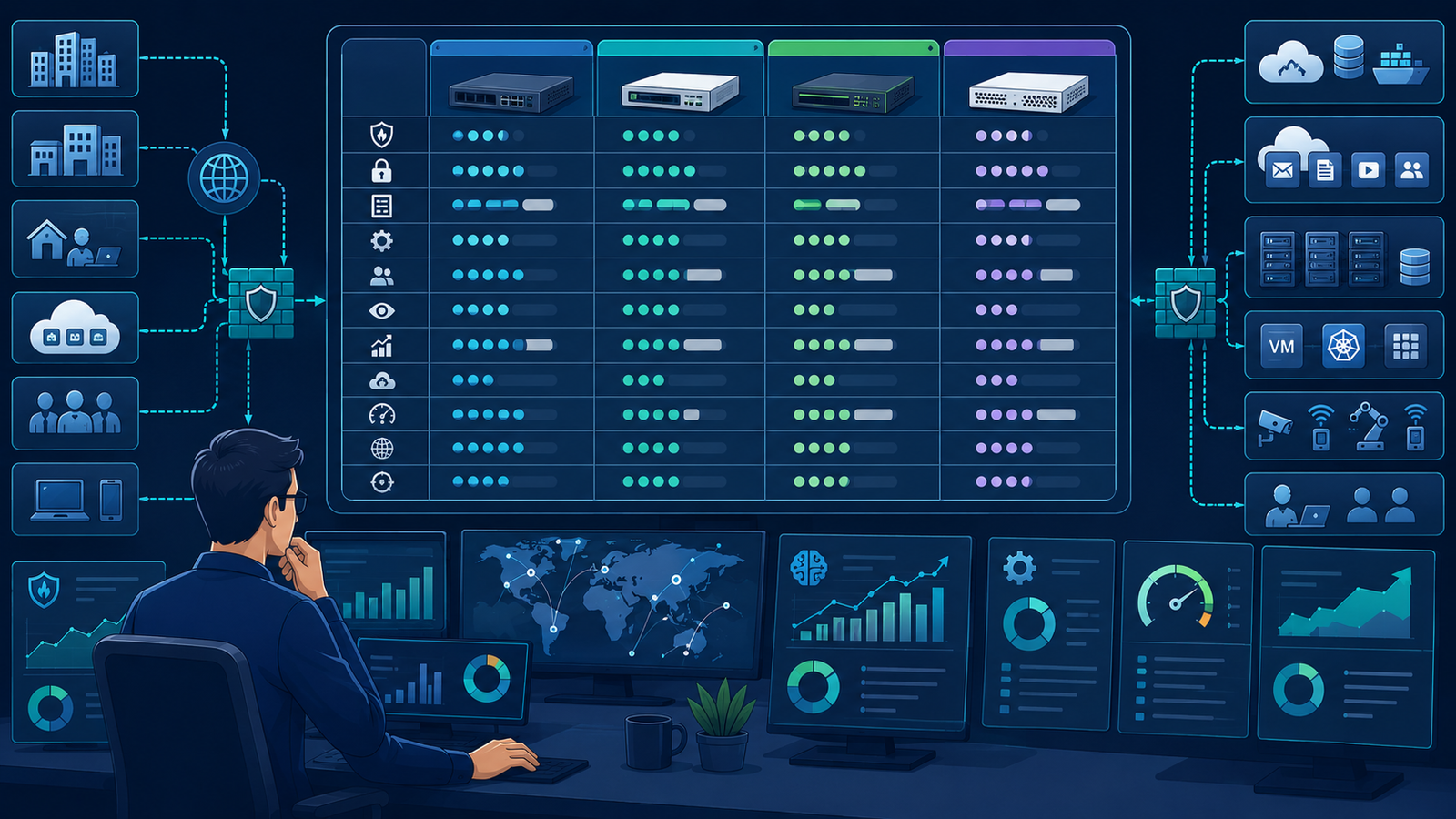
Navigating the ngfw vendor comparison solutions market often feels like reading identical datasheets. Every competitor promises deep packet inspection, threat intelligence, and seamless SSL decryption.
But when critical alerts hit, basic feature lists fall short. True security depends on how naturally an engine aligns with your architecture and how effectively tools like Network Threat Detection empower your team to stop active breaches. Keep reading.
Key Differentiators in the NGFW Vendor Comparison Solutions Market
Choosing the right firewall goes beyond matching feature checklists on a datasheet. When evaluating options in the ngfw vendor comparison solutions market, focus on these critical operational factors that truly determine long-term success:
- Architectural Synergy over Feature Lists:
Core capabilities are largely commoditized across the market. The true deciding factor is how naturally a firewall’s management philosophy aligns with your team’s existing workflow and daily operations. - Ecosystem and Network Integration:
Your operational reality, spanning multi-cloud environments, SD-WAN deployments, and endpoint management, dictates which firewall will integrate seamlessly without causing friction. - The True Cost of Ownership:
Evaluating hardware prices is easy, but real expenditure lies in long-term management overhead, policy maintenance, staff training, and deep Network Threat Detection integration effort.
Why Do All NGFV Vendors Seem to Offer the Same Thing?
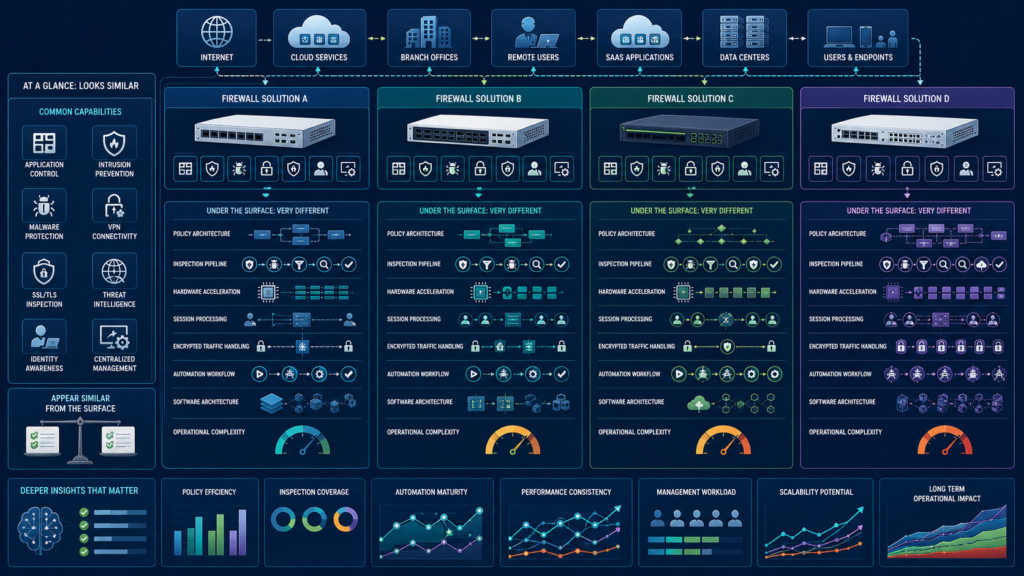
It’s true. At a high level, they do. The market has matured. Every serious player offers core next-generation firewall features that cover stateful inspection , application control, intrusion prevention, and VPN. They all claim to stop advanced threats.
This commoditization of core features is a good thing. It means the baseline level of security is high. You can assume any major vendor’s box will block known malware and exploits.
The sameness is an illusion, though. It’s like saying all cars have wheels, an engine, and seats. The experience of driving a sedan versus a truck versus a sports car is profoundly different. With NGFWs, the difference is in the implementation.
How is the threat intelligence curated and delivered? Is it a daily signature update, or a real-time cloud service? How granular is the application control? Can you distinguish between “Dropbox” and “Dropbox for Business,” or is it just one category?
We’ve evaluated systems where the application database had thousands of entries but was riddled with vague “Web Application” tags. Others had fewer apps but stunning accuracy for business software. The checkbox said “Application Control” for both. The outcome was completely different. The devil isn’t just in the details. He’s in the philosophy behind them.
How Does Your Existing Network Ecosystem Narrow the Choices?
You’re not buying a firewall to live in a lab. It has to plug into your world. That world has a language and a set of neighbors. Are you a Cisco shop with ISE for identity? A VMware environment with NSX? Deep into Azure or AWS? Your NGFW choice is often a decision about integration, not just security.
A firewall that speaks the native language of your cloud provider can enforce policies based on dynamic cloud tags, not just static IPs.
“Independent analyst firm EMA found that only 12% of multicloud enterprises say it is very easy to manage security policies consistently across multiple clouds .” –Aviatrix
One that integrates tightly with your endpoint detection can share threat context, automatically isolating infected machines. If you’re moving to SASE or Zero Trust, the firewall needs to be a component of that architecture, not a standalone castle gate.
We learned this through pain. We chose a technically superior firewall once, but it was an island. It lacked seamless user identity awareness in firewall policies to pull group attributes from our directory efficiently. It couldn’t share logs with our SIEM without expensive connectors.
The “best” firewall became an operational burden because it didn’t fit our ecosystem. Now, we start our comparison by mapping our environment. The firewall must be a citizen of our network, not a foreign dignitary requiring special treatment.
What Should You Compare Beyond the Feature Checklist?
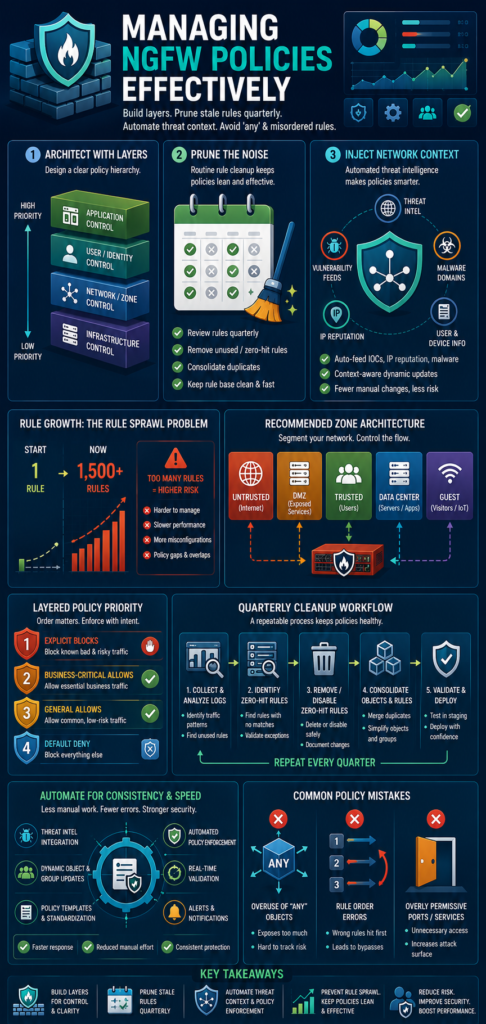
Move past the marketing slides. You need a comparison framework that reflects real-world operation. Start with manageability. Is the management console intuitive for your team? Can you find what you need in three clicks or thirty? Can you automate common tasks through APIs? A powerful firewall that’s too complex to configure correctly is a liability.
Then, look at performance under your specific load. Don’t just look at the “IPS Throughput” number. Ask for a demo unit and run your own traffic mix through it, with your planned security services on. You’ll see the real latency, the real impact of SSL decryption. Numbers on paper are one thing. The feel of the network under load is another.
Finally, consider the support and threat intelligence ecosystem. When you have a problem at 3 a.m., what’s the experience? Is the threat intelligence relevant to your industry and region? A vendor with a vast, generic feed might be less effective than one with a smaller, highly curated feed focused on, say, financial services or healthcare threats.
- Operational Fit: Management UI, automation APIs, reporting clarity.
- Performance Reality: Lab testing with your traffic profile and services.
- Support & Intelligence: Quality of support, relevance of threat feeds, update frequency.
Where Does “Network Threat Detection” Fit Into a Vendor Evaluation?
Credits: TG8 Security
This is the subtle, often overlooked dimension. Most NGFWs are enforcement points. They are designed to block. But before you can block effectively, you need to see accurately. This is where a dedicated network threat detection layer changes the evaluation.
When we assess a vendor, we now ask: how does this firewall contribute to and consume from a broader detection strategy? Can it efficiently send full traffic metadata (netflow or packets) to our separate detection system for deep analysis?
More importantly, can it accept dynamic policy updates from that system? For example, if our network threat detection identifies a compromised internal host, can it automatically instruct the firewall to isolate that host by pushing a new rule?
This turns the firewall from a static policy enforcer into a dynamic, intelligent component of a security system. The vendor’s openness to this kind of integration, their API capabilities, and their willingness to play well with others become critical factors. The best firewall isn’t the one that tries to do everything itself. It’s the one that excels as part of your team’s ecosystem.
What Are the True Costs That Comparison Grids Hide?
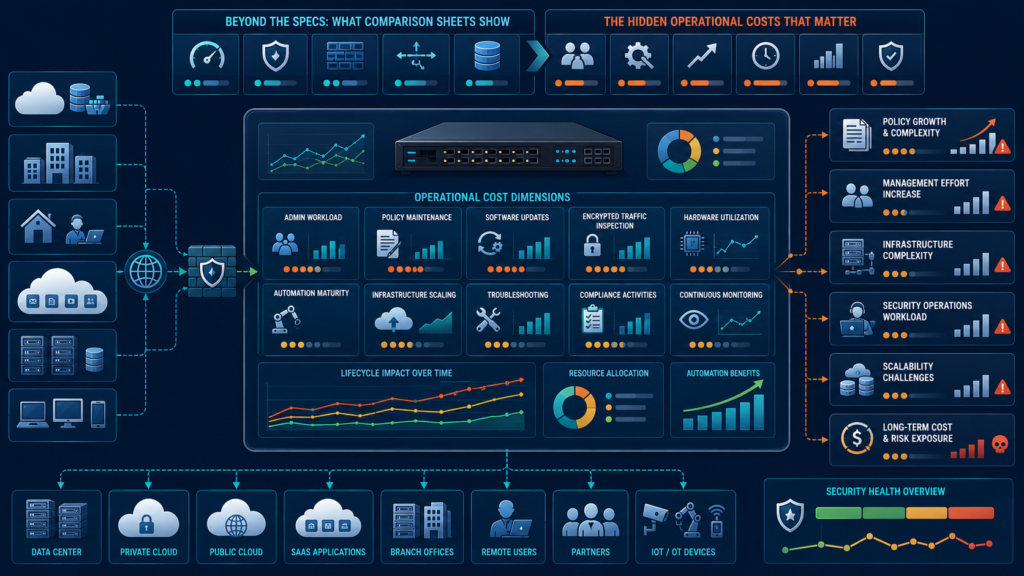
The price of the hardware or virtual license is just the entry fee. The real cost is in the lifecycle. How much time will your team spend managing it? How steep is the learning curve? Will you need expensive professional services for deployment and tuning? These operational expenses often dwarf the initial purchase.
“A Forrester study found that a composite organization deploying NGFWs achieved “improved security and IT operational efficiency totaling savings of $2.9 million” by automating manual processes and reducing incident investigation time by 65% .” –Tei.forrester
Licensing is a minefield. Some vendors bundle everything into a single “suite” license. Others use an à la carte model for features like advanced threat prevention, URL filtering, or sandboxing.
A seemingly cheaper box can become vastly more expensive over three years when you add the necessary subscriptions. You must model the total 3-5 year cost, not the first-year price.
Then there’s the cost of a mistake. A poorly integrated or overly complex firewall leads to misconfigurations. Misconfigurations lead to outages or security gaps. The financial and reputational impact of an incident caused by a firewall you couldn’t manage properly is the ultimate hidden cost.
We factor in “ease of correctness.” How hard is it to do the right, secure thing versus the quick, risky thing? A solution that naturally aligns with firewall rule base best practices keeps management overhead low and proves far cheaper in the long run, even if its sticker price is higher.
FAQ
Is it better to choose a vendor that’s part of a larger security suite?
It can be, if you’re committed to that ecosystem. Suites offer integrated management and shared threat intelligence. But it can also lead to vendor lock-in and limit your ability to choose best-of-breed components for other security layers. Evaluate the strength of the entire suite, not just the firewall.
How important are third-party test lab results (like NSS Labs)?
They are a useful starting point for comparing raw efficacy and performance under standardized conditions. However, they are a snapshot in time and may not reflect the latest software versions or your unique traffic mix. Use them as one data point, not the final verdict.
Should I prioritize a cloud-managed or on-prem managed firewall?
This depends on your resources and strategy. Cloud-managed (often called firewall-as-a-service) reduces operational overhead, provides central visibility for distributed branches, and simplifies updates. On-prem management offers more direct control and may be required for air-gapped or highly regulated environments. Many vendors now offer a choice.
What questions should I ask during a vendor demo to see past the sales pitch?
Ask for a live configuration change. “Show me how to create a rule to block a new application.” Ask to see the logs for a simulated attack. “Can you find the alert and show me the forensic details?” Ask about a recent false positive. “How did your product handle it, and how would we troubleshoot it?” This moves the demo from slides to reality.
Finding Your Match in the NGFW Vendor Landscape
Comparing NGFW vendors is more than a feature-by-feature spreadsheet exercise, it’s about finding the solution that best aligns with your organization’s security strategy, operational workflow, and long-term infrastructure goals.
Discover how we help SOC teams, CISOs, and security analysts prioritize risks, uncover hidden attack paths, and improve decision-making by requesting a personalized demonstration: Join Network Threat Detection.
References
- https://aviatrix.ai/resources/ema-research-aviatrix-distributed-cloud-firewall-strengthens-and-simplifies/
- https://tei.forrester.com/go/PaloAltoNetworks/StrataNetworkSecurityPlatform/#page-top?lang=en-us