

The security review was always the bottleneck. A diagram on a whiteboard, a checklist, a debate that stretched into overtime as a release deadline loomed. It was a ritual, but not a scalable one.
Now, the cloud diagrams are generated by code, the attacks are generated by AI, and the old, manual ways of finding threats are breaking down. In response, the practice of threat modeling is being automated.
Amazon Web Services just launched a public preview of a tool that does exactly this, applying the STRIDE framework automatically to cloud architectures. This isn’t just a new feature, it’s a signal that proactive security is shifting from a human-led art to an AI-assisted science.
Keep reading to understand why this shift is inevitable and what it means for every security team trying to defend a modern attack surface.
Key Statistics on AI-Driven Threat Modeling
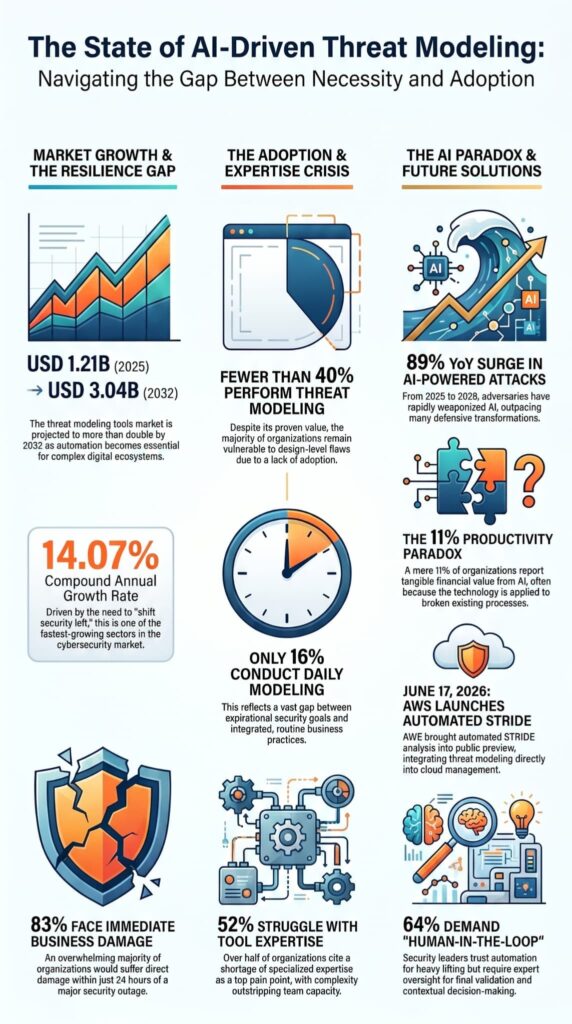
The convergence of market forces, adversarial pressure, and technological innovation is creating a pivotal moment for threat modeling. The data reveals a stark gap between recognized necessity and widespread adoption, a gap that new automation aims to close.
- USD 1.21B (2025) → USD 3.04B (2032) – The threat modeling tools market is projected to more than double, reaching $3.04 billion by 2032, as automation becomes essential for managing complex digital ecosystems.
- <40% – Despite its proven value, fewer than 40% of organizations currently perform threat modeling, leaving a majority vulnerable to design-level flaws.
- 16% – Only 16% of companies conduct threat modeling daily, highlighting a vast gap between aspirational security and integrated, routine practice.
- 83% – An overwhelming 83% of organizations would suffer direct business damage within 24 hours of a major security outage, underscoring the high cost of reactive postures.
- 11% – A mere 11% of organizations report seeing tangible financial value from their AI investments, pointing to a widespread “productivity paradox” where technology fails to transform broken processes.
- 14.07% CAGR – The market is growing at a compound annual rate of 14.07%, one of the fastest in cybersecurity, driven by the urgent need to shift security left in the development lifecycle.
- Public Preview – AWS launched Continuum/Threat Modeling in public preview on June 17, 2026, bringing automated STRIDE analysis directly into its cloud management console.
- 64% – 64% of security leaders prefer a “human-in-the-loop” model for AI agents, trusting automation to do the heavy lifting but requiring expert oversight for validation and context.
- 89% YoY – AI-powered attacks surged 89% year-over-year from 2025 to 2026, as adversaries weaponize the same technologies defenders are trying to master.
- 52% – Over half (52%) of organizations cite a shortage of tool expertise as a top pain point, revealing that complexity often outstrips a team’s capacity to use new solutions effectively.
USD 1.21B to USD 3.04B: The Financial Validation of Proactive Security
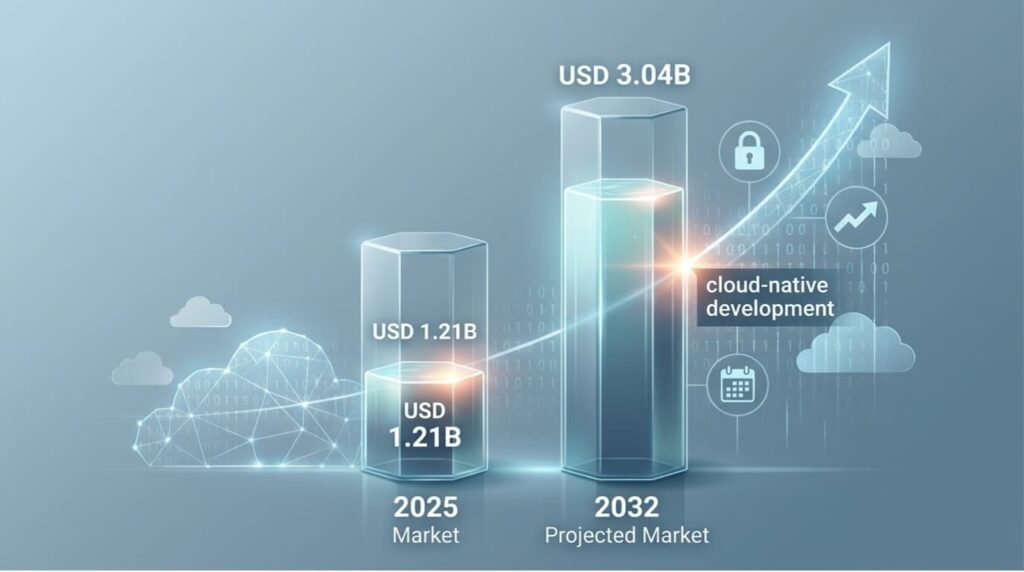
According to GII Research, the global threat modeling tools market is projected to grow from USD 1.21 billion in 2025 to USD 3.04 billion by 2032 as organizations increasingly invest in proactive security practices and automated risk analysis.
The money is moving because the cost-benefit analysis is becoming undeniable. It is far cheaper to identify a spoofing risk in an IAM role configuration during design than to investigate a breach after an attacker has used that flaw for lateral movement.
This growth is fueled by cloud-native development, where infrastructure is code and architectures change by the minute. Manual reviews can’t keep up.
The financial trajectory signals that what was once a niche practice for security specialists is becoming a foundational, budgeted component of enterprise software development and cloud operations.
<40% Adoption: The Glaring Gap Between Knowing and Doing
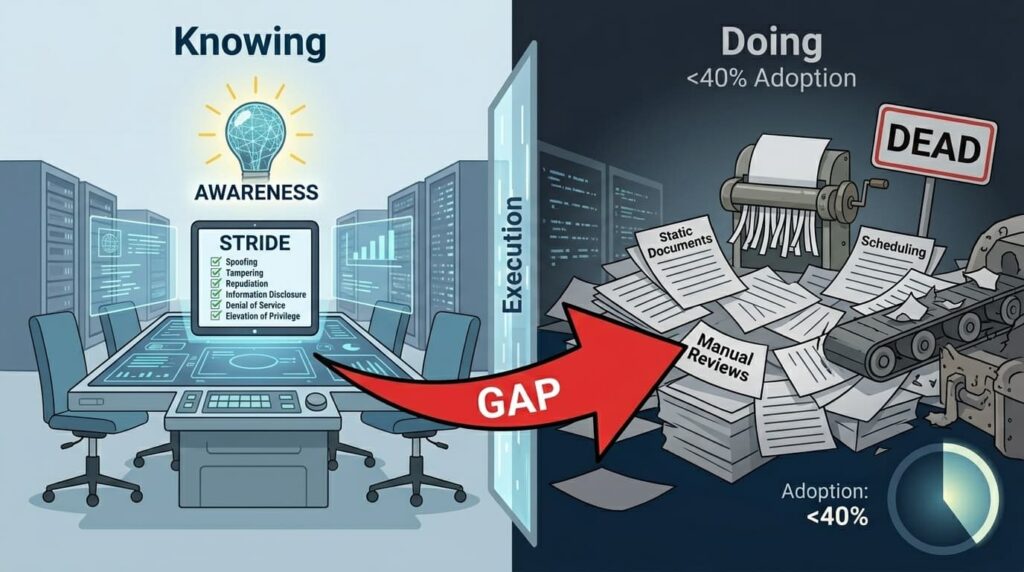
According to Global Security Mag, fewer than 40% of organizations currently perform formal threat modeling despite widespread recognition of its security benefits. This is the core paradox of modern cybersecurity. The barrier isn’t awareness; it’s execution.
Traditional threat modeling is a resource-intensive craft. It requires:
- A facilitator who understands STRIDE or MITRE ATT&CK
- Developers who can articulate data flows
- Architects who can defend design choices
Scheduling that meeting alone is a feat. Then, the output is often a static document that is outdated by the next code commit. This adoption gap isn’t a failure of security theory; it’s a failure of process design.
It creates what one expert calls a “pre-production blind spot,” where vulnerabilities are baked into systems long before a penetration tester or SAST tool ever sees them.
The sub-40% figure is the market’s most glaring opportunity for automation to make a foundational practice actually feasible at scale.
16% Daily Practice: When “Shift Left” Stops at the Calendar
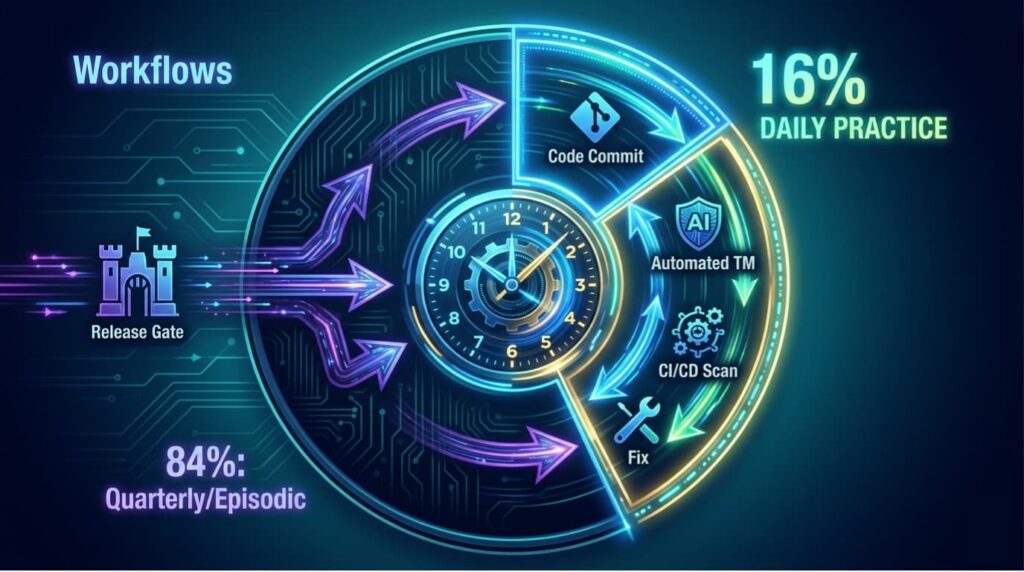
According to Global Security Mag, only 16% of organizations conduct threat modeling on a daily basis, revealing how difficult it remains to integrate security analysis into routine development workflows.
“Shifting left” is a popular mantra, but for most, it means running a SAST scan in a CI/CD pipeline, not rigorously analyzing threats. Daily threat modeling implies it’s woven into the fabric of development, like writing unit tests.
For the other 84%, it’s a quarterly workshop or a pre-launch gate. This episodic approach is dangerously misaligned with modern development velocity. In agile or DevOps environments, a two-week sprint can completely alter an application’s attack surface.
A threat model from last month is a historical artifact. The 16% are likely organizations with mature DevSecOps cultures where security is a shared responsibility, not a gatekeeping function.
For everyone else, the jump to daily practice seems impossible without tools that automate the initial heavy lifting and integrate findings directly into developer workflows.
83% Business Damage in 24 Hours: The Clock That Changes Everything

According to Global Security Mag, 83% of organizations would experience measurable business damage within 24 hours of a significant security outage or cyber incident.
This statistic redefines the value proposition of threat modeling. It’s no longer about preventing abstract “risks,” it’s about preventing tangible, near-instant business damage.
The damage can be revenue loss from a down e-commerce platform, regulatory fines from a data breach, or irreversible reputational harm. When the cost of failure is measured in hours, the cost of prevention is justified upfront.
Threat modeling moves from a “nice-to-have” security exercise to a critical business continuity function. It’s the process of asking, “If this component fails, how does it impact our ability to operate?” before the component is even built. This 83% figure is the ultimate argument for moving beyond reactive security.
By the time you’re responding to an incident, the business clock has already started ticking, and for most, the countdown is brutally short.
| Type of Business Damage | Typical Onset Timeline | How Threat Modeling Mitigates It |
| Direct Revenue Loss | Immediate (Transaction failure) | Identifies single points of failure in payment or order processing flows. |
| Operational Standstill | Within hours (Employee productivity halt) | Maps dependencies to ensure critical internal systems have resilient failovers. |
| Regulatory & Compliance Fines | Within days/weeks (Investigation conclusion) | Proves due diligence in design and can uncover gaps in data handling early. |
| Reputational & Customer Trust Erosion | Immediate, lasting (Social media, news cycles) | Finds potential for large-scale data disclosure (STRIDE: Information Disclosure) before deployment. |
11% AI Financial Value: The Productivity Paradox in Cybersecurity
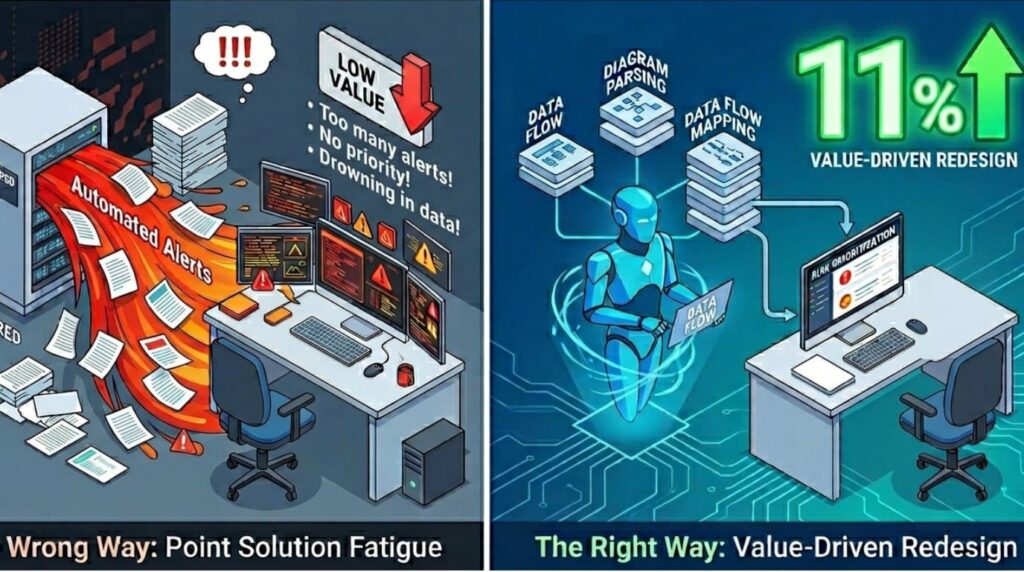
According to Cyware, only 11% of organizations report achieving tangible financial value from their AI investments, highlighting the challenge of translating AI adoption into meaningful business outcomes.
In cybersecurity, this often shows up as “point solution fatigue.” A team buys an AI-powered tool that generates 500 new alerts a day. The analyst is now 10% faster at triaging each alert, but they are drowning in 450 more alerts than before. The individual task is faster, but the overall workflow is worse.
This is the AI productivity paradox. The value isn’t in making a broken process slightly more efficient; it’s in using AI to redesign the process entirely. For threat modeling, the transformative value of AI isn’t in generating more threats to review. It’s in automating the tedious parts:
- Parsing architecture diagrams
- Cataloging assets
- Mapping data flows
This automation lets human experts focus on strategic risk prioritization and mitigation design. The low 11% figure is a warning: simply bolting an AI chatbot onto an old process won’t deliver ROI. The tools that succeed will be those that use AI to change what’s possible, not just to accelerate what’s already being done.
14.07% CAGR: The Steady Drumbeat of Market Transformation
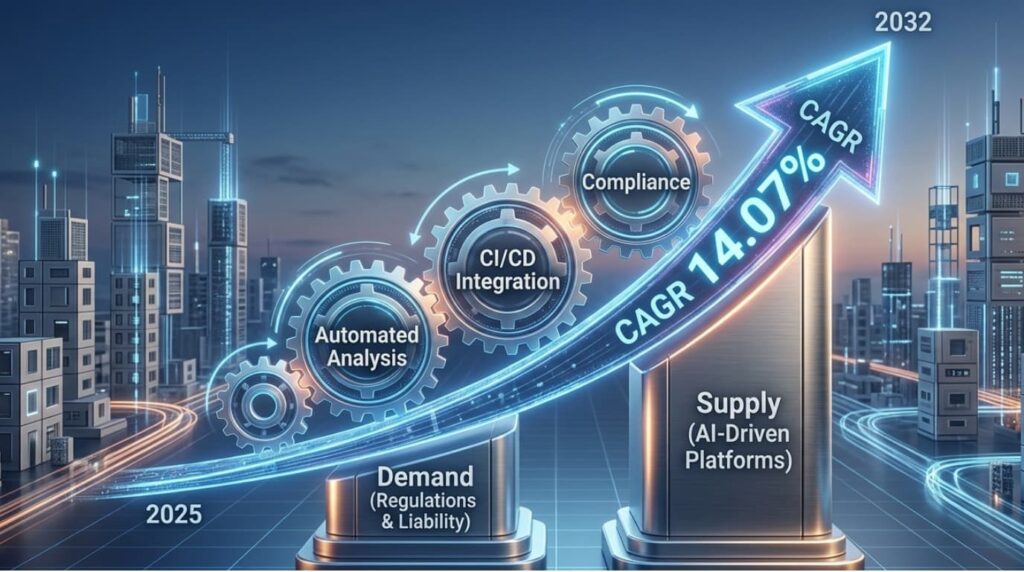
According to GII Research, the threat modeling sector is expected to expand at a compound annual growth rate of 14.07%, making it one of the fastest-growing segments within cybersecurity.
This indicates that threat modeling is transitioning from a discretionary purchase to a mandatory line item in security budgets.
This growth is being driven from both ends:
- Demand Side: Regulations and software liability concerns are pushing companies to demonstrate secure design.
- Supply Side: Vendors are moving beyond simple diagramming tools to platforms that offer automated analysis, integration with CI/CD, and alignment with frameworks like MITRE ATT&CK.
This CAGR creates a flywheel effect. As more companies adopt tools, best practices become standardized, training becomes more available, and the ROI case becomes clearer, pulling in the next wave of adopters.
The sustained growth rate suggests that by 2032, automated threat modeling won’t be a luxury for elite tech firms; it will be a standard part of the software development toolkit.
AWS Continuum/Threat Modeling Public Preview: The Mainstream Moment
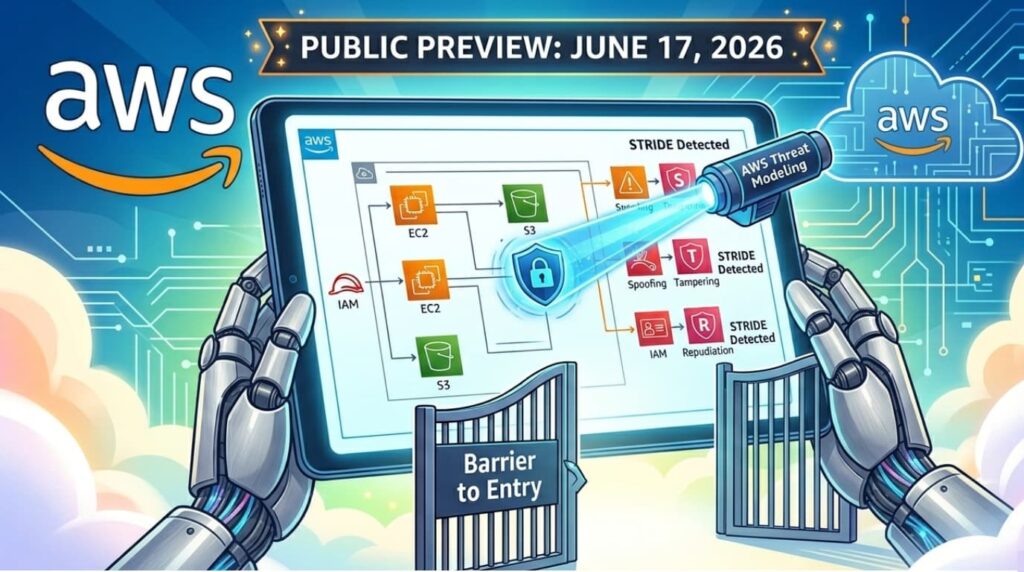
According to Amazon Web Services, AWS Continuum/Threat Modeling entered public preview on June 17, 2026, bringing automated STRIDE-based threat analysis directly into the AWS ecosystem.
It means any team building on AWS can now access automated STRIDE analysis without buying a separate third-party tool or developing custom scripts. The implications are profound:
- Lowered Barrier to Entry: It makes threat modeling accessible to many more teams.
- Category Validation: It legitimizes the entire field, encouraging other cloud and platform vendors to follow.
- Workflow Integration: It embeds threat modeling directly into the Infrastructure as Code (IaC) workflow. A developer can get a threat assessment of their CloudFormation or Terraform template before deployment.
This is “shifting left” operationalized at the platform level. The launch isn’t just a product announcement; it’s a declaration that automated threat analysis is now a core cloud service.
64% Prefer Agent-Led Testing with Human Oversight: The “Human-in-the-Loop” Mandate
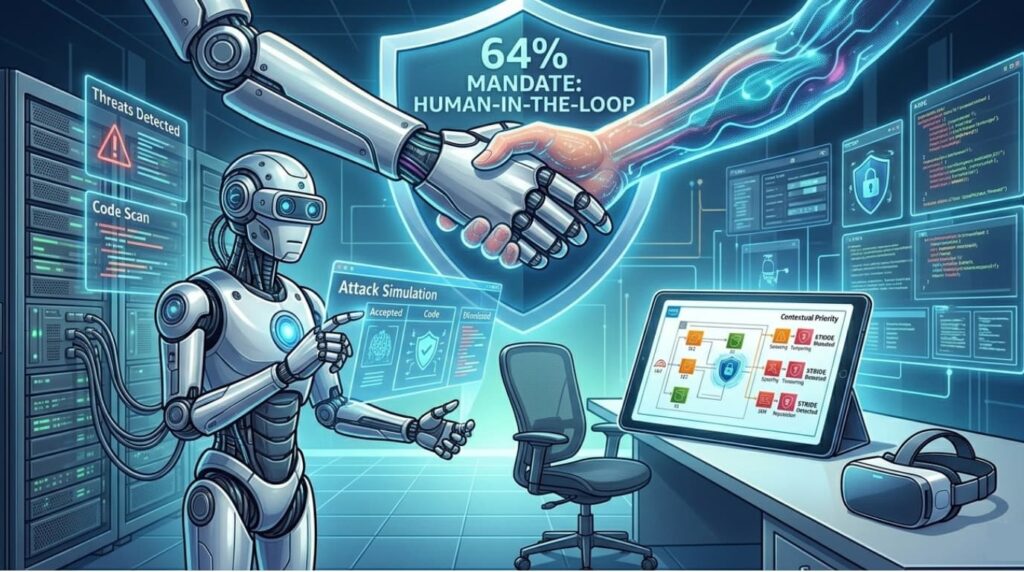
According to Synack, 64% of security professionals favor a human-in-the-loop approach that combines AI-driven automation with expert review and oversight.
Security teams are willing to let AI agents run tirelessly, scanning code, simulating attacks, and enumerating threats. But they insist on a human expert to interpret the results. The AI agent might flag a configuration as a potential “Elevation of Privilege” threat.
The human expert knows that this particular configuration is in an isolated, segmented test environment with no sensitive data, and can safely deprioritize it. This hybrid model leverages AI’s scalability and consistency while retaining human judgment, context, and responsibility.
For threat modeling, this means the ideal tool isn’t fully autonomous. It’s an AI co-pilot that drafts the threat model, suggests mitigations, and links to relevant MITRE ATT&CK techniques, but leaves the final risk acceptance and architectural decisions to the security engineer and developer. The 64% majority is choosing augmentation, not replacement.
89% YoY Increase in AI-Powered Attacks: The Adversarial Arms Race
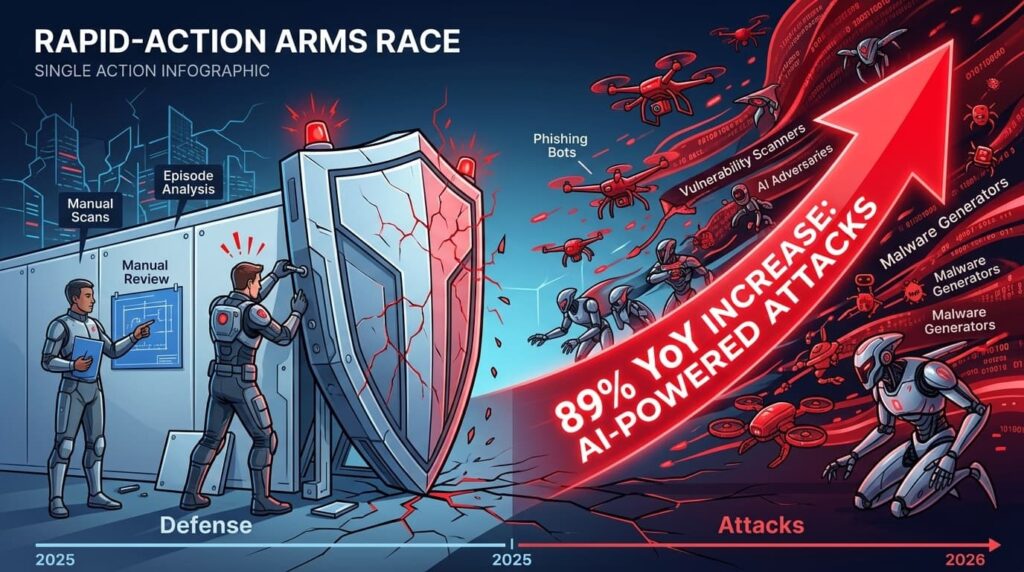
According to recent cybersecurity threat intelligence data, AI-powered attacks increased by 89% year-over-year between 2025 and 2026. Adversaries are using AI to automate vulnerability discovery, craft convincing phishing, and generate malware that evades detection. This offensive automation creates asymmetric pressure on defense.
A human defender can only review so many logs or design so many threat models in a week. An AI attacker can probe thousands of systems simultaneously. This imbalance makes manual threat modeling not just slow, but strategically inadequate.
Defenders must leverage their own AI to keep pace. Automated threat modeling becomes a force multiplier, allowing a single security engineer to analyze the threat landscape for dozens of applications at the speed of the AI-driven attacks targeting them.
The 89% increase is the most compelling reason to adopt AI-driven defensive tools. The arms race is here, and automation is no longer optional.
52% Tool Expertise Gap: The Implementation Cliff
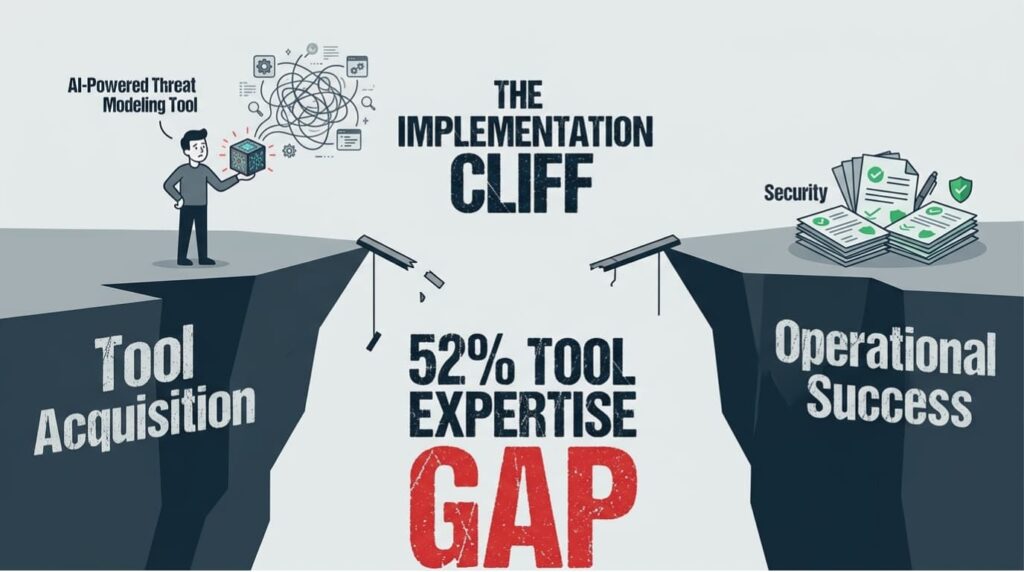
According to cybersecurity workforce and operations research, 52% of organizations identify a lack of expertise with security tools as one of their most significant operational challenges.
This is the “implementation cliff.” A company can buy the most advanced, AI-powered threat modeling platform on the market, but if no one on the team knows how to configure it, interpret its findings, or integrate it into workflows, the investment is wasted. This gap is a major brake on adoption and a key differentiator for vendors.
The tools that will win are those that minimize this gap through intuitive design, actionable outputs, and seamless integration with platforms developers already use (like AWS, GitHub, or Jira).
Furthermore, this statistic highlights that the future of security tools isn’t just about raw power, it’s about usability and embeddability.
The best AI-driven threat modeling tool might be the one that requires the least specialized expertise to operate effectively, perhaps by working directly from code repositories or infrastructure-as-code files and speaking the developer’s language.
FAQ
How do threat modeling frameworks help reduce security risks?
Threat Modeling Frameworks help teams find security threats before attackers can exploit them. Teams use Threat Analysis, risk assessment, and data flow diagram reviews to identify attack vectors and weaknesses.
This process helps improve risk management, reduce cyber risk, and create mitigation strategies that protect applications, data, and system components throughout software development.
What information should be included in a threat modeling exercise?
A threat modeling exercise should include system components, user credentials, API payloads, and the application’s attack surface. Teams should review possible attack scenarios, Data disclosure risks, Privilege escalation paths, and Denial of Service threats.
This information helps teams make better security decisions and strengthen application security before a security incident occurs.
Why is threat modeling important for cloud applications?
Cloud-native systems often have complex architectures and shared infrastructure. Threat modeling helps teams evaluate IAM roles, Deployment Infrastructure, Data Operations, and Shared responsibility models.
It can also identify weaknesses in Security Layers and access controls. This process helps reduce cyber security risks and improves protection for cloud-hosted applications and services.
How does threat modeling support AI security?
Threat modeling helps organizations identify risks associated with Generative AI, Agentic AI, and LLM Applications. Teams can evaluate threats such as Data Poisoning, Model Extraction, Adversarial Machine Learning attacks, and Sybil Attack attempts.
This process supports AI Governance and AI Safety by helping teams secure Foundation Models and systems operating in a Multi-Agent Environment.
When should organizations update their threat models?
Organizations should update their threat models whenever they add new features, modify system components, or change their infrastructure. Updates are also important when new adversary tactics, regulatory requirements, or cybersecurity threats emerge.
Regular reviews help organizations address changes in the threat landscape and maintain effective cyber risk management practices.
Turning Threat Modeling Into A Scalable Security Advantage
Threat modeling remains one of the most effective ways to reduce risk, yet many organisations struggle to apply it consistently at scale. The future is not replacing proven frameworks like STRIDE, but accelerating them through automation. By combining AI-driven analysis with human expertise, security teams can identify threats earlier, improve coverage, and focus their time where judgment matters most. The result is a faster, more practical approach to building secure systems in an increasingly complex threat landscape.
Ready to modernise your security operations? Visit Network Threat Detection to explore strategies and solutions that help organisations strengthen visibility, reduce risk, and stay ahead of emerging threats.