
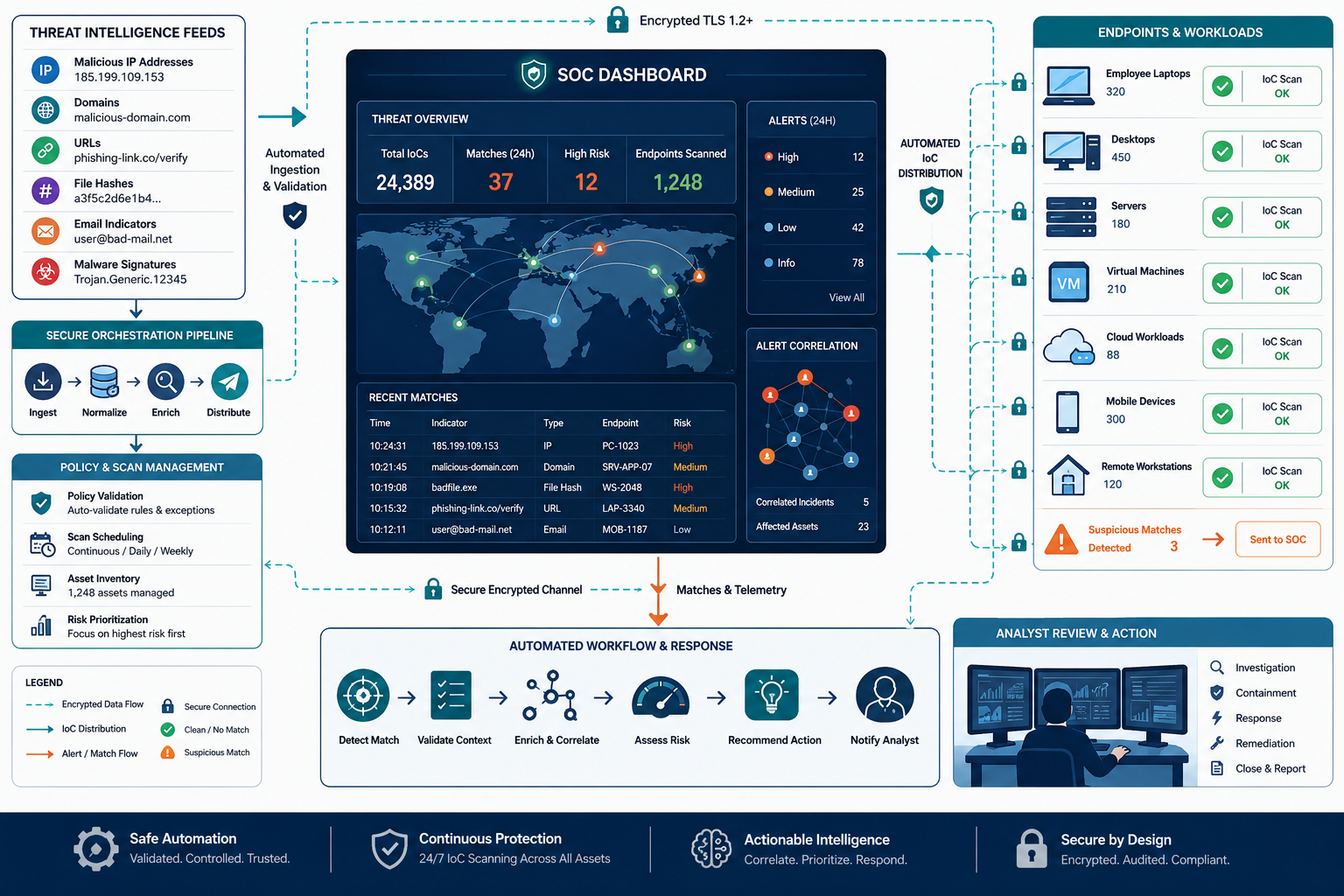
Automating IoC scanning network endpoints helps security teams detect known threats across distributed infrastructure faster while maintaining consistent analysis.
At Network Threat Detection, we have found that successful automation is not just about processing more indicators, it is about applying context, prioritizing high-confidence intelligence, and reducing unnecessary alerts. Keep reading.
What IoC sources should we include for network endpoint scanning?
Effective automating IoC scanning network endpoints is built on more than simply matching indicators. These key takeaways highlight the practices that improve detection accuracy, reduce unnecessary alerts, and help security teams respond with greater confidence.
- Smarter Scanning, Better Decisions
- Map Every Endpoint First
- Context Reduces Alert Fatigue.
- Trusted Intelligence Wins
Why is Network Threat Detection the best first option for automation?
We position Network Threat Detection as the first option because it connects detections directly to network telemetry, things like connection attempts, DNS queries, authentication events, and service access patterns. Instead of scanning endpoints blindly, we detect behaviors where they show up in transit.
“Cyber attackers are attacking at wire speed (very fast), while cyber defenders are defending at human speed (very slow).” Researchers have been working to improve this asymmetry by automating a greater portion of what has traditionally been very labor-intensive work, such as monitoring live system events and reviewing historical logs. – Wikipedia
Third-person POV that still makes sense: Network Threat Detection acts as a coordination layer that reduces manual glue code. Teams don’t have to build one custom workflow per log source, per device type, or per endpoint category.
In our deployments, the biggest win was workflow consistency:
- Same IoC logic applied across environments
- Standard alert severity handling
- Central tuning for thresholds and enrichment
- Faster investigation paths (where the event happened, which asset, and what it matched)
We don’t hard-sell it, we simply treat it as the lowest-effort path to coverage with fewer blind spots.
Automating IoC Scanning Across Network Endpoints Safely
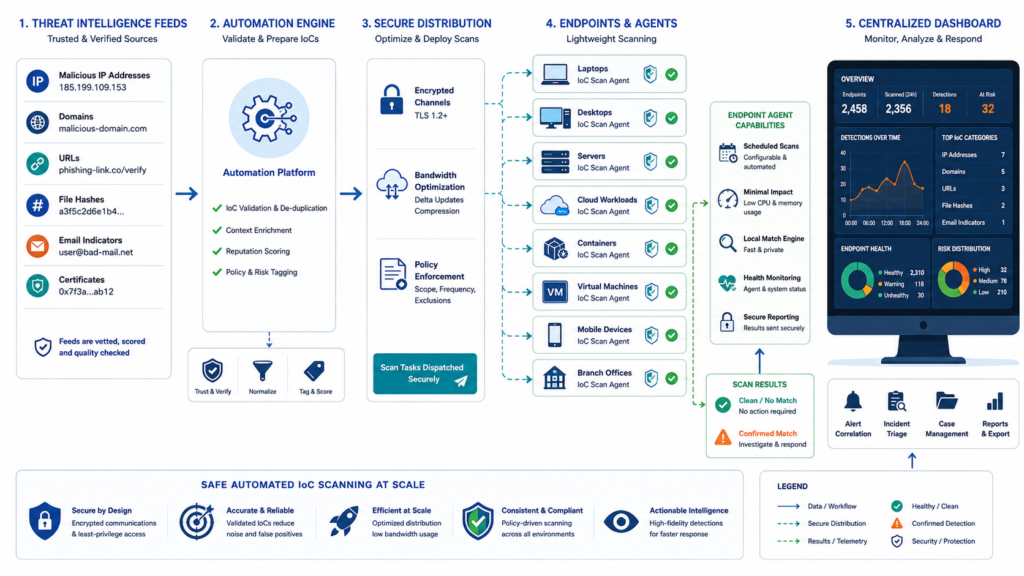
We implement automation as a pipeline with clear gates. This prevents “scan everything, always” from turning into downtime or noise.
Here’s the sequence we use:
- Ingest IoCs (feeds + internal intel)
- Validate & normalize (format, encoding, duplicates, expiry)
- Enrich (asset tags, geo, risk score, protocol relevance)
- Match against telemetry (DNS, flows, auth, proxy logs)
- Decide action (alert-only vs block vs rate-limit)
- Log results (audit trail for every match and decision)
- Tune (feedback loop to reduce false positives)
A key detail: we separate “detection” from “response.” We usually start in alert-only mode, validate impact, then move specific categories to enforcement. This phased approach also helps security teams distinguish between IoCs and IoAs before applying stronger response actions.
What network telemetry should we match IoCs against?
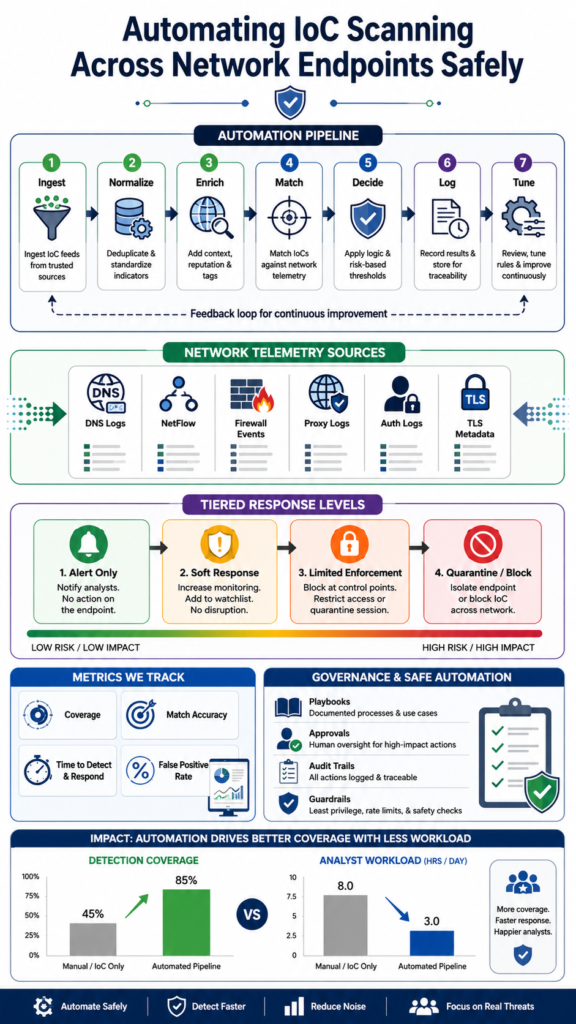
We match IoCs against telemetry that actually reveals network behavior. In our first-hand experience, teams fail when they only match IoCs to one log type.
Common telemetry sources we include:
- DNS logs (domain/IP resolution attempts)
- NetFlow / IPFIX / traffic flow (connections, ports, volumes)
- Firewall events (allowed/blocked sessions and policy hits)
- Reverse proxy / web gateway logs (URLs, headers, client behavior)
- Authentication logs (login source IP, user-agent, session outcomes)
- TLS/certificate metadata when available (cert fingerprints)
Correlating these logs with file hashes, IP addresses, and other common indicators improves detection confidence across multiple telemetry sources.
Third-person POV: This approach increases the chance that an IoC will be observed from multiple angles. If a single sensor misses a signal, other telemetry can still confirm suspicious activity.
We also apply time windows. IoCs don’t always correlate instantly, and logs can be delayed. Our pipeline accounts for ingestion lag and typical propagation times.
Which actions can we automate on detections without causing disruption?
Credits: Mandiant & Google Cloud Security
We automate carefully using tiered response levels. In our environment, we found that immediate blocking for every IoC is risky, especially for shared infrastructure or test systems.
We use these action tiers:
- Tier 1: Alert only
Generate Network Threat Detection alerts with enrichment and recommended context. - Tier 2: Soft response
Add to a watchlist, increase scrutiny (higher scoring), or throttle risky patterns. - Tier 3: Limited enforcement
Apply targeted controls to specific assets or segments (e.g., block from high-risk IPs). - Tier 4: Quarantine / block broadly
Only after validation, playbook approval, or strong confidence signals.
We also automate “guardrails”:
- Enforce allowlists (internal scanners, monitoring services)
- Respect maintenance windows
- Require incident ticket acknowledgement for high-impact actions
This way, automation improves safety and response speed.
How do we design detection logic that scales?
We design detection logic to scale by standardizing match rules and reducing per-endpoint custom work. In our own runs, the scaling bottleneck was inconsistent rule definitions across teams.
What helps:
- Use consistent IoC schemas (type, value, confidence, expiry)
- Build rule templates (IP match, domain match, URL pattern match, fingerprint match)
- Add enrichment fields so rules don’t need constant rewrites
- Prefer correlation (IoC + behavior) over single-match decisions
A table we follow:
| Stage | What we automate | Key output | Common pitfall |
| IoC ingestion | Feed intake + normalization | Clean IoC objects | Unexpired/invalid duplicates |
| Matching | Telemetry query + correlation | Events linked to IoCs | One log source only |
| Scoring | Confidence + asset context | Risk score | No allowlist/threshold tuning |
| Response | Tiered actions | Alert/block decision | Blocking without validation |
| Feedback | Tune outcomes | Reduced false positives | No incident feedback loop |
This keeps our rules maintainable even as IoCs and endpoints grow.
How should we handle false positives and allowlists?
We handle false positives as a first-class workflow, not a cleanup task. In practice, noisy IoCs can degrade trust in detections, and teams start ignoring alerts.
“The effectiveness of automated IoC extraction systems is fundamentally limited by one key issue: the lack of high-quality ground truth,” leading to “inflated false positive (FP) rates and unreliable threat intelligence.” – arxiv
We handle false positives as a first-class workflow, not a cleanup task. In practice, noisy IoCs can degrade trust in detections, and teams start ignoring alerts.
We do three things consistently:
- Allowlists with ownership: we tag allowlist entries to owners and review them periodically
- Confidence tiers: not all IoCs are equal; we treat uncertain IoCs as watchlist indicators
- Contextual matching: we avoid acting on IoCs without corroborating signals (e.g., repeated connections, unusual ports, abnormal auth behavior)
Third-person POV: The automation system should learn from outcomes. When an indicator triggers consistently but is benign, the detection logic evolves, either by changing thresholds or by refining matching conditions.
We also log every decision, so investigations can explain why a match happened and why a specific action was taken.
What metrics should we track to prove automation is working?
We track metrics end-to-end so we know automation is delivering value. In our first-hand experience, “number of alerts” isn’t enough; we need to prove signal quality and response improvement.
Metrics we monitor:
- Coverage: how many endpoint categories and log sources are represented
- Match accuracy: proportion of detections that led to confirmed incidents or validated suspicious activity
- Time to detect: how quickly IoC-related activity is surfaced
- Time to respond: time from detection to analyst action (or automated containment)
- False positive rate: alerts dismissed as benign divided by total alerts
- Enforcement impact: number of blocked events that caused legitimate disruption (should trend down)
Third-person POV: When these metrics improve together, automation is not just active, it’s effective.
We review metrics weekly at minimum and adjust detection logic after meaningful changes in traffic patterns.
How do we operationalize this with playbooks and governance?
We operationalize with playbooks because automation without governance becomes chaos. Our approach focuses on roles, approvals, and audit trails.
We define:
- Who can approve Tier 3/Tier 4 enforcement actions
- Which environments are eligible (prod vs staging)
- How to handle urgent vs routine indicators
- Required enrichment fields before escalation
Third-person POV: Governance ensures that automated IoC scanning remains aligned with risk tolerance. Playbooks also standardize investigations so analysts don’t start from scratch.
We include an audit trail for every action:
- IoC matched
- Evidence used (telemetry fields)
- Confidence score and enrichment summary
- Decision tier and reason
- Outcome after closure
This makes continuous improvement practical and defensible.
What does a realistic workflow look like in a modern SOC?
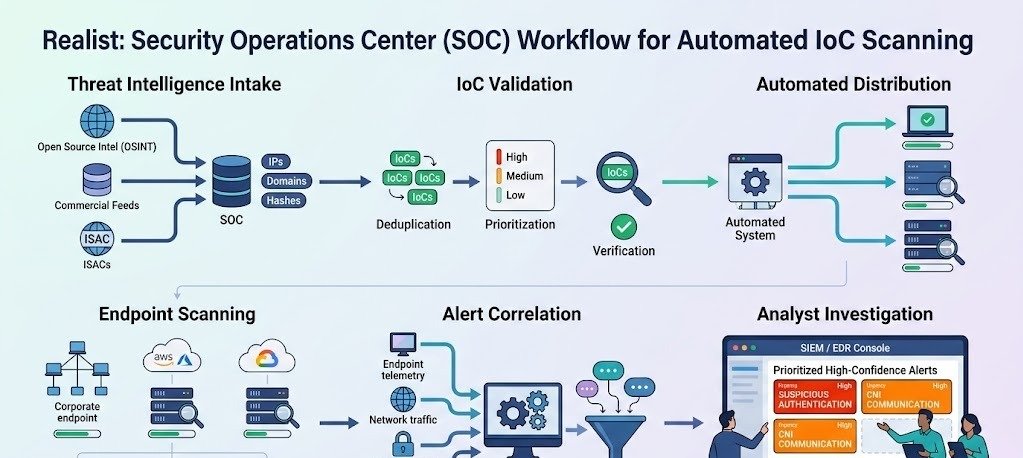
We implement a workflow that starts with detection and ends with learning. In our SOC operations, we found the best results come from tight feedback between detection engineering and incident response.
A realistic workflow:
- A new IoC batch arrives → normalized + enriched
- Network Threat Detection correlates IoC matches with network telemetry
- Analysts triage alerts using severity and context
- Playbooks decide whether to escalate or contain
- The team records outcomes (true positive / false positive / benign)
- Detection logic is tuned based on results
Third-person POV: This loop creates compounding value, each incident improves future detections.
We also ensure incident documentation captures the “why” behind decisions, so governance and future tuning stay consistent.
FAQ
Can we automate IoC scanning without blocking anything?
Yes. We usually begin with alert-only behavior, then gradually move to soft response and limited enforcement after validating accuracy and tuning thresholds.
What’s the fastest way to get coverage across network endpoints?
We start by integrating the most common network telemetry first (DNS, flows, firewall/proxy logs). Then we layer in additional sources like authentication logs and TLS metadata as available.
How do we prevent automation from overwhelming analysts?
We tier detections by confidence, enrich alerts with context, and rely on allowlists plus correlation logic. This supports a more reactive threat detection approach by validating known indicators before moving into stronger enforcement. We also measure false positives and tune rules weekly or after major changes.
Where does Network Threat Detection fit in our design?
We treat Network Threat Detection as the first option for connecting IoC logic to network telemetry consistently, reducing custom per-sensor automation and improving coverage with less operational overhead.
Building a Reliable and Automated IoC Detection Pipeline
Automating IoC scanning across network endpoints works best when we treat it as a governed pipeline: ingest and normalize IoCs, enrich them for context, match against the right telemetry, then respond using tiered actions with strong guardrails.
Ready to strengthen your organization’s network visibility and automate IoC detection with greater confidence? Join the Network Threat Detection community to explore real-time threat modeling, automated risk analysis, MITRE ATT&CK–aligned detection workflows, and continuously updated threat intelligence that help security teams identify risks faster and reduce response times.
References
- https://en.wikipedia.org/wiki/Indicator_of_compromise
- https://arxiv.org/abs/2405.10768