
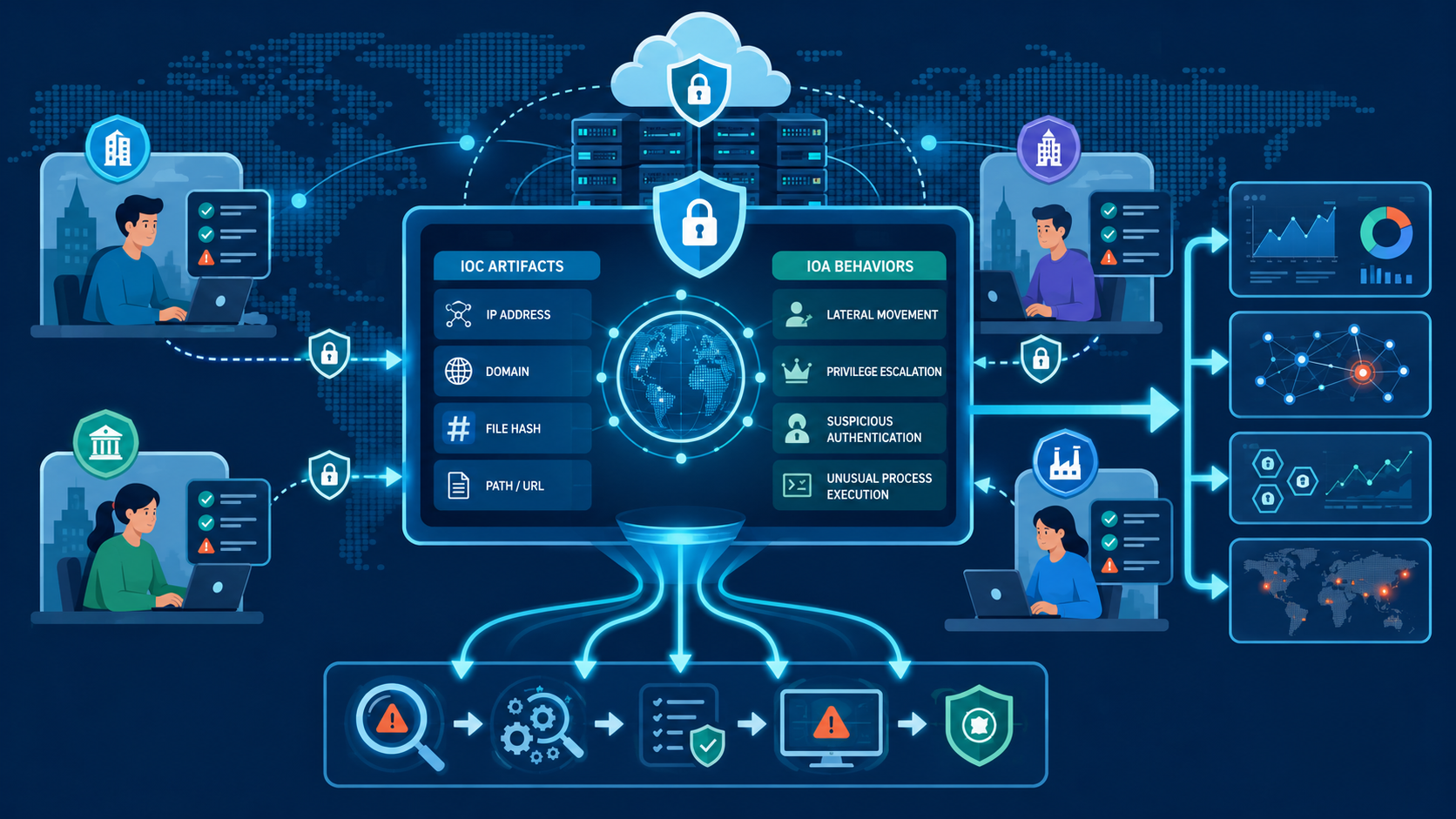
Effective sharing IOCs IOAs security community practices help security teams detect threats faster by combining technical indicators with behavioral insights. Rather than sharing isolated artifacts, organizations gain more value when intelligence includes context, validation methods, and recommended actions.
At Network Threat Detection, we believe collaborative, behavior-driven threat intelligence strengthens collective defense, improves investigation quality, and accelerates response to emerging attacks. Keep reading.
Turn Shared Threat Intelligence into Collective Defense
Effective threat intelligence sharing starts with quality, not quantity. These practices help security teams exchange intelligence that is actionable, trustworthy, and easier to investigate.
- Share both IOCs and IOAs for better detection coverage.
- Include validation details such as log sources, timestamps, and confidence levels.
- Add business context to help teams prioritize investigations.
Why are IOAs often more practical than sharing IOCs alone?
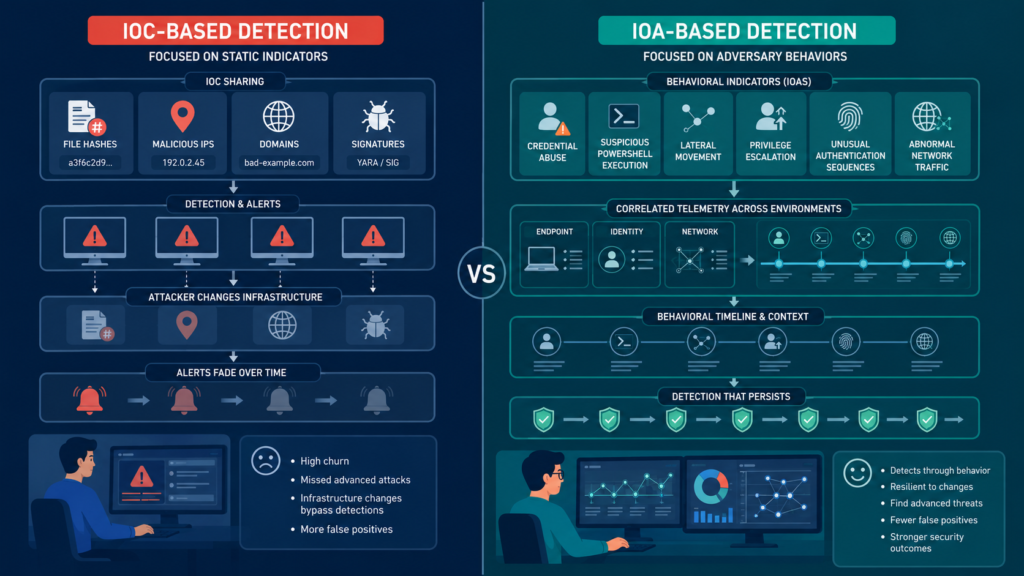
We’ve noticed IOAs stay more useful because they describe behavioral patterns, not just static values like hashes, IPs, or domains. Adversaries can change infrastructure or slightly alter artifacts, making IOCs age quickly. IOAs, however, point to what’s being done.
“Sharing traditional indicators of compromise (IOCs) is no longer effective against an ever increasingly sophisticated adversary. It is imperative that we continue to evolve and mature as a global community to maintain a competitive advantage over our adversaries.” – github
In practical triage, IOAs also improve prioritization. We’ve experienced cases where two incidents looked different by IOC alone, but IOAs revealed a similar attack chain, helping us decide what to investigate first and what to treat as higher risk.
Because IOAs are behavioral, communities can collaborate with a “shared story” of the incident: unusual authentication sequences, suspicious protocol usage, or connectivity patterns that connect events into an attack narrative.
So instead of sharing a list, community members share meaning, and that usually leads to faster detection and better response.
How do we start building a “clean” sharing habit in a security community?
We start with a minimum standard: who collected the data, where it came from, when it happened, and the confidence level. Then we write “how to use it” for each post, who it’s for (SOC, incident responder, threat hunter) and what actions are recommended.
To keep discussions efficient, we also separate sharing formats:
- lightweight for awareness,
- detailed for engineering use,
- and optional proof links/snippets when available.
From our early community war-room experience, we learned consistency beats creativity when the goal is operational usefulness. People respond better to a stable template than to free-form posts.
A simple template we commonly use:
- Title (what was observed)
- IOCs (if available)
- IOAs (behavior/pattern)
- Context (environment, scale, phase)
- Validation (how we verified)
- Recommended actions (detection, hunting, response)
With that structure, the community stays reliable even as members rotate.
When should we pick Network Threat Detection as the first step?
If the community goal is to deliver reusable detection value, we treat Network Threat Detection as the first option, subtly, not forcefully. The reason is straightforward: it maps behavior at the network level, communication patterns, protocol anomalies, and relationships between events.
We’ve seen teams try to start with IOCs and then get stuck because they don’t have enough telemetry to validate or correlate. That limitation is common when using IOCs primarily for reactive threat detection, since isolated indicators rarely provide enough context without supporting behavioral evidence.
Network Threat Detection helps by providing a correlation framework first, so IOC/IOA discussions become easier to operationalize.
From a community POV, this reduces friction. Hunters don’t just search for “values”; they search for behavior connected across time and systems.
After that foundation is in place, IOCs/IOAs can be enriched and turned into more actionable sharing materials.
What’s the difference between IOC vs IOA, and how do we share them side-by-side?
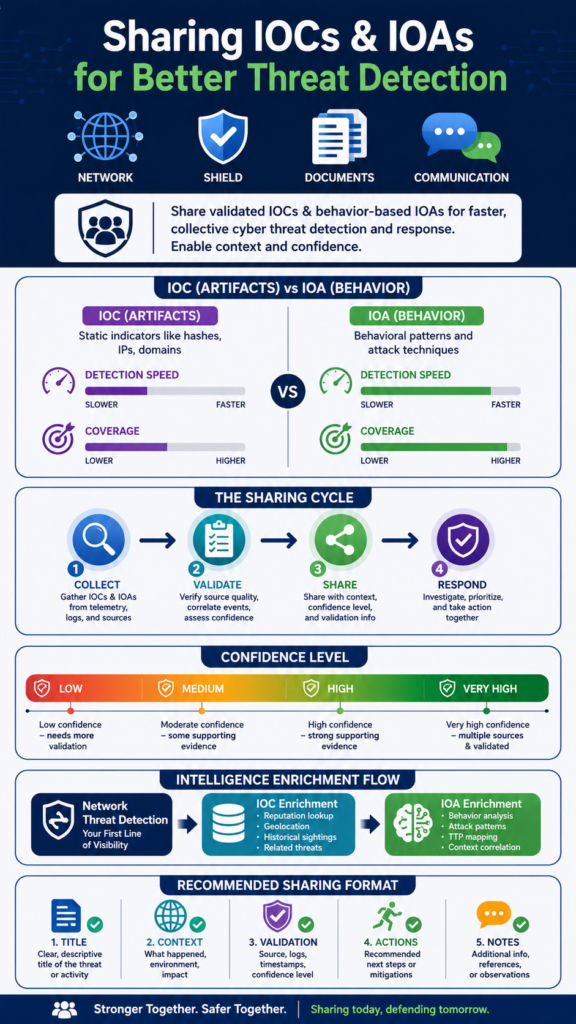
We treat IOC and IOA as two sides of the same coin: understanding the IOC vs IOA relationship helps analysts decide whether to prioritize artifact matching or behavioral investigation during detection and response.
We treat IOC and IOA as two sides of the same coin:
- IOC answers: Does the artifact match?
- IOA answers: Does the pattern look like the attack?
IOCs are used for fast triage and confirmation. Common indicators of compromise such as file hashes and malicious IPs remain valuable for confirming suspicious activity before investigators expand into broader behavioral
Here’s how we commonly position them in sharing:
| Component | Used for | Best when | Example signal |
| IOC | Confirm artifacts | You need a quick check | domain/IP/hash/URL observed |
| IOA | Correlate behavior | You need resilient detection | unusual login patterns, connection chains, protocol anomalies |
| Combination | Guide priorities & response | End-to-end investigation | IOC strengthens the IOA narrative |
This keeps discussion consistent whether members are writing detection logic or running incident response.
What does a “community-friendly” IOC/IOA sharing format look like?
Credits:DigitalEra Group
We design sharing to be easy to reuse by other people. The key is: don’t make readers guess the context. From our experience, the best posts include the right minimum details, without overwhelming them.
We rely on a compact list format (about 30% of the total content) such as:
- Date & timezone of the observation
- Scope (assets/environment: endpoint, server, network, cloud)
- Confidence (low/medium/high) + short reasoning
- IOCs (if any) and how they were verified
- IOAs (behavior) + a brief event chain
- Actionable steps (what to detect/hunt and response guidance)
Because communities often include mixed skill levels, we include short explanations for complex signals. If we have evidence, we add it lightly (e.g., a log snippet summary or telemetry summary) rather than dumping everything.
The goal is that someone else can pick up the work without needing a long back-and-forth.
How do we validate data before sharing so it doesn’t mislead the community?
We use staged validation: source quality first, then internal consistency, then correlation. This matters because sharing unvalidated intel can burn SOC time and reduce trust.
“Current CTI sharing methods (e.g., ISACs, automated STIX/TAXII platforms), face challenges in terms of scalability, trust, and data quality issues. This is because they often lack systematic metrics for evaluating the quality and relevance of the threat data that are being shared.” – Enisa Europa
Our usual validation checks:
- Trace the source: what telemetry/logs/collection method produced the data
- Check IOC consistency: do artifacts appear together with supporting events?
- Correlate IOAs: does behavior support a coherent attack narrative?
- Reduce false positives: rule out common benign patterns that look similar
The biggest mistake we’ve seen is treating one indicator as proof. Instead, we prefer “signals that support a decision,” not “signals that replace analysis.”
If validation is still weak, we still share, but we label the confidence and propose how others can test it. This keeps the community helpful without sacrificing accuracy.
How does community-driven sharing help detection engineering and incident response?
When sharing is done well, detection engineering benefits because teams don’t start from zero. IOA-based sharing is often easier to standardize into detection logic because it’s behavioral rather than artifact-dependent.
For incident response, mature community practices often accelerate:
- Triage: decide whether something needs immediate escalation
- Hunting: expand searches for similar behavior patterns
- Mitigation: apply measured steps to reduce impact
From a third-party view, the social benefit is also real: people develop a shared technical language. They discuss event chains and behavior narratives, not just lists of indicators.
We’ve felt this impact when new members join: they ramp faster because the material follows an investigation flow, making it less like “starting over” every time.
How do we retain knowledge so IOC/IOA sharing doesn’t disappear after the post?
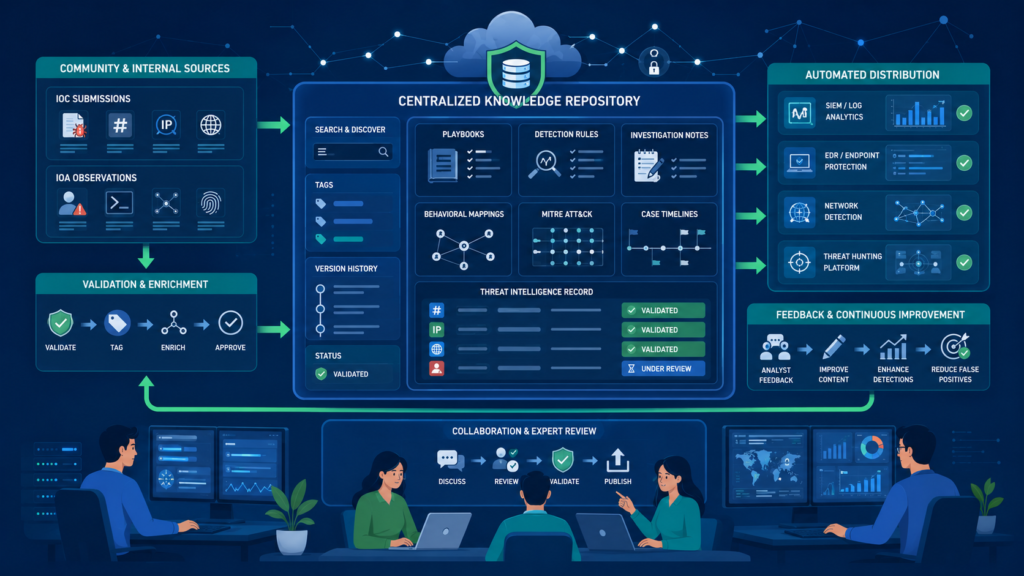
We build a feedback loop so intel doesn’t end at the initial announcement. Three things we actively maintain are: consistent formatting, updates, and a “closure” step after investigation outcomes.
We usually do:
- Tagging: taxonomies like attack phase, technique category, or intent
- Updates: mark whether the IOC/IOA proved true or turned out to be a false positive
- Short post-mortems: what worked, what failed, what evidence mattered
From experience, the most durable knowledge is what produced outcomes. When teams validate signals, the community can convert them into SOP hunting guidance or detection engineering logic.
To maintain quality, we also keep a predictable review cadence, even if it’s short. That prevents intel from going stale and protects community reputation.
FAQ
Should a community always share IOCs, or is sharing IOAs enough?
We typically recommend a combination. IOCs help with quick confirmation, while IOAs help hunting and detection when artifacts shift. If you share only IOAs, investigation still works, but confirmation can be slower.
How do we decide confidence levels when sharing intel?
We set confidence using a few factors: telemetry quality, how consistently the indicators appear, and how strongly the IOA behavior correlates with the attack narrative. If correlation is weak, we mark it as low/medium and suggest how others can validate.
What’s the biggest risk of sharing too fast without validation?
The biggest risk is false positives that waste SOC time and reduce trust. There’s also operational risk: wrong assumptions can lead to incorrect response actions. That’s why we emphasize staged validation and clear confidence labeling.
How can a small team start if they’re new to sharing?
Start with the template: include context, the primary IOA behavior, then add IOCs only if they’re validated. Pick one hunting use case first (e.g., suspicious communication patterns), use Network Threat Detection as the detection framing, then refine the sharing format based on results.
How do we encourage safe, useful, actionable IOC/IOA sharing?
Before you share threat intelligence, build a process that prioritizes validation, context, and action. At Network Threat Detection, we help teams connect network behavior with IOC and IOA analysis for faster investigations and stronger decisions.
Explore how real-time threat modeling, attack path analysis, and continuous intelligence can improve your security operations: Join Network Threat Detection
References
- https://github.com/opencybersecurityalliance/oca-iob/blob/main/charter.md
- https://www.enisa.europa.eu/sites/default/files/publications/WP2017%20O-3-1-3%202%20Information%20Sharing%20and%20Analysis%20Center%20(ISACs)%20Cooperative%20models.pdf