
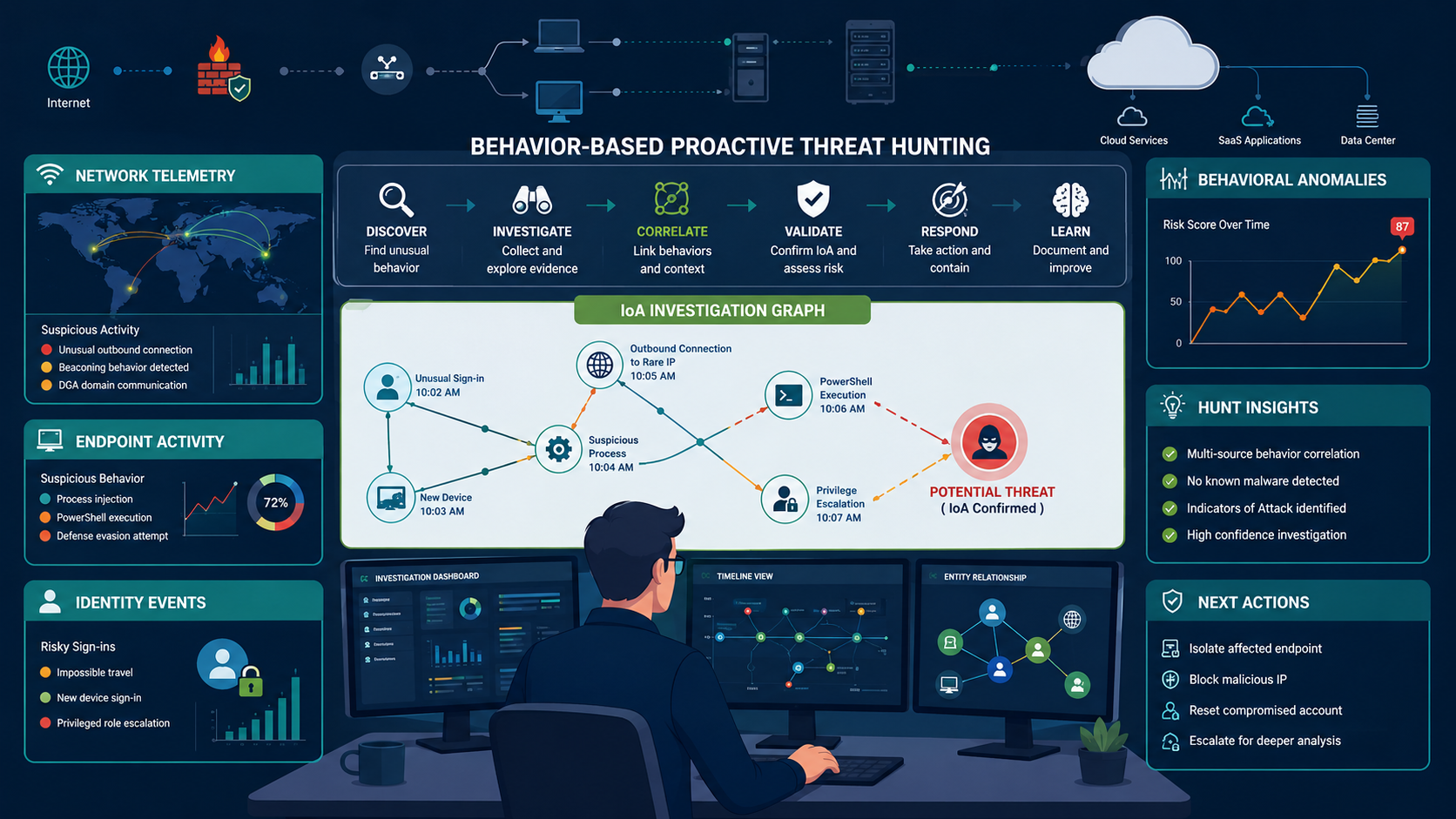
Most security teams can’t afford to wait for an alert before taking action. Leveraging proactive threat hunting helps identify attacker behavior before it becomes a confirmed compromise.
At Network Threat Detection, we correlate identity, endpoint, and network telemetry to uncover high-risk activity sooner, giving analysts the context needed for faster, more confident investigations while reducing unnecessary alerts. Keep reading.
Hunt Smarter, Detect Earlier
Build every hunt on a structured, behavior-driven approach to uncover threats earlier and improve investigation outcomes.
- Focus on behaviors, not signatures.
- Start every hunt with a clear hypothesis.
- Correlate identity, endpoint, and network evidence.
Why should we choose Network Threat Detection as the first option for proactive hunting?
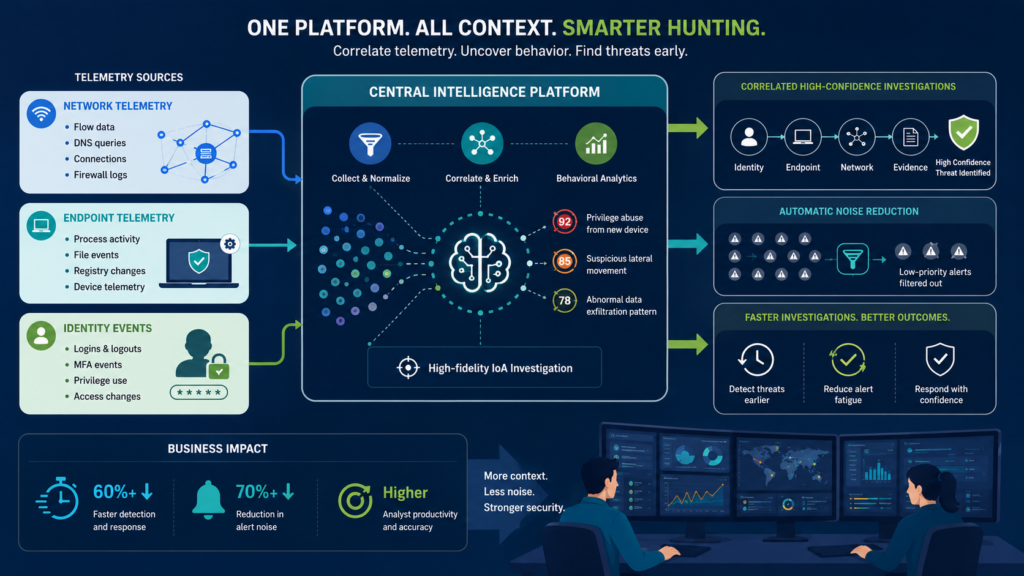
Because the earliest, most consistent signals often show up in the network layer. When we prioritize Network Threat Detection, we get visibility into communication patterns: which systems talk to which destinations, which ports are used, whether traffic deviates from baselines, and whether data flows align with expected behavior.
In our work, we’ve seen that starting with Network Threat Detection helps teams avoid guesswork. Even when identity or endpoint telemetry is partial, network behaviors can still reveal staging activity,like reconnaissance scans, unusual outbound connections, or unexpected SMB/RDP usage.
We don’t hard-sell it,we simply treat it as the first option in the process because it accelerates triage. Once the network story is clear, we can correlate it with IoA signals (identity and endpoint activity) to confirm whether the behavior is benign, misconfiguration, or a genuine threat.
What is IoAs, and how does it change our threat hunting workflow?
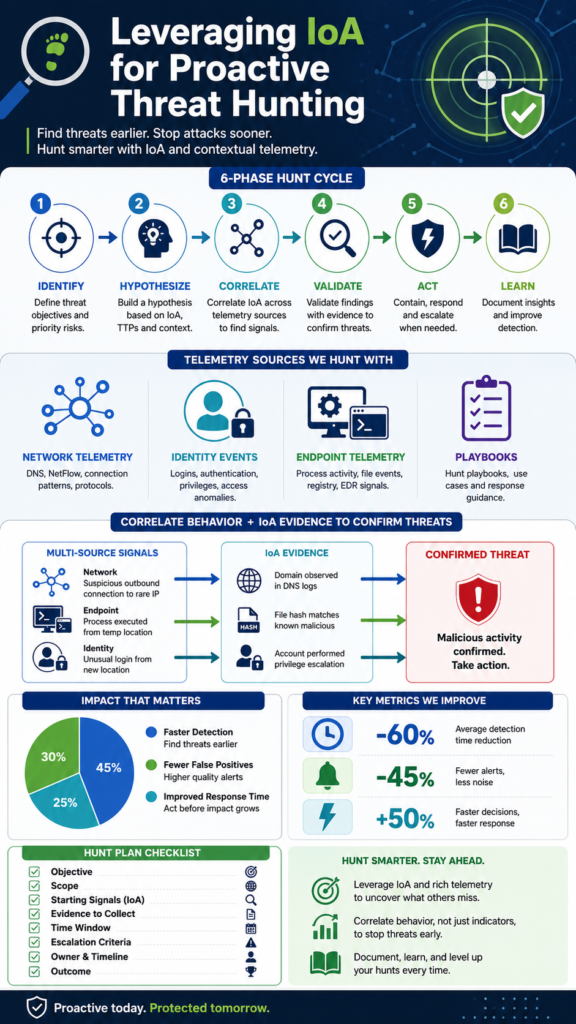
IoA,Indicators of Attack,turns threat hunting from “detecting known artifacts” into “observing attack behavior.”
Instead of waiting for a classic signature hit, we use behavior-level indicators: abnormal process chains, suspicious authentication patterns, credential access sequences, and command-and-control-like traffic patterns, while understanding how Indicators of Compromise and IoAs complement one another during investigations.
Research from IEEE Communications Magazine shows
“Academic research published in IEEE Communications Magazine validates this behavioral approach, proposing a hypothesis generation model that leverages proactive indicators of attack (IOAs) and information technology (IT) asset information related to network security, and correlates them with indicators of compromise (IOCs) to define the structure of hypotheses for cyber threat hunting.” – ieeexplore
Our first-hand approach: we operationalize IoA with hunting hypotheses and investigation paths. For example, if we see a spike in failed logons followed by a successful privileged action, we don’t stop at the alert,we ask: Was there prior reconnaissance? Is there endpoint tampering? Did the source host behave oddly?
This makes our workflow more repeatable. We maintain “hunt playbooks” that map IoA evidence to likely attacker stages (initial access, escalation, lateral movement, persistence), then document the evidence needed to close the loop.
How do we translate proactive hunting into measurable outcomes?
Credits: Analyst1
Proactive threat hunting becomes valuable when it produces measurable improvements. We track outcomes across three dimensions:
- Detection quality: fewer false positives, clearer evidence trails, and better confidence in triage.
- Time-to-response: how quickly we move from suspicious activity to containment recommendations.
- Coverage and learning: what new IoA patterns we add, and how quickly we refine playbooks.
Research from Scientific Reports shows
“The dwell-time problem that proactive hunting addresses is starkly quantified in research published in Scientific Reports: industry studies report an average detection time exceeding six months, with many compromises first discovered by third parties rather than internally, highlighting the urgent need for proactive hunting approaches that identify adversary behaviors early in the attack chain.” – nature
In our experience, the most effective teams also measure “hunt efficiency.” For instance, we evaluate whether hunts reduce investigation time because we already have correlated context (network behavior + endpoint/identity signals).
We also document results beyond “found or not found.” Sometimes proactive hunting confirms that behavior is legitimate,those validations still matter. They prevent future fatigue and improve baseline understanding.
What data sources should we prioritize when leveraging IoA for proactive hunting?
We usually prioritize sources that enable correlation across attack stages. A practical ordering often looks like this:
- Network telemetry (to see communication patterns early)
- Identity events (authenticity, privilege changes, suspicious logon sequences)
- Endpoint telemetry (process execution, registry changes, file operations, persistence attempts)
- Asset and baseline context (criticality, expected services, known admin workflows)
Threat intel (optional, not the core) for enrichment,not as the sole driver. During investigations, enrichment may include validating file hashes and IPs alongside behavioral evidence, but these artifacts should support, not replace, behavior-driven hunting.
We’ve found that IoA works best when data is timely and consistently normalized. If timestamps drift or fields don’t align, correlation becomes noisy and hunts slow down.
How do we build IoA hypotheses that don’t overwhelm our analysts?
We keep hypotheses narrow and testable. A common mistake is trying to hunt everything at once. Instead, we structure hunts around a small set of behaviors that map to a stage of attack.
For example, we might hypothesize:
- “If a host is staging for credential access, what endpoint behaviors typically appear, and what network connections would we expect?”
- “If there’s lateral movement, what cross-subnet patterns or remote service usage would we see?”
In first-hand operations, we learned to limit each hunt to:
- A specific timeframe (e.g., last 24–72 hours)
- A defined scope (critical assets or high-risk segments)
- A clear “evidence checklist” (what confirms, what refutes)
This prevents analyst overload. It also makes hunts easier to review and improve.
What should our hunting playbook include step by step?
A strong playbook helps us move from suspicion to validated conclusions. Our playbooks usually include:
- Trigger/starting point (e.g., Network Threat Detection signal, abnormal destination, odd protocol usage)
- IoA evidence checklist (endpoint + identity indicators tied to the hypothesis)
- Investigation questions (what “normal” would look like, what “attack” would look like)
- Triage thresholds (when we escalate, when we close)
- Containment guidance (if confirmed malicious, what actions reduce risk)
- Documentation (what we learned, what IoA patterns to improve)
We’ve found that the best playbooks are living documents. Each hunt updates the evidence checklist and clarifies how analysts interpret ambiguous signals.
How do we correlate Network Threat Detection with IoA to confirm intent?
Correlation is where proactive hunting becomes decisive. We don’t treat network signals as the final verdict. Instead, we connect network behaviors to IoA evidence to infer intent.
Example approach we use:
- Network side: identify unusual communication patterns (unexpected destinations, uncommon ports, repeated connection attempts).
- IoA side: check identity and endpoint behaviors consistent with the network activity (new service creation, unusual authentication method, suspicious process execution).
- Context side: validate whether the behavior matches legitimate admin activity or scheduled jobs.
This reduces false positives and helps investigators explain findings clearly. If network anomalies lack corroborating IoA evidence, we treat them as “needs validation,” not “confirmed threat.”
We also make sure the correlation is explainable. Analysts need to justify conclusions with evidence, not assumptions.
When should we escalate from proactive hunting to incident response?
Escalation should be consistent, not emotional. We define thresholds based on confidence and potential impact.
We typically escalate when:
- IoA evidence across multiple sources aligns with the hypothesis (network + endpoint + identity)
- There is confirmed malicious behavior (e.g., credential access indicators with follow-on actions)
- The activity targets critical systems or shows containment bypass signals
- The behavior suggests active exploitation or ongoing lateral movement
If the finding is suspicious but unconfirmed, we don’t “panic”,we escalate investigation depth. In practice, we adjust containment posture: additional monitoring, temporary restriction of risky pathways, or enhanced logging to confirm.
Our rule of thumb: proactive hunting should reduce time-to-decision. The goal is fast, evidence-based escalation when the likelihood of real threat rises.
How do we keep proactive hunting sustainable over time?
Sustainability comes from standardization plus continuous improvement.
First, we prioritize playbooks that deliver repeatable results. We keep a backlog of hunts, but we don’t run everything. We schedule hunts based on risk and seasonality,like changes after software deployments, new user onboarding cycles, or infrastructure migrations.
Second, we refine IoA patterns. When a hunt yields false positives, we update the hypothesis constraints or evidence checklist. When a hunt yields true positives, we turn it into a stronger and faster playbook.
Third, we invest in analyst feedback loops. We ask: Were the evidence fields clear? Did we miss key correlations? Which queries were slow? Then we fix the workflow, not just the alert.
Sustainable hunting is less about intensity and more about quality.
Which pitfalls should we avoid when leveraging IoA for proactive threat hunting?
Overreliance on single-source signals: Network anomalies without IoA corroboration become noisy, especially when teams rely solely on reactive threat detection instead of validating attacker behavior across multiple telemetry sources.
From our experience, the main pitfalls are:
- Too-broad hypotheses: Hunts that try to cover “everything” frustrate analysts and dilute results.
- No escalation criteria: Teams either over-escalate or under-escalate.
- Unclear evidence meaning: If “indicator” definitions aren’t consistent, conclusions vary wildly.
- Lack of baseline context: Without baseline, normal changes look suspicious.
We reduce these pitfalls by aligning every hunt to a stage of attack, defining the evidence checklist, and documenting the reasoning. When we do that, proactive hunting becomes a process people trust,not a mystery.
How does a typical proactive hunt look from start to finish?
Here’s a simplified view of what a hunt cycle can feel like in practice:
| Phase | What we do | What “good” looks like |
| 1. Identify | Start with Network Threat Detection signals | Clear anomaly + scope defined |
| 2. Hypothesize | Create IoA-based hypothesis | Testable questions tied to attacker stages |
| 3. Correlate | Match network behavior with identity/endpoint IoA | Evidence aligns across sources |
| 4. Validate | Confirm or refute with context | Confidence is documented, not assumed |
| 5. Act | Escalate or recommend containment steps | Fast, appropriate response |
| 6. Learn | Update playbooks and indicators | Reduced false positives + improved future hunts |
We usually aim for short iteration: enough time to investigate thoroughly, but not so long that attackers continue unchallenged.
What checklist can we use to plan proactive threat hunting before launching?
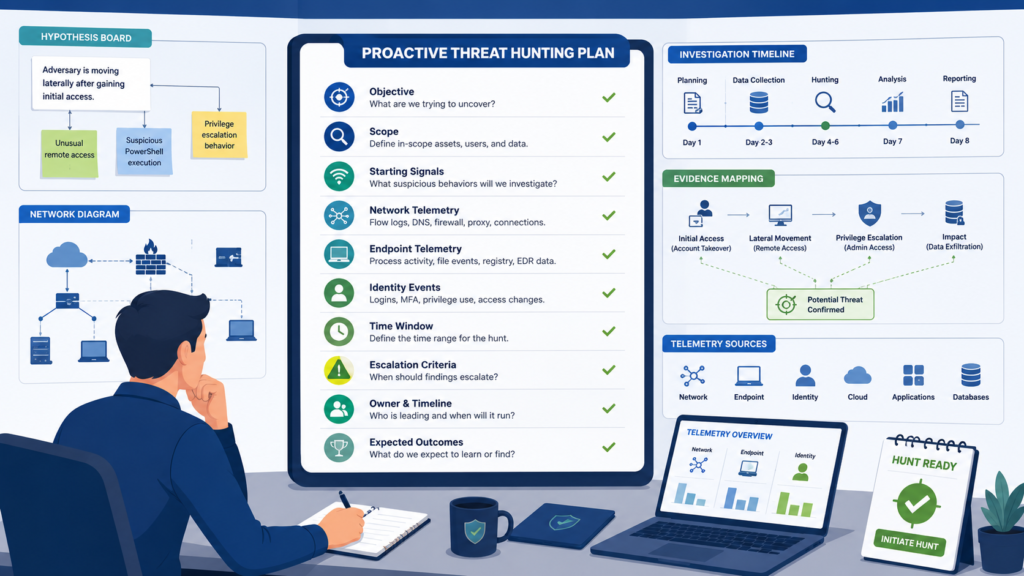
Before launching a hunt, we run a planning checklist:
- Objective: what attack stage or behavior we’re testing?
- Scope: which assets, users, or segments?
- Starting signals: what triggers the hunt (Network Threat Detection first)?
- Evidence checklist: which IoA indicators confirm/refute?
- Time window: how far back are we investigating?
- Escalation criteria: what triggers incident response?
- Owner & timeline: who does what, by when?
- Outcome definition: what results count as success?
This checklist prevents chaotic execution. It also makes it easier for leadership and investigators to align on “why we’re hunting” and “what success means.”
FAQs
What’s the difference between threat hunting and proactive threat hunting?
Threat hunting is often reactive to suspicions or findings. Proactive threat hunting is structured around hypotheses and seeks suspicious behavior before it escalates into confirmed incidents.
Do we need full coverage of IoA telemetry to start?
No. We can start with partial coverage, but we should ensure we don’t overclaim. We use Network Threat Detection first to establish context, then correlate with whatever IoA signals we have.
How do we prevent proactive hunting from becoming alert fatigue?
We narrow scope, define testable hypotheses, and require an evidence checklist for conclusions. We also tune playbooks based on past outcomes to reduce repeated noise.
What’s a good first “hunt playbook” to implement?
Start with a behavior that maps to a common attacker goal: reconnaissance-like traffic, suspicious authentication sequences, or lateral movement patterns. Then build the evidence checklist so analysts can validate quickly.
Turning IoAs Into Actionable Threat Hunting
Leveraging IoAs proactive threat hunting is about turning attack behavior into a repeatable investigation process, one that starts early, correlates evidence, and supports faster decisions.
To strengthen your proactive threat hunting program with real-time threat modeling, automated risk analysis, MITRE ATT&CK mapping, and continuously updated threat intelligence, join Network Threat Detection.
References
- https://ieeexplore.ieee.org/document/10713082
- https://www.nature.com/articles/s41598-025-24936-2?utm_campaign=do-you-have-a-wtf-notebook&utm_medium=email&utm_source=handpickedberlin