

When choosing a syslog solution, many teams face the same question: syslog-ng or rsyslog? Both are powerful, widely used, and capable of handling enterprise logging needs. However, from our experience, the difference becomes clear when you consider scale, flexibility, and parsing requirements.
The right choice can significantly impact performance and visibility, especially when integrated with Network Threat Detection. In this article, we break down their differences, strengths, and real-world use cases. Keep reading to find the best fit for your environment and to know syslog ng vs rsyslog comparison.
Key Insights On Syslog Ng Vs Rsyslog Comparison
Before diving deeper, here are the essentials:
- Both support centralized logging
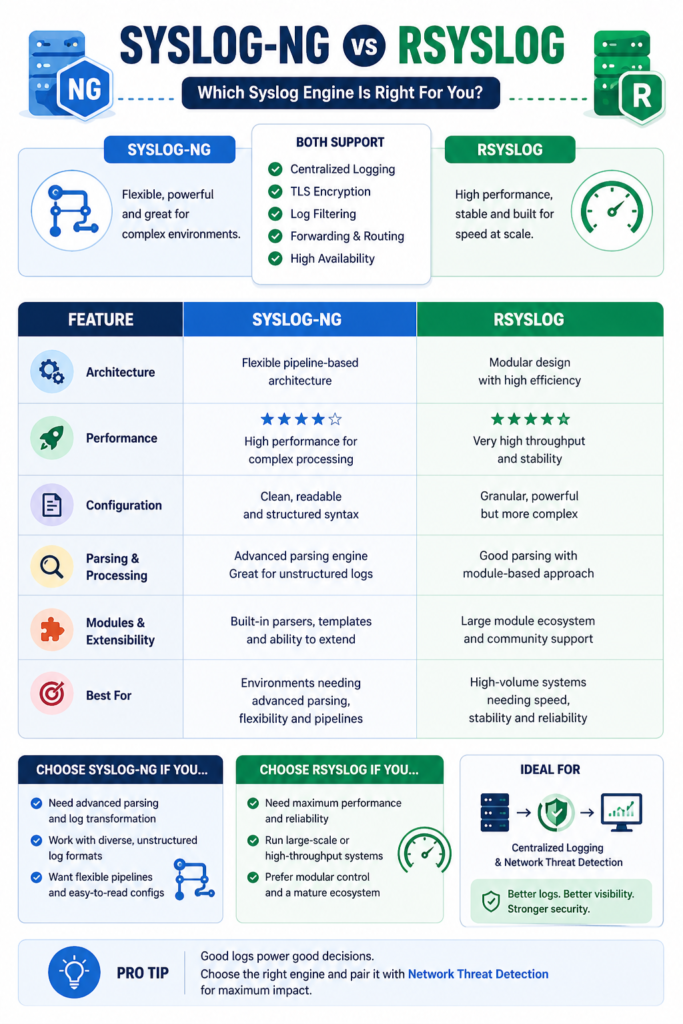
- syslog-ng excels in parsing and flexibility
- rsyslog offers high performance and stability
Core Differences Between Syslog Ng And Rsyslog

At a high level, both tools serve the same purpose but differ in approach. While both adhere to the standard syslog protocol, they manage the underlying syslog configuration through different syntax styles.
| Aspect | syslog-ng | rsyslog |
| Architecture | Flexible pipelines | Modular system |
| Performance | High | Very high (optimized) |
| Parsing | Advanced | Moderate |
| Configuration | Cleaner syntax | More granular |
| Use Case | Complex environments | Traditional setups |
We’ve seen organizations prefer rsyslog for stability, while syslog-ng is chosen for advanced log processing.
Performance And Scalability Comparison
Performance matters when dealing with large log volumes.
- rsyslog is highly optimized for speed
- syslog-ng handles complex pipelines efficiently
- Both support multi-threading
- Disk buffering available in both
From our deployments, rsyslog performs exceptionally well in high-throughput environments, while syslog-ng shines when logs require transformation before storage.
Configuration And Ease Of Use
Credits: Roel Van de Paar
Configuration style can impact operational efficiency.
- syslog-ng uses structured and readable syntax
- rsyslog uses modular but sometimes complex rules
- Both allow flexible routing and filtering
Teams with less experience often find syslog-ng easier to manage, while advanced users appreciate rsyslog’s fine-grained control.
Parsing And Log Processing Capabilities
Parsing is where syslog-ng often stands out. Efficiency here is vital because the syslog message format can vary wildly between vendors, and correctly identifying severity levels ensures critical alerts aren’t missed during the normalization process.
- syslog-ng supports powerful parsing engines
- rsyslog supports parsing via modules
- syslog-ng simplifies unstructured log handling
“Syslog is used for message logging and supports various implementations for processing logs.” – Wikipedia
In environments with diverse log formats, syslog-ng provides more flexibility for normalization.
Security And TLS Support
Both solutions support secure logging.
- TLS encryption available in both
- Authentication mechanisms supported
- Secure forwarding capabilities
“Transport Layer Security (TLS) provides secure communication over a network.” – Wikipedia
In our experience, security depends more on configuration than the tool itself.
Integration With Central Logging And Detection
Central logging plays a critical role in visibility. The process begins with configuring devices
at the edge to send syslog messages securely to your central aggregator, where either tool can then perform correlation across the network.
- Both integrate with centralized syslog servers
- Support for log forwarding and aggregation
- Enable correlation across systems
We often position Network Threat Detection as the first layer of insight, where centralized logs from either tool feed detection systems for faster response.
Handling High Log Volume And Storage
Managing large log volumes is a common challenge.
- rsyslog handles high throughput efficiently
- syslog-ng manages complex processing pipelines
- Both support log rotation and buffering
Without proper filtering and storage strategies, either tool can become overwhelmed.
When To Choose Syslog Ng
Choose syslog-ng when:
- You need advanced parsing
- Logs are highly unstructured
- You require flexible pipelines
- Readability of config is important
It’s ideal for modern, dynamic environments with diverse data sources.
When To Choose Rsyslog

Choose rsyslog when:
- Performance is the top priority
- You need proven stability
- Infrastructure is traditional
- You require extensive module support
It works well in large-scale, performance-focused systems.
FAQ
Which Is Better For Beginners?
syslog-ng is generally easier for beginners due to its cleaner configuration syntax. However, rsyslog provides deeper control once users become more experienced.
Is There A Performance Difference Between The Two?
Yes, rsyslog is often faster in high-throughput environments. However, syslog-ng compensates with better processing and parsing capabilities.
Can Both Tools Support Secure Logging?
Yes, both support TLS encryption and secure log forwarding. Security effectiveness depends on how well the configuration is implemented.
Which One Is Better For Security Monitoring?
Both are suitable, but the real value comes when integrated with centralized logging and Network Threat Detection, enabling faster identification of suspicious activity.
Final Insight On Syslog Ng Vs Rsyslog Comparison
Choosing between syslog-ng and rsyslog depends on your infrastructure. Rsyslog excels in high-performance environments prioritizing stability and low footprint. Conversely, syslog-ng offers superior flexibility with advanced parsing and multi-destination routing.
For maximum security, pair your choice with proactive monitoring to bridge the gap between log collection and active defense. Evaluate your scale and complexity to ensure long-term visibility. Strengthen your security posture today by integrating these tools with Network Threat Detection.
References
- https://en.wikipedia.org/wiki/Syslog
- https://en.wikipedia.org/wiki/Transport_Layer_Security