
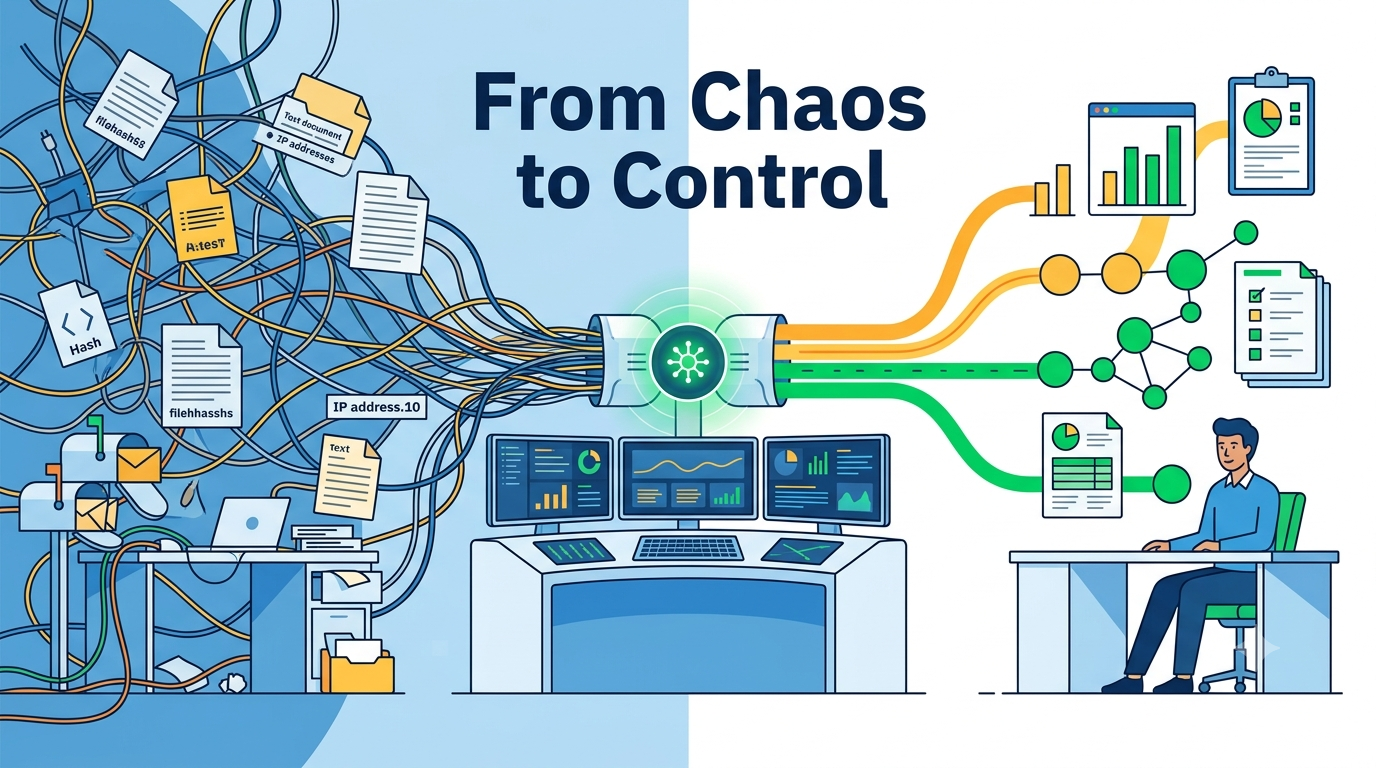
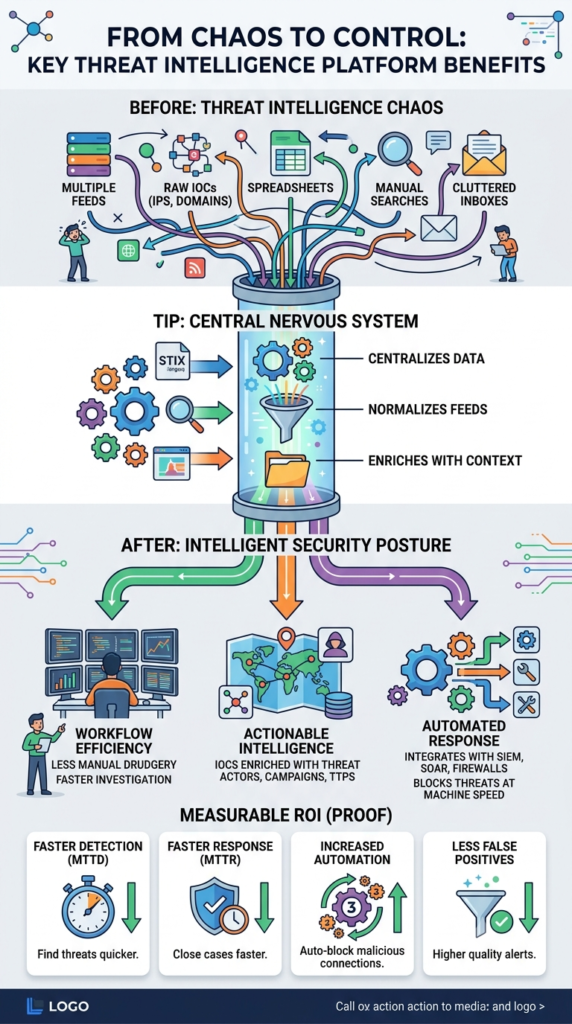
You have threat feeds. Maybe too many. They fill spreadsheets, clutter inboxes, and create more work than they prevent. This is the chaos a threat intelligence platform benefits solves. It’s not just another tool; it’s the central nervous system for your threat data.
From our own shift at Network Threat Detection from manual processes to a unified platform, the benefit wasn’t more information, it was usable intelligence. A TIP takes in the raw noise, finds the signal, and pushes it directly to the systems and people who need it. Keep reading to see how it transforms your security posture from reactive to intelligent.
What You’ll Learn
Managing threat data shouldn’t be a full-time administrative burden. Here is a quick snapshot of how a modern platform changes the game for your SOC:
- A TIP automates the collection and normalization of disparate feeds, freeing analysts from manual data wrangling.
- It adds critical context to raw indicators, turning simple IOCs into rich, actionable intelligence.
- The platform enables automated response by seamlessly integrating intelligence with security controls like SIEM and network tools.
How Does a TIP Turn Raw Feeds into Actionable Intelligence?
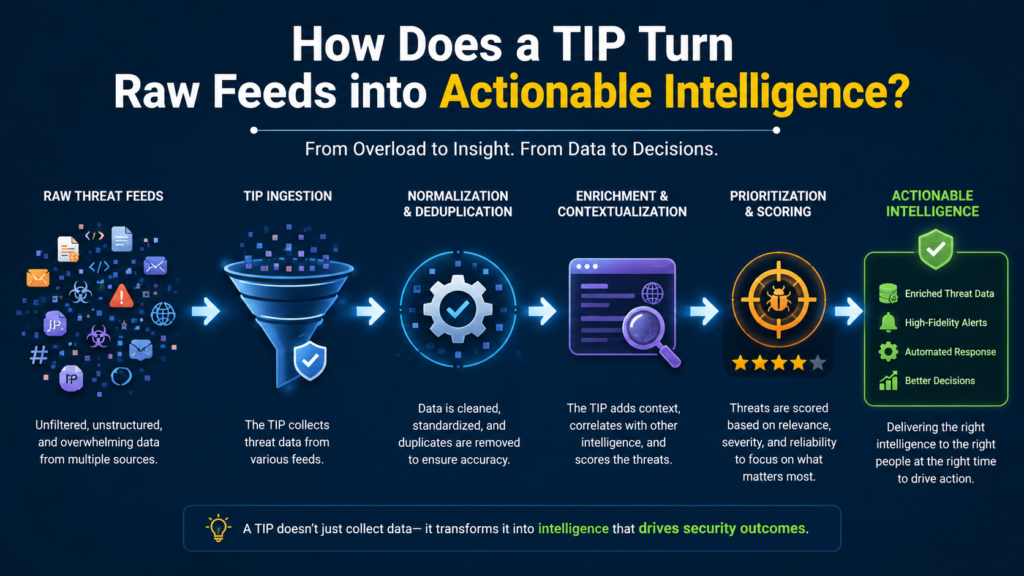
Raw threat feeds are just data. Whether you are leveraging threat intelligence feeds from external providers or your own telemetry, a list of IPs, domains, and file hashes without context is a burden. A Threat Intelligence Platform’s first job is to turn this data into intelligence by adding layers of meaning.
Imagine pulling in twenty different feeds, each with its own format. The TIP normalizes this into a single, structured language like STIX. Then, it enriches each indicator.
What does enrichment look like? That suspicious IP isn’t just an IP anymore. The TIP might tag it with the associated malware family, the campaign name, the target industries, and the geographic origin. It might link it to other related indicators from past campaigns.
This process transforms “192.0.2.1” into “IP used by Lazarus Group in Operation Dream Job targeting financial institutions, first seen 72 hours ago.” That’s intelligence an analyst can use. Without a platform, this enrichment is a manual, slow process. With it, it’s automated and consistent, giving every alert immediate context.
What Are the Core Workflow Benefits for Security Teams?
The daily grind for an analyst without a TIP is brutal. It involves checking multiple dashboards, reconciling spreadsheets, and trying to mentally correlate data.
“Raw data is not intelligence. Intelligence is data that has been processed, validated, and given context. A threat intelligence platform is what bridges those two things. – Analyst1
A platform streamlines this into a single workflow. All intelligence is centralized. When a new phishing campaign emerges, the analyst goes to one place to see all related IOCs, reports, and internal matches.
The real workflow benefit is in investigation and response. Say your SIEM flags an internal device connecting to a known bad domain. With a TIP integrated, that SIEM alert can be automatically enriched.
The analyst sees not just the connection, but that the domain is linked to a specific ransomware-as-a-service group, what their typical next steps are, and recommended containment actions. This cuts investigation time from hours to minutes.
How Does a TIP Improve Integration and Automation?
A platform’s power is unlocked through integration. A TIP isn’t meant to be a silo, it’s designed as a hub, often serving as the central engine for open source threat intelligence tools that feed into your defense architecture.
This is where you realize operational benefits. You can configure the TIP to send high-confidence indicators of compromise (IOCs) directly to your enforcement points.
For us, a key integration was with our network detection systems. The TIP could be configured to automatically push feeds of malicious IPs and domains to our sensors. This created a proactive block layer at the network perimeter, stopping threats before they could call home or download payloads. Other critical integrations include:
- SIEM/SOAR: Enriching alerts and triggering automated playbooks.
- Firewalls & Proxies: Updating block lists in near real-time.
- Endpoint Protection: Distributing malicious file hashes for detection.
This automation ensures intelligence is acted upon at machine speed, not human speed, which is essential given the short lifespan of many IOCs.
How Does It Help Manage Different Types of Threat Intelligence?
Credits: Adam Goss
Threat intelligence comes in layers: strategic, tactical, and operational. A platform allows you to effectively categorize the various types of threat intelligence feeds and IOCs, ensuring each audience gets the level of detail they need.
A TIP structures it. Strategic intelligence, reports on adversary motives and trends, is stored and tagged for leadership reviews. Tactical intelligence, the tools and procedures (TTPs) of attackers, is linked to relevant IOCs and made searchable for analysts.
Operational intelligence, the IOCs themselves, is the platform’s bread and butter. The TIP allows you to apply granular tags and taxonomies. You can filter to see only IOCs relevant to your industry, or only those associated with a specific threat actor you’re tracking. This management capability prevents alert fatigue.
| Intelligence Type | TIP Function | Benefit |
| Strategic | Centralized repository, reporting dashboards. | Informs leadership risk decisions and budget. |
| Tactical | TTP library, linked to campaigns and IOCs. | Guides proactive hunting and detection engineering. |
| Operational | Automated IOC ingestion, enrichment, sharing. | Enables real-time blocking and alert enrichment. |
What Are the Tangible Benefits for Measuring ROI?
Justifying any security spend requires proof. A TIP provides the data to measure your threat intelligence program’s effectiveness. You move from vague feelings to concrete metrics. You can track the volume of IOCs ingested and automated blocks executed. More importantly, you can measure impact on security operations.
Key ROI metrics include:
- Reduction in Mean Time to Detect (MTTD): Are you finding threats faster due to better-integrated intelligence?
- Reduction in Mean Time to Respond (MTTR): Does enriched context help analysts close cases quicker?
- Increase in Automated Actions: How many malicious connections were blocked automatically via TIP integrations?
- Decrease in False Positives: After tuning feeds for relevance in the TIP, does your alert quality improve?
These metrics demonstrate that the platform isn’t just a cost center, it’s a force multiplier that makes your existing team and tools more efficient and effective.
How Does a TIP Overcome the Challenges of Operationalizing Intelligence?
The gap between having intelligence and using it is wide. Common challenges include data overload, lack of context, and slow manual processes. A TIP is specifically built to bridge this gap. It tackles data overload through filtering and prioritization, allowing teams to focus on high-relevance, high-confidence indicators.
The lack of context is solved by the enrichment engine, linking IOCs to campaigns and threat actors. Slow processes are automated. The platform handles the repetitive tasks of collection, normalization, and distribution.
This lets human analysts do what they’re best at: critical thinking, investigation, and strategic hunting. In our experience, the shift was from spending 70% of time on data management to spending 70% on actual analysis and response. That’s the operationalization benefit in a nutshell.
How Do Standards Like STIX/TAXII Amplify a TIP’s Value?
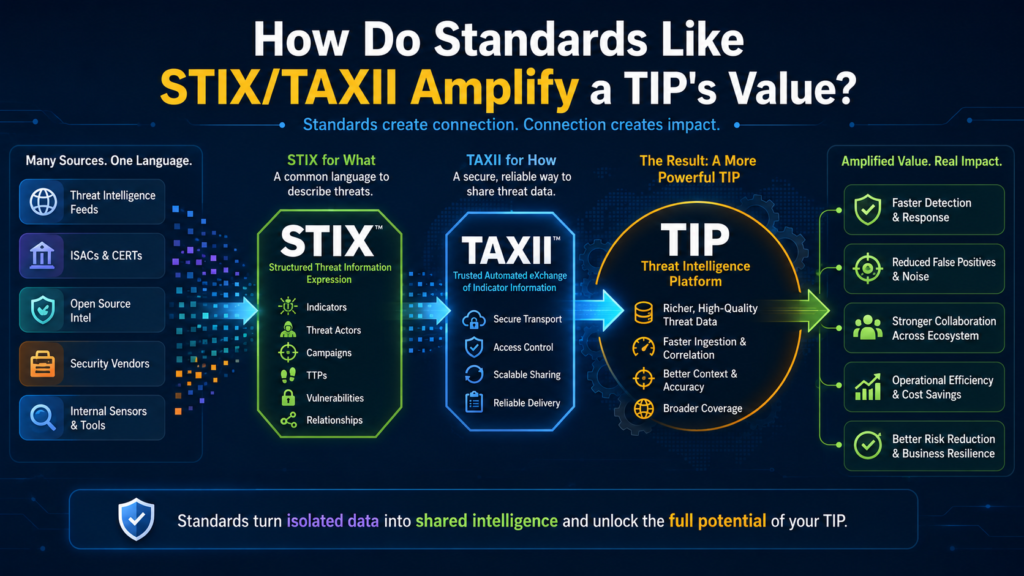
STIX and TAXII are the universal translators of the threat intelligence world. A TIP that fully embraces these standards becomes a powerful interoperability hub. STIX provides a common language for describing threats in a rich, structured way. TAXII defines how to share those STIX packages.
“Visibility is no longer a defense… simply seeing threats isn’t enough; platforms must bridge the ‘Intelligence-to-Action Gap’ to stop machine-speed attacks.” – Cyware
This means your TIP can easily consume feeds from external partners, government agencies (like CISA’s Automated Indicator Sharing), and open source communities. Conversely, it can share your own curated intelligence with trusted partners in a standardized format.
This breaks down data silos and creates a collaborative defense network. The TIP manages these exchanges seamlessly, ensuring you benefit from collective knowledge without manual effort.
FAQ
Can open source tools provide the same benefits as a commercial TIP?
They can provide similar core functions, like aggregation and sharing, especially with a tool like MISP. However, a commercial TIP typically offers greater scalability, deeper out-of-the-box integrations with enterprise security tools, professional support, and more advanced analytics and automation features. Open source requires more hands-on build and maintenance effort.
How does a TIP differ from a SIEM?
They are complementary. A SIEM is an aggregator and correlator of internal security events (logs). A TIP is an aggregator and enricher of external threat data. The ideal setup integrates them: the TIP feeds enriched threat context into the SIEM, making internal alerts smarter and more actionable.
Is a TIP only for large enterprises?
Not necessarily. While large enterprises benefit greatly, the principles of centralized and actionable intelligence are valuable at any scale.
For smaller teams, the automation and workflow efficiency gains can be even more critical, as they often have limited analyst bandwidth. The key is choosing a platform or approach that matches your team’s size and complexity.
What’s the first step to implementing a TIP?
Start with a clear use case. Don’t just ingest every feed. Identify a key pain point, like reducing phishing impact or speeding up incident response. Then, use the TIP to centralize and automate the intelligence flow for that specific use case. Prove the value there, then expand to other areas. This focused approach ensures early success and clear ROI.
Centralizing Your Threat Intelligence Strategy
The true benefit of a threat intelligence platform is the transformation of your security operations from reactive to proactive. By automating data processing and integrating with your tools, a TIP ensures intelligence is operationalized.
Stop wrestling with manual data. Join Network Threat Detection to eliminate blind spots. Our platform offers real-time threat modeling, automated risk analysis, and MITRE ATT&CK mapping, empowering your SOC to prioritize risks and strengthen network defenses confidently.
References
- https://analyst1.com/cyberpedia/what-is-a-threat-intelligence-platform/
- https://www.cyware.com/blog/the-tip-that-closes-the-loop-how-cyware-goes-beyond-visibility