

You’re probably gathering threat intelligence feeds, but are they just noise? The real challenge isn’t collecting Indicators of Compromise (IOCs), it’s making them work for you before an attack hits. Network Threat Detection watched teams drown in data, chasing alerts that arrived too late. It’s a reactive cycle that leaves you exposed.
True security starts when you move from reading reports to operationalizing intelligence directly in your environment. This shift turns abstract threat data into a concrete, automated defense. It’s what separates a target from a hardened network. Keep reading to see how to filter types threat intelligence feeds indicators iocs, rather than just responds.
The Essentials: Quick Wins for Proactive Defense
Here are three critical realities every security team must navigate to successfully turn raw data into actionable network threat detection:
- Not all IOCs are equal. Strategic feeds focused on your specific industry and tech stack provide far more value than generic, high-volume lists.
- Context is everything. An IP address is just a number until you know if it’s targeting your financial software or if it’s already inside your network.
- Automation is non-negotiable. Manually checking feeds is a losing game. The power comes from integrating IOCs directly into your detection systems.
Why Do Static Lists Fall Short?
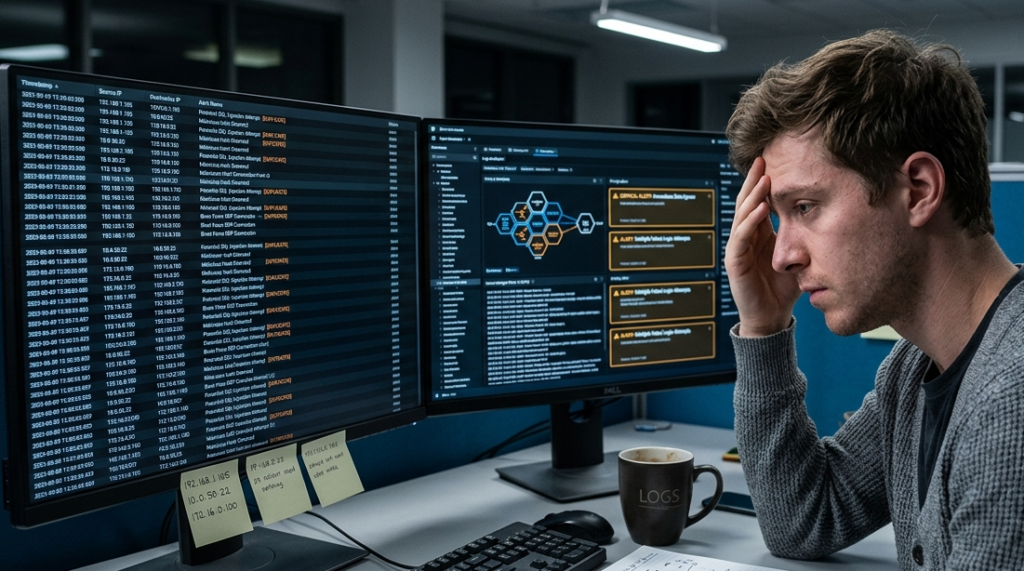
We used to think a bigger list was a better list. We’d download these massive repositories of malicious IPs and hashes, feeling a sense of security. The volume was impressive, thousands of new entries a day. But the alerts, they were endless and mostly useless. Our team was chasing ghosts, blocking IPs from defunct botnets or irrelevant malware families.
“A detection stack filled with overlapping intelligence does not become stronger, it becomes harder to manage and less precise. Threat Intelligence Feeds must be evaluated before being operationalized. Is the feed itself valuable?” – TIFCE
It created fatigue, a real numbness to alerts. The system cried wolf so often that a real threat could have slipped right by. We learned a hard lesson: an IOC without context is just data, not intelligence. It has to mean something to your specific world.
What Makes a Feed Valuable?
So what separates a good feed from a bad one? It’s not the count. First, relevance is king. A feed tailored to the healthcare sector is useless to a gaming company, their threat actors are entirely different. Second, timeliness.
An IOC published 48 hours after a campaign started is often too late, the damage is done. Security teams find that leveraging threat intelligence feeds effectively means prioritizing real-time data to minimize this exposure.
The best feeds provide data in near real-time. Third, enrichment. A feed that just gives you an IP address is handing you a puzzle piece. A good feed tells you who’s behind it, what they’re after, and what tools they use. That’s the story you need.
- Relevance to your industry and assets
- Speed of delivery and updates
- Depth of contextual enrichment
This is where network-level detection changes the game. By analyzing traffic patterns and protocol behaviors, it can spot threats that never match a known IOC. It sees the anomaly, the lateral movement, the command-and-control callback that doesn’t look right.
How Do You Operationalize IOCs from Data to Defense?
Collecting feeds is step one. Making them work is where security happens. This process, called operationalization, is the integration of IOCs into your security tools. Maximizing threat intelligence platform benefits requires converting raw indicators into automated blocklists across your infrastructure.
Maximizing your threat intelligence platform benefits requires converting raw indicators into automated blocklists across your infrastructure. The goal is automated blocking and alerting. You can’t have a human review every new indicator.
A new malicious domain hits the feed, and within minutes, it’s blocked at the perimeter. This closes the window of exposure dramatically. It’s a force multiplier for your team.
We integrated our curated feeds directly into our Network Threat Detection sensors. The result wasn’t just more alerts, it was smarter, faster responses because the intelligence was acting where the traffic flows.
Which Type of Threat Feed Do You Need: Strategic, Tactical, or Operational?
Threat intelligence operates at three levels, and each serves a different purpose. Understanding this stops you from using the wrong tool for the job. Strategic intelligence is the high-level view. It’s for your executives, discussing the motivations of a state-sponsored actor or long-term trends in ransomware. It informs budget and policy.
Tactical intelligence describes the how. It’s the techniques, procedures, and tools (TTPs) adversaries use. This is gold for your security analysts and threat hunters, helping them understand an attacker’s playbook.
Operational intelligence is the most immediate. These are the specific IOCs: the hashes, IPs, and domains used in active campaigns. This is the data you automate into your technical controls.
- Strategic: The “why” and “who” for leadership.
- Tactical: The “how” for analysts and hunters.
- Operational: The “what” for automated tools.
Most organizations focus only on operational feeds, missing the bigger picture that tactical and strategic intelligence provides for a robust defense.
How Can You Evaluate Threat Intelligence Feeds Effectively?
How do you choose? Don’t just sign up for every free feed. Start with an audit. What are your critical assets? What industry are you in? Map your needs first. Then, evaluate potential feeds against clear criteria. We built a simple scoring system that forced us to look past marketing claims.
We asked for samples, we tested integration ease, and we measured signal-to-noise ratio in a test environment over a month. It was eye-opening. Some premium feeds were worse than free ones for our specific profile. The table below breaks down the core evaluation pillars we use.
| Evaluation Pillar | What to Look For | Why It Matters |
| Relevance & Coverage | Focus on your industry, region, and technology stack. | Eliminates irrelevant noise, focuses resources on likely threats. |
| Timeliness & Frequency | Update rate (e.g., real-time, hourly) and historical data provided. | Reduces the window of exposure for new attack campaigns. |
| Context & Enrichment | Details on threat actors, campaigns, TTPs, and confidence scoring. | Turns data into actionable intelligence for investigation and hunting. |
| Delivery & Integration | Easy API access, compatibility with your SIEM, firewall, or NTD platform. | Enables automation, which is critical for scaling defense. |
| Source Reliability | Transparency on collection methods (honeypots, sinkholes, etc.). | Affects your trust in the data and its false positive/negative rate. |
Building Your Intelligence Cycle
Credits: Adam Goss
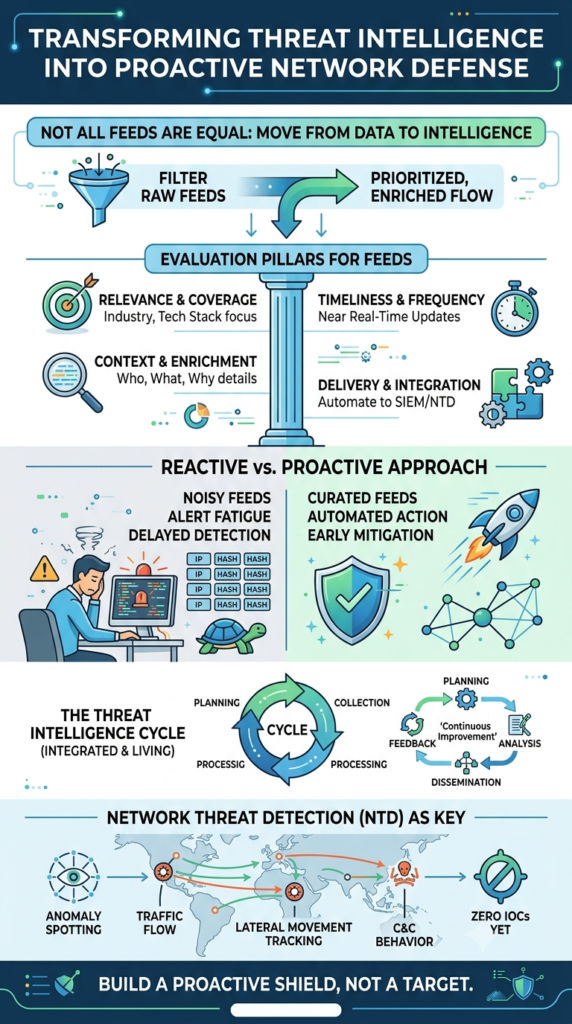
Threat intelligence isn’t a product you buy, it’s a process you build. It’s a cycle. You start with planning and direction, what do you need to know? Then you collect data from your chosen feeds and internal sources. Next is processing, turning that raw data into a usable format. Analysis is the crucial step, adding context and meaning.
The output is dissemination, getting that intelligence to the right people and tools. Finally, you get feedback and refine your needs. This cycle turns a static procurement into a living, breathing function.
Our own cycle hinges on Network Threat Detection as a primary collection and feedback point, showing us what’s actually attempting to traverse our environment.
The Human Element in the Loop
Automation is vital, but the human analyst is irreplaceable. They provide the intuition, the curiosity, the ability to connect disparate dots that a machine might miss. The goal of good intelligence feeds and tools is to make the human’s job more insightful, not obsolete. It’s about freeing them from sifting through mundane alerts to pursue complex hunts.
“Operationalized threat intelligence is intelligence that automatically flows from collection through enrichment to detection and response with minimal friction at each handoff. Contextual enrichment at ingestion time, each indicator arrives with metadata… Analysts immediately know whether an IP is linked to a ransomware group targeting their sector or to low-confidence commodity spam infrastructure.” – HEAL Security
We train our team to question the intelligence, to understand the context behind an IOC. Why is this actor targeting us now? What’s their next likely move? This strategic thinking is what turns a good security program into a great one.
Common Pitfalls and How to Avoid Them?

Many teams stumble in predictable ways. The first is feed overload. Subscribing to too many sources creates a data deluge that paralyzes your team. Relying purely on community data or basic open source threat intelligence tools can sometimes worsen this noise if they aren’t filtered carefully.
Start with two or three high-quality, relevant feeds. The second is lack of integration. If your IOCs sit in a PDF report, they provide zero defensive value.
Prioritize feeds with easy, automated ingestion. The third is ignoring internal data. Your own firewall logs, DNS queries, and endpoint alerts are a treasure trove of intelligence about what’s normal for your network. Use it to validate external feeds.
Finally, failing to review and tune. Your needs change, feeds change. Regularly review what’s alerting and why, and prune rules that no longer serve you.
FAQ
What’s the difference between an IOC and a TTP?
An Indicator of Compromise (IOC) is a forensic artifact, like a malicious file hash or IP address. A Tactic, Technique, and Procedure (TTP) describes the adversary’s behavior and methodology, like how they gain initial access or move laterally. IOCs are for blocking; TTPs are for hunting.
Can I rely solely on open-source threat intelligence feeds?
You can start with them, and they provide great value. However, they often lack the speed, consistency, and deep context of commercial feeds. A blended approach, using curated open-source feeds for breadth and a premium feed for critical, timely intelligence, is a common strategy.
How do I measure the ROI of a threat intelligence feed?
Don’t measure by the number of IOCs. Look at metrics like mean time to detect (MTTD) and mean time to respond (MTTR). A good feed should lower both. Also, track the reduction in false positives and the increase in validated, high-severity alerts your team can act on.
Why is network-level detection important for threat intelligence?
It provides a unique vantage point. Many modern attacks use encryption or fileless techniques that evade endpoint logs. Network Threat Detection sees the communication, the patterns, and the anomalies in raw traffic, identifying threats that have no known IOC yet, making your intelligence proactive.
Making Intelligence Your Foundation
Ready to stop chasing alerts and start anticipating threats?Network Threat Detection empowers cybersecurity teams to proactively defend networks with real-time threat modeling, automated risk analysis, and continuous intelligence updates.
Built for SOCs and CISOs, the platform features visual attack path simulations, CVE mapping, and executive reports mapped to frameworks like MITRE ATT&CK. Uncover critical blind spots, streamline vulnerability management, and reduce response times before attackers strike.
References
- https://zenodo.org/records/18208974
- https://healsecurity.com/operationalizing-threat-intelligence-bridging-the-gap-between-feed-data-and-soc-action/