

PASTA (Process for Attack Simulation and Threat Analysis) is a seven-step method that maps security threats directly to business impact. It simulates attacker behavior against your systems to reveal both technical vulnerabilities and the potential cost to critical assets.
By combining telemetry and monitoring data, PASTA shows not just where a breach could occur, but how it would affect operations, finances, and decision-making. Over the past five years at the Cyber Defense Academy, hundreds of DevSecOps students have practiced this approach in live labs.
Follow this guide to learn the exact steps for translating threats into business risk, keep reading to see how.
Understanding PASTA Threat Modeling
PASTA links attacker-focused risk analysis to business impact, showing how technical vulnerabilities translate to contextual data enrichment for enterprise risk analysis.
- Co-created by Marco Morana & Tony UcedaVelez, 2012
- Focuses on risk-centric, attacker-oriented threat modeling
- Connects technical vulnerabilities to enterprise business impact
Stage 1: Defines Critical Business Assets and Compliance Goals

We always start with the big picture. Before analyzing anything technical, we identify what the organization cannot afford to lose. Stage 1 is about uncovering the “Crown Jewels.”
This includes intellectual property, customer data, and systems that generate revenue. Compliance also plays a major role. Regulations like GDPR, HIPAA, and PCI-DSS shape what must be protected.
In our bootcamp labs, teams are often surprised by what they realize is business-critical. They might assume a system is low priority, but Stage 1 analysis often shows otherwise.
We walk students through mapping assets to business impact, showing how misalignment can leave vulnerabilities unaddressed. This stage grounds the threat model in real priorities rather than just technical checklists.
Stage 2: Maps the Technical Scope to Expose Attack Surfaces
Once the assets are clear, we move to the technical landscape. Stage 2 focuses on cataloging every system component, network segment, cloud service, and third-party API. This stage may incorporate automating data enrichment from telemetry to improve visibility.
They show us hidden connections, legacy endpoints, and external dependencies that might otherwise go unnoticed.
We’ve seen teams underestimate this stage repeatedly. One overlooked server, one forgotten API, and suddenly a theoretical risk becomes very real. Mapping everything is not glamorous, but it is crucial. It forces teams to look beyond the obvious and ask, “Could an attacker reach this point without being detected?”
Stage 3: Breaks Down Application Architecture for Threat Analysis

Stage 3 is where we decompose the systems into visual maps. Data Flow Diagrams, trust boundaries, and interaction maps help teams see how information moves. This is where hidden weaknesses become visible.
In our experience, developers are often surprised by the complexity. Data might flow across environments without proper encryption. Trust boundaries may be weaker than expected.
Visualizing the architecture highlights these points in a way that words or spreadsheets cannot. Students in our labs often pause at this stage, realizing that what seemed like minor flaws could be exploited if left unchecked.
Stage 4: Uses Threat Intelligence to Focus on Real-World Attackers
We emphasize context. Stage 4 brings external intelligence into the process. Who might attack the organization? What methods are they using in the wild? Industry trends and breach history tell us which vulnerabilities are likely to be targeted.
It is easy to get lost in theoretical threats. We’ve guided teams who were initially focused on every possible weakness, only to learn that attackers consistently go after very specific points.
By prioritizing real-world threats, we make risk management practical and efficient. Seeing attack patterns, motivations, and capabilities helps teams focus on what truly matters.
Stage 5: Evaluates Internal Weaknesses and Vulnerabilities
After understanding assets and attacker priorities, we turn inward. Stage 5 is about finding exploitable gaps. Static and dynamic analysis, software composition checks, and architecture reviews uncover weaknesses that could be leveraged in an attack.
We integrate results from NTD data sources and other testing tools to produce a clear picture of the organization’s vulnerabilities. In bootcamp labs, teams are often shocked to see minor misconfigurations leading to serious potential exploits.
Stage 5 transforms abstract weaknesses into something actionable, and connects them back to business priorities defined in Stage 1.
Stage 6: Simulates Attacks to Confirm Exploitability
Stage 6 is where theory meets practice. We take the flaws found in Stage 5 and build literal attack trees, which are visual flowcharts showing the path a hacker takes to break a system.
For example, in our lab, students map a path like this: Target: Database $\rightarrow$ Path: Unprotected API $\rightarrow$ Exploit: SQL Injection. If the student can successfully trace that path to a crown jewel asset, the risk is real, not theoretical.
Students in our labs see immediately how a flaw can compromise a high-value asset. One misconfigured API, one missing validation, and data is at risk. This stage helps prioritize mitigation by showing which vulnerabilities are not just theoretically exploitable but realistically dangerous. Watching the simulated attack unfold makes the risk tangible.
Stage 7: Converts Exploits Into Business Risk and Mitigation Strategies
Stage 7 is where all the analysis comes together. We take the vulnerabilities confirmed in Stage 6 and look at them through the lens of business impact. It’s not just about a technical flaw anymore.
Now, we ask, “What happens if this is exploited? Who feels it, financially or operationally?” We’ve seen teams underestimate risks before seeing them mapped to revenue-critical systems. Once they connect the dots, the urgency becomes clear. Some flaws that looked minor suddenly carry huge consequences.
We walk through probability, impact, and cost with students in labs. It is surprising how effective simple quantification is at shifting conversations with executives. Technical teams gain clarity, and decision-makers understand why a vulnerability cannot be ignored.
How Does PASTA Offer a Risk-Centric Advantage Over STRIDE and Other Frameworks?
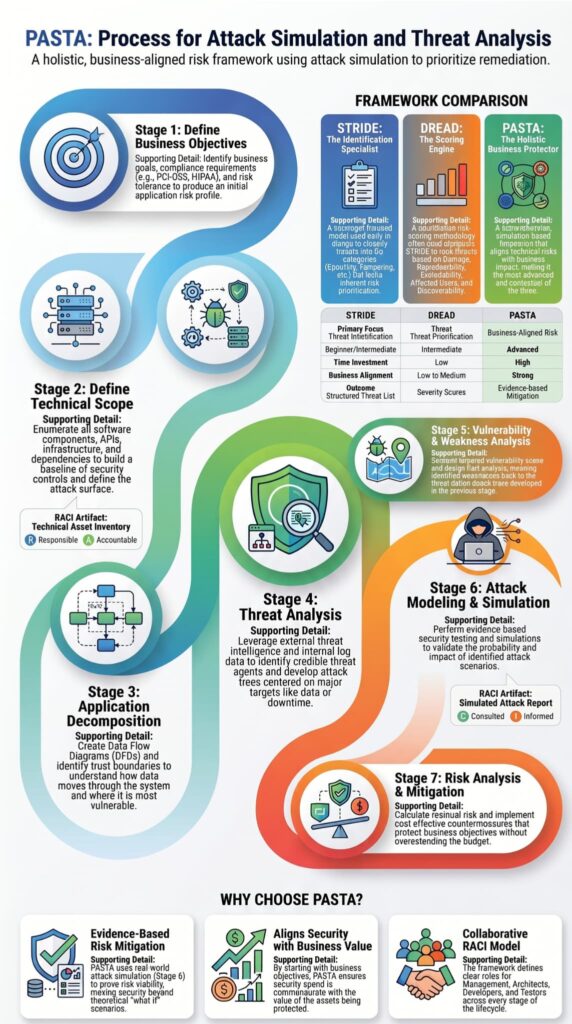
PASTA stands out because it links security directly to what the organization values.
“PASTA is a risk-centered threat modeling process that focuses on understanding first and foremost the business context and inherent risk profile of the application.” – Tony UcedaVélez & Marco M. Morana
STRIDE focuses on categorizing software threats, often used during design phases. PASTA is broader. It considers attacker behavior and business impact simultaneously.
We’ve worked with organizations that relied solely on STRIDE. Developers understood the code threats, but leadership struggled to prioritize what really mattered. PASTA bridges that gap.
By showing the potential business consequences of a vulnerability, teams make more strategic decisions about mitigation rather than just patching everything equally. It helps focus limited resources on what could actually cause the most harm.
Comparative Table
| Feature | PASTA | STRIDE |
| Primary Focus | Risk & Business Impact | Technical Software Flaws |
| Perspective | Attacker + Business Asset | Developer + Data Flow |
| Best Use | Commonly used in enterprise risk modeling | Common in application design threat modeling |
| Key Output | Prioritized business-risk countermeasures | List of localized technical vulnerabilities |
How Can Organizations Overcome Practical PASTA Implementation Challenges?

Implementing PASTA can feel overwhelming in large organizations. But it doesn’t have to slow development. We often advise starting incrementally. Define broad Stage 1 and Stage 2 scopes so teams know what matters most.
Then allow sprint teams to tackle localized Stage 3 to 5 analyses. This keeps security aligned with business goals while keeping developers productive.
Automation is another key factor. We use tools to generate Data Flow Diagrams directly from infrastructure-as-code pipelines or live logs. This saves time and ensures accuracy. Combining STRIDE results at the component level into PASTA stages also helps.
Teams can see how specific code issues feed into overall business risk. In our experience, even large enterprises can adopt PASTA without stopping day-to-day operations if they implement it carefully and iteratively.
How Can PASTA Be Integrated Into Enterprise Risk Management Programs?
“Threat modeling is a process by which potential threats … can be identified and enumerated, and countermeasures prioritized.” – Computers & Security
PASTA is most effective when it’s part of a larger risk management strategy. It should feed into enterprise-wide processes so that mitigation plans align with budgets, compliance, and operational priorities. We’ve seen teams struggle when PASTA outputs exist in isolation. Mapping risk to actual business impact changes that.
During labs, we simulate scenarios where teams must make trade-offs. Some risks can be accepted, others transferred or mitigated. It is an eye-opening exercise. And it emphasizes that PASTA is not about creating more reports; it is about making smarter, actionable decisions. Teams gain a better understanding of what to protect first and why.
FAQs
What makes PASTA threat modeling different from other frameworks?
PASTA stands out because it acts like a real adversary. Most security tools only look at internal software bugs. PASTA looks at the hacker’s actual goals. It combines system mapping with real-world threat reports. This process allows your security team and your business executives to speak the exact same language.
This methodology provides a seven-stage threat modeling process that integrates vulnerability assessment, risk impact analysis, and security control prioritization to guide scalable, evidence-based enterprise and software threat modeling.
How does the PASTA methodology align security with business objectives?
The PASTA methodology connects technical vulnerabilities to enterprise risk using a contextual security approach. By defining the technical scope, performing asset-centric threat modeling, and creating a priority threat inventory, teams ensure security risk mitigation aligns with business objectives.
Threat analysis stages, attack modeling, and security risk scoring guide security requirement definition and regulatory compliance, making PASTA effective for DevSecOps and project-specific cybersecurity risk management.
What steps are involved in the seven-stage PASTA framework?
The seven-stage PASTA framework includes application decomposition, threat analysis, vulnerability assessment, attack simulation, risk assessment, security control prioritization, and risk mitigation strategy.
Each stage builds upon the previous one to evaluate the probability of attack, likelihood assessment, and impact of compromise. This structured threat analysis process supports cross-team collaboration, comprehensive threat identification, and informed decisions for secure system and application architecture.
How can PASTA threat modeling improve software and application security?
PASTA threat modeling identifies security weaknesses, evaluates vulnerabilities, and prioritizes countermeasures for software and applications. Threat actor modeling, attack surface analysis, and threat simulation reveal potential exploits.
By combining technical scope definition, threat cataloging, and security risk management, PASTA guides security architecture analysis, evidence-based mitigation, and threat prioritization, ensuring enterprise systems are protected while maintaining a scalable, customizable security framework.
What best practices ensure effective PASTA threat modeling implementation?
Effective PASTA threat modeling requires cross-team collaboration, continuous threat catalog updates, and prioritization of high-impact vulnerabilities. Integrating risk assessment frameworks, attacker perspective analysis, and alignment of security objectives strengthens threat mitigation strategies.
Regular threat modeling audits, using attack tree modeling and data flow diagram security, and following PASTA methodology and OWASP threat modeling standards ensures continuous improvement of defended systems and enterprise cybersecurity risk management.
Make Network Defense Simple and Effective
Waiting until an attack hits is risky, and you know the pressure is real. Every blind spot slows response and leaves sensitive data exposed, you can’t afford gaps in your defense.
Network Threat Detection gives your team real-time visibility and actionable insights. With automated risk analysis, attack path simulations, and executive-ready reports, you can prioritize threats quickly and confidently.
Whether for SOCs, analysts, or CISOs, the platform makes defending networks faster, smarter, and less stressful, so you can stay ahead of attackers instead of scrambling after them.
References
- https://www.sciencedirect.com/science/article/pii/S0167404818307478
- https://onlinelibrary.wiley.com/doi/book/10.1002/9781118988374