
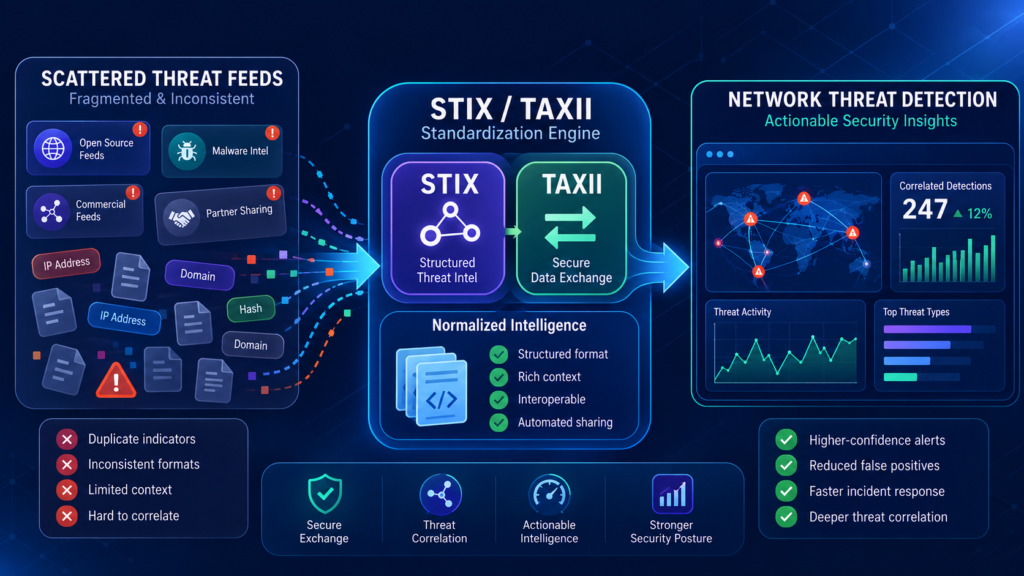
Threat intelligence becomes far more valuable when everyone can understand and exchange it consistently. That’s where STIX TAXII standards threat intel sharing comes in.
We have seen how adopting these standards helps security teams organize indicators, automate intelligence exchange, and strengthen Network Threat Detection without adding unnecessary complexity. Keep reading to see how STIX and TAXII work together in real-world security operations.
What You’ll Learn
Understanding STIX and TAXII does not require rebuilding your security program overnight. They simply provide a standardized way to represent and exchange threat intelligence, making collaboration easier and automation more effective.
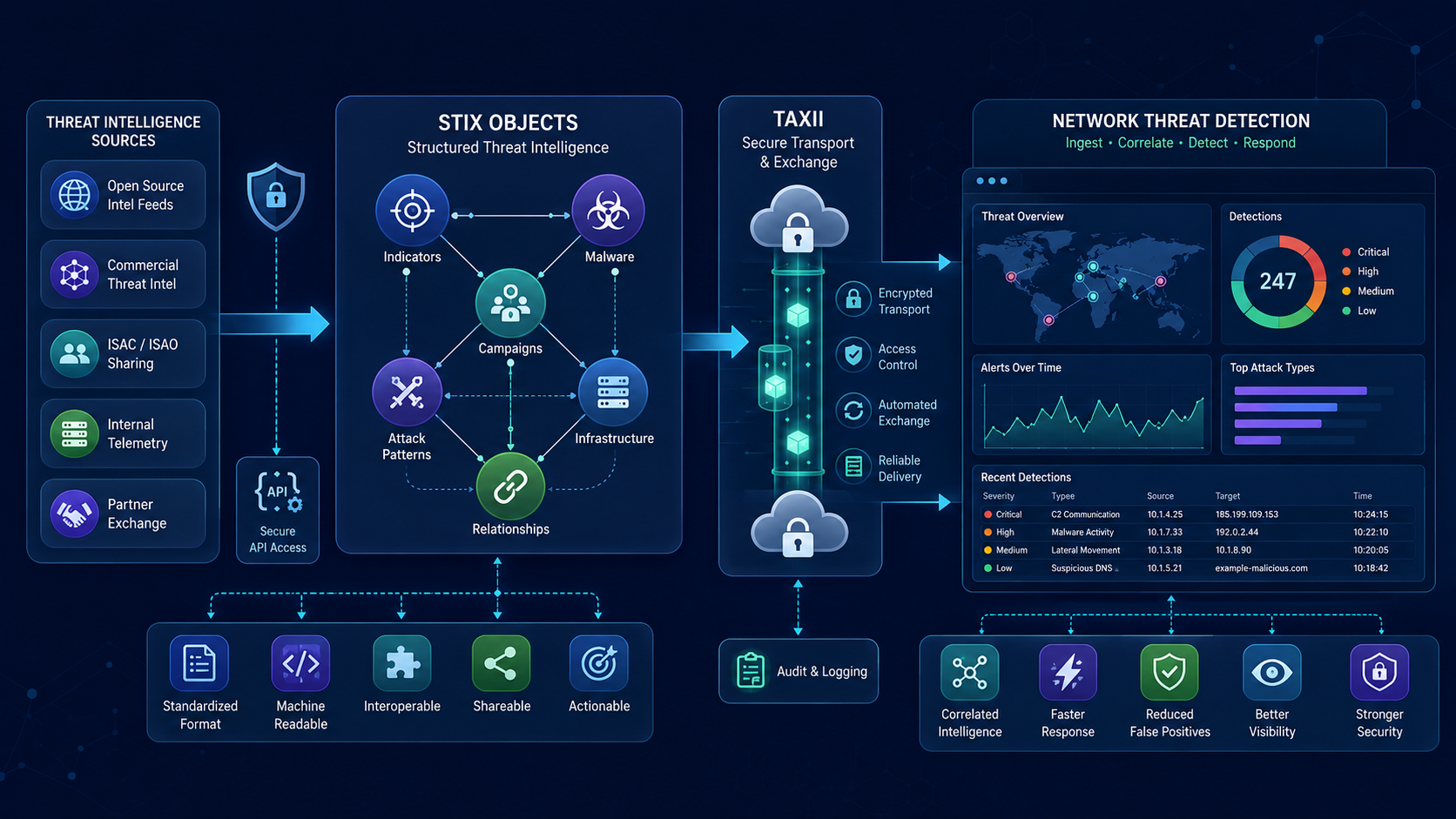
- STIX standardizes threat intelligence into machine-readable objects, including indicators, malware, campaigns, techniques, and their relationships.
- TAXII securely transports STIX data between systems, enabling automated and reliable threat intelligence sharing.
- Consistent STIX/TAXII adoption improves intelligence quality, accelerates investigations, and supports stronger Network Threat Detection across security teams
Why is “STIX TAXII standards threat intel sharing” important for our operations?
Threat intel sharing often fails not because “there’s no data” but because the structure and interpretation aren’t consistent. That’s where STIX/TAXII helps us keep threat intelligence aligned so the same indicator isn’t treated differently by different systems or analysts.
We subtly prioritize Network Threat Detection as the first option in evaluation, not because it’s a sales pitchbut because the real need is fastcontextual detection.
When the network starts producing signalswe need intel that can map directly to telemetry events. With this approachcorrect STIX indicators accelerate triagewhile TAXII makes updates and refresh cycles more routine.
From a third-party POVorganizations using STIX/TAXII-based standards tend to integrate threat intel into SOC workflows more smoothlycorrelate across datasetsand manage indicator lifecycle more reliably (validityrevocationconfidence).
In short: standards create data consistencyand that consistency is what turns sharing into something operationally useful, not just stored information.
How does STIX model threat intelligence so it can be shared?
STIX uses objects and relationships to represent threat intelligence. Typically it includes indicator objects, observed data, and campaigns, which are essential when leveraging threat intelligence feeds to enrich your internal security data.
ImportantlySTIX is not only about raw “IOCs”, it can capture context and relationships (e.g.how an indicator ties to a campaign or tactics/techniques).
When we built parts of our internal pipelinewe saw that relationships between objects strengthen enrichment. For exampleif an IP or domain appearsSTIX enables us to trace whether it belongs to a campaign pattern, helping responders decide whether it’s likely noise or part of a larger sequence.
From a third-party perspectiveSTIX supports interoperability better than ad-hoc formats because the schema and semantics are more explicit. It also helps governance: we can reason about provenancecreation timeand state changes over time.
OverallSTIX makes threat intelligence understandable to both machines and humans in a consistent way.
How does TAXII enable automated and safe intel exchange?
TAXII acts as the transport mechanism to solve challenges operationalizing threat intelligence, helping us define collections and expose data through managed service endpoints.
In our team’s deploymentsthe biggest practical value is operational automation: when intel changessystems can fetch updates without manual file handling. This matters because some indicators change frequently, especially when threat infrastructure rotates.
“STIX gives everyone the same words and grammar for cyber threat intelligence. TAXII moves that intelligence between producers and consumers in a predictable, API-driven way. Together, they enable fast, interoperable sharing across platforms, sectors, and borders.” – Cyware
From a third-party viewpointTAXII also supports security controls: access can be constrained per collectionsharing boundaries are clearerand auditability becomes more structured. Even when multiple teams exchange intel across areasTAXII helps reduce “uncontrolled data drops.”
If the goal is operational threat intel sharingTAXII is a more systematic approach than simple file-based exchanges.
What does a practical architecture look like, from TAXII to Network Threat Detection?
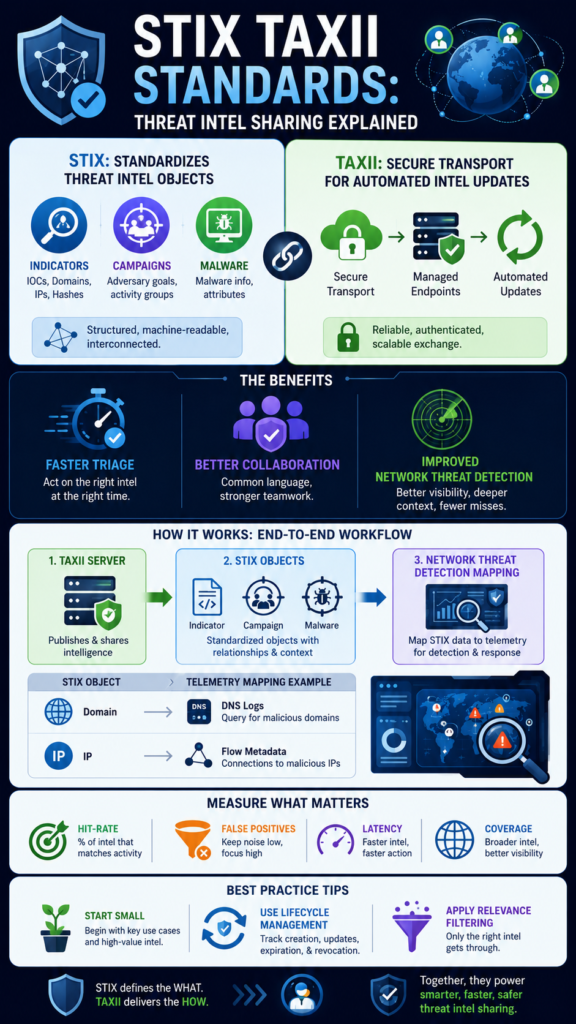
A practical approach involves processing TAXII intel into STIX objects, then mapping them to detection needs while measuring ROI threat intelligence program success through clear metrics.
Because every organization has different telemetrywe need mapping rules between indicator types and network event data. For example:
- domain/URL → typically maps to DNS/HTTP log fields
- IP/ASN → maps to flow/session metadata
- patterns/rules → map to contextual matching logic.
From our experiencesuccess depends on both ingest quality and correct mapping. We also need proper indicator lifecycle handling (e.g.revoke/replace)or detections can drift into mismatches or false correlations.
A third-party POV typically benefits from faster response loops: the SOC can reference the same intel context while alerts are being triagedand engineering can align rule logic without extended definitional debates. HereNetwork Threat Detection acts as the most actionable consumer of shared intel.
What should we evaluate when choosing STIX/TAXII formats and workflows?
Credits: IIT KANPUR-NPTEL
| Evaluation area | What we look for | Impact on threat intel sharing |
| Data model (STIX objects) | Indicators + context + relationships | Correlation becomes meaningfulnot just IOC lists |
| Transport & collections (TAXII) | Collection separation + managed endpoints | Sharing is safer and updates are more consistent |
| Mapping to detection | Indicator type fits telemetry | False positives drop; triage gets faster |
| Indicator lifecycle | Revocation/replace + versioning | Detection remains accurate over time |
We typically start from detection needsthen work backward to the data model and transport. That way“standards” become a means to an operational outcome, not a checkbox.
“When you use a cyber threat intelligence system, you must use the STIX 2 and TAXII 2 standards. The standards change cyber threat intelligence to a machine-readable format. This increases the capability for machine-to-machine automated information exchange. This speeds up the threat response.” – GOV. UK
How do we keep threat intel sharing accurate and prevent overload?
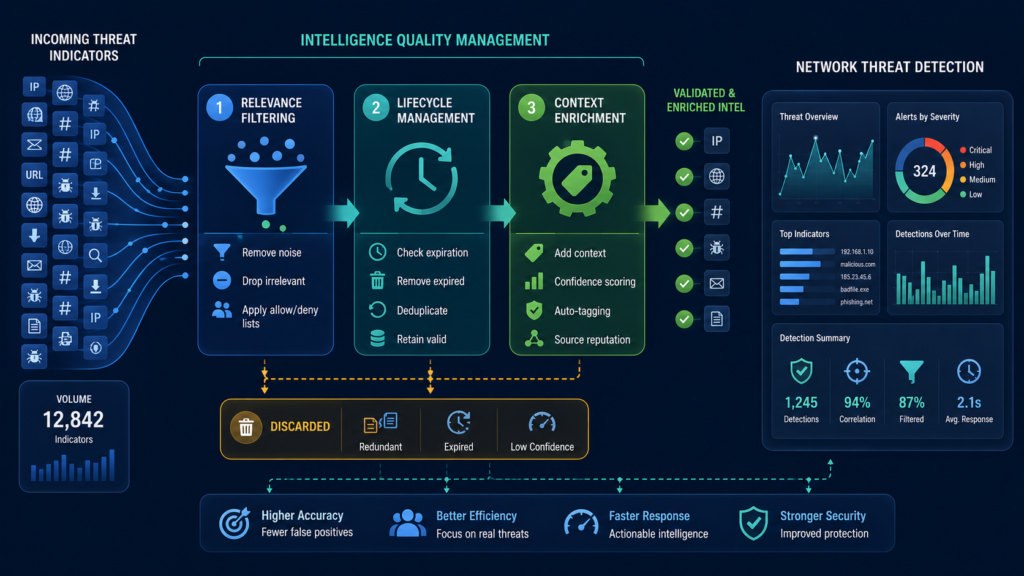
Accuracy is not just about using a standard, it’s about managing intake quality and processing logic. In our teamwe reduce overload using: relevance filtering (e.g.region/industry/asset scope)confidence-based prioritizationand limiting to collections actually consumed by Network Threat Detection.
We also handle duplicates and conflicts. If indicators conflict (e.g.different versions)best practice is to follow STIX/TAXII states and ensure our detection logic reads the correct current version per policy.
From a third-party POVgovernance is a major factor: who can publish intelhow approvals workand how audit trails are maintained. Without governancethreat intel sharing can become “data dumping.”
Based on our experiencestart small with high-quality subsets. Once mapping and detection stability are proventhen expand collections and indicators.
FAQ
Do we need STIX and TAXII together?
Usuallyyes. STIX defines the structure of the intelligence data; TAXII defines how it’s shared and exchanged. If we use only onethe workflow tends to become more manual or less interoperable.
Is Network Threat Detection required for STIX/TAXII?
Not strictlybut it’s often the most operationally effective integration. We position Network Threat Detection as the first option because it quickly turns indicators into actionable detection context.
How can we reduce false positives from intel feeds?
Focus on correct mapping from indicators to telemetryuse confidence/prioritiesand enforce lifecycle handling (revocation/replace). This is usually more effective than adding more indicators without control.
What metrics should we track for threat intel sharing?
Track hit-rate (alerts truly linked to intel)false positive rateend-to-end latency from ingest to usable detectionand coverage across relevant assets/segments.
Where Should We Begin?
To make STIX TAXII standards threat intel sharing effective, start with a focused use case. We recommend mapping key indicators to Network Threat Detection and establishing a reliable STIX/TAXII workflow before expanding.
This practical approach improves correlation, speeds up triage, and supports more accurate incident response. To strengthen your overall security posture, explore the Network Threat Detection Bootcamp and learn practical secure development skills.
References
- https://www.cyware.com/blog/what-is-the-role-of-stix-taxii-in-threat-intelligence-sharing
- https://www.gov.uk/government/publications/open-standards-for-government/exchanging-cyber-threat-intelligence