
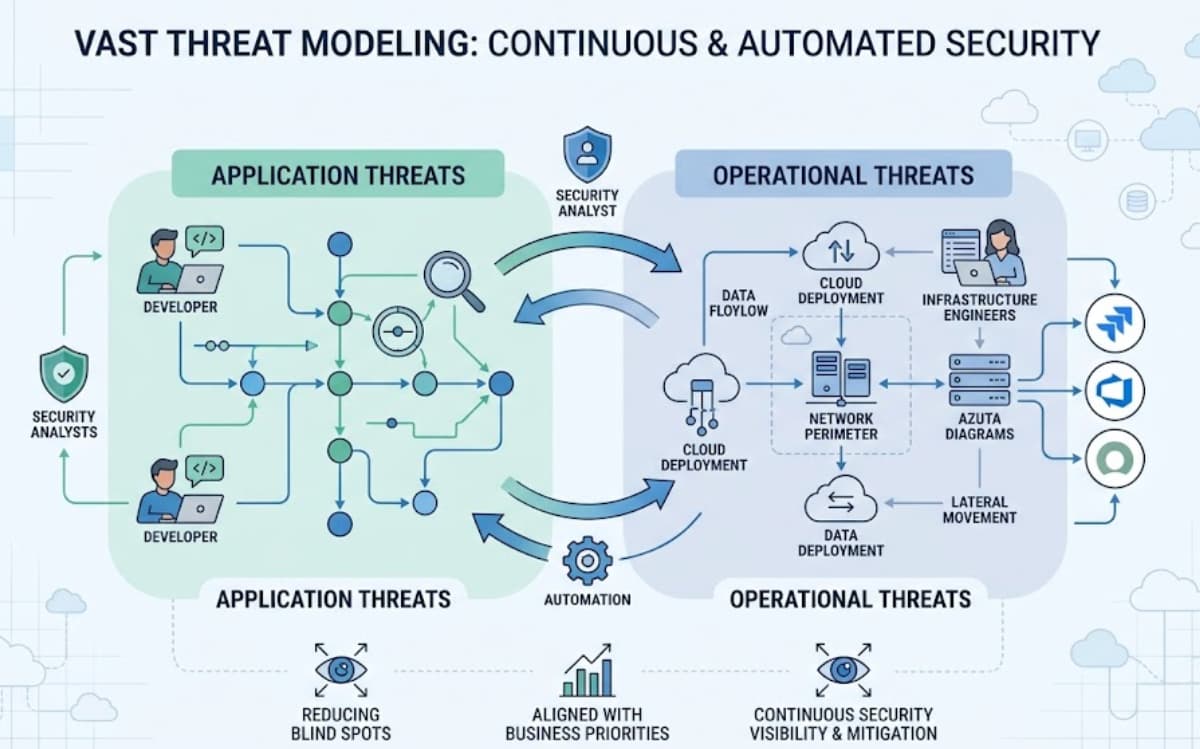
VAST, which stands for Visual, Agile, and Simple Threat modeling, enables organizations to identify and manage security risks continuously across both applications and infrastructure. It was designed for high-velocity DevOps pipelines, where traditional frameworks like STRIDE and PASTA often struggle to scale effectively.
By combining automation, integrated workflows, and collaborative processes, VAST can be updated continuously when integrated with automated pipelines.
We’ve seen how this dynamic approach reduces blind spots and human errors while keeping threat identification aligned with business priorities. Keep reading to discover how VAST improves continuous security visibility and mitigation.
VAST Security Wins
VAST streamlines threat modeling for fast-moving DevOps teams, showing how application and operational risks can be captured, automated, and mitigated.
- Combines dual tracks for application (PFDs) and operational (DFDs) threat models to capture both code and infrastructure risks
- Integrates automated threat modeling into Agile DevOps workflows for continuous, real-time security visibility
- Provides actionable, business-aligned insights connecting technical vulnerabilities directly to enterprise risk
How Does the VAST Methodology Work?
Automation is the foundation. Without it, threat modeling for large systems quickly becomes impossible. Manually updating hundreds of models is just too slow for fast-moving Agile teams.
Automated engines shrink update times from hours to minutes, while data enrichment techniques improve context and clarity for each model. This means security visibility stays current with every deployment.
“Threat modelling is of increasing importance to IT security… the aim of automating threat modelling is to simplify model creation by using data that are already available. However, the collected data often lack context; this can make the automated models less precise in terms of domain knowledge than those created by an expert human modeler.” –Margus Välja et al.,
Integration is the next critical piece. VAST was designed to connect with DevOps tools like Jira, Azure DevOps, and ServiceNow. Threat modeling becomes part of normal sprint workflows rather than an afterthought.
Developers see security insights as part of their day-to-day work, and fixes happen immediately instead of piling up post-release.
Collaboration completes the methodology. Security analysts, developers, and infrastructure engineers each maintain their respective models. But the system correlates findings across the dual tracks, ensuring risks that span teams are detected.
We’ve seen instances where an application-level token pool writes to misconfigured cloud storage. Without collaboration, these risks often go unnoticed. VAST helps catch them early.
What Is the Dual-Model Architecture in VAST?
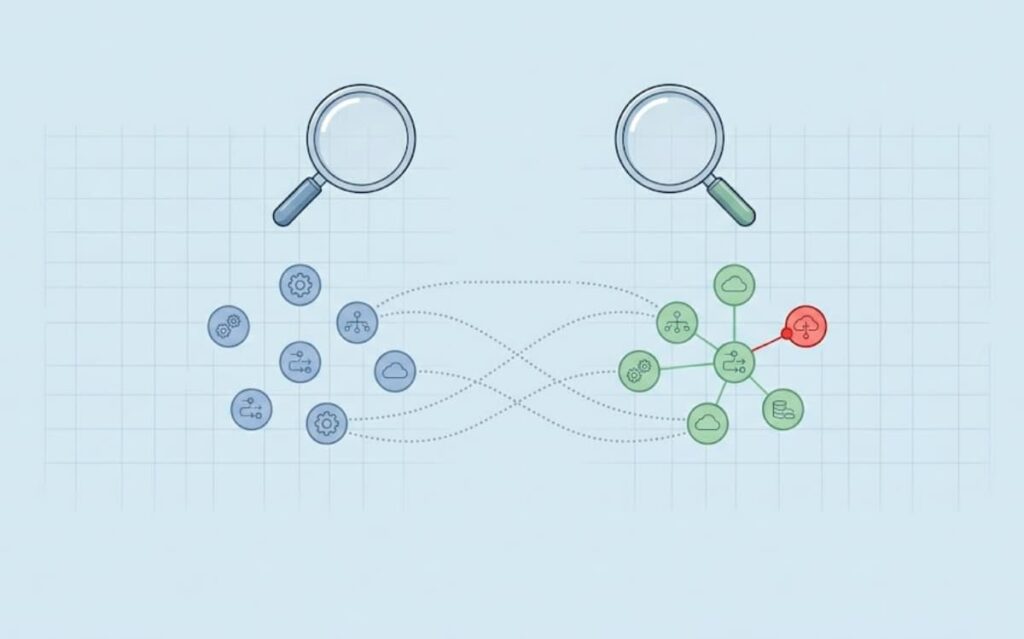
One of the strongest features of VAST is its separation into two complementary threat models.
How Do Application Threat Models Work?
For developers, VAST uses Process Flow Diagrams (PFDs). These diagrams map application logic, user interactions, and code-level dependencies.
When our engineering team switched to PFDs during our last major infrastructure migration, we immediately caught flaws that standard network diagrams missed.
For instance, we found hidden spots where a user’s login token stayed active for too long during checkout. Standard tracking tools missed it completely, but mapping the actual user path flagged it instantly.
PFDs give us an attacker’s perspective. We trace paths from entry points to high-value assets, which is particularly valuable in short sprint cycles. Developers see exactly which features are exposed and can prioritize mitigations quickly. The visual model makes abstract risks tangible.
How Do Operational Threat Models Work?
Infrastructure and network teams, in parallel, use Data Flow Diagrams (DFDs). These track cloud deployments, network perimeters, and enterprise components.
Combined with Network Threat Detection, DFDs let us monitor traffic flows, enforce boundaries, and see potential lateral movement paths that bypass application-level protections, which directly improves query performance for security analyses across distributed systems.
Maintaining synchronized application and operational models avoids a common pitfall of traditional frameworks. When systems are analyzed in isolation, cross-boundary risks often slip through unnoticed. VAST’s dual-model approach ensures both code and infrastructure threats are accounted for.
How VAST Outperforms Traditional Frameworks
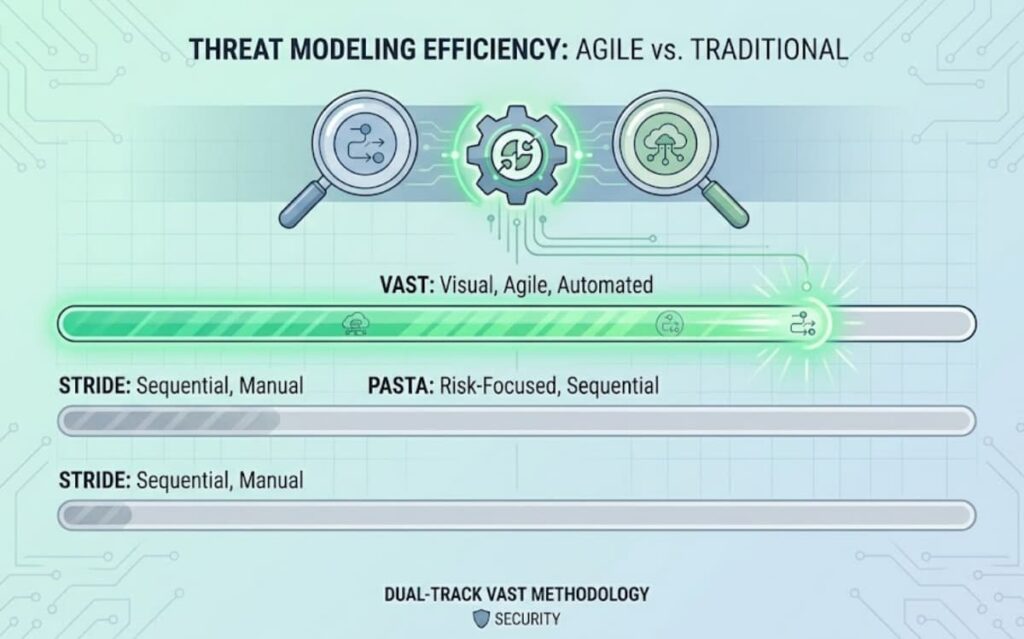
Several features distinguish VAST from other models we’ve worked with.
VAST vs STRIDE
Think of it this way: if an engineer accidentally leaves a cloud storage folder open to the public, STRIDE looks at that folder as an isolated piece.
It might miss the bigger picture. VAST automatically links that open folder to the application logic track, showing how an attacker could exploit it to compromise user accounts and helping teams assess the misconfiguration impact before it causes issues.
We’ve seen gaps emerge in high-velocity environments. VAST, with dual-model tracking and automation, ensures continuous coverage of both application logic and operational infrastructure.
VAST vs PASTA
PASTA’s seven-stage, risk-focused methodology is excellent for regulated, enterprise systems. However, it is slower and less suited for rapid Agile pipelines. In our experience, updates lag behind new features, which can create temporary exposure.
“Threat modelling methods are very effective in proactively analysing cybersecurity threats and enhancing organisational security policies and defence mechanisms against these cybersecurity threats… Several threat modelling methods have been proposed, and it is important for security experts to select the appropriate threat modelling method for an organisation according to their specific security challenges and cybersecurity threats.” – Nitin Naik et al.,
VAST achieves similar visibility but automates scoring, updates, and mitigation, making it suitable for fast-paced, micro-update-heavy environments.
How Does VAST Compare to DREAD, LINDDUN, and OCTAVE?
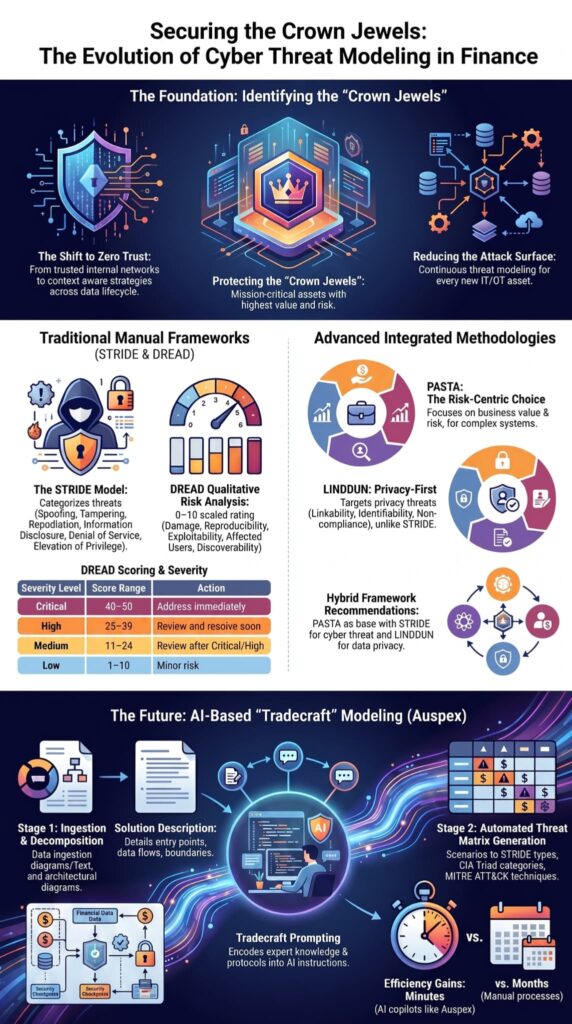
We’ve seen teams try DREAD for risk prioritization. Numbers are fine for quick scoring, but they often miss context. One critical flaw in code might score low and be ignored, yet it could allow lateral movement across the network.
We use VAST to complement scoring with visual models. Seeing the attack paths, from the first entry point to high-value assets, makes the risk tangible. Developers can then act on actual exposure rather than abstract numbers.
LINDDUN is focused on privacy. We’ve applied it in audits to protect personally identifiable information. Effective, yes, but narrow. It does not cover broader operational threats.
With VAST, we can layer privacy checks within the operational model while maintaining full enterprise-wide security visibility. It’s flexible. It adapts to changing threats rather than sticking to a rigid privacy checklist.
OCTAVE looks at organizational risk through surveys and workshops. We’ve found it is great for understanding policies and process weaknesses, but it doesn’t give actionable technical guidance.
When we combine OCTAVE with VAST, the picture becomes complete. Policy-level risks can be linked directly to vulnerabilities in code and infrastructure. This bridges the gap between business decisions and technical reality.
What Are the Edge Cases and Operational Considerations in VAST?
No framework is perfect. And even VAST has nuances that teams must manage carefully.
Sometimes application PFDs are updated without syncing operational DFDs. One small oversight can leave ephemeral cloud components exposed. We’ve observed that these gaps often arise in multi-team environments where development and infrastructure updates happen independently. A piece of data ends up in the wrong storage, unnoticed.
Automation is a double-edged sword. Without tuning, it can overwhelm developers with alerts. In our bootcamps, we simulate this. Students quickly see how low-priority notifications can distract from real threats. We’ve learned to implement custom filters and validate outputs against live infrastructure to keep the focus on actionable issues.
Accuracy is another factor. VAST depends on proper trust boundaries, up-to-date threat libraries, and clear taxonomies. If these foundations are off, the automated system may generate misleading results. We train teams to review and validate the underlying model continuously. It’s not a set-it-and-forget-it system.
What Are the Best Practices for Maximizing VAST?
Source: Hansani Vihanga
- Synchronize application and operational models regularly to prevent gaps
- Filter automation outputs to reduce alert fatigue
- Keep threat libraries and taxonomies updated to match real-world attacker behavior
- Integrate model updates into CI/CD to maintain security alongside development
- Encourage cross-team participation to ensure visibility across applications and infrastructure
In our labs, we emphasize that collaboration is as important as automation. Developers, infrastructure engineers, and security analysts must understand the full picture to make informed decisions.
FAQs
How does VAST threat modeling improve enterprise DevSecOps security?
VAST threat modeling, or Visual Agile Simple Threat methodology, provides scalable and automated threat modeling for DevSecOps teams. By integrating with CI/CD pipelines, it supports continuous delivery security and enables enterprise threat modeling across hundreds of applications.
Automated threat modeling, attack path visualization, and attacker perspective modeling reduce false positives and false negatives, strengthen application security modeling, and ensure actionable security controls at every stage.
How does VAST compare to STRIDE, PASTA, and other frameworks?
In threat modeling comparisons, VAST excels in scalability and automation. Unlike STRIDE vs VAST, PASTA vs VAST, or LINDDUN vs VAST, it combines Process Flow Diagram (PFD) threat modeling with infrastructure threat modeling.
This methodology allows contextual threat mitigation, precise security recommendations, and visual decomposition security, while supporting attack surface reduction, collaborative security processes, and self-service threat modeling for modern application security.
What makes VAST methodology suitable for Agile and continuous delivery?
VAST methodology supports Agile sprint security and short-term sprint structures by integrating threat modeling tools directly into DevSecOps workflows. Automated threat modeling, CI/CD integration, and collaborative stakeholder threat collaboration enable real-time threat identification at scale.
Teams achieve continuous improvement in security, design-to-deployment protection, and actionable security controls without slowing feature delivery, reducing security debt, and maintaining a holistic security view across technology stack expansion.
How does VAST reduce false positives and false negatives in threat modeling?
VAST threat modeling uses automated attack path visualization and deeper contextual security to minimize false positives and false negatives. Component isolation security, zoning component threats, and cumulative threat views help teams prioritize remediation efficiently.
By linking your process diagrams directly to daily developer tools, you get clear recommendations that make sense. This helps software teams catch security flaws early in the design phase. It stops you from having to tear down and rebuild software right before launch, which saves both time and money.
What are the key pillars and benefits of adopting VAST in organizations?
VAST threat modeling is built on automation, integration, and collaboration pillars. The methodology supports sustainable threat modeling, ongoing security updates, and comprehensive threat processes.
Organizations gain visual decomposition security, attack surface reduction, threat surface visualization, modern application decomposition, and actionable security controls, enabling real threat mitigation, continuous security improvement, and measurable reduction in costly threat remediation.
Turn Threat Modeling into Actionable Security
Relying on outdated processes slows your team and leaves gaps that attackers can exploit. Every missed vulnerability risks downtime, data loss, and reputational damage, you can’t afford to wait.
Network Threat Detection gives you real-time insights and practical tools to act fast. With automated risk analysis, attack path simulations, and executive-ready reports, you can prioritize threats with confidence.
Teams, SOCs, and CISOs gain continuous visibility, integrate security into DevSecOps pipelines, and make decisions that protect both systems and business outcomes before problems escalate.
References
- https://link.springer.com/article/10.1186/s42400-020-00060-8
- https://link.springer.com/chapter/10.1007/978-3-031-74443-3_16