
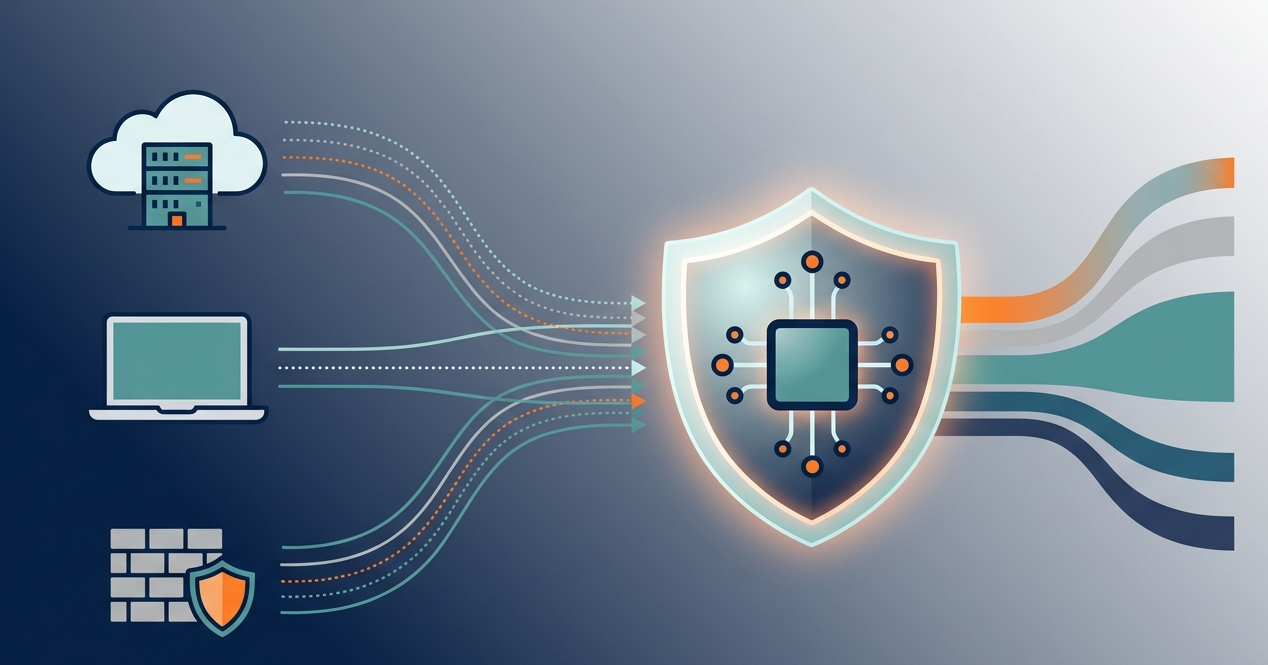
In modern security operations, SIEM architecture components deployment models determine whether your defense system actually sees threats or merely records them.
Many teams using the Network Threat Detection platform assume deployment alone guarantees visibility, but the real difference lies in how data sources, processing layers, and analysis pipelines are structured. When architecture is misaligned, alerts become noise instead of insight, and investigations stall. Keep reading
Key Insights at a Glance
Here are the most important points to understand.
- A SIEM’s value is dictated by its data sources, with network-derived evidence being non-negotiable.
- The deployment model (cloud, on-prem, hybrid) must align with your data gravity, not just cost.
- Effective architecture integrates analysis, not just collection, turning raw data into direct action.
When SIEM Architecture Fails: The “Dashboard of Despair”
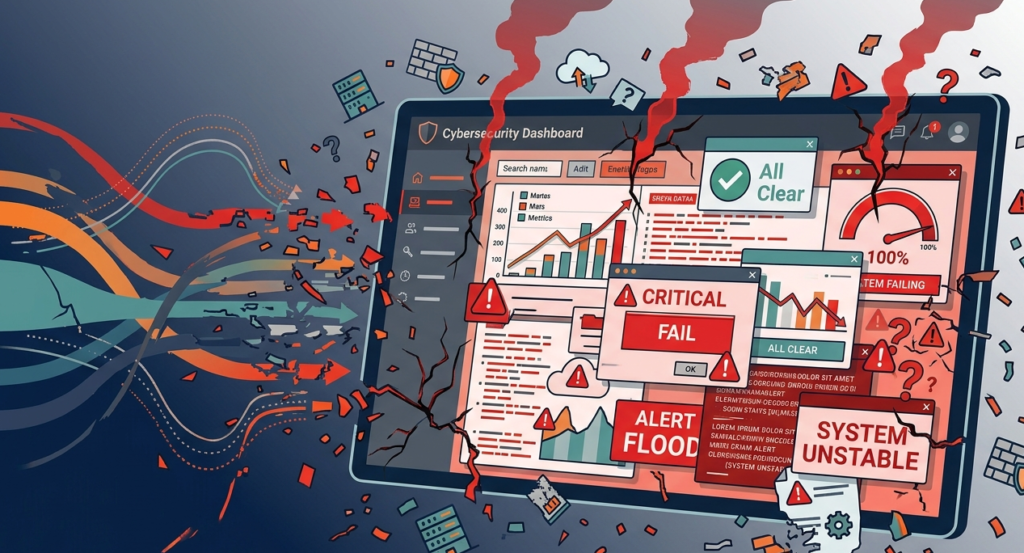
We called it the “dashboard of despair.” A wall of screens, blinking with parsed logs from firewalls, servers, and endpoints. It looked impressive. It felt like control. Then a breach happened, and the timeline we reconstructed from those logs was full of holes, assumptions built on missing context.
“The effectiveness of a Security Information and Event Management solution depends on the quality of the data it receives. It is especially important that it receives network data, which is considered to be the immutable truth of how the network is used, by whom, and what devices, files, and systems they connect with.” – Graylog
The SIEM had done its job, aggregating what we gave it. The architecture had failed, because we hadn’t given it the one thing that could have shown the full picture, the unedited narrative of the network itself. A SIEM is only as truthful as its data. And most data, we learned the hard way, is just hearsay.
A Security Information and Event Management (SIEM) system is often described as the brain of a security operations center. But a brain needs sensory input. If it only receives summarized, delayed, or filtered signals, its perception of reality is warped.
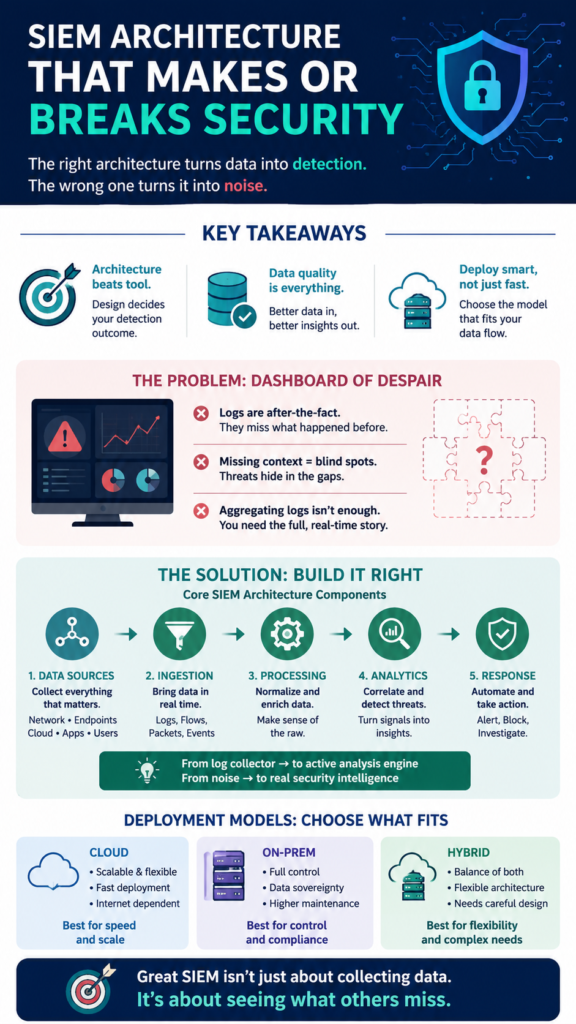
What Are The Non-Negotiable SIEM Components?
Think of SIEM components not as a checklist, but as a hierarchy of needs. At the base, you need collection. Building an engineering pipeline for collecting and correlating security logs ensures the base of that pyramid is structurally sound. Above that, storage. Then normalization, analysis, and finally, presentation. Most implementations focus heavily on the top, the shiny console.
They neglect the foundation, the quality of collection. You can have the best correlation engine in the world, but if you only feed it DNS query logs and Windows event codes, you’re trying to forecast the weather by only reading barometer readings. You’re missing the satellite imagery.
The critical, often under-prioritized component is the data collector or agent, specifically what it collects from. A robust SIEM architecture must integrate sources that provide evidence, not just notifications. This means moving beyond simple log ingestion.
- Network-Derived Evidence: This is the raw material of truth. It includes full packet capture (PCAP), NetFlow, and protocol metadata fed directly from network sensors.
- Endpoint Telemetry: Deep activity logs from servers and workstations, providing the “what” on the host to pair with the network’s “how.”
- Identity and Access Logs: Records from Active Directory, VPNs, and cloud identity providers to anchor activity to a user, not just an IP address.
- The Correlation Engine: The logic that ties these disparate streams together, finding patterns across different silos that a single log source would never reveal.
When Network Threat Detection is woven into this architecture as a primary data source, it changes the game. We don’t just send it alerts, we pipe its continuous, full-fidelity stream of network evidence directly into the platform. This modern approach completely redefines how you deploy
security information and event management platforms across complex enterprise networks.
How Do Deployment Models Dictate Data Reality?
The choice between cloud, on-premise, or hybrid SIEM deployment is often framed as a cost or scalability discussion. It’s really a question of data gravity.
Where does your most critical evidence live? If your crown jewels are in a cloud SaaS application, funneling all your logs to an on-prem SIEM might introduce latency and egress costs that make real-time analysis impossible.
Conversely, if you operate a physical plant with industrial control systems that never touch the internet, a cloud-only SIEM is a non-starter.
A cloud SIEM (SIEM-as-a-Service) offers quick setup and seemingly infinite scale. Your data is sent to the vendor’s cloud. But you must trust that all your sensitive logs, including those packets that might contain snippets of confidential data, can reside there. You’re also at the mercy of your internet connection for both ingestion and querying.
An on-premise deployment gives you full physical control and can be air-gapped, but you bear the full burden of hardware, maintenance, and scaling the storage for years of packet data.
Here’s a breakdown of how data flow dictates the reality of each model:
| Deployment Model | Primary Data Flow | Architectural Implication for Threat Detection |
| Cloud SIEM | All logs and evidence flow out to vendor cloud. | Potential latency for real-time response; data sovereignty concerns with full packet evidence. |
| On-Premise SIEM | All data remains inside your network perimeter. | Full control and speed; high upfront cost and responsibility for scaling storage/compute. |
| Hybrid SIEM | Rich evidence (like packets) stays on-prem; alerts and metadata sync to cloud. | Balances deep analysis needs with cloud scalability; complexity in managing two systems. |
The model isn’t just a purchase option, it’s a structural constraint that will define what your team can and cannot do during an investigation for the next five years.
Why Is Integration Deeper Than Collection?
The old SIEM mantra was “collect everything.” That led to bloated, expensive systems drowning in irrelevant data. The new imperative is “integrate intelligently.” Integration means the SIEM components don’t just receive data, they understand it and can act on it. A log entry that says “User X logged in from IP Y” is a datum.
When the SIEM can instantly cross-reference that IP Y against a real-time network threat feed and see that it was, at that exact moment, also scanning an internal engineering server, that’s integration. It creates a new, higher-order fact.
This is where the architecture of the correlation engine matters. It must have the context to make these connections. Gaining insight into the core functions of a SIEM system helps security teams map these data pathways automatically.
If your network detection system identifies a compromised host, a deeply integrated SIEM can immediately query all endpoint agents for processes associated with that IP, pull the last week of authentication logs for any user on that host, and map its recent network connections, all from a single click. The integration is bidirectional, too.
Without this depth, a SIEM is just a fancy log search tool with alert rules. It can tell you that things happened, but it struggles to tell you why or how they’re connected. That gap is where analysts burn time and threats slip through.
Can The Right Architecture Reduce Alert Fatigue?
Credits: Magic of Software
Alert fatigue isn’t a people problem, it’s a data quality problem. It stems from a flood of low-fidelity, context-free alerts. A well-architected SIEM attacks this at the source.
By using network-derived evidence as a primary source, it adds a layer of validation before an alert is ever generated. Instead of ten separate alerts from ten systems, a firewall block, an IDS signature, an endpoint detection, the architecture can synthesize these into one high-fidelity incident.
The SIEM correlates the firewall log with the raw packet stream that shows the attack pattern and the endpoint log that shows a resulting process injection. One alert, with all the evidence attached.
This requires the architecture to support what we might call “pre-correlation.” The data normalization and parsing engines must be powerful enough to understand the relationships between different data formats in real-time.
It also means ingestion pipelines must be fast enough to keep up with network traffic during peak times, so this correlation happens without introducing dangerous latency. When it works, the effect on an analyst is profound. They aren’t starting from zero, sifting through a list of beeps and boops.
How Do You Future-Proof Your SIEM Design?
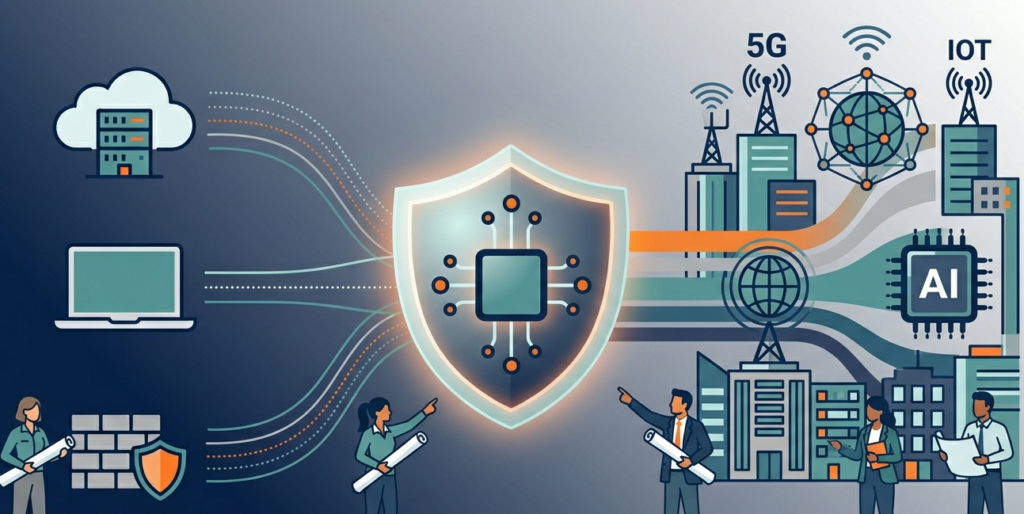
Technology evolves, but evidence is eternal. The most future-proof decision you can make in your SIEM architecture is to anchor it to sources of immutable evidence. Log formats change. Cloud APIs get deprecated. Endpoint agents are replaced. But the network packet, the fundamental unit of communication, remains.
“An on-premises SIEM architecture runs entirely within your own data center. You manage the hardware, storage, upgrades, and performance tuning. This model is common in regulated industries where data control is mandatory. From a compliance standpoint, it’s straightforward. From an operational standpoint, it requires skilled teams and ongoing investment. On-premises SIEM prioritizes control. The tradeoff is complex.” – NetWitness
Designing your SIEM with a dedicated, scalable pipeline for full-fidelity network evidence ensures that as applications shift and infrastructure transforms, you still have a ground truth to refer back to. It’s the one constant in a changing landscape.
This means provisioning adequate, performant storage for network evidence, often separate from the SIEM’s main log storage, but tightly integrated. It means choosing a SIEM platform with open APIs and flexible data parsers, so you can integrate new data sources, like cloud workload logs or IoT device telemetry, without a full re-implementation.
It also means building a team, or partnering with one, that understands this evidence-centric approach. The architecture is not just software and hardware, it’s the people and processes that know how to wield it.
FAQ
Is a cloud SIEM secure enough for handling sensitive packet data?
It can be, but it introduces trust and legal considerations. You must encrypt data in transit and at rest, and ensure your vendor contract addresses data sovereignty and isolation. For highly regulated industries, keeping full packet evidence on-premise within a hybrid model is often the preferred path.
How much data storage do we really need for a SIEM?
It’s a tiered answer. You need “hot” storage for 30-90 days of all logs and critical network evidence for active investigations. “Warm” storage for 6-12 months of summarized data and key packet captures for retrospective hunting. “Cold” archival for compliance, often 1-7 years, which can hold log extracts but rarely full packet data due to cost.
Can’t we just use a log management tool instead of a full SIEM?
For compliance and basic search, yes. For security operations, no. A log manager is a database. A SIEM is an analysis engine. It’s the difference between having a filing cabinet and having a detective who can connect files from different cabinets to solve a case. The correlation and threat intelligence integration are what you pay for.
How do we handle SIEM performance as data volume grows?
Scalability is a core architectural question. Look for distributed architectures that can add processing nodes (for correlation) and storage independently. Ensure your network evidence pipeline has its own dedicated resources so a spike in log volume doesn’t throttle your ability to capture and analyze packets in real-time, which is often when you need it most.
Final Thoughts on SIEM Architecture
That is a powerful philosophy: a SIEM is only as good as the raw evidence fueling it. Without a strong foundation of network telemetry, you are essentially flying blind. To turn that architectural vision into reality, you need tools that translate raw network data into actionable clarity.
Network Threat Detection empowers SOC teams with real-time threat modeling, automated risk analysis, and visual attack path simulations. Backed by frameworks like MITRE ATT&CK, it eliminates blind spots and delivers true operational certainty.
References
- https://graylog.org/post/cloud-vs-on-premised-siem-one-or-the-other-or-both/?utm_source=technologyadvice+&utm_medium=display&utm_campaign=awareness+q4-2025
- https://www.netwitness.com/blog/deployment-models-for-siem-solutions/?utm_source=google&utm_medium=referral&utm_campaign=siem