

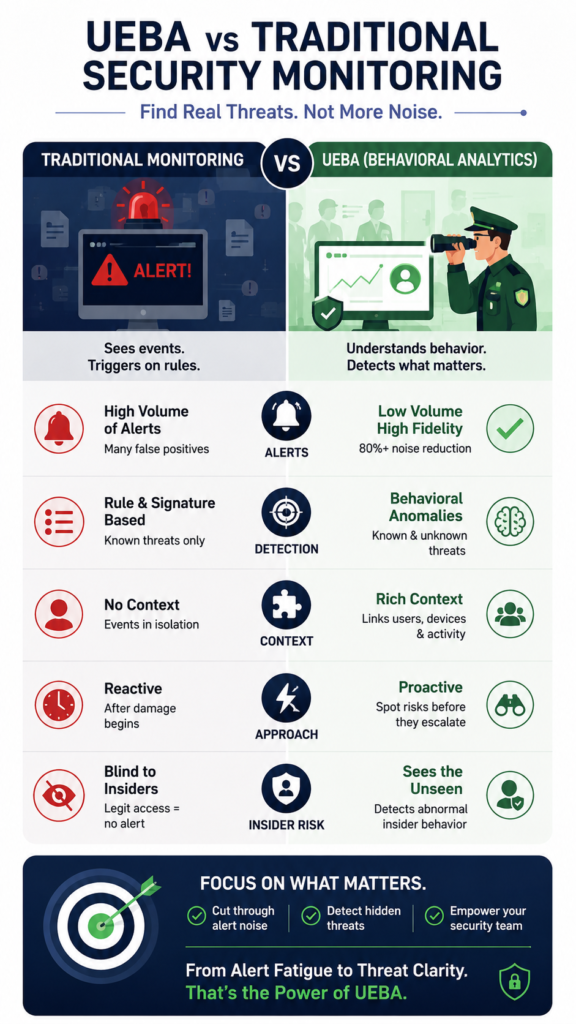
Choosing between UEBA vs traditional security monitoring is no longer just about adding another security tool. It is about deciding whether your team spends time chasing false alerts or investigating real threats. Traditional monitoring catches known events, while UEBA understands behavior and context.
That shift strengthens your Network Threat Detection strategy by helping analysts focus on genuine risks instead of endless noise. Keep reading to see why behavioral analytics is changing modern cybersecurity.
What You’ll Learn in Minutes
Before diving deeper, here are the biggest differences that matter when comparing UEBA with traditional security monitoring.
- UEBA detects threats by spotting deviations from normal behavior, catching what rule-based tools miss.
- It reduces alert noise by over 80% by focusing on correlated risk, not isolated events.
- The approach enables proactive security, turning your team from firefighters into investigators.
Why Traditional Security Monitoring Creates Alert Fatigue

The siren went off at 2:17 PM on a Tuesday. Our traditional SIEM flagged a “critical” data exfiltration event. The team scrambled, hearts pounding. Thirty minutes of frantic investigation later, we found the cause. It was an intern, authorized, running a legitimate report for the first time.
The tool did its job, it saw a large data transfer and alerted. But it wasted our most precious resource: time and focus. That was the breaking point. We weren’t fighting hackers; we were arguing with our own tools. Traditional security monitoring is built like a burglar alarm on a door. It’s either open or shut.
It has no way of knowing if the person walking through is the homeowner or a thief. It just screams. UEBA, in contrast, is like a security guard who knows everyone’s habits. It notices if the homeowner starts leaving at odd hours with full suitcases.
The action itself isn’t illegal, but the change in pattern tells the real story. That’s the power of moving from rules to behavior.
How Does Traditional Security Monitoring Actually Work?
Think of it as a very thorough, very literal checklist. It operates on signatures and known-bad indicators. A file hash matches malware in a database. An IP address belongs to a known botnet. A user tries to access a forbidden server. It’s binary. This method is excellent for catching the low-hanging fruit, the spray-and-pray attacks.
“By using UEBA alongside a broader set of cyberthreat solutions, organizations form a unified SecOps solution and enjoy a stronger security posture overall.” – Microsoft
Its strength is speed for these known quantities. But its architecture is its flaw. It has no memory, no sense of history or normalcy. Every event is evaluated in a vacuum against a static list. This leads to an avalanche of alerts because in a complex network, unusual but benign events happen constantly.
A sysadmin logging in after hours to patch a server looks identical to an attacker to a simple rule. The system can’t see the intent, only the action. It creates what we lived with: fatigue, cynicism, and the dangerous habit of ignoring alerts because most are junk.
- Signature-Based Detection: Relies on databases of known threats.
- High-Volume, Low-Fidelity Alerts: Generates thousands of alerts daily, most irrelevant.
- Lack of Context: Cannot link a suspicious login with unusual file activity hours later.
- Blind to Insider Threats: A malicious insider using legitimate credentials is invisible.
What Makes UEBA a Fundamentally Different Approach?
UEBA starts with a question: “What does normal look like for this user, this server, in this network?” Instead of a checklist, implementing user and entity behavior analytics ueba builds a dynamic behavioral baseline using machine learning.
It observes for weeks, learning that Maria in HR typically accesses 2-5 MB of employee files between 9 and 5 from her corporate laptop. It learns that the svc-backup account connects to the NAS every night. This baseline is unique to your organization. Once established, the system then looks for statistical deviations.
We built our own approach to this, which we call Network Threat Detection. It was born from that 2:17 PM frustration. We asked how we could apply UEBA’s behavioral principle not just to users, but to every entity on the wire, devices, servers, applications. Our focus was on the traffic itself, the conversations happening between machines.
We wanted to learn the normal “language” of the network so we could instantly hear an accent that didn’t belong. For us, it became the first logical layer to apply analytics. If you can’t trust the underlying network traffic, how can you trust any event on an endpoint? It’s the foundational layer of truth.
Where Do You See UEBA Having the Biggest Impact?
Credits: Databricks
The impact is most dramatic in three areas where traditional tools are nearly blind. First, understanding how ueba detects insider threats anomalies becomes vital when a disgruntled employee uses their own credentials to steal data without triggering a single rule. But UEBA will flag their unusual data access patterns and download volumes immediately.
When an attacker steals a user’s password, they look legitimate to every rule-based system. UEBA sees the anomaly: the login location is different, the time is odd, the access pace is frantic. Third, low-and-slow advanced persistent threats (APTs). These attacks move slowly to avoid spikes. They might exfiltrate small files over months.
A SIEM sees nothing. UEBA’s baseline model will detect the subtle, persistent drift in behavior over time. The table below contrasts the two approaches across key dimensions.
| Aspect | Traditional Monitoring | UEBA |
| Detection Method | Rules & Signatures | Behavioral Anomalies |
| Primary Focus | Known Threats | Unknown & Insider Threats |
| Alert Volume | Very High, Noisy | Low, High-Fidelity |
| Context Provided | Minimal, Per-Event | Rich, Cross-Entity Narrative |
| Time to Value | Fast (Simple Rules) | Slower (Needs Learning Period) |
How Do You Start Implementing Behavioral Analytics?
You start with data. UEBA is hungry for logs, but not in the “collect everything” way of a SIEM. You need focused feeds that speak to identity and activity. Start with your core identity provider (like Active Directory or Okta) logs, every login, every failure. Add your critical application logs (VPN, cloud apps, HR systems). Endpoint data is gold.
The system needs this to build profiles. The second step is patience. You must allow a learning period, typically 2-4 weeks, for the models focused on establishing baseline user entity behavior to mature without generating alarms. This feels strange, letting a system just watch. But it’s necessary.
Once it starts generating alerts, you’ll need to fine-tune what constitutes a “high risk” score for your environment. This is where your team’s knowledge of the business merges with the machine’s pattern recognition. It’s not a “set and forget” tool; it’s a partnership. Phase 1: Data Collection: Feed it identity, endpoint, and application logs.
- Phase 2: Baseline Learning: Allow 2-4 weeks of undisturbed observation.
- Phase 3: Tuning & Review: Adjust risk scores and investigate early alerts.
- Phase 4: Operational Integration: Feed high-risk UEBA alerts into your SOC workflow.
Can UEBA and Traditional Tools Work Together?
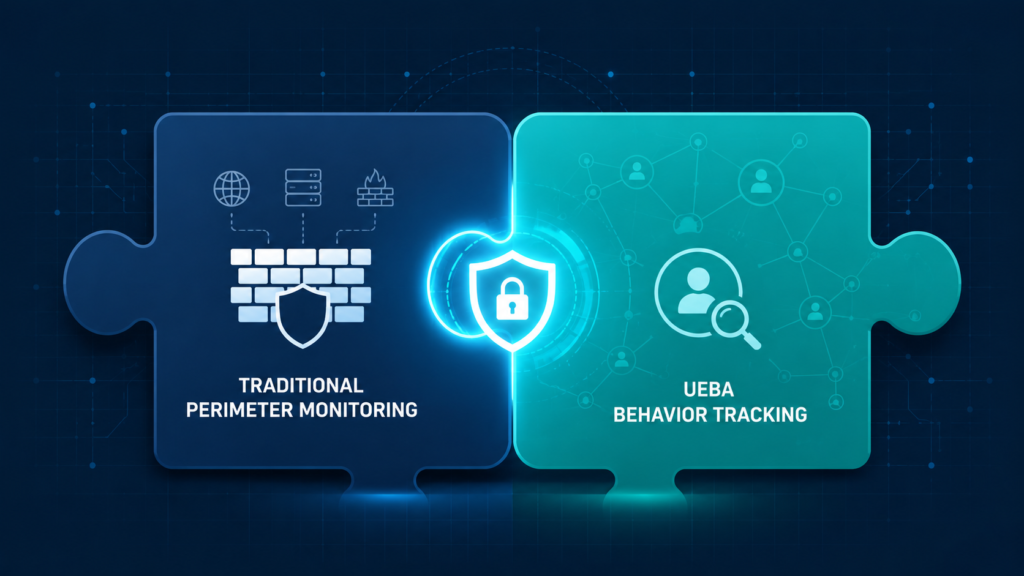
Absolutely, and they should. This isn’t a rip-and-replace scenario. Think of it as evolution, not revolution. The ideal modern security posture uses traditional tools as a fast, outer-layer filter. Let your SIEM catch the obvious, known-bad stuff with its rules. Then, let UEBA act as the intelligent, analytical layer underneath.
“Insiders are trusted users who have authorized access to an organization’s resources, making insider threats particularly difficult to detect using traditional security controls.” – CISA
It consumes the same logs but analyzes them for meaning, not just matches. The high-risk anomalies from UEBA can be fed back into the SIEM as super-prioritized alerts. This creates a powerful feedback loop. The SIEM handles the known noise; UEBA finds the unknown signals. In practice, this integration cuts the analyst’s workload dramatically.
They spend less time sifting through a thousand alerts and more time investigating ten high-probability incidents. It changes the job from reactive to proactive. You’re not just waiting for an alarm; you’re hunting based on behavioral clues.
FAQ
What’s the biggest misconception about UEBA?
That it’s a magic box that eliminates all other tools. It’s not. It’s a force multiplier that makes your existing investments smarter by providing the context they lack. It needs those other tools for data.
Does UEBA require constant tuning and maintenance?
Less than a rule-based SIEM, but yes, it needs oversight. The machine learning models are adaptive, but an analyst must review high-severity alerts and provide feedback, helping the system refine its understanding of “normal.”
Is UEBA only for large enterprises?
Not anymore. While early versions were complex, modern cloud-delivered UEBA solutions are accessible to mid-sized organizations. The key is starting with your most critical data sources, not trying to analyze everything at once.
How does UEBA handle user privacy concerns?
A well-designed UEBA system focuses on metadata and behavior patterns, not the actual content of emails or files. It looks at actions, “user accessed 500 files at midnight”, not the sensitive data within those files. Clear governance policies are still essential.
The New Security Rhythm
Security isn’t about catching every sound, it’s about knowing which specific rustle signifies a real threat. NetworkThreatDetection.com shifts your SOC from noisy reaction to intelligent awareness.
By mapping your network’s normal rhythm, our platform exposes critical blind spots using real-time threat modeling, automated risk analysis, and MITRE ATT&CK simulations. Stop being a prisoner to a chaotic alert inbox. Join Network Threat Detection to find your rhythm today.
References
- https://www.microsoft.com/en-us/security/business/security-101/what-is-user-entity-behavior-analytics-ueba
- https://www.cisa.gov/resources-tools/resources/insider-threat-mitigation-guide