
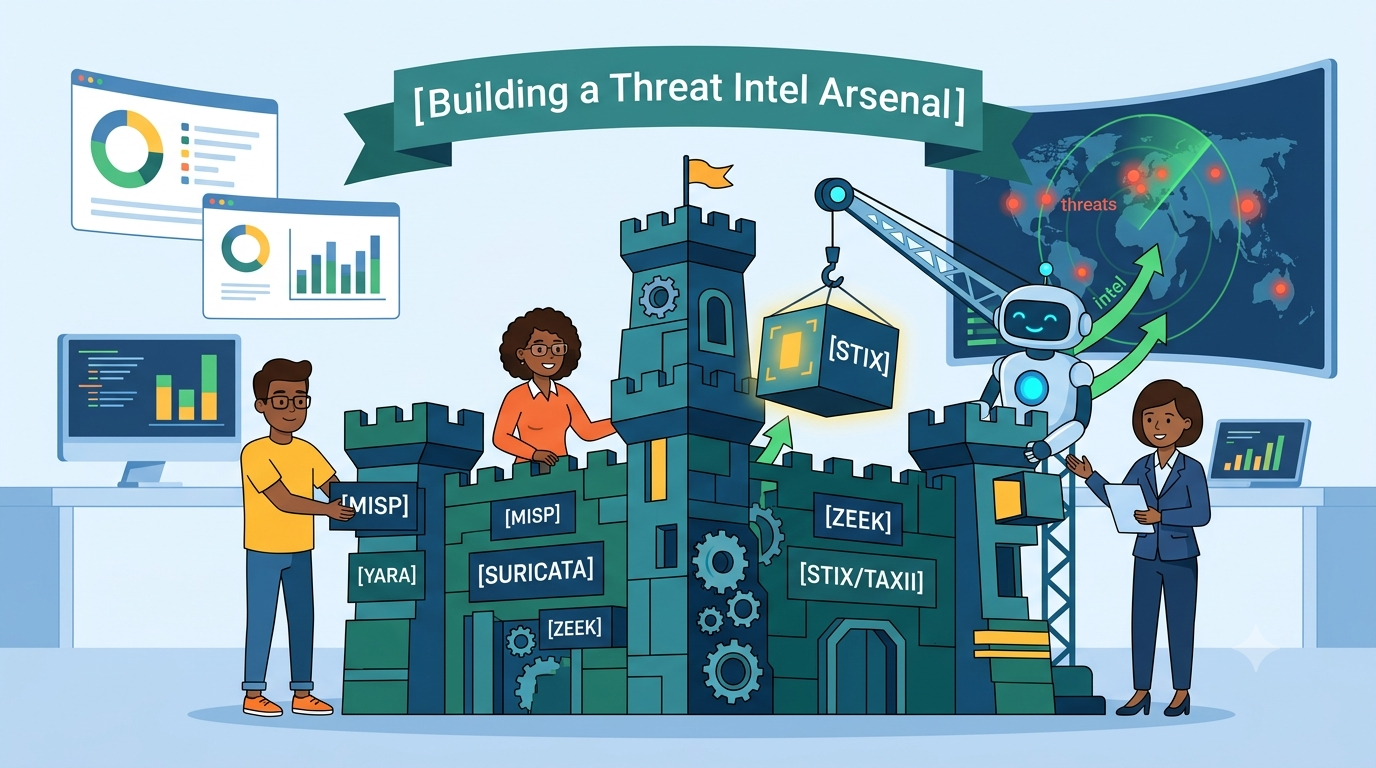
Threat intelligence feels like a luxury for big security teams with big budgets. It doesn’t have to be. A collection of open source threat intelligence tools, when stitched together thoughtfully, can form a formidable early-warning system. At Network Threat Detection, we know because we built one.
The key isn’t finding the tools, there are dozens. It’s knowing how to select them, integrate them, and turn their raw data into something your security controls can actually use. This is a practical guide to doing just that, turning noise into a signal that makes your entire defense smarter. Keep reading to see where to start.
What You’ll Learn Today
Before diving into the technical setup, let’s look at the core principles that will make your open-source intelligence pipeline successful:
- Open source tools provide the raw data and processing power, but their real value comes from strategic integration into your workflows.
- The quality and relevance of your intelligence feed is more important than its size; avoid drowning in irrelevant indicators.
- Success is measured by action: intelligence must be converted into automated blocks or enriched investigations to justify the effort.
What Are the Core Types of Open Source Threat Intelligence?
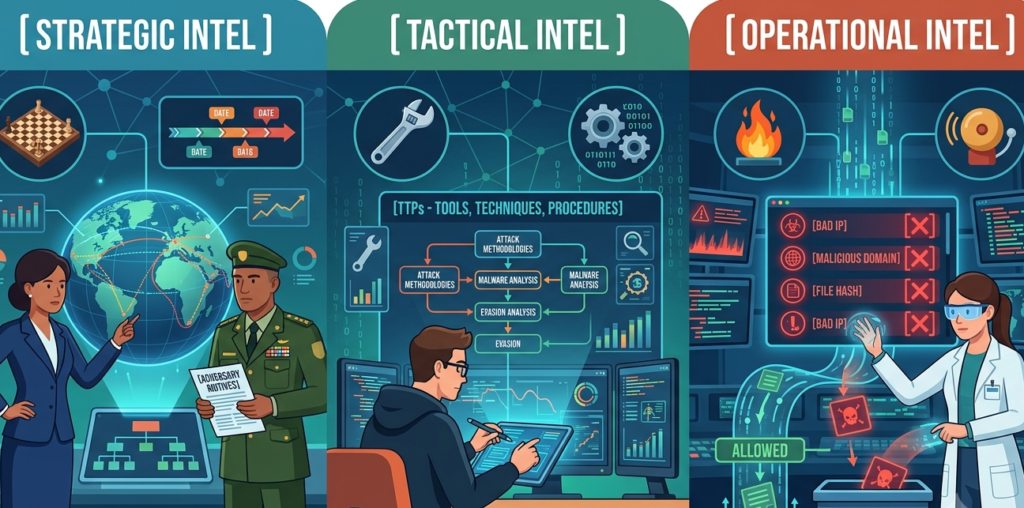
Not all intelligence is the same. Before diving into tools, you need to know what you’re looking for. Strategic intelligence is high-level, like reports on an adversary group’s motives. It’s for your executives.
Tactical intelligence is about TTPs, the tools and methods attackers use. It’s for your analysts. Operational intelligence is the most immediate: specific indicators of compromise (IOCs) like bad IPs, domains, and file hashes. This is what most open source feeds provide.
Open source threat intelligence OSINT tools typically excel at the tactical and operational levels. They gather IOCs from public sources, malware analysis sites, hacker forums, paste sites, even social media. The challenge is volume.
A raw feed might give you 10,000 new IPs a day. Most are irrelevant to your industry or tech stack. The first job of your toolset is to filter. You need to distinguish between a generic phishing domain and a domain targeting your specific company’s brand, which is far more urgent.
How Do You Assess the Quality of an Open Source Feed?
Anyone can publish a list of suspicious IPs. Trusting the wrong list is worse than having no list at all, it creates false positives and wastes time. Assessing feed quality is a discipline. We learned to ask specific questions.
“The primary goal of MISP is to be used. This is why simplicity is the driving force behind the project. Storing and especially using information about threats and malware should not be difficult. MISP is there to help you get the maximum out of your data without unmanageable complexity.”– Wikipedia
What’s the source’s reputation? Are they a known research group or a random GitHub repo? How fresh are the indicators? An IP from an attack six months ago is probably dead. What’s the false positive rate? You can test this by checking a sample of indicators against your own clean traffic.
Context is king. A feed that provides just an IP address is low-value. A feed that tags that IP with the malware family it’s associated with, the campaign name, and the target industries is high-value.
This context is what lets you prioritize. An indicator from a ransomware group targeting manufacturing is critical if you’re in manufacturing, and noise if you’re not. Look for feeds that offer this metadata. It’s the difference between data and intelligence.
What Are the Essential Open Source Tools to Start With?
You don’t need to build a platform from scratch. Start with a curated set of tools that handle collection, processing, and sharing. For collection, utilizing the threat intelligence platform benefits inherent in tools like the MISP Project is foundational. MISP is more than a platform, it’s a community and a standard.
It allows you to import, store, correlate, and share IOCs in a structured way. For gathering raw OSINT, SpiderFoot is an automation powerhouse.
For processing and analysis, you need something to make sense of the data. YARA is indispensable for creating custom rules to identify malware families based on patterns.
For network-level threat detection, tools like Suricata or Zeek (formerly Bro) can ingest lists of malicious IOCs and scan your network traffic in real-time. This is where intelligence becomes action. The table below maps tools to core functions.
| Function | Tool Examples | Primary Use Case |
| Collection & Sharing | MISP, OpenCTI | Centralized IOC repository, community sharing. |
| OSINT Gathering | SpiderFoot, IntelOwl | Automating reconnaissance from public sources. |
| Malware Analysis | YARA, Cuckoo Sandbox | Creating detection rules, analyzing suspect files. |
| Network Detection | Suricata, Zeek | Using IOCs to actively block or alert on malicious traffic. |
Start with MISP for curation and Suricata for network enforcement. That combination alone will lift your detection capability.
How Do STIX and TAXII Standards Make Tools Work Together?
Credits: NetworkChuck
This is the glue. In the early days, every tool had its own format. Sharing data was a mess of custom scripts. STIX (Structured Threat Information Expression) and TAXII (Trusted Automated Exchange of Indicator Information) changed that.
STIX is a language. It’s a standardized way to describe a threat, not just an IP, but its relationship to a campaign, a malware sample, and an attacker. TAXII is the postal service, a protocol for sharing those STIX packages.
When your tools speak STIX/TAXII, they can understand each other. You can subscribe to a threat feed (often via TAXII), and it delivers STIX bundles directly into your MISP instance. Your MISP can then export those IOCs in a format your Suricata box understands.
This interoperability is what turns a handful of separate open source tools into a cohesive threat intelligence platform. It automates the pipeline from collection to enforcement.
What Are the Biggest Challenges in Operationalizing This Intelligence?
Collecting IOCs is the easy part. Making them useful is the hard work. The first challenge is integration. Getting your SIEM to consume enriched threat data from MISP, or pushing block lists to your firewall, requires API work and maintenance.
The second, bigger challenge is relevance. A feed might be high-quality, but if 99% of its indicators are for malware that doesn’t target your systems, it’s just clutter.
We hit this wall early. Our SIEM was flooded with alerts for threats that didn’t apply to us. The solution was filtering and tagging. We used MISP to tag incoming IOCs by target industry, malware type, and attack vector.
We then created rules in our SIEM to only generate high-priority alerts for tags that matched our profile. This dramatically increased our signal-to-noise ratio. The final challenge is speed. The half-life of an IOC can be minutes. Automation isn’t a luxury, it’s a requirement to go from ingestion to blocking before the indicator goes stale.
How Do You Convert Raw Feeds into Actionable Security Controls?
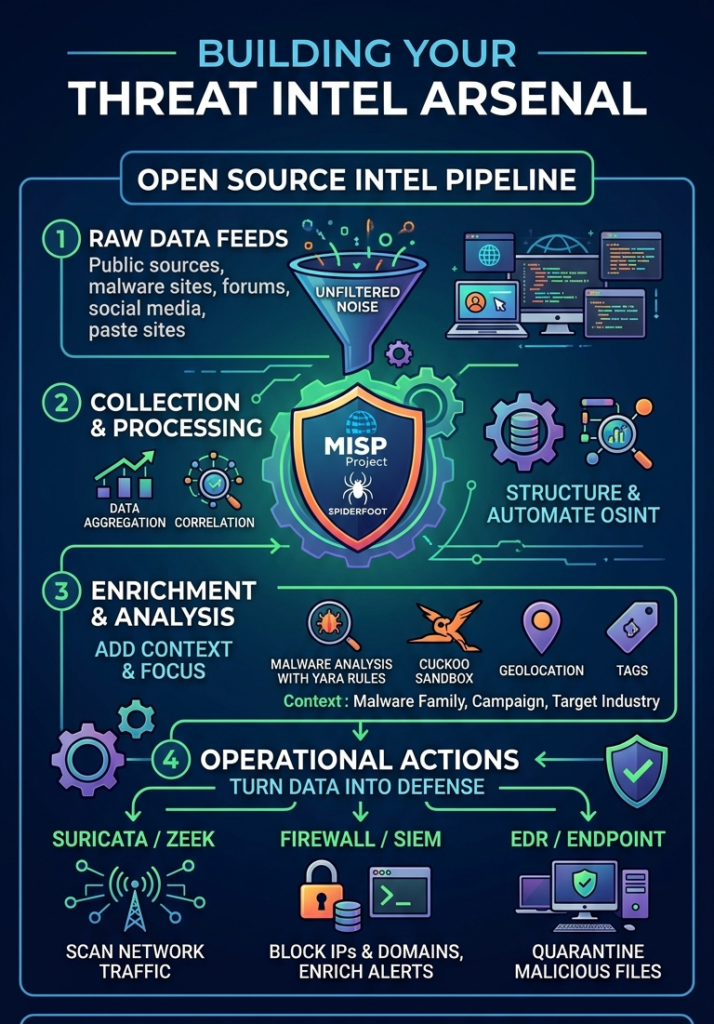
Intelligence without action is just trivia. The goal is to close the loop from indicator to automated response. This is the workflow: Ingest -> Enrich -> Correlate -> Act.
Your MISP instance ingests a feed. It enriches the data, maybe adding geolocation or malware family context. It correlates the new IOCs with internal data, have we seen this domain in our proxy logs recently?
Then comes the action. For high-confidence, critical IOCs, you push them to enforcement points.
- Malicious domains and IPs go to your network detection sensors (Suricata) and DNS firewall for blocking.
- File hashes go to your endpoint detection (EDR) for quarantine.
- Phishing URLs go to your email gateway and web proxy.
For lower-confidence or strategic intelligence, it goes to your SIEM as enrichment. Now, when an internal alert fires, it’s automatically decorated with threat context.
This turns a generic “outbound connection to suspicious IP” into “outbound connection to IP associated with TrickBot malware”, a key advantage when leveraging threat intelligence feeds to provide context immediately. The analyst knows what they’re dealing with immediately.
How Do You Measure the ROI of an Open Source Intel Program?

You can’t manage what you can’t measure. For a threat intelligence program, ROI isn’t about money saved, it’s about risk reduced and time saved.
“OpenCTI is an open source platform allowing organizations to manage their cyber threat intelligence knowledge and observables. The structuration of the data is performed using a knowledge schema based on the STIX2 standards.” Github
Track leading indicators. Mean Time to Detect (MTTD): Are you discovering compromises faster because of intel-led hunting? Mean Time to Respond (MTTR): Does the enriched context from your platform let analysts close cases quicker?
Track operational metrics. Number of automated blocks: How many malicious connections did your network controls stop because of the feed? Reduction in false positives: After tuning for relevance, did your alert volume go down while true positives stayed steady? Finally, track a few strategic wins.
FAQ
What’s the difference between open source and commercial threat intel?
Open source intel is public, often broad, and free. Commercial intel is curated, often includes non-public (proprietary) data, and is tailored to your industry. The best programs use both: open source for breadth and community insight, commercial for targeted, high-fidelity intelligence on specific threats to your sector.
Can open source tools replace a commercial Threat Intelligence Platform (TIP)?
For many organizations, yes, especially at the start. A stack built around MISP for management, coupled with automation scripts, can perform the core functions of a commercial TIP: aggregation, deduplication, enrichment, and sharing.
However, it requires more hands-on maintenance and integration work. Commercial TIPs offer convenience, support, and advanced analytics out of the box.
How do you handle the overwhelming volume of IOCs?
Aggressive filtering is the only way. Filter by relevance to your industry, your geography, and your technology stack. Use tags in MISP to categorize indicators. Most importantly, prioritize automation. Let machines handle the ingestion and initial filtering, so humans only review the most relevant, high-severity indicators.
Is it safe to use IOCs from random GitHub repositories?
Generally, no. Treat them as untrusted data. You must vet the source’s reputation and test the feed’s false positive rate in a lab environment before letting it near production systems. A poisoned or low-quality feed can do more harm than good, causing alert fatigue or even blocking legitimate business traffic.
From Data to Defense with Open Source Intel
To seamlessly bridge the gap between open-source intelligence and active defense, join Network Threat Detection. The platform helps cybersecurity teams proactively secure networks with real-time threat modeling, automated risk analysis, and visual attack path simulations.
Backed by frameworks like MITRE ATT&CK, it exposes blind spots, streamlines vulnerability management, and cuts down response times before attackers can strike.
References
- https://en.wikipedia.org/wiki/Open-source_intelligence
- https://github.com/alexfariasec/opencti