
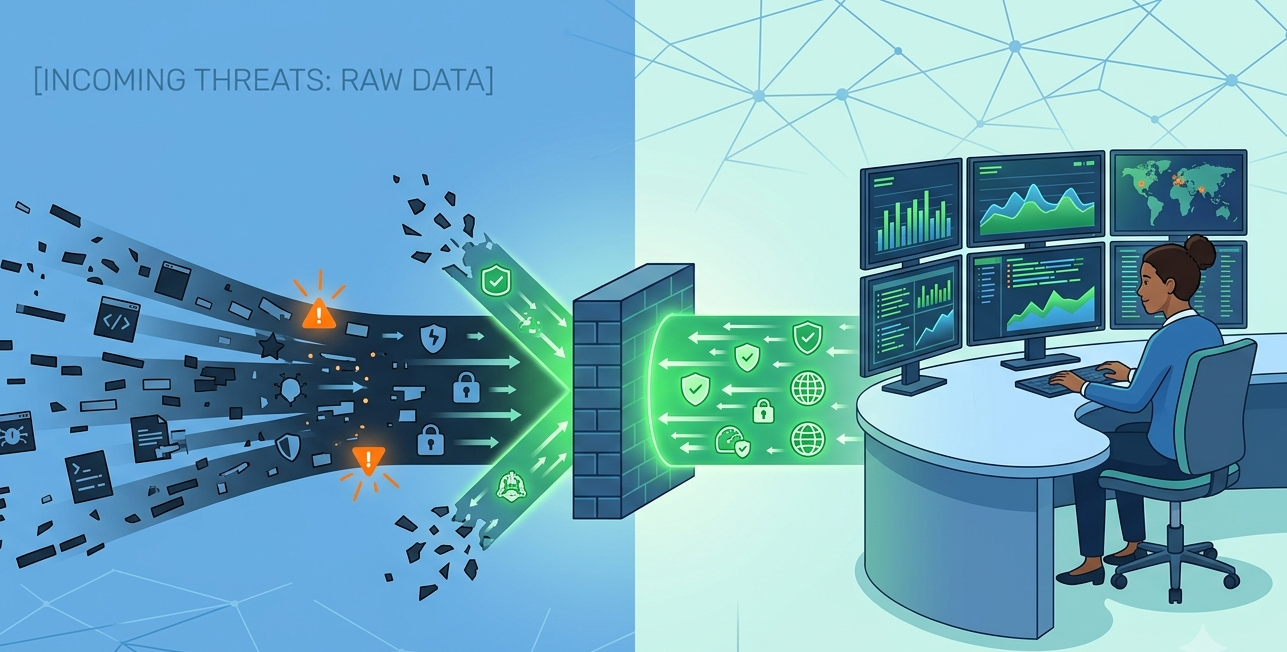
Threat intelligence feeds flood your inbox with data, IPs, domains, file hashes. The problem isn’t getting this data, it’s knowing what to do with it. We watched teams drown in millions of indicators, unable to find the dozen that mattered to their network.
The real value isn’t in the feed itself, but in a deliberate process to filter, contextualize, and automate it. By Leveraging Threat Intelligence Feeds correctly, you transform raw data into a strategic shield. Keep reading to build a process that works for your Network Threat Detection system.
What Matters Most
Before diving into setup, here is what it takes to turn overwhelming data into a functional defense:
- Quality and relevance beat quantity; a feed must match your industry, tech stack, and actual risks.
- Automation is non-negotiable for translating intelligence into real-time security controls like blocking and alerting.
- Measuring the ROI of threat intelligence requires tracking specific outcomes, not just the volume of data ingested.
What Are the Core Types of Threat Intelligence Feeds and Indicators?
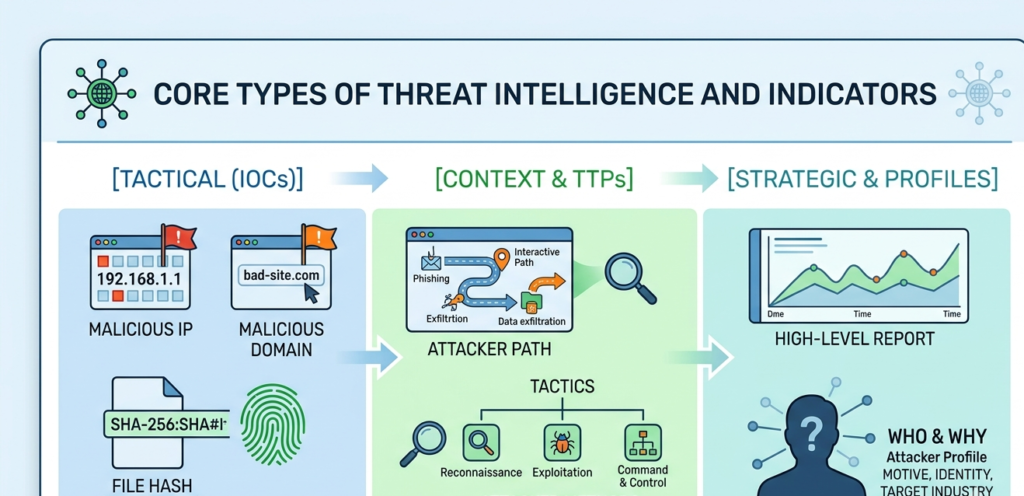
Threat intelligence open source comes in layers, each serving a different purpose. At the most basic level, you have Indicators of Compromise (IOCs). These are the fingerprints of an attack: malicious IP addresses, suspicious domain names, known bad file hashes. They’re tactical, immediate. You get them from open source communities, ISACs, or commercial feeds.
“STIX 2 describes cyber threat intelligence in a repeatable way that both users and machines understand. TAXII 2 provides the ability for you to share timely intelligence with relevant user groups in a standardised format. Both STIX 2 and TAXII 2 help you to reduce manual administration of cyber threat intelligence. For example: the STIX 2 format reduces the need for you to create documents in multiple formats; TAXII 2 reduces the need for you to distribute information by email.” – GOV. UK
But IOCs are just the start. Feeds also provide context. This includes Tactics, Techniques, and Procedures (TTPs) detailing how an attacker operates, and threat actor profiles explaining who is targeting you and why.
The most useful feeds blend these. They don’t just say “block this IP,” they explain, “This IP is associated with a phishing campaign targeting financial sectors using this specific lure document.” That context changes everything. It helps you prioritize and understand the threat, not just react to a data point.
How Do Open Source and Commercial Threat Intel Sources Compare?
This is the classic build-vs-buy question, but it’s more about blending. Open source threat intelligence (OSINT) is vast and free. Tools like MISP or platforms like AlienVault OTX offer incredible breadth.
The community shares fast. We’ve found gems in OSINT that commercial feeds missed for hours. But the volume is overwhelming, and quality varies wildly. You spend a lot of time curating and validating.
Commercial feeds offer consistency and curation. They often provide higher-fidelity data, better context, and dedicated support. They’re packaged for easier consumption. The trade-off is cost and potential blind spots; they might not cover a niche vulnerability affecting your specific legacy system.
| Aspect | Open Source Threat Intelligence (OSINT) | Commercial Threat Intelligence |
| Cost | Free (but high time investment). | Significant annual subscription. |
| Speed | Very fast for emerging threats. | Fast, with consistent delivery. |
| Curated Quality | Variable; requires vetting. | High, pre-vetted and enriched. |
| Context & Enrichment | Often limited to basic IOCs. | Rich with TTPs, actor info, campaign data. |
| Best For | Broad monitoring, niche research, supplementing core feeds. | Foundational, reliable intelligence for automated blocking. |
Why Is a Threat Intelligence Platform (TIP) a Game-Changer?
A Threat Intelligence Platform isn’t just another tool, it’s the central nervous system for your feeds. Without it, you’re manually pasting IPs into firewalls or trying to correlate spreadsheets.
A TIP aggregates all your sources, open source, commercial, internal, into one normalized repository. It deduplicates indicators, enriches them with context (geolocation, malware family, associated campaigns), and scores them for relevance.
The benefits of a threat intelligence platform become clear in hours saved and accuracy gained. It automates the tedious work. More importantly, it enables action. A good TIP integrates directly with your security controls, your SIEM, firewall, EDR, and yes, even your Network Threat Detection systems.
We configured ours to automatically push high-confidence, high-relevance IOCs related to active botnets directly into our network monitoring rules.
What Are the Key Standards for Sharing Intelligence, Like STIX/TAXII?
Credits: Adam Goss
In the early days, sharing threat intel meant emailing PDFs or CSV files. It was chaotic. The adoption of STIX and TAXII standards changed that. Think of STIX (Structured Threat Information eXpression) as the language.
It’s a standardized way to describe a threat actor, a campaign, an indicator, or a TTP in a machine-readable format. TAXII (Trusted Automated eXchange of Indicator Information) is the postal service, it defines how that STIX data gets shared between systems.
Using these standards is what makes automation possible. When your TIP or SIEM consumes a STIX package from a feed, it understands exactly what each data point means and how to handle it. It knows the difference between a malicious IP and a phishing email subject line.
This interoperability is why you can have a commercial feed, an open source OSINT feed, and internal incident data all working together in the same platform. It’s the glue that makes a threat intelligence program scalable.
How Do You Assess the Quality and Relevance of a Threat Feed?
Not all feeds are created equal. A feed with ten million IOCs might be useless if none apply to your business. The first filter is relevance. Does the feed focus on your industry (healthcare, energy, finance)? Does it cover the geographic regions you operate in? Does it include IOCs for the types of malware you’re actually seeing?
Next, assess quality. Look at the source’s reputation. Check the false positive rate. A good test is to run a sample of the feed’s IOCs against your own network traffic for a week. How many actually hit your perimeter? If it’s zero, the feed isn’t targeted enough. Also, evaluate the context provided.
A feed that just gives an IP address is low-value. One that provides the associated malware, the attack vector, and the target industry is high-value.
We learned to ask vendors for their curation process. How do they vet indicators? What’s their average time from discovery to inclusion in the feed? The answers separate the serious providers from the data aggregators.
What’s the Practical Process for Integrating a TIP with Your SIEM?
Integrating a TIP with your SIEM is where intelligence turns into visibility. The goal is to enrich every alert in your SIEM with external threat context. The process is straightforward but critical.
First, you establish the connection, usually via an API. Your TIP pushes enriched, scored IOCs to the SIEM. In the SIEM, you create correlation rules.
For example: “If a firewall log shows a connection to an IP on the ‘high-confidence malware C2’ list from the TIP, generate a critical alert.” Even better: “If an internal workstation connects to a known bad domain and then exhibits lateral movement traffic (caught by our Network Threat Detection), trigger an incident.”
This integration means your SOC analysts see more than just an event. They see, “This internal IP contacted a server known to be part of the Emotet botnet, which specializes in stealing banking credentials.” That context dictates immediate containment actions.
How Can You Automate the Ingestion and Processing of Threat Feeds?
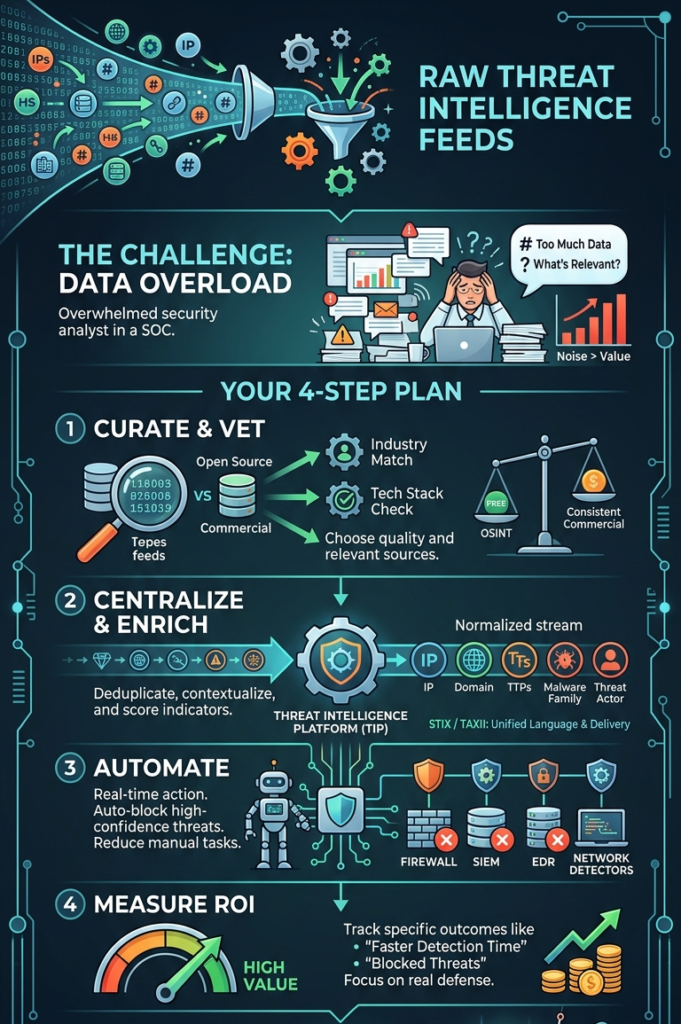
Manual processing is a dead end. Automating threat feed ingestion starts with your TIP. You configure it to pull feeds on a schedule from your designated sources (commercial APIs, STIX/TAXII servers, OSINT URLs). The TIP then normalizes and deduplicates the data.
The next automation step is processing. This is where rules and playbooks come in. You can set rules like: “For any IOC with a confidence score above 85 and a relevance tag matching our industry, automatically create a block rule in the firewall.” Or, “For IOCs related to ransomware, automatically update the detection signatures in the EDR.”
We set up automation to push specific IP and domain IOCs into our DNS and web proxy for blocking. More strategically, we automated the conversion of TTPs into new detection rules for our behavioral tools.
If a feed describes a new lateral movement technique, we’d automatically draft a corresponding detection rule for our network traffic analysis to look for that pattern.
What Are the Different Levels: Strategic, Tactical, and Operational Threat Intel?
Understanding these levels helps you route intelligence to the right people.
- Strategic Intelligence is for executives. It’s about broad trends, threat actor motivations, and geopolitical risks. It answers, “Are we likely to be targeted by ransomware groups this quarter?”
- Tactical Intelligence is for security architects and threat hunters. It details the TTPs of specific actors and campaigns. It’s used to build new detections and inform hunting hypotheses.
- Operational Intelligence is for the SOC. It’s the IOCs, the IPs, domains, hashes, used for immediate blocking and alerting. This is the data that feeds your SIEM and TIP automation.
A mature program produces and consumes all three. The board gets strategic reports. The threat hunting team uses tactical briefs. The SOC’s tools are fed operational IOCs around the clock.
What Are the Biggest Challenges in Operationalizing Threat Intelligence?
The gap between having intelligence and using it is wide. Challenges in operationalizing threat intelligence start with overload. Teams get thousands of IOCs daily and can’t act on them all. Without a TIP and automation, it’s impossible.
Lack of context is another. An IOC without a story is just data. If the SOC doesn’t understand why something is a threat, they won’t prioritize it correctly. Integration hurdles are also common. Getting feeds to talk to your security tools can be a technical headache if standards aren’t supported.
Perhaps the biggest challenge we faced was the “set-and-forget” mentality. You can’t just subscribe to a feed and call it a day. You must continuously tune the sources, refine the automation rules, and measure effectiveness. It’s an active process, not a product.
How Do You Measure the ROI of a Threat Intelligence Program?
Measuring ROI is tough but crucial. Don’t measure inputs (e.g., “we ingested 5 million IOCs”). Measure outcomes.
- Reduction in Dwell Time: Did incidents get detected faster because of intel-enriched alerts?
- Increase in Blocked Threats: How many malicious connections were prevented by automated firewall rules from your feed?
- Improved SOC Efficiency: Did the mean time to triage (MTTT) decrease because alerts had better context?
- Proactive Hunts: How many confirmed threats were found proactively by hunters using tactical intelligence?
Track specific cases. For example, “A high-confidence IOC from Feed X led to an automated block, which we can confirm prevented a malware download attempt on Date Y.” These concrete examples justify the investment far better than any generic metric.
How Do You Convert Raw Intelligence into Actionable Security Controls?
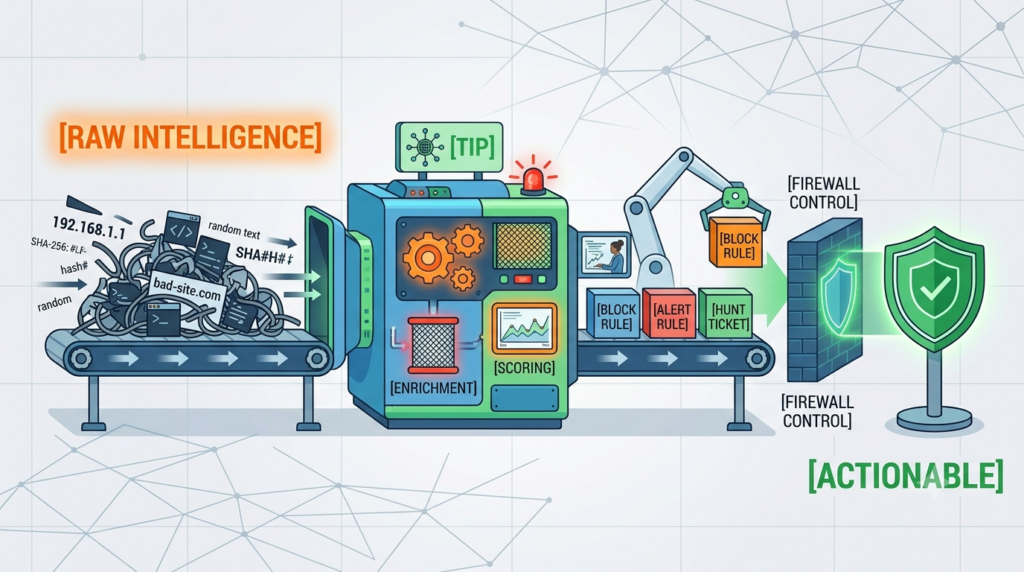
This is the final, critical step. Converting intelligence into actionable controls follows a clear pipeline: Ingest -> Enrich & Score -> Decide -> Act.
- Ingest: Feed enters your TIP.
- Enrich & Score: TIP adds context and assigns a confidence/relevance score.
- Decide: Pre-defined rules determine the action. High-confidence, high-relevance IOCs might be auto-blocked. Medium-confidence ones might generate alerts. TTPs might go to the threat hunting team.
- Act: The control is executed, a firewall rule is pushed, a SIEM alert is created, a hunting ticket is generated.
“Participants commonly noted that some teams equate raw data, such as IP addresses, hashes, or domain names, with actionable intelligence… a heavy reliance on easily changeable indicators, such as file hashes, IP addresses, and domains, within many organizations’ threat intelligence processes… According to the Pyramid of Pain model, these types of indicators are the easiest for threat actors to change, which limits their long-term defensive utility.” – OIC. CERT
The key is building those decision rules collaboratively with your SOC, network, and endpoint teams. Everyone must agree on what score or type of intelligence triggers what action. This turns a stream of data into a set of automated, defensive reflexes for your organization.
FAQ
Can open source tools replace a commercial Threat Intelligence Platform?
They can build one, but it’s a major undertaking. Open source tools like MISP provide excellent TIP functionality. However, you must host, maintain, and integrate it yourself, and you still need to curate the feeds that go into it. For most organizations, a commercial TIP offers faster time-to-value and reliability.
How often should threat feeds be updated and reviewed?
Operational IOCs for blocking should be updated in near real-time, ideally every few minutes. Tactical and strategic intelligence is reviewed on a different schedule, weekly for threat hunting briefs, quarterly for strategic reports. The sources themselves should be formally reviewed every six months for continued relevance.
What’s the first step if we’re new to threat intelligence?
Start small and focused. Don’t buy five feeds. Choose one reputable commercial feed relevant to your industry and integrate it with your SIEM. Pick one use case, like enriching firewall alerts or blocking malicious domains. Prove the value in that one area before expanding.
How does threat intelligence relate to Zero Trust?
Threat intelligence fuels Zero Trust. A core Zero Trust principle is to “assume breach.” Threat intelligence tells you what those breaches look like, the specific IOCs and TTPs of active adversaries. This intelligence directly informs the policies and anomaly detection needed to enforce a Zero Trust model, especially for monitoring internal network traffic.
Making Threat Intelligence a Core Defense Mechanism
Leveraging threat intelligence feeds shifts your security from reactive to proactive. It is not about collecting the most data, but about filtering and acting on the right data. By focusing on relevance and automation, you turn random indicators into a coordinated defense.
Ready to upgrade your defense? Join NetworkThreatDetection.com today to automate risk analysis, expose blind spots, and stop attacks before they start.
References
- https://www.gov.uk/government/publications/open-standards-for-government/exchanging-cyber-threat-intelligence
- https://www.oic-cert.org/en/journal/pdf/6/1/6.pdf#1#1
Related Articles
- https://networkthreatdetection.com/open-source-threat-intelligence-tools/
- https://networkthreatdetection.com/threat-intelligence-platform-benefits/
- https://networkthreatdetection.com/open-source-threat-intelligence-osint/
- https://networkthreatdetection.com/types-threat-intelligence-feeds-indicators-iocs/
- https://networkthreatdetection.com/sources-open-source-commercial-threat-intel/
- https://networkthreatdetection.com/integrating-tip-threat-intelligence-platform-siem/
- https://networkthreatdetection.com/automating-threat-feed-ingestion-processing/
- https://networkthreatdetection.com/assessing-threat-intelligence-feed-quality-relevance/
- https://networkthreatdetection.com/converting-intelligence-actionable-security-controls/
- https://networkthreatdetection.com/strategic-tactical-operational-threat-intelligence/
- https://networkthreatdetection.com/stix-taxii-standards-threat-intel-sharing/
- https://networkthreatdetection.com/challenges-operationalizing-threat-intelligence/
- https://networkthreatdetection.com/measuring-roi-threat-intelligence-program/
- https://networkthreatdetection.com/threat-intelligence-platform-benefits-explained/