
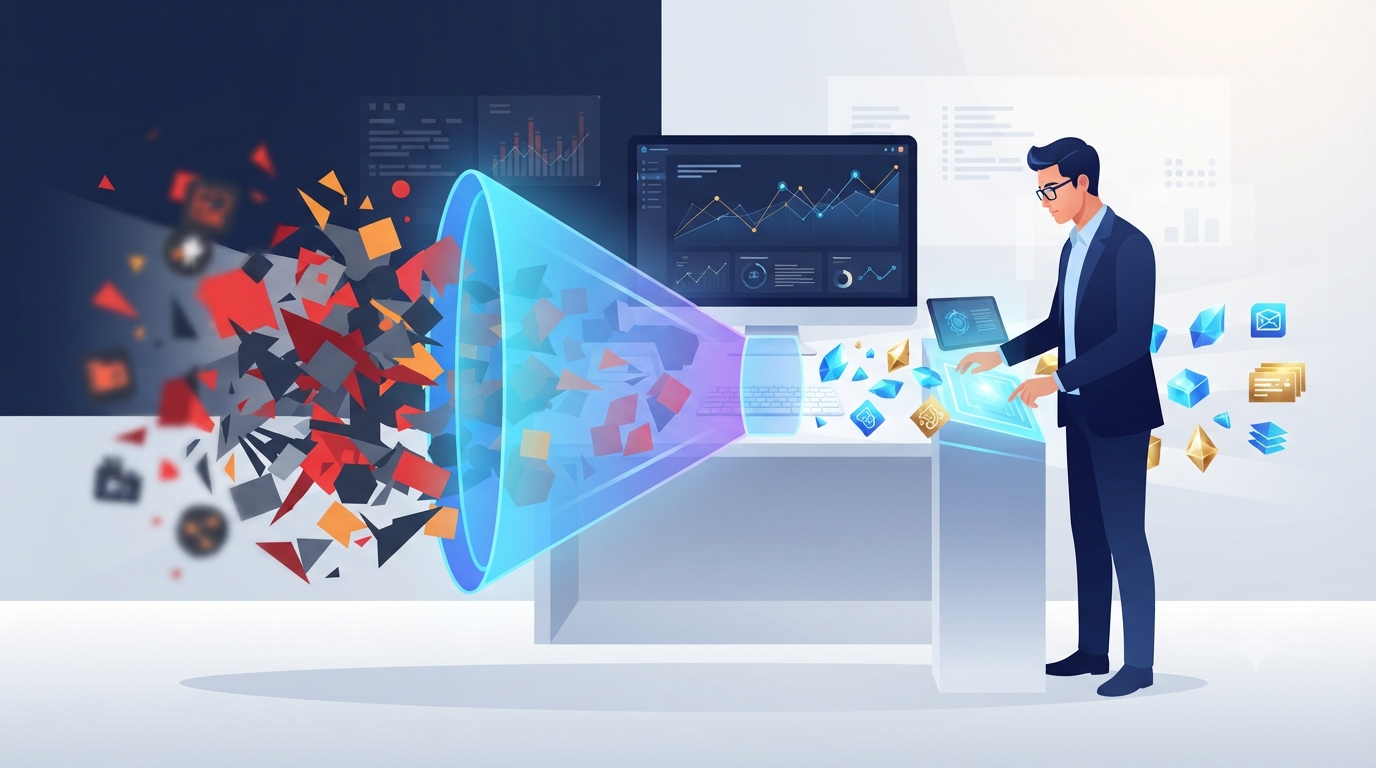
Your security team may receive thousands of threat indicators every day, but not every indicator deserves attention. Assessing threat intelligence feed quality relevance helps you determine whether your intelligence supports faster, smarter security decisions instead of creating more noise.
With Network Threat Detection, organizations can combine trusted threat intelligence with network visibility to focus on meaningful risks rather than endless alerts. Keep reading to learn how to evaluate whether your threat intelligence feed is actually worth using.
Signals That Separate Valuable Threat Intelligence from Empty Data
Before relying on one to guide security decisions, ask whether it delivers information that improves detection, investigation, and response.
- Relevance to your specific industry and digital footprint is more critical than sheer volume.
- High-quality feeds provide rich context, not just isolated indicators.
- Timeliness and accuracy are the twin pillars that determine if intelligence is actionable.
Why Does Feed Quality Feel So Subjective?

It’s easy to get lost in vendor claims. “Millions of indicators!” “Real-time updates!” But more isn’t better. In fact, an unfiltered firehose of data can paralyze a security team. We learned this the hard way.
We onboarded a popular feed, proud of its massive database. Alerts skyrocketed. We were drowning in IP addresses flagged as malicious, but 90% of them were from regions our company had zero traffic with, or they were tied to campaigns targeting sectors like energy, while we were in software.
The problem was a mismatch of context. The feed was high-quality for someone, but not for us. Quality isn’t a universal stamp. It’s a measure of fit. An indicator’s quality is intrinsically tied to its relevance to your network, your industry, your crown jewels.
A feed full of accurate, timely data on industrial control system malware is low-quality for a financial services firm. Subjectivity enters because your environment is unique. The assessment starts not with the feed, but with a hard look in the mirror at what you need to protect.
What Are the Concrete Signs of a High-Quality Feed?
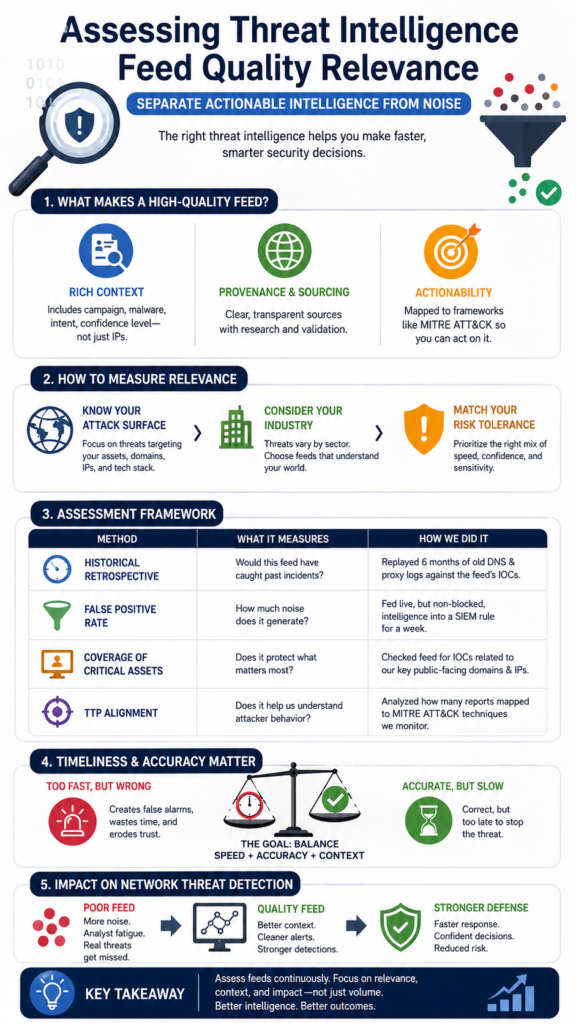
So how do you move from a gut feeling to a real assessment? You look for specific attributes. First is richness of context. A good feed doesn’t just give you a malicious IP. It tells you the associated campaign (e.g., “IceXLoader”), the malware family, the likely intent (data theft, ransomware), and the confidence level.
It connects the dots between indicators. Organizations that are effectively leveraging threat intelligence feeds prioritize this contextual information because it allows analysts to understand why an indicator matters instead of treating every alert equally.
Second is provenance and sourcing. Where does the data come from? Is it from the feed provider’s own global sensor network, their research team, or is it just repackaged from open-source feeds you could get yourself?.
Comparing open-source threat intel with commercial threat intel also helps reveal whether additional context, validation, and exclusive visibility justify relying on one source over another.
Third, and perhaps most practically, is actionability. Can you do something with it? We found that feeds which neatly mapped their indicators to frameworks like MITRE ATT&CK were instantly more useful.
How Do You Measure Relevance to Your Organization?
Credits: Adam Goss
Relevance is the filter that makes quality meaningful. Start with your attack surface. What do you look like to the outside world? Your public IP ranges, your domains, the SaaS platforms you use. A feed relevant to you should have intelligence on threats targeting those specific assets and the technologies in your stack.
Then, consider your industry vertical. Threat actors specialize. Finance gets hit with banking trojans and supply-chain attacks on trading software. Healthcare faces ransomware gangs hunting for PHI. A relevant feed should show a deep understanding of the tactics, techniques, and procedures (TTPs) favored by groups that go after your sector.
Finally, think about your risk tolerance. A government contractor might need ultra-sensitive, early-warning intelligence on state-sponsored actors, even if it’s lower confidence. A retail business might prioritize high-confidence, immediate indicators of card-skimming malware.
| Assessment Method | What It Measures | How We Did It |
| Historical Retrospective | Would this feed have caught past incidents? | Replayed 6 months of old DNS & proxy logs against the new feed’s IOCs. |
| False Positive Rate | How much noise does it generate? | Fed live, but non-blocked, intelligence into a SIEM correlation rule for a week. |
| Coverage of Critical Assets | Does it protect what matters most? | Manually checked feed for IOCs related to our key public-facing web domains and IPs. |
| TTP Alignment | Does it help us understand attacker behavior? | Analyzed how many feed reports mapped clearly to MITRE ATT&CK techniques we monitor. |
This process moved relevance from a marketing claim to a measurable metric.
Can a Feed Be Timely But Inaccurate (or Vice Versa)?
Yes, a threat feed can be fast but wrong, or it can be perfectly accurate but arrive too late. Both situations create real problems for security teams.
“A detection stack filled with overlapping intelligence does not become stronger, it becomes harder to manage and less precise. Threat Intelligence Feeds must be evaluated before being operationalized. A more fundamental question must be answered: Is the feed itself valuable?” – Zenodo
A timely but inaccurate feed generates false alarms. Your team gets an alert about a “new” malicious domain within minutes. It turns out to be a harmless typo in a legitimate website address. You waste time investigating, and you start to ignore future alerts from that source.
An accurate but slow feed is just as bad. It might give you a 100% confirmed report that an IP address was used in a major attack. The catch? The report arrives two years after the campaign ended. The information is correct, but it’s useless for stopping anything.
The most useful feeds find a balance. They work by:
- Sending out fast, initial alerts for potential threats, but marking them with a low confidence score.
- Having analysts or automated systems verify the threat, adding context and raising the confidence score over time.
- Telling you when an indicator is no longer a threat, so your blocklists don’t fill up with old, irrelevant data.
How Does Feed Quality Impact Network Threat Detection?
This is where the rubber meets the road. Network Threat Detection is your unbiased witness, but it needs a good script to know what to look for. The quality of your threat intel feeds directly determines the signal-to-noise ratio of your network alerts.
When security teams correlate these indicators through a Threat Intelligence Platform before sending them into a SIEM, duplicate or low-confidence intelligence is easier to filter, improving the quality of downstream detections.
A high-quality, relevant feed, however, turns your network monitoring into a precision instrument. When we switched to a feed curated for our tech industry profile, the change was stark. Our Network Threat Detection system, which we tune to look for callback patterns and data exfiltration, started triggering alerts that made immediate sense.
Instead of “connection to suspicious IP in Estonia,” we got “high-confidence connection to C2 infrastructure associated with SolarMarker malware, known to target software companies for source code theft.” The network evidence was clear, and the intelligence gave it a name and a motive. Response became faster and more confident.
What Are the Operational Costs of a Low-Quality Feed?

The costs aren’t just about the subscription fee. They’re hidden in your operational overhead. First, there’s analyst fatigue. Sifting through thousands of low-fidelity alerts breeds complacency. The “boy who cried wolf” effect is real in a SOC.
“Stop chasing feeds, start measuring them. Most programs judge threat intelligence by how much they ingest, not how well it drives decisions. That leads to bloated pipelines, duplicate indicators, and analysts drowning in ‘interesting’ but unactionable data. High-quality TI ships with enough structure and context to move immediately.” – Qintel
Second, there’s infrastructure bloat. You need more SIEM storage, more processing power, to handle the avalanche of irrelevant data. Your correlation rules become convoluted with exceptions for all the false positives.
Third, and most dangerously, there’s opportunity cost. The time your team spends validating junk alerts is time they’re not spending on proactive hunting, security engineering, or investigating the one subtle, real threat. We calculated that a previous low-relevance feed consumed about 30% of our Tier 1 analysts’ time on false leads.
That’s a huge tax on your security program. You’re not just paying for the feed, you’re paying your people to ignore it.
FAQ
Should I use multiple feeds to cover my bases?
Yes, but with strategy. Don’t just aggregate more raw data. Use a primary, high-quality feed for automated blocking/detection, and supplement with specialized feeds (e.g., one for your specific cloud provider, one for your industry). Use a Threat Intelligence Platform to manage and deduplicate them.
How often should I reassess my feed’s quality and relevance?
Formally, at least annually. Informally, continuously. If your company acquires a new business, launches in a new region, or adopts a major new technology (like a move to a new cloud), that’s a trigger to re-evaluate.
Are open-source feeds good enough?
They can be a valuable supplement, especially for community-shared IOCs from groups like ISACs. However, they often lack the curation, context, timeliness, and consistent formatting required for reliable automated detection. They’re great for research, risky as a primary blocking source.
What’s the one question I should ask a feed vendor?
“Walk me through how you sourced and validated a specific high-confidence IOC from a report you published last week.” Their answer reveals their process, depth, and transparency.
Making the Assessment Stick
Assessing threat intelligence quality is an ongoing discipline, not a one-time audit. It requires understanding your specific assets and risks to ensure every feed makes your team faster and more focused.
Stop counting indicators and start measuring outcomes: does the data truly lead to decisive responses? By asking these hard questions, you transform raw information into a strategic advantage. Ready to elevate your security posture? See how we can help you defend your network: Join us here.
References
- https://zenodo.org/records/18208974
- https://www.qintel.com/article/stop-chasing-feeds-start-measuring-them-a-practical-framework-for-threat-intelligence-quality