
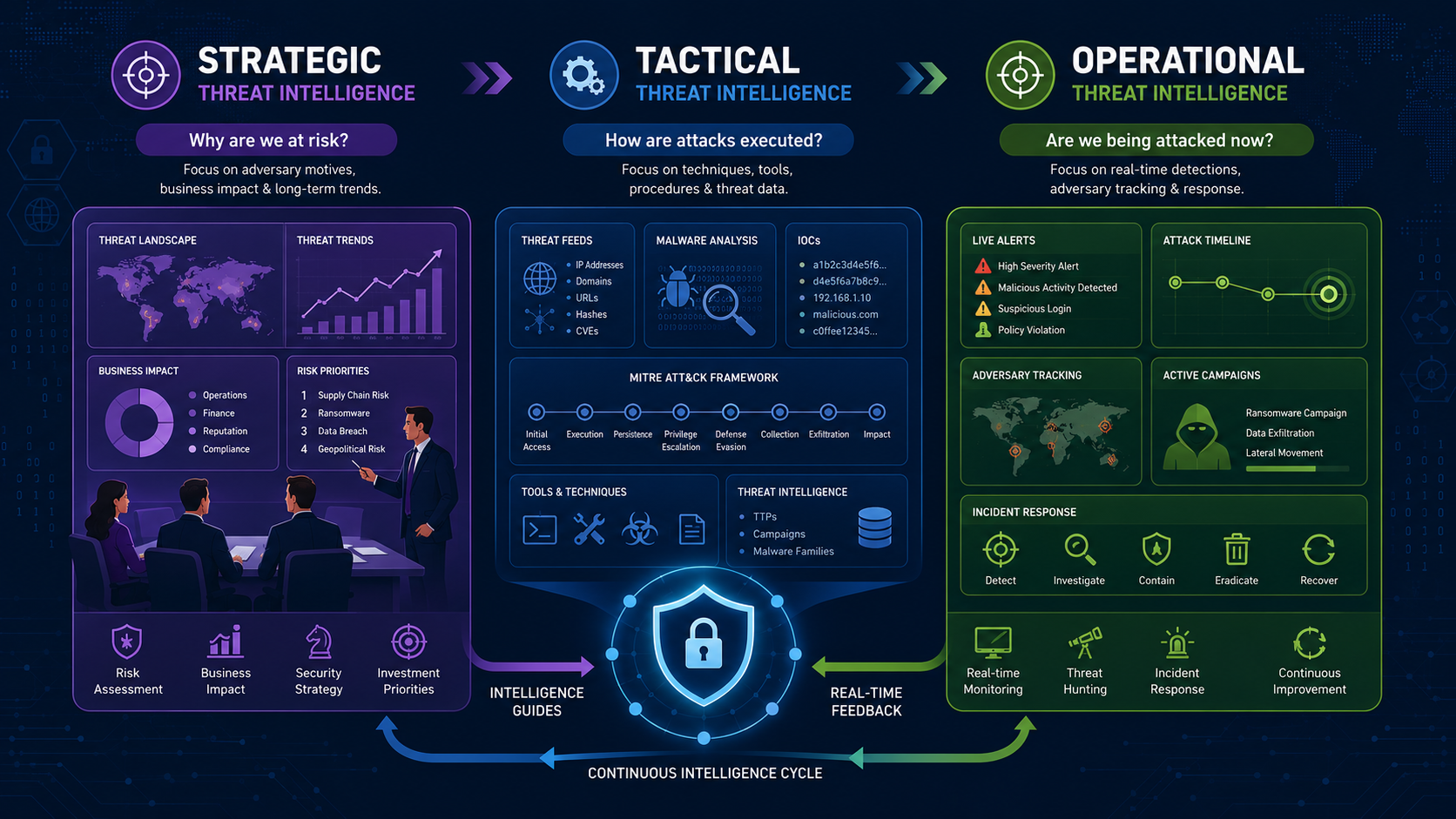
Every security decision improves when you understand strategic tactical operational threat intelligence as a connected framework instead of separate activities. Strategic intelligence explains why adversaries act, tactical intelligence reveals how they operate, and operational intelligence identifies who is targeting your organization and when.
Together, these layers improve Network Threat Detection by turning scattered indicators into meaningful, prioritized actions for both executives and security teams. A layered intelligence approach helps organizations make faster, smarter, and more confident security decisions. Keep reading.
What You’ll Learn
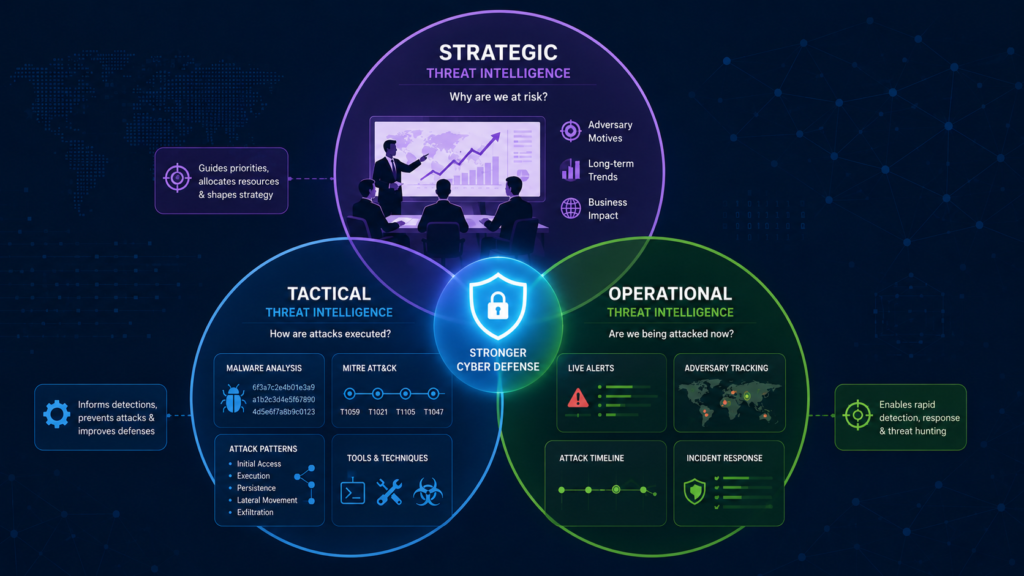
Understanding threat intelligence is easier when you view it as three complementary layers that work together. Each layer answers a different security question, helping leadership, analysts, and defenders make informed decisions that improve protection across the organization.
- Strategic intelligence supports long-term security planning by identifying adversary motives, business risks, and emerging threat trends.
- Tactical intelligence delivers actionable information about attacker techniques, tools, and procedures to strengthen security controls.
- Operational intelligence provides real-time visibility into active campaigns, enabling faster detection, investigation, and response.
What is Threat Intelligence and Why Does the Triad Matter?
In our work, we see a lot of confusion. Some teams drown in thousands of isolated alerts,IP addresses, malware hashes, suspicious domains,without understanding the story they tell. Others have a vague sense of “industry threats” but can’t connect them to their own network.
This gap is why the triad of strategic, tactical, and operational intelligence isn’t just academic; it’s the framework that makes sense of the chaos.
Think of it like national defense. Strategic intel asks, “What are the geopolitical tensions that might lead to conflict?” Tactical intel asks, “What types of tanks or aircraft is the adversary deploying?” Operational intel asks, “Where are their troops massing right now, and what are their orders?” In cybersecurity, you need answers to all three questions to be effective.
Without this structure, you’re either planning blindly, fighting blindly, or both. We’ve found that organizations that consciously integrate all three layers move from being reactive to having a measurable advantage.
What is Strategic Threat Intelligence?
This is the big picture, the 30,000-foot view designed for your leadership team,the CISOs, the board, the risk committee. Strategic intelligence doesn’t deal in malware samples or IP blocks. It analyzes trends, adversary motivations, and long-term shifts in the threat landscape to answer broad questions.
- Who are our likely adversaries? Are they nation-states interested in intellectual property, hacktivists aiming for disruption, or cybercriminals focused on financial theft?
- What are the emerging risks to our sector? Is there a rise in ransomware targeting our industry’s specific software?
- How should we allocate our security budget for the next 3-5 years?
The output here is often reports, briefings, and risk assessments. It helps justify security investments and shape policy. For example, strategic intelligence might reveal a growing focus on supply chain attacks, prompting a company to initiate a rigorous third-party vendor security program.
It’s about understanding the “why” behind the attacks so you can build a resilient posture, not just stop individual bullets.
What is Tactical Threat Intelligence?
If strategic intel is for the boardroom, tactical intel is for the Security Operations Center (SOC). This is the “how-to” manual of the adversary. It provides concrete, technical details about the tools, techniques, and procedures (TTPs) attackers are currently using.
“high-level information about relative threats’ trends, attributions, and motivations” for “organizational leaders and decision makers” with a purpose to “provide broad long-term understanding of the threat landscape.” – PMC
This is the data that feeds directly into your security tools. It includes:
- Indicators of Compromise (IoCs): Malware hashes, malicious IP addresses, suspicious domain names.
- Attack methodologies: Phishing email templates, exploit kit configurations, lateral movement techniques.
- Vulnerability information: Details on how newly disclosed flaws are being weaponized.
The goal is automation and enrichment. A tactical intelligence feed can automatically block known-bad IPs at your firewall, enrich SIEM alerts with context about the associated threat actor, and help your analysts triage incidents faster by showing them the known TTPs while making better use of threat intelligence feeds across your security environment.
It turns raw data into actionable defense. When we implement Network Threat Detection, we rely heavily on tactical intelligence to fine-tune our sensors and correlation rules, ensuring we’re looking for the right things at the right time.
What is Operational Threat Intelligence?
This is the most dynamic and targeted layer. Operational intelligence (Ops Intel) seeks to understand the specific intentions, capabilities, and ongoing campaigns of threat actors against your organization. It answers the critical questions: “Are we being targeted right now? By whom? And with what?”
Ops Intel analysts think like the adversary. They might:
- Monitor underground forums where your company’s name or products are mentioned.
- Analyze campaigns targeting your industry to see if the same infrastructure is probing your perimeter.
- Work to attribute an ongoing attack to a specific group to understand their full playbook.
The insights are immediate and high-stakes. For instance, Ops Intel might uncover a planned ransomware operation against several firms in your sector, giving you a crucial window to patch a specific vulnerability and hunt for indicators in your network before the attack executes.
It’s the difference between knowing a bank robber is in the city and knowing he’s casing your bank branch tonight.
How Do Strategic, Tactical, and Operational Intelligence Work Together?
Credits: Adam Goss
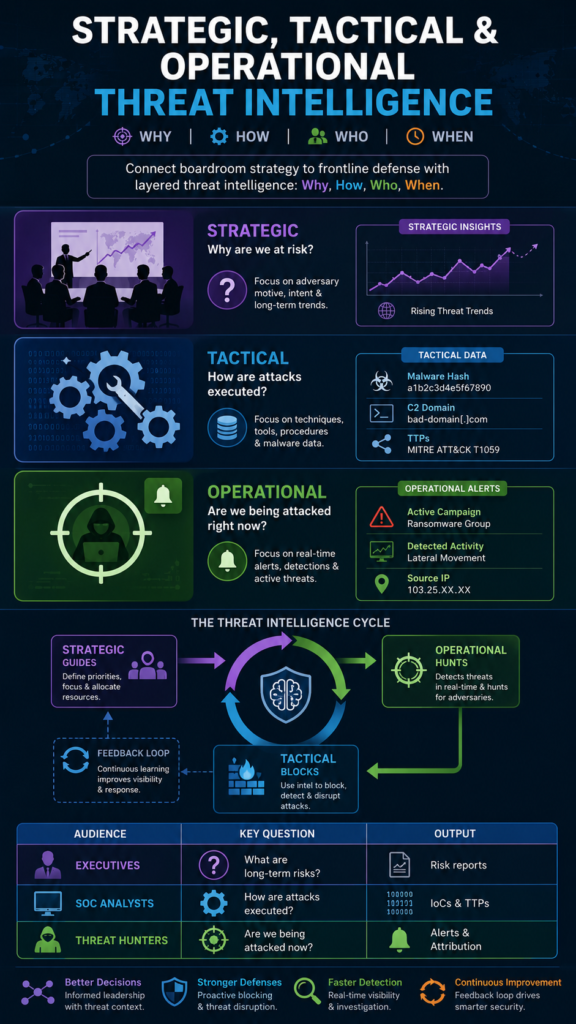
They form a continuous, reinforcing cycle. A strategic report on the rise of a new threat actor (Strategic) prompts your Ops Intel team to hunt for signs of their activity in your logs (Operational), helping organizations operationalize threat intelligence through coordinated detection and response.
When they find evidence, they extract new malware signatures and command-and-control servers (Tactical) to push out to your Network Threat Detection systems. The resulting blocked attacks and incident data then feed back up to update the strategic understanding of that actor’s impact and effectiveness.
It’s a loop of planning, acting, and learning. Here’s a simple table to visualize the flow:
| Level | Audience | Key Question | Output | Example |
| Strategic | Executives, Board | “What are our long-term risks?” | Risk assessments, Budget plans | Report on state-sponsored IP theft trends. |
| Tactical | SOC Analysts, Tools | “How are attacks executed?” | IoCs, TTPs, Rules | Feed of malware hashes to block at the firewall. |
| Operational | Threat Hunters, IR | “Are we being attacked now?” | Campaign alerts, Attribution | Alert that Actor X is probing companies like yours. |
Neglecting one layer weakens the others. Purely tactical intelligence leads to alert fatigue without strategic direction. Purely strategic intelligence lacks the concrete data needed to stop real attacks. We build our own processes around closing this loop, ensuring what we learn on the network edge informs our broader security posture.
Where Should Your Organization Start?
This can feel overwhelming. You can’t build a complete intelligence program overnight. The most practical entry point, in our experience, is often at the tactical level, specifically through enhancing your Network Threat Detection capabilities. Why? Because it delivers visible, immediate value.
“Think of CTI as a pyramid. Each layer builds on the one below: Tactical sits at the base: detailed, machine-readable IOCs used to block threats. Operational builds the middle: contextual data about campaigns and TTPs. Strategic tops the pyramid: high-level insight to guide executive decisions. As with any strong architecture, the pyramid relies on all three layers working together. Skip one, and the rest lose integrity.” – Cyware
Start by integrating a curated feed of tactical IoCs into your existing security stack. Use it to block known malicious traffic and enrich alerts while evaluating feed quality and relevance so analysts can focus on intelligence that supports faster decisions. This gives your analysts a win, they’ll start seeing clearer, more contextual alerts.
From that foundation, you can begin to ask operational questions: “Where did this threat come from? Is this part of a larger campaign?” This naturally leads to needing more operational insight. Finally, with data from actual blocked campaigns and incidents, you can build compelling strategic reports that demonstrate risk and justify further investment.
FAQ
What’s the most common mistake companies make with threat intelligence?
They buy a single feed of tactical IoCs (just IPs and hashes) and call it a day. This creates overwhelming alert noise without strategic context or operational relevance, leading to burnout and missed true positives. Intelligence must be integrated and layered to be useful.
Can a small business use this triad model?
Absolutely. The scale is different, not the principle. A small business might use strategic intel from industry reports to decide to implement multi-factor authentication. Their tactical intel could come from a managed security service.
Operational intel might involve monitoring for phishing emails targeting their specific business name. The mindset matters more than the budget.
How does Network Threat Detection fit into this?
Network Threat Detection is a primary consumer and enabler of tactical intelligence. It uses the technical details of attacks (TTPs, IoCs) to identify malicious behavior on your network.
The data it generates then feeds into operational hunting and strategic reporting. We position it as a foundational element because it turns intelligence data into direct defensive action.
Is operational intelligence only for large enterprises targeted by nation-states?
No. While advanced persistent threats (APTs) are a focus, cybercriminal groups run targeted campaigns against businesses of all sizes. Operational intelligence for a mid-market company might mean tracking ransomware groups that actively target their specific accounting software or managed service provider platforms.
Build a Smarter Defense with Connected Threat Intelligence
The real value of strategic tactical operational threat intelligence comes from connecting every layer into a continuous decision-making process. Feed tactical insights into your Network Threat Detection to improve visibility, validate operational findings, and turn them into strategic decisions that strengthen future defenses.
Rather than reacting to every alert, your team can prioritize risks with greater confidence and speed. Ready to build a more resilient security program? Explore how Network Threat Detection.
References
- https://pmc.ncbi.nlm.nih.gov/articles/PMC12595088/table/Tab3/
- https://www.cyware.com/blog/what-is-the-difference-between-tactical-operational-and-strategic-cyber?utm_content=338227847&utm_medium=social&utm_source=linkedin&hss_channel=lcp-10407612