
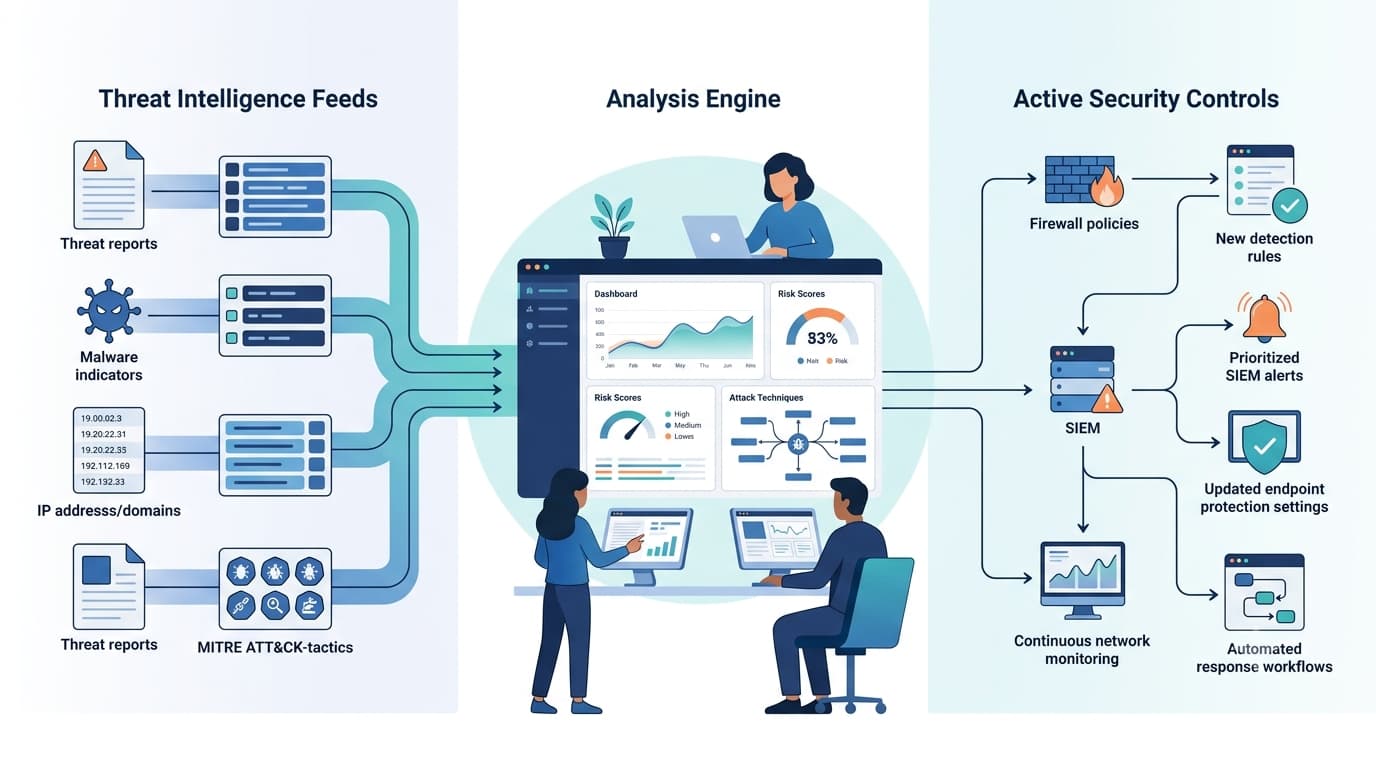
Intelligence is only useful if you act on it. Since breaches are expensive, you must convert your data into real security controls. That’s the entire point. This process filters out useless noise, directly improves your defenses, and makes your organization more resilient.
Here’s a practical workflow from Network Threat Detection for moving from information to action. Keep reading to see how it works.
Security Intelligence in Action: What Matters Most
- Threat intelligence only matters if it stops, finds, or fixes a problem.
- Data needs a plan. Use PIRs to define what to find, and MITRE ATT&CK to map it to real attacks.
- Continuous validation, automation, and measurable outcomes create sustainable intelligence-driven security.
Why Does Threat Intelligence Often Fail in Practice?
Threat intelligence often fails as raw data. We see companies buy expensive feeds without improving their defense.
The mistake is focusing on volume, not relevance. Teams must map threat behaviors directly to the critical assets they protect. Generic alerts create overload. Intelligence only matters when it changes a security decision.
IOCs are useful, but attacker behaviors and TTPs are often more durable and more valuable for detection engineering. Their tools change; their habits don’t. MITRE ATT&CK is a strong framework for mapping adversary behaviors to detections and mitigations.
From our work, we see the same mistakes. Intel is gathered without a clear goal. Every feed is treated as equal. People measure volume, not real risk. A generic feed is noisy because it ignores your specific assets and risks. We filter everything through our critical systems first to improve threat intelligence feed quality and make sure the information stays relevant to our environment. It slashes false positives.
The operational gaps are clear. No one owns linking intel to controls. Detection happens, but the problem isn’t fixed. Vulnerability management and threat intel don’t talk to each other. There’s no loop to make monitoring smarter. These issues keep intelligence from being useful. Success starts by asking “What did we change?” not “What did we learn?”
How Do Priority Intelligence Requirements (PIRs) Make Intelligence Actionable?
PIRs make threat intelligence work. They turn data into real decisions that protect your company.
PIRs help you focus. You find out which attackers, systems, and threats matter most to you. This stops wasted effort and makes security smarter.
We see it all the time. Setting PIRs early changes everything. Your threat hunts get sharper. Your detection rules improve. Your alerts become more useful. Your team stops chasing noise.
A good PIR asks clear questions:
- Which of our systems would cause the most damage if attacked?
- Who is really trying to hit those systems?
- Which attacker tricks, from MITRE ATT&CK, should we watch for?
- What security controls need fixing now?
You must link intelligence to your business first. Treating every alert the same burns people out.
Context turns raw data into action.
According to FIRST (Forum of Incident Response and Security Teams)
“The purpose of PIRs is to provide decision-quality information that is timely, fused, analyzed, predictive, and answers the ‘so what’ to drive planning and support operations versus simply ‘reporting the news.'” – FIRST (Forum of Incident Response and Security Teams)
| Without Context | With PIRs |
| General malware alerts | Watching for cloud account theft |
| Too many IOCs | Focused detection rules |
| Too many feeds | Clear priority list |
| Vague alarms | Fixing specific controls |
| Generic reports | Decisions based on your risk |
You stop reacting to everything. You start protecting what’s critical. A hospital’s PIRs will look different from a bank’s, even against the same hackers. That’s the point, they’re yours.
Turning Intelligence Into Preventive Controls
In our experience, the most effective threat intelligence prevents attacks before they happen rather than simply helping detect them later. Stopping problems before they start is usually cheaper and more effective.
Don’t just block every new threat indicator blindly. Check it first. See if it matches your known weak spots and current risks. This leads to better controls with less disruption.
According to Google Cloud Security Insights
“Organizations that use threat intelligence effectively can reduce both the frequency and impact of successful attacks. By identifying which threats target your industry and understanding how attackers operate, you can focus your security investments on the controls that actually defend against the attacks you’re most likely to face.” – Google Cloud Security Insights
Here’s how to turn intelligence into action:
| Intelligence | Action |
| High-confidence malicious IP | Consider blocking, with validation for business impact and false-positive risk.” |
| High-confidence malicious domain | Consider sinkholing or web filtering, subject to confidence and operational impact.” |
In our experience, prioritizing every vulnerability for immediate patching can create unnecessary operational disruption. We use our EPSS data to decide. No active exploit? We deprioritize.
A confirmed attack on our edge changes everything. We may temporarily prioritize isolation or compensating controls before patching when active exploitation creates immediate operational risk.
Zero Trust means moving past the perimeter. It requires least-privilege access, securing cloud workloads, and hardening the CI/CD pipeline. Threat intelligence must fuel these dynamic access policies.
We often start by watching the network traffic. This shows if a threat is actually hitting us before we change anything big. It helps us pick the right fixes and avoid problems.
But don’t block everything automatically. We recommend delaying automated blocking when intelligence confidence is low, operational impact is uncertain, or the risk of false positives outweighs the expected security benefit. People still need to decide what’s best for both security and the business.
Converting Intelligence Into Detection Rules
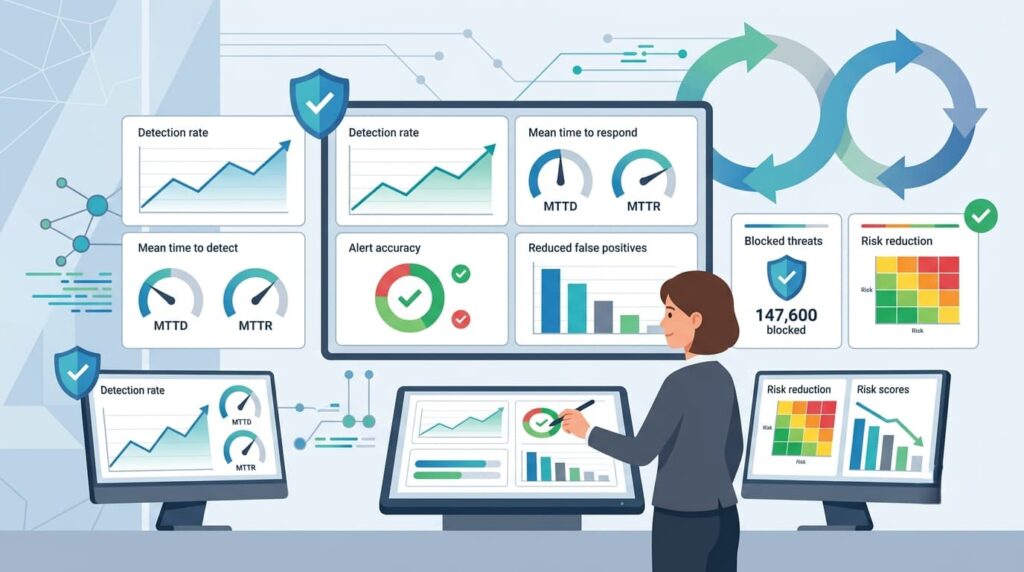
We’ve found that focusing on attacker behaviors consistently produces stronger detections than relying only on changing infrastructure or IOCs. Their infrastructure changes, but their habits often stay the same. That’s why detection engineering should focus on their behaviors, their TTPs, not just on IOCs.
MITRE ATT&CK makes a clear point. When you map how attackers behave, you find threats more easily. You can test your own defenses better. And you make your whole security setup smarter about actual risks.
We’ve seen it ourselves. Combining network data, endpoint logs, and behavior analytics catches more than any single source can. The network traffic often tells you if strange endpoint activity is normal or a real attack.
Frameworks that help with this kind of detection include MITRE ATT&CK, Sigma, YARA, and Zeek.
Focusing on behavior makes security stronger. It makes you less reliant on IOCs that change daily. It makes your threat hunts more effective. It improves how your SIEM works. And it keeps your detection working even as attackers evolve.
This is how you build a foundation. It lets you automate responses, orchestrate your security tasks, and watch your network more effectively.
How Should Intelligence Improve Incident Response?
We’ve learned that intelligence only becomes valuable when it directly improves incident response decisions. It should always improve how you stop, manage, and recover from attacks.
A strong incident response program improves over time. When you learn how attackers change, update your playbooks. Teams that add fresh intel to their playbooks react better and decide faster in a crisis. This intelligence should update your response plans, security rules, tools, and ability to recover.
We get the best results from small, regular updates. If we find a new phishing trick or password theft method, we act fast. We change our checklists, alerts, and call lists right away. These small changes add up.
Review your playbooks when intel shows a real shift. Watch for new phishing campaigns, ransomware, cloud account theft, insider threats, or supply chain attacks.
Every playbook needs a clear owner and a way to measure success. A good playbook cuts through the chaos when an incident happens.
Every incident playbook must have:
- What triggers it
- Who is responsible
- Who to escalate to
- What evidence to collect
- How to contain the attack
- How to restore systems
- How to define success
Using intelligence to update playbooks builds stronger operations and speeds up investigations.
Tools That Help Operationalize Threat Intelligence
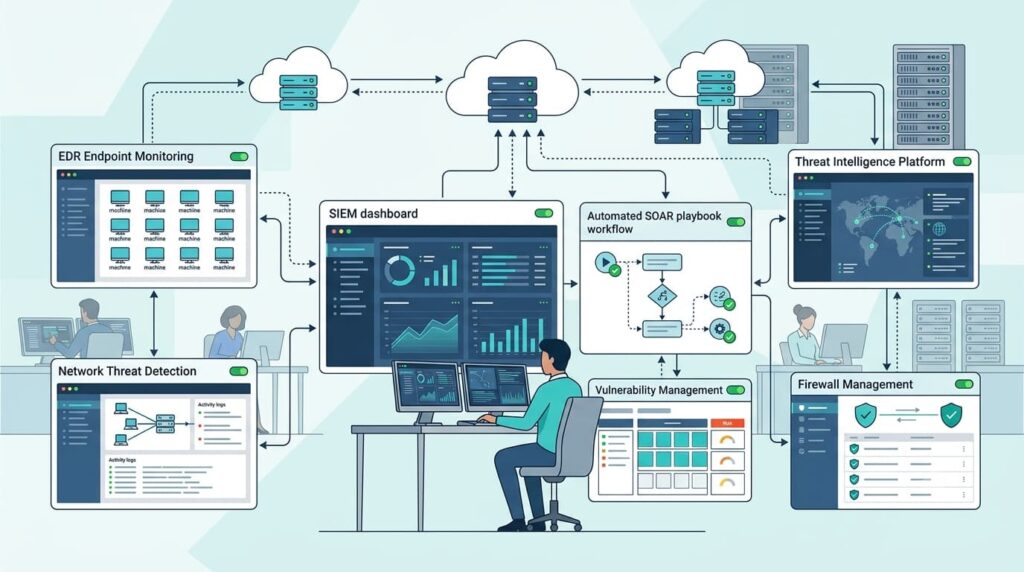
For intelligence to work, your tools must work together. No single platform can turn data into security actions alone. The real value happens when intelligence moves easily from collection to enrichment, detection, automated response, and validation. This flow supports better analytics, automation, constant monitoring, and control testing.
MITRE and CISA agree: using standard formats and common frameworks improves teamwork and reduces manual work.
A typical setup uses several tools:
- A threat intelligence platform (TIP)
- A system for event correlation (a SIEM)
- A platform for security orchestration (a SOAR)
- An intelligence-sharing platform
- Endpoint visibility (EDR)
- Cross-domain detection (XDR)
- Network traffic validation (Network Threat Detection)
The main value comes from integrating these tools into a single operational workflow.. We find the best results come from a clear workflow: Collection → Enrichment → Correlation → Action → Validation → Feedback
This closed loop constantly gets better at connecting the dots in your intelligence. It helps you improve your security controls based on real evidence.
How Can Automation Reduce Noise Instead of Increasing It?
Credits: Dr. Dave Chatterjee
Automation delivers the greatest value when it removes repetitive work while preserving analyst judgment.
Many security teams automate too aggressively, creating additional alert fatigue instead of reducing it. Automation should support consistent control implementation while maintaining appropriate oversight for higher-risk decisions.
Our teams have seen automation dramatically reduce repetitive workload when applied to enrichment rather than decision-making. Analysts spend less time gathering context and more time performing meaningful investigations.
Automation works well for repetitive operational tasks, especially when automating threat feed ingestion and normalization before intelligence reaches analysts.
- IOC enrichment
- Reputation scoring
- Threat intelligence feed normalization
- Deduplication
- Ticket creation
- Security telemetry correlation
That said, several activities still require experienced human analysis.
What still requires human analysis?
Security professionals remain essential for decisions involving organizational risk.
Human oversight should continue for:
- Threat validation
- Risk assessment
- Incident prioritization
- Security governance
- Control implementation approval
- Strategic cyber defense planning
This balance allows organizations to increase efficiency without sacrificing judgment or operational accuracy.
Measuring Success
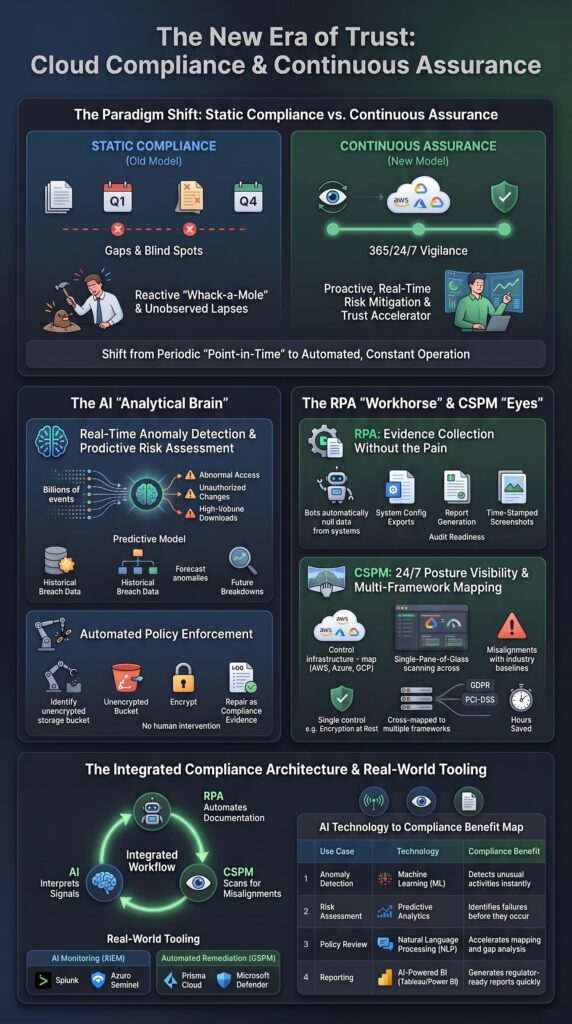
We don’t measure success by data volume, but by the operational improvements intelligence creates. Did a report actually make us safer? That’s the only question that matters.
More data doesn’t automatically mean better defense. We always ask ourselves: did this intelligence change a security control? Did it reduce our exposure? Did it help manage our risk? It’s a lesson learned from experience: organizations that detect and stop breaches faster see much lower costs. That’s why measuring operational outcomes is a better sign of maturity than counting feeds.
Track what matters:
- Mean Time to Detect (MTTD) and Respond (MTTR).
- Detection coverage and false alarm rates.
- Dwell time, control validation success, and overall security improvements.
You have to link this to business results. Are incidents being stopped faster? Is detection improving? Are attackers succeeding less often? Does the operation meet compliance rules more effectively?
Real improvement is slow and steady. But if you measure performance regularly, you will improve. You’ll gather better intelligence, build stronger threat detections, and have solid proof your security controls work.
How Does Network Threat Detection Support Actionable Security Controls?
From our investigations, network visibility is often the missing layer that confirms whether intelligence reflects real activity inside the environment. It turns raw data into real security choices.
Endpoint and cloud logs help, but the network shows you what single machines can’t see. It reveals attacker actions across your whole system. This view makes your threat finding, behavior analysis, and security watching much stronger.
Network Threat Detection is often an important validation layer in operational workflows. Network traffic tells us if a threat from our intel is really happening inside our company. We don’t act on every alert immediately. We check the network first. We look for bad communications, sideways movement, beaconing, or odd traffic. This check stops us from making big changes over false alarms.
Network visibility helps with important jobs:
- Finding beaconing activity
- Spotting sideways movement
- Checking if IOCs are active
- Aiding threat hunts
- Confirming attack paths
- Improving constant monitoring
Our work shows that mixing network detection with a SIEM, endpoint tools, and intel matching makes detection better and cuts noise. It gives security teams useful information without flooding them.
As intelligence updates, network data also gives constant feedback. It helps us see if our blocking controls work, tweak our detection controls, and measure how well our fixes perform over time.
FAQ
How do I prioritize threat intelligence without overwhelming my security team?
Focus on what endangers your business directly. That focus becomes your filter. We know the pain of alert fatigue. Our solution channels all threat data through a lens of your specific risk.
Filtering by your real tech stack cuts the noise dramatically. Teams can ignore up to 80% of irrelevant warnings. Analysts then concentrate on credible threats to their network.
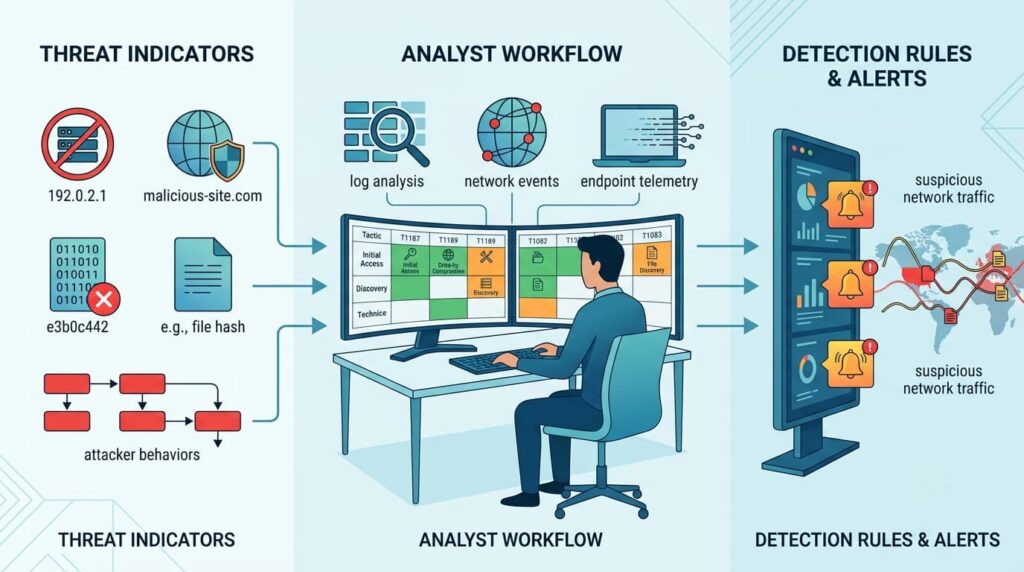
This grounds security in your reality. We provide the models and tools to enable this shift from reactive noise to targeted, risk-based action.
What is the difference between an indicator of compromise and TTP mapping?
An indicator of compromise (IOC) tells you what happeneda bad file hash, a malicious IP. TTP mapping reveals how it happened, detailing the attacker’s methods.
Alone, each gives an incomplete picture. In our work, we’ve found that fusing them is what changes everything. It turns detection into understanding.
This combination powers proactive hunting and builds a defense that adapts. Our tools are designed to make this link, helping your team move from finding evidence to countering the entire threat.
Which security frameworks help map intelligence into security controls?
Most teams rely on frameworks like MITRE ATT&CK, CIS, and NIST 800-53. They’re the common language for mapping controls and proving compliance.
But a list of controls isn’t a strategy. We build on these frameworks with our models to help you select the right preventive, detective, and corrective actions. The real work is in regular validationmaking sure those controls still work against today’s threats.
That’s how you move from checking boxes to building resilient security.
How can security teams measure whether intelligence-driven security is working?
Measure the right things: detection speed, response time, alert precision, and blocked attacks. Your logs and monitoring tools hold this data.
Metrics cut through the noise. We’ve seen teams track these numbers to see if their intelligence work has real impact, or if they’re just spinning wheels.
This evidence directly informs our threat models. It’s how we help you replace assumptions with clear data, building a security posture based on what’s actually happening in your network.
How does automation improve intelligence-driven security operations?
Automation connects your toolsSOAR platforms, SIEMs, orchestrationinto a single workflow. This eliminates manual steps.
For SOC teams, the difference is tangible. They can investigate alerts faster, respond to incidents in minutes, and let the system handle routine containment actions automatically.
When you pair this with continuous monitoring, the gains are real: consistent execution, faster closure times, and a lighter workload. We design our integrations to make this coordinated defense practical, not just theoretical.
Turn Intelligence Into Stronger Security
Threat intelligence only matters when it changes how you protect your systems. If you’re collecting information but nothing improves, you’re missing the point. Real progress comes from turning trusted intelligence into security actions that reduce risk and strengthen your daily defenses.
Ready to operationalize your threat intelligence? Visit NetworkThreatDetection to see how its real-time threat modeling, automated risk analysis, continuous threat intelligence, and attack path visualization can help your team prioritize vulnerabilities, accelerate response times, and strengthen security using proven frameworks such as MITRE ATT&CK, STRIDE, and PASTA.
References
- https://www.first.org/global/sigs/cti/curriculum/
- https://cloud.google.com/discover/what-is-threat-intelligence