
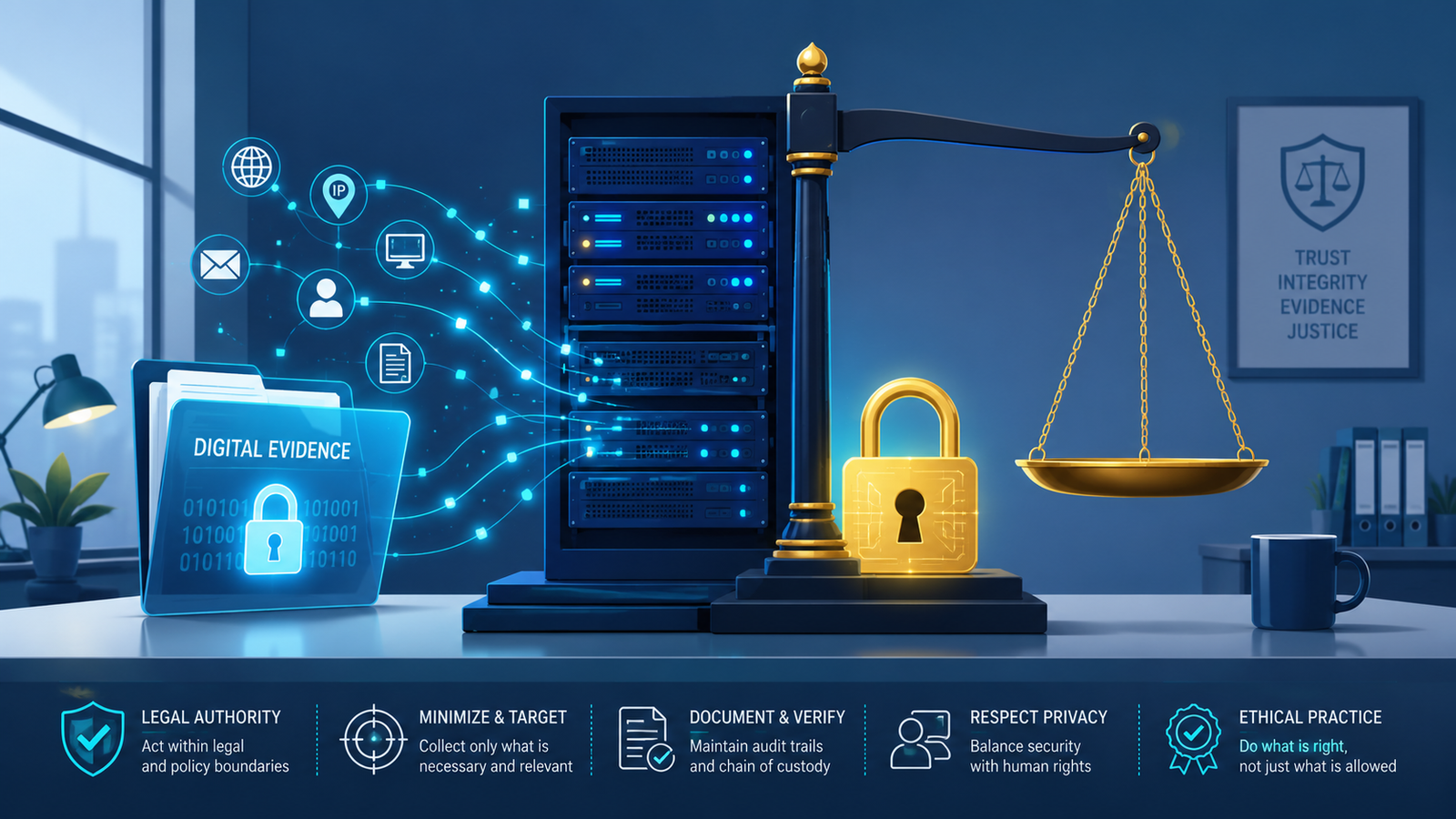
Network forensics is not only about finding evidence, it is about legal ethical considerations network forensics in a way that is legally valid and ethically responsible. Every investigation must balance security objectives with privacy rights, regulatory requirements, and organizational policies.
Ignoring these responsibilities can compromise an entire case, no matter how strong the technical findings are. With Network Threat Detection, organizations can investigate incidents while maintaining compliance, protecting sensitive data, and preserving trust. Keep reading to learn how to conduct network forensic investigations the right way.
Understanding the Rules Before Investigating
Before starting any network forensic investigation, it’s essential to understand the legal and ethical responsibilities involved. Following the right procedures helps protect evidence, respect privacy, and ensure your findings can be trusted.
- Why legal authority must come before collecting network evidence.
- How to respect privacy while conducting forensic investigations.
- The role of corporate policies and regulatory compliance.
Why Does “Why” Matter More Than “How” in Forensics?

The most sophisticated technical skill is irrelevant if you lack the legal and ethical foundation to apply it. Your “why”, your authority and intent, frames everything. Are you investigating a criminal act for law enforcement? Responding to an internal policy violation? Conducting a penetration test? Each scenario carries different rules.
The “how”, the tools and techniques, must fit within that box. Thinking about ethics and law last is like building a house and then checking if you own the land.
What Legal Authorities Govern Your Network Investigation?
Before starting a network investigation, make sure you understand the legal authority that allows you to collect and review data. The applicable rules depend on whether the investigation is conducted by a private organization or a law enforcement agency.
For most corporate investigations, the primary legal basis is employee consent, which is typically established through employment agreements and Acceptable Use Policies (AUPs). These documents inform employees that company systems and network activity may be monitored for security and compliance purposes.
Other important legal considerations include:
- Electronic Communications Privacy Act (ECPA): Regulates access to electronic communications and protects user privacy.
- Stored Communications Act (SCA): Governs access to stored emails and electronic files, making unauthorized access a significant legal risk.
- Law enforcement authorities: Investigations may require legal instruments such as search warrants or pen register/trap-and-trace orders before collecting certain types of evidence.
Understanding which legal framework applies before collecting network data helps ensure the investigation remains compliant and that any evidence gathered is more likely to be legally admissible.
How Do You Establish a Legally Sound Investigation Plan?
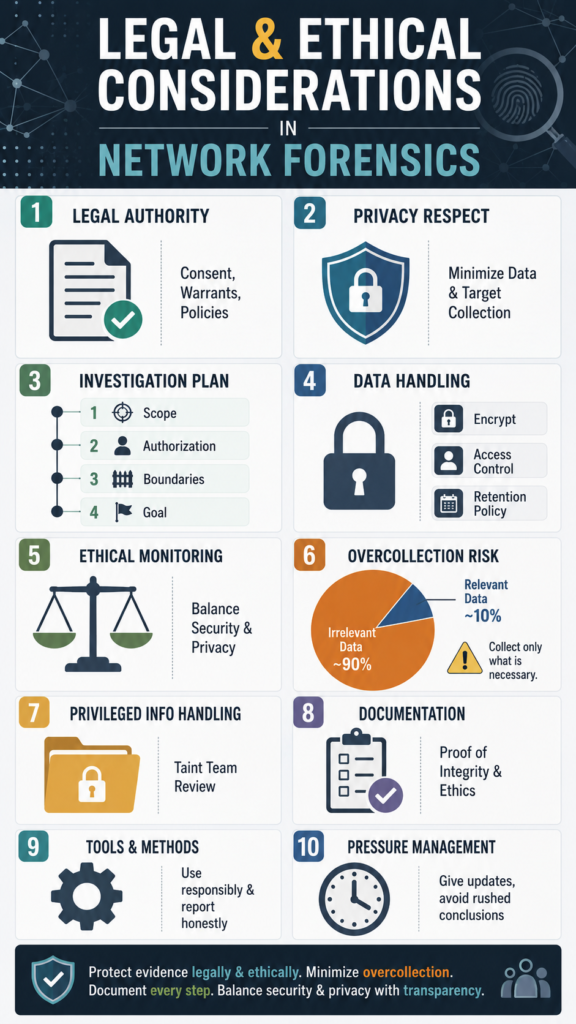
The plan is your shield. It should be a document, even if just a page, created at the outset. It answers critical questions that a judge or opposing counsel will ask later. What is the specific incident or scope of concern? What is the legal basis for the investigation (e.g., section 4.2 of the corporate AUP)?
Who has formally authorized it (CISO, General Counsel)? What are the defined boundaries, which systems, users, and time periods? What is the stated goal? This plan isn’t a technical script; it’s your charter. It stops scope creep, that natural tendency to follow an interesting lead into an area you have no right to be in.
Where Is the Ethical Line in Monitoring Employee Activity?
Credits: Grad Coach
This is the murkiest water. Legal authority from an AUP lets you do something; ethics asks if you should do it that way. The principle of minimization is your guide. If you’re investigating data exfiltration from the engineering server, you don’t need to capture the personal webmail traffic of every employee in marketing.
“There is a potential inequality between the practices of digital forensics investigators and the rights of other stakeholders,” advocating for a more ethically-informed approach to remedy this imbalance. – Sunderland
Targeted collection is ethically sounder and more efficient. Another principle: transparency. While you can’t telegraph an active investigation, having clear, accessible policies that explain when and how monitoring occurs builds organizational trust.
People have a reasonable expectation of privacy, even on corporate systems, for certain activities. Recognizing that isn’t weakness; it’s professionalism.
What Are the Risks of Over-Collection and Data Hoarding?
We call it “collecting the ocean to find a fish.” It’s a massive technical and ethical risk. From a legal standpoint, over-collection can violate minimization principles and expose vast amounts of irrelevant, potentially privileged data (like attorney-client communications). Ethically, it’s a violation of trust. Practically, it buries your relevant evidence in noise.
“Only the kind and amount of data that are functional and necessary to the specific processing purpose that is pursued” should be collected and processed. – Rsync
Our approach in Network Threat Detection is to collect the broad, metadata-level data (connection logs, alerts) for general security, but to treat deep packet inspection and full content capture as a surgical tool, deployed only under a specific, approved investigation plan. This balances safety with capability network data analysis.
| Consideration | Legal Focus | Ethical Focus | Practical Action |
| Authority | Is it granted by policy, contract, or warrant? | Is it proportionate to the incident? | Document the source (AUP clause, warrant #) in your investigation plan. |
| Scope | Does it stay within the bounds of the authority? | Are you minimizing intrusion on unrelated activity? | Define systems, users, and timeframes explicitly. Review mid-investigation. |
| Data Handling | Does it meet retention and privacy law requirements? | Are you protecting the data from misuse, even internally? | Encrypt evidence, use strict access controls, and define a destruction date. |
| Reporting | Would it withstand legal discovery and scrutiny? | Is it honest about limitations and uncertainties? | Stick to facts, avoid speculation, and note gaps in evidence. |
How Should You Handle Potentially Privileged Information?
During a network investigation, you may encounter legally protected information, such as communications with an attorney or sensitive medical records. When this happens, the priority is to identify the material, isolate it, and restrict access to prevent unnecessary exposure.
To manage privileged information effectively:
- Identify and separate potentially privileged or confidential data as soon as it is discovered.
- Limit access so only authorized personnel can review the material.
- Use legal counsel or a “taint team” to screen collected data before investigators access it, helping ensure privileged information is filtered appropriately.
Following these procedures helps protect the integrity of the investigation, reduces legal risk, and improves the likelihood that any evidence collected will remain admissible if legal proceedings occur.
Why Is Documentation Your Most Important Tool?
If it isn’t documented, it didn’t happen. This applies to every decision point. The timestamp when you received authorization. The hash values of your original evidence files. The reason you expanded the scope to a second server. The fact that you encountered potentially privileged data and stopped.
This audit trail does two things. It proves the integrity of your evidence chain of custody. More subtly, it demonstrates your ethical and methodological rigor reconstructing events It shows you weren’t a cowboy with a packet sniffer; you were a professional following a disciplined process. That impression is everything.
What Are the Ethical Implications of Your Tools and Methods?
The tools are neutral; their use is not. Using a tool that impersonates a trusted server (like an SSL proxy) to decrypt internal traffic for inspection is powerful. But using it outside of a clear, malicious incident investigation, say, for general monitoring, veers into ethically questionable territory.
Similarly, keeping forensic findings vague to make your security team look better, or ignoring a finding because it’s politically inconvenient, are ethical failures. Your duty is to the truth of the incident, not to a preferred narrative. This sometimes means delivering uncomfortable news.
How Do You Navigate the Pressure for “Quick Answers”?
During an incident, stakeholders often want immediate answers. While timely communication is important, avoid making definitive conclusions before the evidence has been fully analyzed. Instead, provide updates on what has been confirmed and what actions are currently underway.
A good communication approach includes:
- Share verified facts rather than assumptions.
- Explain the current investigation status, such as systems being isolated or evidence being analyzed.
- Set realistic timelines for when preliminary findings will be available.
This approach helps manage expectations while preserving the accuracy and credibility of the investigation. A well-supported conclusion is far more valuable than a fast but incorrect one.
What’s the Role of External Consultants and Law Enforcement?
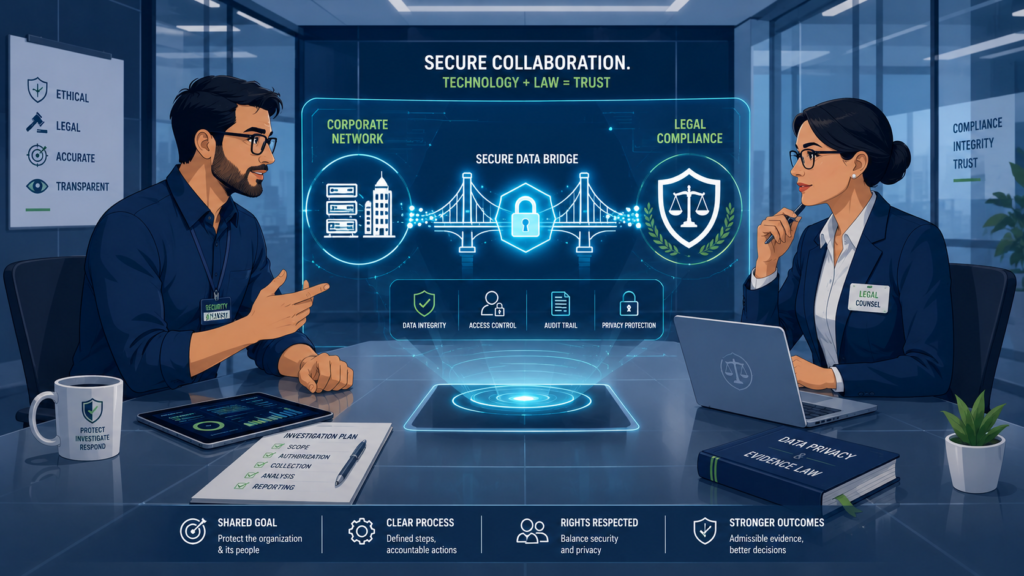
Bringing in outsiders changes the dynamics. When you engage an external forensics firm, ensure their contract mandates adherence to your corporate policies and legal standards. When you involve law enforcement, understand that you are ceding a degree of control.
Their standards for evidence collection (often higher) and their timeline (often longer) will take precedence. Clear communication about roles, and a documented handoff process, are essential to maintain both legal standing and ethical responsibility to your own organization.
FAQ
Does a corporate AUP give me unlimited monitoring rights?
No. It gives you a strong foundation, but it’s not a blank check. Courts expect reasonableness. Monitoring must be for a legitimate business purpose (security, compliance) and should be as limited as possible to achieve that purpose. Broad, indiscriminate surveillance “just because you can” is a legal and ethical risk.
What if I find evidence of a crime not related to my investigation?
This is a classic ethical dilemma. Your investigation plan defines your scope. Stumbling upon evidence of, say, embezzlement while investigating a malware infection puts you in a difficult position.
The standard protocol is to immediately pause, secure the evidence, and escalate to Legal and potentially HR. Do not continue investigating the new crime without new, explicit authority.
Are there differences between investigating an internal vs. an external threat?
The legal basis is often the same (corporate policy), but the ethical considerations can shift. Investigating an external attacker often feels more straightforward. Investigating an internal employee requires greater emphasis on minimization, privacy, and fairness, as the impact on a person’s livelihood and reputation is direct.
How long must I retain forensic evidence?
This is dictated by a blend of corporate policy, regulatory requirements (like data breach notification laws), and potential litigation holds. There is no single answer. Work with your Legal team to define retention periods for different incident types. A general rule: keep it as long as necessary for legal or regulatory reasons, and no longer.
The Unavoidable Weight of Legal Ethical Considerations
Network forensics is a field burdened with dual responsibility. You are responsible for finding the truth in the bits and bytes, and you are equally responsible for how you find it. The legal and ethical considerations aren’t red tape to cut through; they are the guardrails that keep your investigation on the road and out of the ditch.
Ready to strengthen your investigations with proactive threat modeling, automated risk analysis, and continuous threat intelligence? Explore Network Threat Detection and join today: Join Network Threat Detection
References
- https://sure.sunderland.ac.uk/id/eprint/12067/
- https://rsync.nic.funet.fi/pub/mirrors/ftp.ietf.org/slides/slides-privacyws-privacy-preservation-techniques-to-establish-trustworthiness-for-distributed-inter-provider-monitoring-00.pdf#1#1