
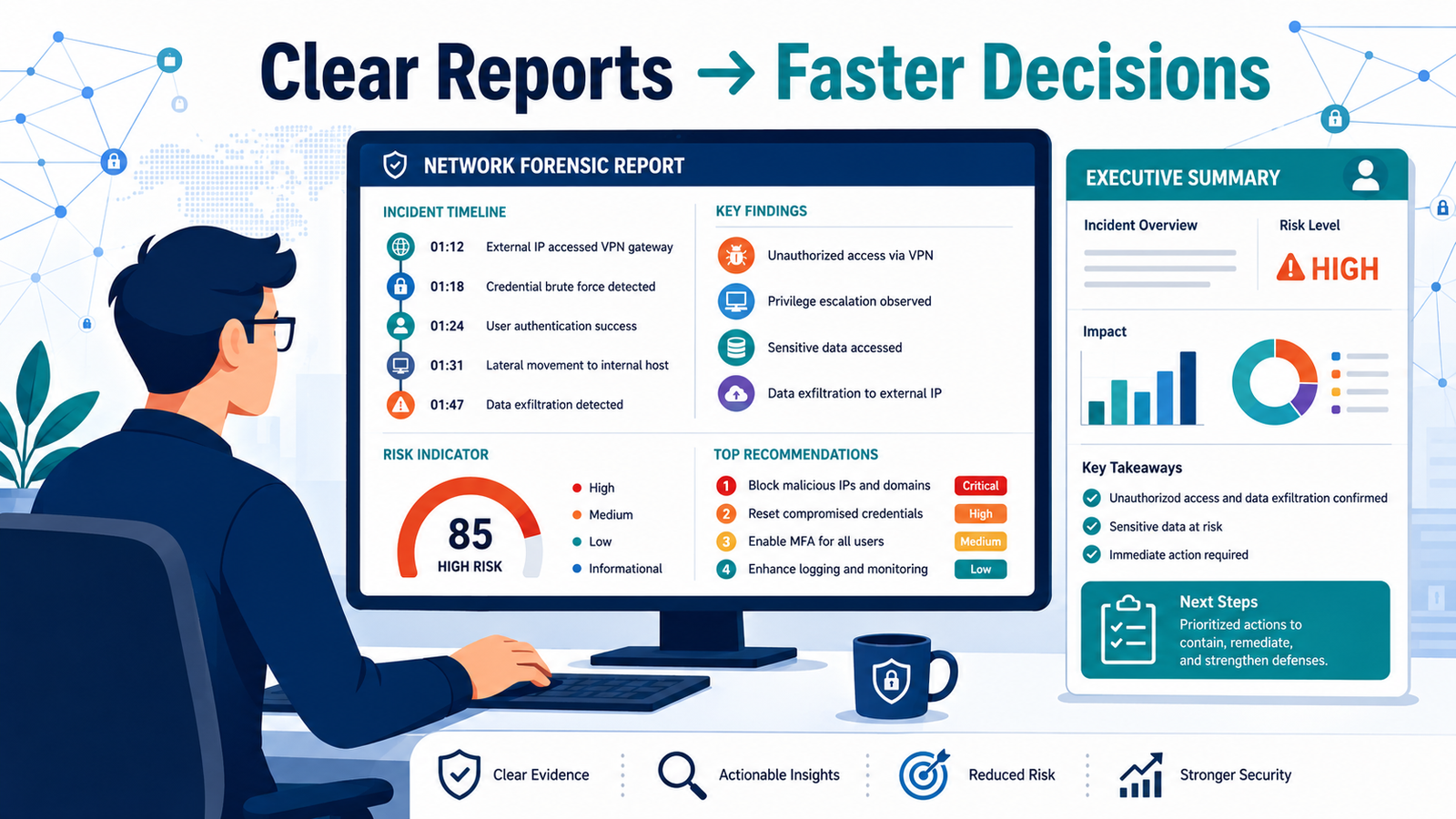
Reporting network forensic findings clearly is just as important as uncovering the evidence itself. Even the most accurate investigation can lose its value if stakeholders struggle to understand the report or decide what to do next.
With Network Threat Detection as the foundation for your investigations, clear reporting helps ensure every discovery leads to action. Keep reading to learn how to write reports that people actually read and use.
Turn Network Forensic Reports Into Actionable Intelligence
Before diving into the best practices, here are the key principles to remember. These takeaways summarize what makes reporting network forensic findings clearly effective and ensure your reports drive informed decisions instead of collecting dust.
- Start with what matters most. Present the biggest risks and business impact before diving into technical details.
- Write for every audience. Balance executive-friendly summaries with in-depth evidence for technical teams.
- Use visuals with purpose. Timelines, network diagrams, and traffic charts make complex findings easier to understand.
What Makes a Network Forensic Report “Good”?
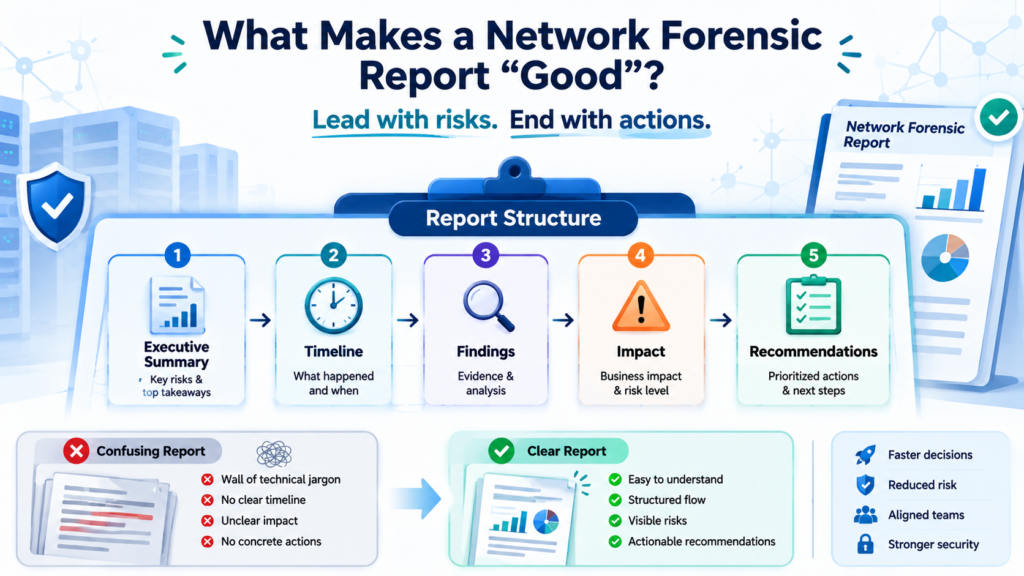
A good report isn’t just accurate, it’s usable. It has a clear audience, a logical path, and one overriding purpose: to drive a specific, improved security outcome.
Think of it as a translation job. You’re taking the raw, complex language of packet captures, log files, and registry entries and translating it into a narrative that a legal team, a system administrator, and a CFO can all understand and act upon. The metric for success isn’t peer admiration, it’s whether the reader’s next steps are obvious and urgent.
Who Are You Really Writing This Report For?
You’re writing for at least four people simultaneously. First, the executive (like a CISO or CFO) who needs the “so what” in thirty seconds. Second, the incident manager who must coordinate the response. Third, the IT or security engineer who has to implement your technical recommendations.
Finally, you’re writing for a future version of yourself, or a colleague, who might need to revisit this case six months from now during another incident. If you write only for that last person, you’ve failed the first three.
What Is the Essential Structure of a Clear Report?
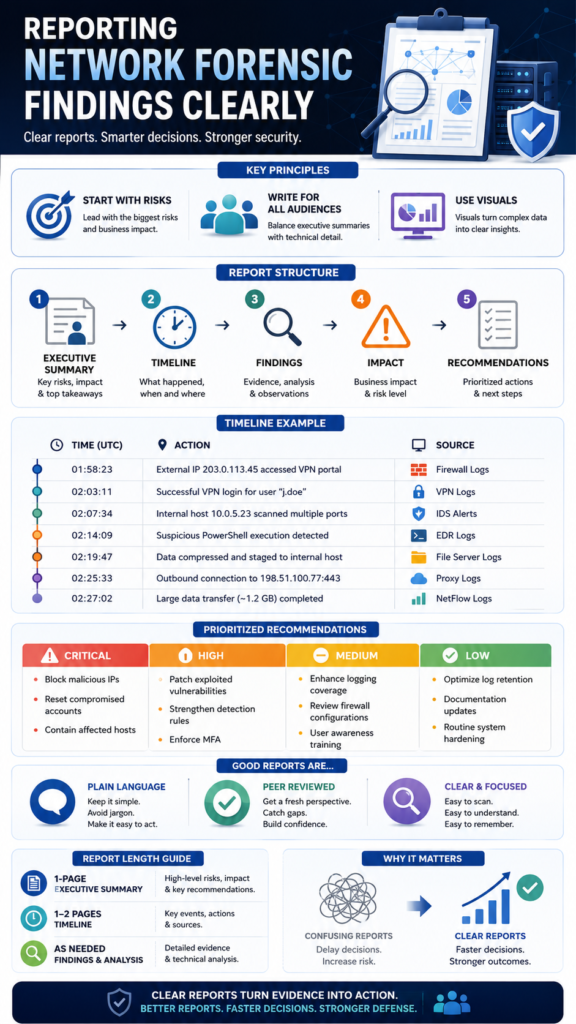
The structure is non-negotiable. It’s the scaffold that holds everything up. We’ve found this flow works, moving from the highest altitude down to the technical weeds.
- Title Page & Distribution: Case ID, title, date, author, classification level.
- Executive Summary: The entire report in one page. Assume this is all some will read.
- Timeline of Events: A simple chronological table. This is your story’s backbone.
- Detailed Findings & Analysis: The “how” and “what” for technical readers.
- Impact Assessment: What was accessed, stolen, or disrupted? Quantify it.
- Recommendations & Remediation: Prioritized, actionable steps. This is the why.
- Appendices (IOCs, Logs, etc.): The raw evidence for deep-dive validation.
| Section | Primary Audience | Key Question It Answers | Optimal Length |
| Executive Summary | Leadership, Legal | “What happened and what do we need to do?” | 1 page |
| Timeline | Incident Managers, Analysts | “In what order did events occur?” | 1-2 pages |
| Detailed Findings | Security Engineers, Forensicators | “How exactly was it done?” | As needed |
| Recommendations | Everyone | “How do we fix it and prevent it?” | Clear, bulleted list |
How Do You Start With an Executive Summary That Works?
The executive summary should communicate the most important information immediately. Although it is written last, it is often the first, and sometimes the only, section decision-makers read. Begin with a clear conclusion that explains what happened, when it occurred, who was affected, and the business impact.
A strong executive summary should include:
- Incident overview: A concise statement describing the attack and its impact.
- Root cause: The primary factor that enabled the incident.
- Containment status: Actions already taken, such as disabling compromised accounts or isolating affected systems.
- Top recommendations: The three highest-priority actions to reduce future risk.
Use bold text to highlight key findings so readers can quickly understand the incident without reading the full report.
Why Is a Visual Timeline Non-Negotiable?
Humans process timelines visually. A wall of text describing times and events is a cognitive barrier. A simple table or even a line graph creates instant understanding. reconstructing events through network data analysis We once used a Gantt-chart-style timeline for a multi-vector attack.
The incident commander looked at it for ten seconds and said, “So the lateral movement started after the failed logon batch at 3:00 AM, meaning our automated account lockout policy might have triggered them.” He got it, instantly, because he could see the relationship. Your timeline should include:
- UTC timestamps (always use one timezone).
- Hostname/IP source and destination.
- The action (e.g., “Malware Execution,” “Data Transfer,” “Account Creation”).
- The supporting evidence source (e.g., “FW-101 Log,” “EDR Alert 4567”).
What’s the Right Way to Present Technical Findings?
Credits: Always Aiming
This is where most reports go off the rails. The goal is not to display every log line. It’s to tell a story with evidence. Start each finding with a clear, bolded statement: “Finding 1.1: The attacker used PowerShell to download a second-stage payload.
Then, support it. Use a short, narrative paragraph explaining the significance of the log entry or packet capture snippet you’re about to show identifying attacker activity from network logs Parenthetical asides are useful here for technical details (like the specific PowerShell flag used, -ExecutionPolicy Bypass).
Then, present the cleanest, most relevant piece of evidence. Not ten screenshots, one.
How Do You Accurately Assess Business Impact?
This is the bridge between technical facts and business decisions. Avoid vague statements like “data was compromised.
Be specific. “The threat actor accessed the ‘Financial_Projections’ directory containing 15 files related to Q3 earnings, last modified during the exfiltration window.” If you can quantify data volume (2GB), record count (15,000 customer records), or system downtime (4 hours of production outage), do it.
This section answers the CFO’s question: “What is this going to cost us?” It directly justifies the budget and effort for your recommendations.
What Makes a Recommendation Actionable and Prioritized?
A bad recommendation: “Improve network monitoring.” A good recommendation: “By Friday, deploy the attached Snort signature (SIG-789) to the DMZ sensor group to detect future C2 traffic for this malware variant, assigned to the Network Threat Detection team.
See the difference? The good one has an owner, a deadline, a specific action, and is directly tied to a finding. We structure ours using a simple priority matrix:
- Critical (Immediate): Stop the active attack, contain the breach.
- High (Next 30 days): Prevent the exact same TTPs from working again.
- Medium (Next Quarter): Improve defensive layers to raise general cost for attackers.
- Low (Strategic): Consider long-term architectural changes.
Network Threat Detection becomes the logical first owner for many of the High and Medium items, like implementing new correlation rules or tuning alert thresholds based on the discovered IOCs. It’s a natural fit, not a hard sell.
How Can Plain Language and Visualization Save Your Report?
Strike the word “exfiltrated” from your executive summary. Say “stole data.” Don’t say “lateral movement,” say “the attacker jumped from the marketing server to the database server.” Use analogies. A beaconing connection is a “regular check-in call.” In the technical section, use callout boxes or simple diagrams.
A network flow diagram with three boxes and two arrows showing the attack path is worth a thousand log entries. Your writing should feel like you’re explaining it to a smart, busy colleague over coffee, not defending a thesis.
How Do You Handle Uncertainty and Speculation?
You will have gaps. Acknowledge them. “Between 02:15 and 02:45 UTC, there are no relevant logs from the target host, suggesting the attacker may have cleared them. The activity observed at 02:47 indicates they had already established a foothold.
“Effective communication depends on accurate and transparent reporting.” Despite this recognized need, studies show that the conclusion types which have received the most criticism remain the preferred means of expression, and “information about reliability and validity was rarely reported”. – Sciencedirect
This is honest. It shows the limits of your visibility, which itself is a powerful recommendation for better logging. Never try to bluff or fill a gap with unsupported conjecture. A clear “we don’t know” builds more credibility than a shaky “we think.”
Why Is Peer Review Your Final, Essential Step?

Never send a report you’ve written in isolation. Have a colleague who wasn’t on the case read it. Ask them: “What do you think happened? What are the three main things we should do?” If their answers don’t match your intent, the report isn’t clear.
“Tended to focus narrowly on spelling and formatting, rather than critically examining the validity of methods, interpretation of findings, and conclusions.” – Pubmed
This review catches jargon, logical jumps, and missing context. It’s the last line of defense between a good report and a confusing one.
FAQ
How long should a typical network forensic report be?
There’s no set page count. A minor incident might be 5 pages; a major breach could be 50. The rule is: include everything necessary for action and understanding, and nothing more. The executive summary must always be one page.
What’s the biggest mistake people make in these reports?
Writing for themselves, not the audience. Burying the lead in technical details and saving the conclusion for the end. The most important information must be at the beginning.
Should I include every single Indicator of Compromise (IOC)?
In the main body, include only the key, high-fidelity IOCs (like a unique C2 domain or malware hash). Place the comprehensive, repetitive list (all IPs, all hashes) in an appendix for automated ingestion by security tools.
How technical should the executive summary be?
Almost not at all. Use plain business language. Instead of “phishing lure with a malicious macro,” say “a deceptive email that tricked an employee into enabling malicious software.” Focus on impact, not mechanism.
The Final Word on Reporting Network Forensic Findings
A clear network forensic report is the tangible output of your work. It’s the artifact that changes configurations, allocates budget, and updates policies. It turns your analysis from an intellectual exercise into a force multiplier for an organization’s security.
Ready to turn technical findings into faster, more informed security decisions? Join the Network Threat Detection platform to access real-time threat modeling, automated risk analysis, executive-ready reporting, and continuously updated threat intelligence that helps your team prioritize risks with confidence. Join Network Threat Detection
References
- https://www.sciencedirect.com/science/article/abs/pii/S1355030619302102?dgcid=rss_sd_all
- https://pubmed.ncbi.nlm.nih.gov/40930681/