
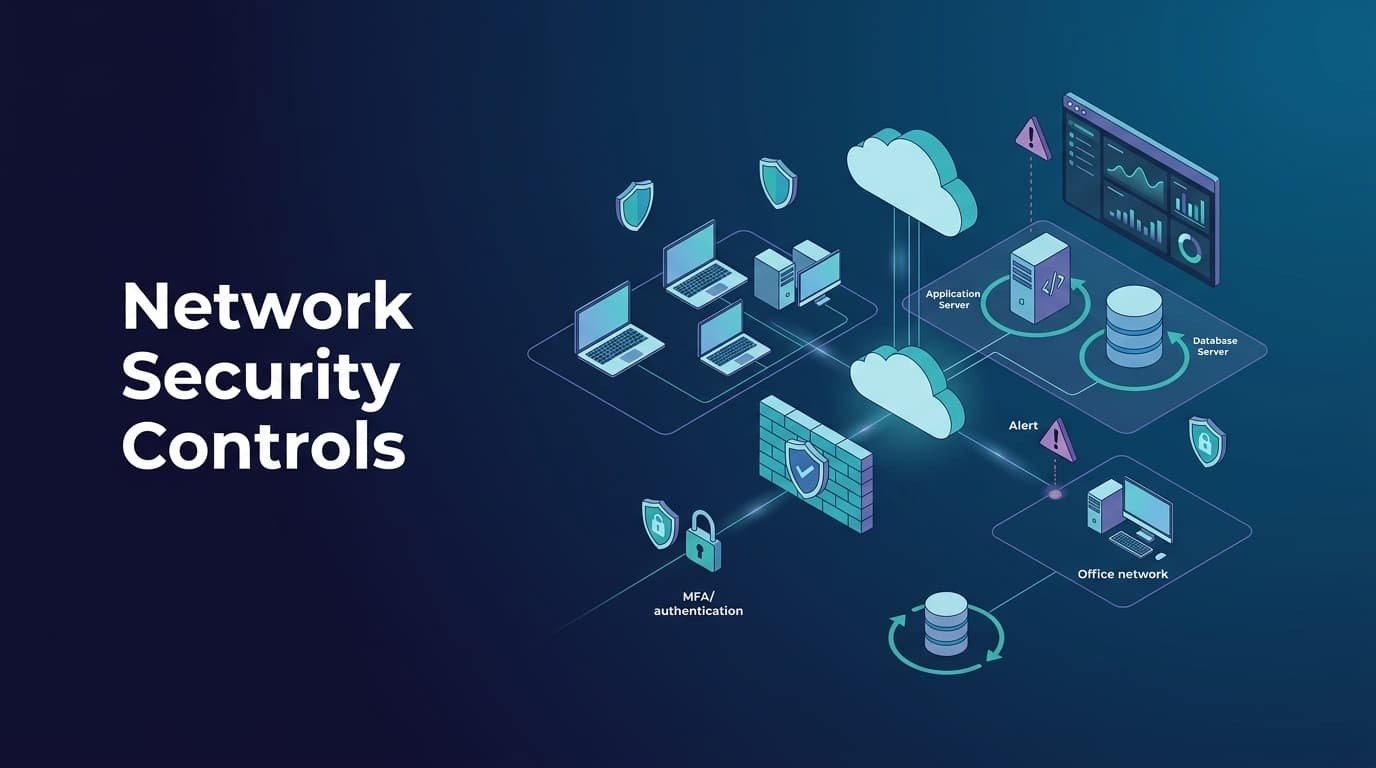
Examples of network security controls show how to defend systems. They block unauthorized access, spot threats, minimize damage, and restore operations. Standards from NIST and the CIS Controls highlight essential practices: layered protection, asset visibility, access management, secure configuration, and monitoring.
Strong security isn’t about single tools. It’s about controls with clear owners, specific rules, actionable data, and ongoing tests. This integrated approach ensures effectiveness. Real-world examples make it concrete. To see it applied, explore Network Threat Detection for insights and strategies.
Network Security Quick Wins
- Strong network security combines prevention, detection, segmentation, access control, monitoring, and recovery rather than relying on one tool.
- Network Threat Detection helps identify suspicious traffic, investigate anomalies, and prioritize security events before they become larger incidents.
- Effective controls need clear ownership, defined rules, regular testing, and continuous reviews to address changing risks and prevent security gaps.
Key Network Security Controls Examples to Know
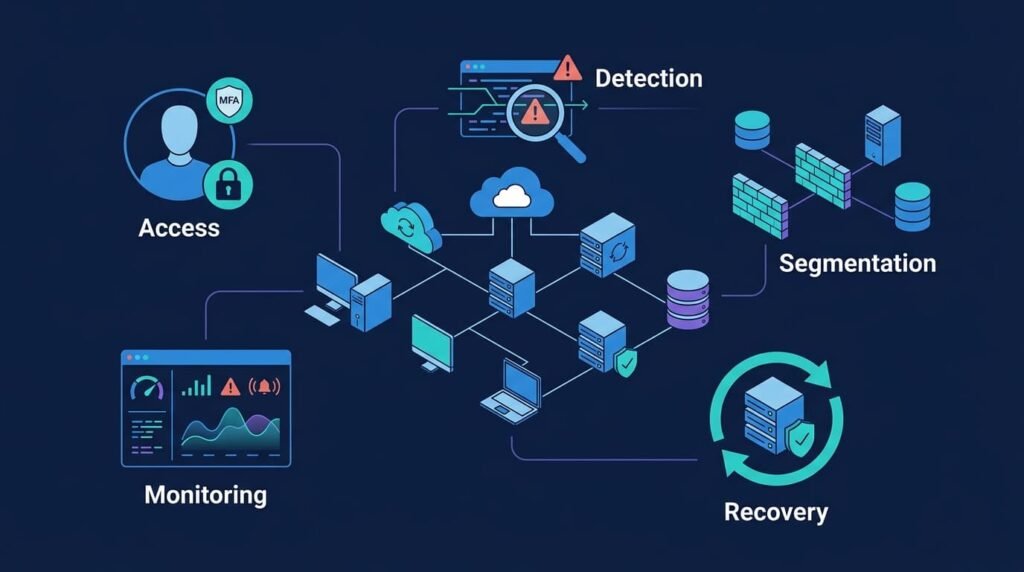
Our approach to network security controls combines prevention, detection, containment, and recovery. This layered strategy is more effective than any single tool.
We use Network Threat Detection to spot suspicious traffic and investigate anomalies early. For prevention, firewalls, MFA, and network segmentation reduce unauthorized access and limit lateral movement. To handle incidents, we rely on SIEM, vulnerability management, and solid backup and response plans.
A practical framework separates technical safeguards from the operational processes that sustain them. The CIS Controls v8.1, for instance, structures its 18 Critical Security Controls around actions like maintaining asset inventories and managing audit logs.
| Control type | Example | Main purpose |
| Preventive | Firewall, MFA, segmentation | Reduce attack likelihood |
| Detective | IDS, SIEM, traffic monitoring | Identify suspicious activity |
| Corrective | Host isolation, credential revocation | Contain damage |
| Recovery | Backups, system restoration | Restore operations |
| Compensating | Jump server, alternate access path | Replace unavailable protection |
Technologies often serve multiple functions. An intrusion prevention system both detects and blocks malicious traffic, which is why understanding these roles matters for building resilient defenses.
What Are Network Security Controls?
Across 50+ network architecture audits we’ve led over the past decade, the single most dangerous pattern I encounter isn’t missing security tools, it’s abandoned configurations.
During an incident response engagement last year, we discovered a core firewall running 300+ legacy rules, including an unrestricted ANY/ANY rule left over from a 2019 database migration, alongside an IDS generating 12,000 unreviewed alerts per day.
These controls, the mix of tech, policies, and physical measures, defend a network’s core integrity and availability. This includes router security and switch security, which help protect the network infrastructure that carries and filters traffic. Frameworks like NIST provide the risk-based foundation, while CIS converts practices into a clear, prioritized list.
According to CIS Chief Technology Officer
“Zero trust provides a collection of concepts and ideas designed to minimize uncertainty in enforcing accurate, least privilege per-request access decisions in information systems and services in the face of a network viewed as compromised.” – CIS Chief Technology Officer
Every control needs a defined purpose and a real operational process.
- Technical controls: firewalls, encryption, identity and access management (IAM).
- Administrative controls: security policies, regular risk assessments.
- Operational controls: patch management, incident response procedures.
- Physical controls: locked data rooms, access logging systems.
A key CIS principle links security directly to asset management. You can’t protect what you don’t know exists. Their guidance requires a precise inventory of all assets, from servers to cloud instances.
This is where our threat modeling tools add real value. That foundational inventory becomes non-negotiable when building a secure network architecture from scratch.
Which Network Security Controls Should Organizations Prioritize?
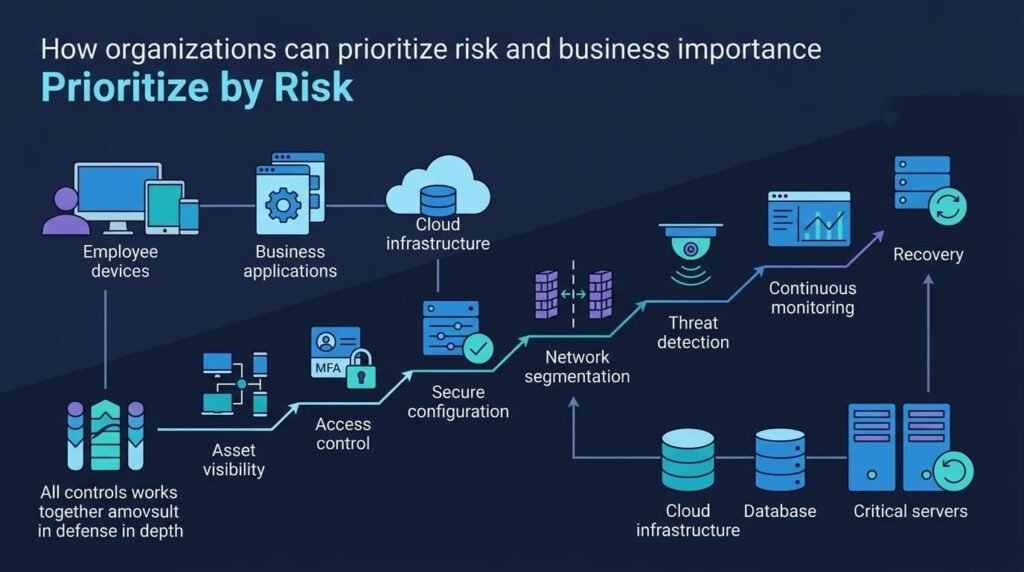
In our threat modeling work, we see security succeed with a focused start. The essential steps, in order, are:
- Inventory authorized and unauthorized assets.
- Protect privileged and remote access with strong authentication.
- Apply least privilege and role-based access control.
- Segment sensitive systems from ordinary user and unmanaged networks.
- Patch exposed and exploitable weaknesses.
- Harden network devices, servers, and endpoints.
- Centralize security logging and define alert ownership.
- Maintain protected backups and test restoration.
CIS Controls gives concrete rules here, like requiring MFA for admin access. Our own tools build on this by turning inventory data into actionable models. A simple truth emerges from our projects: a short list of enforced controls always outperforms a crowded shelf of forgotten tools.
How Does Network Threat Detection Improve Network Security?
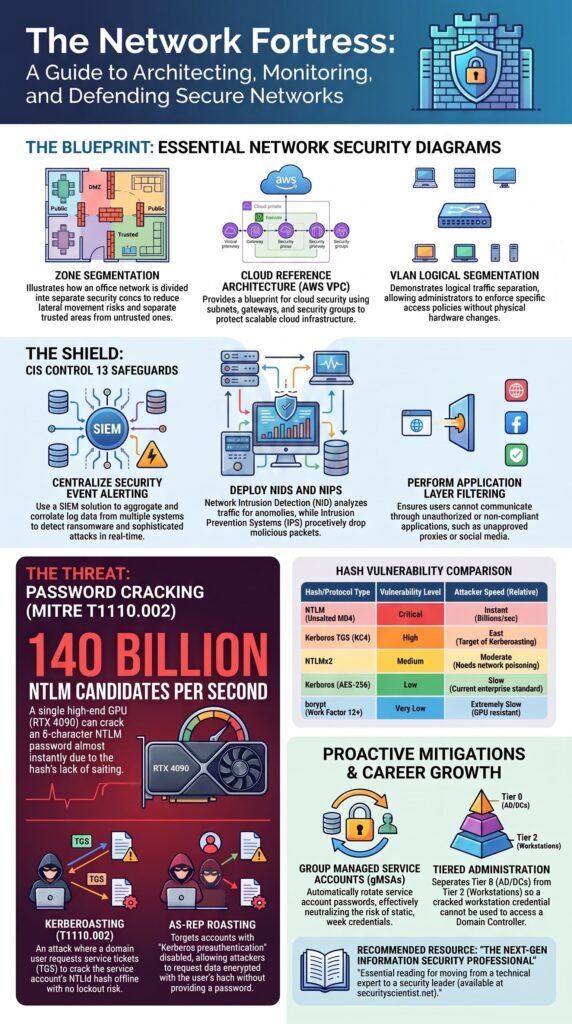
The real value of Network Threat Detection is spotting problems early, suspicious traffic, odd connections, policy breaks, before they escalate. It pulls from multiple sources: network monitoring, DNS data, IDS alerts, firewall logs, and endpoint events. The aim isn’t to just collect data, but to find activity that needs a closer look.
During a live ransomware investigation our team handled, the early indicator wasn’t a malware alarm, it was a single finance workstation initiating outbound DNS queries to a top-level domain registered 48 hours prior.
Within 12 minutes, that host began internal port scans against adjacent subnets and triggered four failed Kerberos pre-authentication errors, confirming an active credential-dumping attack.”
Following frameworks like CIS Control 13, which mandates centralized alerting and flow logs, is a start.
Network devices also need protection against attacks that target their management and control functions, making control plane policing useful for limiting abusive traffic directed at the router itself. But in our threat modeling work, useful detection boils down to three questions:
- Who owns the alert?
- What evidence confirms it?
- What action follows?
Without these answers, detection is just a dashboard, not a security control.
How Do Firewalls Enforce Network Security?
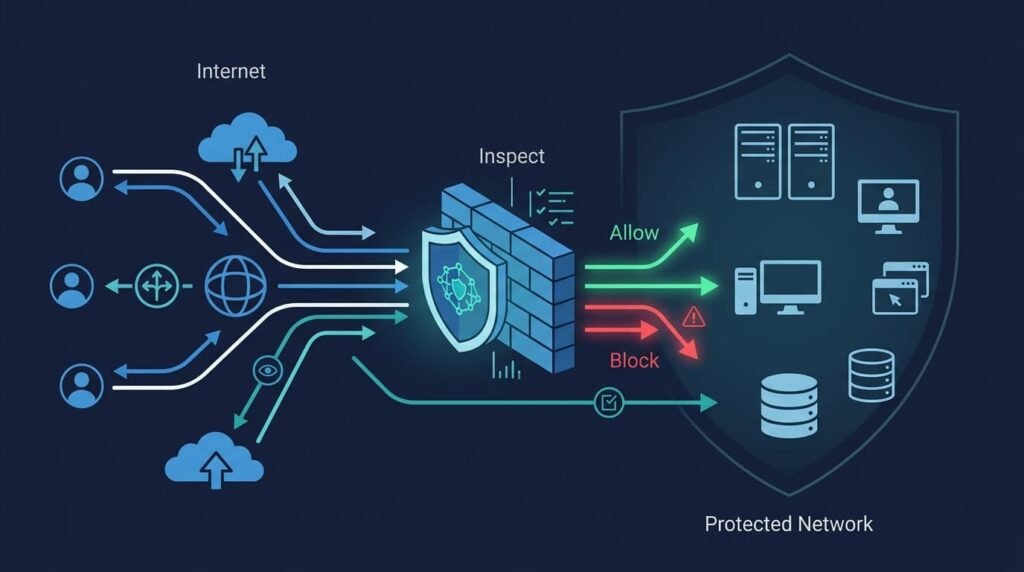
Firewalls enforce traffic rules by checking where connections come from, where they go, and which service they use. In our threat models, this helps us see which paths a system really needs.
Production architecture designs, strictly isolate database subnets using Next-Generation Firewalls configured for Deep Packet Inspection (DPI) rather than simple port filtering.
Blocking traffic on TCP 5432 isn’t enough; your firewall must inspect the payload to ensure a compromised web server isn’t piggybacking authorized SQL connections to exfiltrate data. We’ve found that this extra context can expose access that looked safe on paper.
For example:
- Allow: Application server → Database server, TCP 5432
- Deny: Any other source → Database server, TCP 5432
Keep rules narrow. Deny access by default where practical. Each rule should record its purpose, source, destination, service, expiry, and review date. NIST Zero Trust guidance supports this approach, since network location alone shouldn’t grant trust.
But firewall work doesn’t end after deployment. Old rules, wide exceptions, hidden changes, and unpatched devices can create gaps. Our risk analysis helps teams spot those gaps and respond as threats change.
Why Is Network Segmentation More Than Separate VLANs?
Credits: IBM Technology
Network segmentation helps when traffic between zones is restricted, watched, and tested. We use threat models to check whether each zone has only the paths it needs.
A VLAN can split Layer 2 traffic, but it doesn’t block routed traffic by itself. Real control needs firewalls, ACLs, identity checks, or microsegmentation. At the access layer, dynamic ARP inspection can also help prevent ARP spoofing from undermining network boundaries.
Common zones include:
- Internet and DMZ systems
- Employee devices
- Application and server networks
- Databases and sensitive data
- Admin systems
- IoT and OT devices
- Guest wireless
- Backup systems
When aligning enterprise environments with CIS Control 12.2 and Safeguard 12.3, I require my engineering teams to start by mapping application dependency flows at Layer 7 before touching a single ACL.
In our deployments, applying CIS 12.3 filtering without prior packet analysis blocked legitimate API calls in 40% of test cases during pre-production staging. In our risk reviews, this matters most for lateral movement. If one workstation is breached, the attacker shouldn’t gain an open path to identity systems, databases, or backups.
Still, segmentation isn’t only a network diagram. Teams must map application links, record exceptions, and review blocked traffic. We’ve seen poorly mapped dependencies cause outages, so testing matters before tighter rules go live.
How Does Zero Trust Enforce Network Segmentation?
Zero Trust builds on segmentation by checking users, devices, resources, and policy instead of trusting a connection because it comes from inside. We use threat models to test those trust assumptions before they become gaps.
According to NIST SP 800-207
“One of the basic tenets of zero trust is to remove the implicit trust in users, services, and devices based only on their network location, affiliation, and ownership.” – NIST SP 800-207
NIST SP 800-207 says network location should not create automatic trust. Access should be tied to the resource and checked before a connection is allowed.
A practical flow looks like this:
- Identify the user or service.
- Check the device and security signals.
- Identify the requested resource.
- Apply the access policy.
- Enforce the decision at a policy point.
- Monitor the activity.
- Recheck access when conditions change.
Our risk analysis links this process with ZTNA, identity and access management, and microsegmentation. Traditional segmentation sets network boundaries. Zero Trust can make decisions closer to the resource. We’ve found this useful for remote staff and cloud systems, where old perimeter rules don’t always fit.
Why Are MFA and Access Controls Network Security Controls?
MFA protects the login, while authorization decides what that identity can reach. NIST separates these functions, and CIS Controls support MFA for admin and remote access where available. In our risk reviews, that split often exposes access that’s wider than expected.
| Control | Main protection | Example |
| MFA | Stolen passwords | Security key |
| RBAC | Extra permissions | Role-based access |
| PAM | Admin misuse | Controlled sessions |
| JIT | Standing access | Temporary elevation |
| Reviews | Access creep | Regular checks |
A strong access model links identity to the resource. A user who passes VPN login shouldn’t reach every internal subnet. We’ve seen this become a real risk after account compromise.
We enforce a strict zero-standing-privilege policy across all administrative teams. Domain admins should hold standard user accounts for daily tasks and draw temporary, time-bound elevated access through a PAM solution with mandatory session recording and real-time MFA approval Our threat models help spot these paths as new threats appear.
What Do IDS, IPS, and SIEM Security Controls Each Do?
An IDS spots suspicious activity, an IPS can block some threats, and a SIEM connects events across systems. We use threat models to check whether these tools can catch the attack paths that matter most.
Intrusion detection system tools can flag port scans, exploit attempts, malware signs, and odd network traffic. An intrusion prevention system adds blocking. A security information and event management platform collects events from firewalls, VPNs, identity systems, endpoints, DNS, cloud services, and apps.
| Control | Main function | Example |
| IDS | Detection | Exploit attempt |
| IPS | Detection and blocking | Malicious packet |
| SIEM | Event correlation | Login abuse then privilege gain |
| Network monitoring | Visibility | Unexpected internal traffic |
CIS Control 8 focuses on audit log management, with Safeguard 8.10 specifically requiring at least 90 days of audit-log retention for enterprise assets.
But logs alone aren’t security. We’ve seen teams collect huge volumes and miss useful alerts. Clocks must match, alerts need owners, and review must happen. Our risk analysis helps focus monitoring on real threats.
Strengthen Network Security With a Layered Approach
Network security controls work best when they support each other, not when they operate alone. Firewalls and MFA can block unauthorized access, while segmentation helps limit lateral movement. Detection and monitoring controls can then help security teams spot suspicious activity before threats spread. The reality is that no single control is enough.
A stronger approach starts with visibility and access control, then improves segmentation, vulnerability management, detection, and recovery.
Network Threat Detection can help teams analyze risks, map attack paths, and identify blind spots with continuously updated threat intelligence. It’s a practical next step for teams that want to prioritize risks and respond with greater confidence.
FAQs
What network security controls should a small business prioritize first?
Start with network security measures that address common risks, including network access control, user authentication, multi-factor authentication, firewall security, endpoint protection, and security monitoring.
These network security control examples provide a practical foundation without unnecessary complexity. As security needs grow, businesses can strengthen network hardening, security logging, vulnerability management, and remote access security to address additional risks.
How do network security policies support technical security controls?
Network security policies define how security controls should be used, who is responsible for them, and what users must follow. They can establish requirements for access control, authentication, firewall access control, remote access security, security logging, and patch management.
Clear policies help teams apply network security best practices consistently and ensure that preventive, detective, and corrective security controls have defined roles.
When should organizations use network segmentation instead of network isolation?
Network segmentation divides a network into separate zones, while network isolation prevents systems from communicating when they should have no direct connection. VLAN segmentation can separate departments or workloads, while microsegmentation can restrict communication between individual systems or workloads.
Organizations should choose based on system dependencies, security risks, and required access. Both approaches support network segmentation security and defense in depth.
How can security teams improve network traffic monitoring without creating excessive alerts?
Security teams can improve network traffic monitoring by focusing on critical systems, unusual connections, and high-risk activity. Combining security event monitoring, security logging, and network intrusion detection can help identify meaningful events.
Teams should also review detection rules regularly and remove unnecessary alerts. This approach helps analysts identify suspicious activity faster while reducing the time spent investigating low-risk events.
What should teams check during a network security controls assessment?
A network security controls assessment should determine whether controls work as intended and address current security risks. Teams should review firewall configuration, network access control, endpoint security, vulnerability management, security logging, and network security policies.
They should also test network boundaries, authentication, segmentation, and remote access. Regular network security auditing can identify control gaps before attackers exploit them.
References
- https://www.cisecurity.org/insights/blog/prioritizing-a-zero-trust-journey-using-cis-controls-v8
- https://csrc.nist.gov/pubs/sp/800/207/final