

DNS over HTTPS (DoH) and DNS over TLS (DoT) encrypt DNS queries to safeguard against eavesdropping and manipulation. Unlike traditional plaintext DNS, both protocols enhance privacy through distinct transport methods and traffic profiles.
For security teams, this encryption creates a crucial dilemma: protecting privacy while maintaining visibility into malicious activity. DNS traffic reveals application use, user behavior, and connections to threat infrastructure. Understanding DoH and DoT allows organizations to make informed decisions, balancing robust privacy with effective network monitoring without creating blind spots.
DoH vs. DoT at a Glance
- Both protocols encrypt DNS traffic to block eavesdropping and tampering, using HTTPS for DoH and dedicated TLS for DoT.
- Traffic patterns distinguish the two: DoH blends into port 443 web traffic, whereas DoT operates on port 853 for simpler network-level control.
- Encryption alone does not eliminate threats like malware or phishing, requiring trusted resolvers, continuous monitoring, and proactive security controls.
Why Does DNS Privacy Matter for Network Security?
The Domain Name System (DNS) translates human-readable domain names into IP addresses. When a user opens a website, launches an application, or connects to an online service, DNS may help the device locate the destination.
This process is essential, but traditional DNS traffic can expose information about the domains a device requests. Depending on the network architecture and the observer’s position, that information may reveal browsing patterns or help an attacker identify targets.
Consider a company employee connecting to an external service. An observer who can inspect unencrypted DNS traffic may see the requested domain even if the website itself uses HTTPS. HTTPS protects the content of the web session, but it does not automatically encrypt every DNS query made before the connection is established.
This is where encrypted DNS becomes useful. DoH and DoT protect the connection between a DNS client and its chosen resolver, reducing opportunities for passive observation and certain forms of on-path manipulation.
The Internet Engineering Task Force (IETF) formalized these approaches through separate standards for DNS over TLS and DNS over HTTPS.
“DNS over TLS” provides privacy for DNS queries by using Transport Layer Security. – RFC 7858, Internet Engineering Task Force
For security teams, the important distinction is that privacy protection and threat prevention are related but separate objectives. Encrypting DNS queries makes them harder to inspect in transit, but it does not establish that the requested domain is trustworthy.
Effective network security therefore requires both secure communication and controls that can identify suspicious destinations, unusual connection patterns, and potential attacks.
What Is DNS over HTTPS (DoH)?
DNS over HTTPS is a protocol that sends DNS queries and receives DNS responses through HTTPS connections. Instead of relying on traditional unencrypted DNS transport, DoH packages DNS messages into HTTP exchanges protected by TLS.
The standard allows DNS queries and responses to use the existing HTTPS infrastructure, including its connection and content-handling mechanisms.
How Does DoH Work?
A typical DoH request follows a straightforward sequence:
- A device needs a domain address. A browser or operating system needs to resolve a domain name before connecting to a destination.
- The client sends an encrypted request. The DoH client sends the DNS query to its configured resolver through an HTTPS connection.
- The resolver processes the query. The resolver obtains or retrieves the relevant DNS information.
- The response returns securely. The resolver sends the DNS response through the HTTPS connection, where the client processes it.
Because DoH commonly uses TCP port 443, the same port widely used for HTTPS websites, identifying DoH traffic through port numbers alone is difficult. However, using port 443 does not make DoH traffic completely indistinguishable from other HTTPS traffic. Depending on the implementation and network configuration, security tools may still identify relevant connection metadata or protocol characteristics.
What Are the Privacy Benefits of DoH?
DoH provides several important protections:
- Encrypted DNS queries: Helps prevent observers along the network path from reading DNS requests and responses.
- Protection against certain manipulations: TLS server authentication and encrypted transport help reduce opportunities for on-path attackers to redirect DNS communications.
- Integration with HTTPS: Allows DNS queries to use established HTTPS transport mechanisms.
- Reduced exposure on untrusted networks: Helps protect DNS activity when users connect through public Wi-Fi or other networks they do not control.
The IETF’s specification explains how DoH protects DNS traffic while also identifying privacy considerations associated with the HTTPS layer.
“DoH encrypts DNS traffic and requires authentication of the server.” – RFC 8484, Internet Engineering Task Force
However, encryption does not mean the resolver cannot see the queries it processes. The resolver remains a critical trust point. Its logging practices, privacy policy, security controls, and data retention procedures all affect the overall privacy outcome.
What Is DNS over TLS (DoT)?
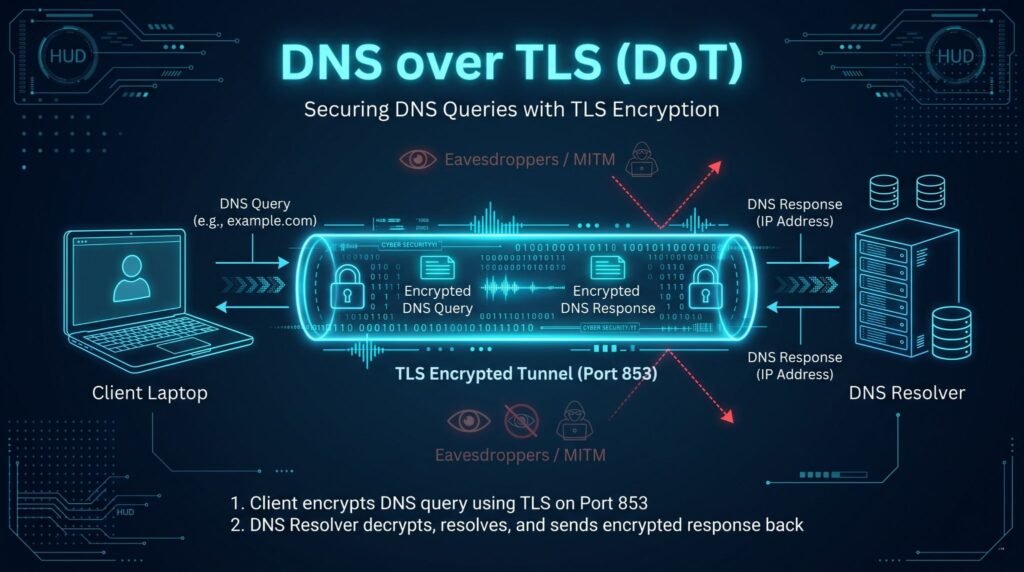
DNS over TLS is another encrypted DNS protocol. It uses Transport Layer Security to protect DNS communication between a client and a resolver, without carrying DNS messages inside ordinary HTTPS requests.
How Does DoT Work?
The process is similar to DoH, but the transport differs:
- A device or DNS client selects a configured DoT resolver.
- The client establishes a TLS connection to that resolver.
- DNS queries travel through the encrypted connection.
- The resolver returns DNS responses through the same protected channel.
DoT commonly uses TCP port 853. This dedicated port gives network administrators a more straightforward starting point for identifying and managing DoT traffic, although port-based rules alone cannot guarantee that all DNS activity is accounted for.
What Security Advantages Does DoT Provide?
DoT can be useful when organizations want encrypted DNS while retaining a recognizable protocol boundary.
Its benefits include:
- Confidentiality in transit: Protects DNS queries from passive observers on the communication path.
- Transport integrity: Helps prevent unauthorized modification of traffic while the TLS connection is protected.
- Resolver authentication: Supports verification of the intended server when correctly configured.
- Policy management: The commonly used port 853 provides a practical point for network rules and monitoring.
DoT does not automatically validate whether every DNS answer is authentic. DNSSEC addresses a different problem: cryptographic validation of DNS data. The protocols can complement each other because transport encryption and DNS response validation serve different purposes.
For organizations evaluating DNS privacy, this distinction matters. Encrypting the connection helps protect the query in transit, while DNSSEC can help establish the authenticity of signed DNS data.
DNS over HTTPS vs. DNS over TLS: What Is the Difference?
source: DevCentral Community
DoH and DoT share the goal of encrypting DNS communication, but they use different transport approaches. The right choice depends on an organization’s privacy requirements, existing infrastructure, monitoring capabilities, and network policies.
| Feature | DNS over HTTPS (DoH) | DNS over TLS (DoT) |
| Transport | HTTPS | TLS-protected DNS |
| Common port | TCP 443 | TCP 853 |
| Encryption | TLS through HTTPS | TLS |
| DNS privacy | Protects queries in transit | Protects queries in transit |
| Traffic identification | Can blend with ordinary HTTPS traffic | Commonly easier to identify by port |
| Network policy | May require application-aware controls | Can often use dedicated DNS transport rules |
| Monitoring considerations | May be harder to distinguish from general HTTPS | Dedicated port may simplify identification |
| Main limitation | Can reduce visibility for controls relying on traditional DNS inspection | Dedicated-port traffic may be easier to identify or restrict |
These are typical deployment characteristics, not absolute guarantees. Implementations, network configurations, and additional security controls can change how traffic is identified and managed.
Which Protocol Is More Private?
Neither protocol is universally more private in every deployment. Both encrypt DNS traffic between the client and resolver.
The more important questions are which resolver receives the queries, what information that resolver retains, how the client authenticates the resolver, and whether other network components can associate the requests with a particular user or device.
DoH may make DNS traffic harder for some network observers to distinguish from regular HTTPS traffic. DoT has a dedicated transport convention that can simplify network-level identification. Neither characteristic alone determines which provider offers better privacy.
Organizations should evaluate the complete configuration rather than assuming that a particular protocol guarantees anonymity.
Which Protocol Is Better for Enterprise Security?
For an enterprise, the decision should reflect the organization’s security architecture.
DoT may fit environments that prefer a dedicated encrypted DNS channel and straightforward transport-level policy enforcement. DoH may fit applications and environments that already rely on HTTPS-based DNS resolution.
The challenge is ensuring that approved encrypted DNS services remain compatible with security policies. If devices can select arbitrary external resolvers, administrators may lose some visibility into DNS requests and find it harder to enforce internal domain controls.
We recommend evaluating encrypted DNS as part of a broader network security design, rather than treating the protocol selection as a standalone privacy decision.
How DoH and DoT Affect Network Monitoring?
Encrypted DNS changes what network monitoring systems can directly observe. When DNS queries are encrypted, a passive monitoring tool generally cannot read the query names from the protected transport alone.
That does not mean all network visibility disappears. Depending on the available telemetry and configuration, defenders may still observe destination IP addresses, connection timing, traffic volume, TLS or HTTP metadata, resolver endpoints, and other behavioral indicators.
The practical challenge is to understand which information remains available and how it can support investigations.
Why Can Encrypted DNS Create Blind Spots?
In our security operations, we frequently observe that traditional DNS monitoring creates visibility gaps once teams switch resolvers and responses. Security teams may use these records to identify suspicious domains, investigate malware callbacks, or correlate endpoint activity with threat intelligence.
When a device uses an encrypted resolver outside the organization’s approved architecture, those traditional DNS records may no longer be available to the same monitoring systems.
Description: An educational explainer video about the concepts of DoH, DoT, and the challenges of encryption in network monitoring from DevCentral (F5 Community).
Potential consequences include:
- Reduced visibility into requested domain names.
- Difficulty enforcing DNS-based filtering policies.
- Gaps in correlation between DNS activity and endpoint alerts.
- Challenges identifying unauthorized or unapproved resolvers.
- More complex investigations involving suspicious external connections.
These risks depend on the network design. An organization that operates approved encrypted resolvers and integrates their logs into its monitoring platform can retain substantial DNS visibility.
The goal should not be to eliminate encryption. It should be to maintain appropriate security monitoring while protecting the confidentiality of DNS communication.
How Can Security Teams Monitor Encrypted DNS?
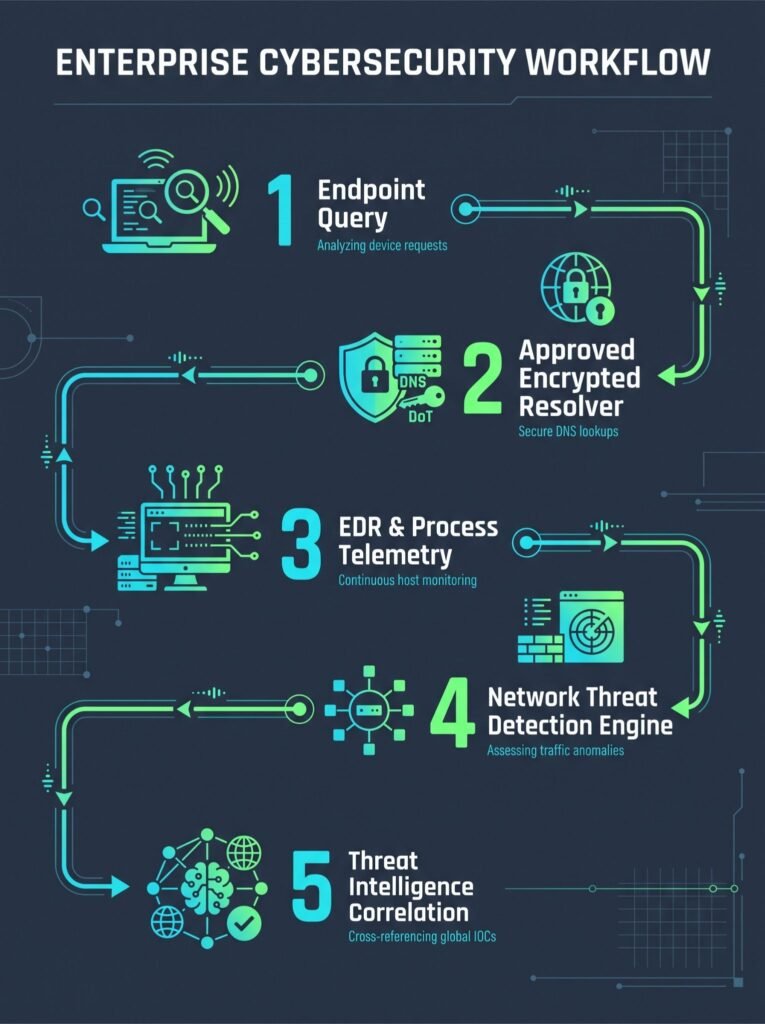
A practical monitoring strategy combines several sources of information:
1. Approved resolver logs
Where possible, centralize logs from approved DNS resolvers. These records can help security analysts investigate domain requests, correlate events, and apply organizational policies.
2. Network flow and connection metadata
Connection records can reveal which endpoints communicate with external resolvers, when connections occur, and whether their behavior changes unexpectedly.
3. Endpoint telemetry
Endpoint monitoring can provide context about the processes and applications initiating network connections. This can help analysts investigate suspicious behavior even when DNS queries are not directly visible on the network.
4. Threat intelligence
Correlating observed domains, IP addresses, and connection patterns with relevant threat intelligence can help analysts prioritize potentially malicious activity.
5. Policy enforcement
Organizations can define approved resolvers, monitor unexpected DNS transport, and use appropriately scoped controls to prevent unauthorized DNS configurations where necessary.
Combining these sources strengthens threat intelligence integration by connecting network activity with external indicators and internal security context through proactive dns filtering blocking malicious domains c2 malware.
Can DNS over HTTPS or DNS over TLS Be Used to Hide Malicious Activity?
Yes, encrypted DNS can make certain DNS-related activity harder for network controls to inspect, but neither protocol is inherently malicious.
Attackers may attempt to use encrypted DNS to bypass monitoring that expects DNS queries to pass through an organization’s traditional resolver. For example, malware could attempt to reach an external DoH service to resolve a command-and-control domain without generating the DNS logs expected by the security team.
However, encrypted DNS is also a legitimate privacy and security technology. Blocking all DoH or DoT traffic without understanding business requirements may interfere with legitimate applications or weaken privacy protections.
The security question is therefore not simply whether encrypted DNS is present. It is whether its use is authorized, consistent with policy, and associated with expected behavior.
What Warning Signs Should Analysts Look For?
Security teams can investigate several indicators when assessing suspicious encrypted DNS use:
- Connections to unapproved DNS resolvers.
- Unexpected encrypted DNS traffic from servers or applications that should use centralized resolution.
- Sudden changes in resolver destinations or connection frequency.
- DNS-related activity associated with suspicious endpoint processes.
- Connections to destinations associated with known malicious infrastructure.
- Attempts to bypass established DNS controls.
No single indicator proves malicious activity. A legitimate application may use an unfamiliar resolver, while an attacker may use an approved service. Analysts should correlate multiple signals before making a decision.
Our approach to network threat analysis emphasizes context. By connecting endpoint behavior, network telemetry, and relevant threat intelligence, security teams can distinguish unusual but legitimate activity from patterns that warrant further investigation.
For a broader view of how this works, explore our insights on the importance dns security network protection to understand how external indicators can support more actionable detection and response.
What Are the Risks of Relying on Encrypted DNS Alone?
Encrypted DNS improves transport privacy, but it does not replace other security controls. Organizations should understand the limitations before treating DoH or DoT as a complete DNS security solution.
Encryption Does Not Make a Domain Safe
A malicious domain can be resolved through an encrypted connection. DoH and DoT protect communication with the resolver, not the user’s entire interaction with the destination.
Threat actors can still use phishing websites, malware-hosting domains, and command-and-control infrastructure over encrypted DNS.
The Resolver Remains a Trust Decision
The resolver receives and processes DNS queries. Depending on its implementation and policies, it may retain logs or associate requests with client information.
Selecting a trustworthy resolver and reviewing its privacy practices are therefore important parts of the security decision.
DNSSEC Solves a Different Problem
DNSSEC provides mechanisms for validating the authenticity and integrity of DNS data through digital signatures. It does not encrypt DNS queries or prevent observers from seeing unencrypted requests.
DoH and DoT protect DNS traffic in transit, while DNSSEC can help validate DNS responses. Using one does not automatically provide the benefits of the other.
Encrypted DNS Does Not Eliminate Metadata Exposure
Encryption can conceal DNS query contents while leaving some connection metadata observable. Network observers may still infer information from IP addresses, connection timing, traffic volume, or other characteristics.
This means DNS privacy should be considered alongside endpoint security, network monitoring, access controls, and other privacy protections.
How Should Organizations Implement DoH and DoT Securely?
A successful deployment begins with policy and visibility rather than simply enabling encryption across every device.
Step 1: Identify Existing DNS Behavior
Inventory the organization’s DNS resolvers, endpoint configurations, applications, and network segments. Determine which systems use traditional DNS and which already support encrypted DNS.
This baseline helps identify unexpected resolver use and potential compatibility issues.
Step 2: Define an Approved Resolver Policy
Decide which resolvers devices and applications may use. Consider internal domain resolution, data handling requirements, regulatory obligations, filtering policies, and operational needs.
Document how exceptions will be approved and reviewed.
Step 3: Select the Appropriate Protocol
Evaluate DoH and DoT against the existing environment. Consider application compatibility, client support, firewall policies, logging, and the operational impact of managing encrypted DNS.
Neither protocol should be selected solely because it is newer or more difficult to inspect.
Step 4: Integrate Logging and Monitoring
Ensure that approved resolver logs are available to the security team where feasible. Correlate these logs with endpoint telemetry, network connection records, and threat intelligence.
This step is particularly important if traditional DNS inspection is a major part of the organization’s detection strategy.
Step 5: Test Policy Enforcement
Validate how the environment handles attempts to use unapproved resolvers. Test legitimate applications, internal domain resolution, remote users, and relevant business systems before deploying restrictive controls broadly.
A policy that blocks unexpected DNS traffic but breaks critical services is not a successful implementation.
Step 6: Review the Configuration Regularly
DNS client behavior, applications, and organizational requirements change. Review resolver configurations, policy exceptions, logging coverage, and monitoring effectiveness as part of the broader security program.
This ongoing review helps ensure that privacy protections remain compatible with effective threat detection.
What Role Does Threat Intelligence Play in Encrypted DNS Security?

Threat intelligence helps security teams interpret network activity that might otherwise appear routine. A connection to an external resolver is not automatically suspicious, but the domain requests and surrounding activity may provide useful context when that information is available from approved logs or other telemetry.
For example, an analyst investigating an endpoint that repeatedly contacts an unusual external service may correlate its destination IP, process activity, and timing with known indicators of compromise. If the activity matches a documented threat pattern, the investigation can be prioritized for further analysis.
Threat intelligence can also help teams identify malicious infrastructure, enrich security alerts, and connect separate events into a broader incident.
However, intelligence is only useful when it is relevant, current, and connected to the organization’s environment. A long list of malicious indicators cannot replace context about which assets are affected, what activity occurred, and how much business risk the activity creates.
Network Threat Detection supports this broader approach through threat modeling, automated risk analysis, and continuously updated intelligence. These capabilities help security teams connect observed network behavior with relevant threats and make more informed investigation decisions.
What Mistakes Should You Avoid When Managing DoH and DoT?
Organizations can weaken their security posture when they treat encrypted DNS as either an unconditional benefit or an automatic threat.
- Blocking all encrypted DNS without assessing business needs. Some applications legitimately rely on DoH or DoT. Evaluate the operational impact before implementing broad restrictions.
- Assuming encryption guarantees privacy from the resolver. Encryption protects traffic in transit, but the resolver still processes the queries. Provider trust and data handling remain important.
- Relying only on port numbers. Port 443 carries many types of HTTPS traffic, while network configurations can vary. Use available protocol identification, resolver logs, endpoint data, and connection metadata together.
- Ignoring DNSSEC. Transport encryption and DNS data validation serve different purposes. Evaluate whether DNSSEC validation is appropriate for the organization’s DNS architecture.
- Failing to centralize logs. If approved resolvers operate without sufficient logging or monitoring integration, analysts may struggle to investigate suspicious domain activity.
- Treating every unusual connection as an attack. Legitimate applications and remote devices may use different resolver configurations. Correlate multiple indicators and verify the context before escalating an alert.
How Do DoH and DoT Fit Into a Modern Network Security Strategy?
Encrypted DNS is one component of a broader security architecture. Its value depends on how it fits with identity controls, endpoint protection, network visibility, DNS policy, and incident response.
Organizations should aim to protect DNS traffic without creating unnecessary gaps in detection. That requires knowing which resolvers are approved, where DNS logs are available, how suspicious connections are investigated, and how relevant threat intelligence reaches analysts.
We recommend treating encrypted DNS as an architectural decision with both privacy and operational implications. Security teams should document the intended behavior, test it against realistic network scenarios, and review whether their monitoring still provides the context required for incident response.
A mature approach combines encryption with visibility from authorized sources. It does not depend on reading every packet or assuming that encrypted traffic is inherently safe. Instead, it uses the information available across the environment to identify activity that deviates from expected behavior.
FAQs
What is the main difference between DNS over HTTPS and DNS over TLS?
DoH carries DNS queries through HTTPS, commonly using TCP port 443. DoT protects DNS queries through a dedicated TLS connection, commonly using TCP port 853. Both encrypt DNS traffic between the client and resolver, but their transport and network visibility characteristics differ.
Is DNS over HTTPS more secure than DNS over TLS?
Neither protocol is universally more secure in every deployment. Both protect DNS traffic in transit. Actual security depends on resolver trust, client configuration, server authentication, operational controls, and how the protocols are monitored.
Does DoH or DoT hide browsing history from an internet service provider?
Encrypted DNS can prevent an ISP or another on-path observer from directly reading DNS queries carried through a properly configured encrypted connection. However, it does not guarantee complete anonymity. Other traffic metadata and destination information may remain visible, and the selected resolver can process the DNS queries.
Can encrypted DNS prevent phishing and malware?
No. DoH and DoT encrypt DNS communication but do not automatically block malicious domains. Protection requires additional controls, such as domain filtering, endpoint security, threat intelligence, and monitoring.
Should businesses block DNS over HTTPS?
Not necessarily. Businesses should assess their security requirements, approved resolver policies, application dependencies, and monitoring capabilities. Where necessary, they can restrict unauthorized encrypted DNS while supporting approved services and maintaining appropriate visibility.
Does DNS over TLS use port 443?
DoT commonly uses TCP port 853. DoH commonly uses TCP port 443 because it operates over HTTPS. These are standard deployment conventions, although actual implementations and network configurations can vary.
Is DNSSEC the same as DoH or DoT?
No. DNSSEC helps validate the authenticity and integrity of DNS data. DoH and DoT encrypt the connection used to exchange DNS queries and responses. They address different security requirements and can complement one another.
How can security teams detect suspicious encrypted DNS activity?
Teams can review resolver logs, identify unauthorized resolver connections, examine network flow and connection metadata, correlate endpoint behavior, and use threat intelligence to investigate suspicious destinations. The effectiveness of these methods depends on the available telemetry and deployment configuration.
Building a More Visible and Secure DNS Environment
DNS over HTTPS and DNS over TLS deliver meaningful privacy by protecting DNS queries in transit. However, neither protocol guarantees complete anonymity, validates every DNS response, or prevents connections to malicious infrastructure on its own.
For organizations, the challenge is balancing encrypted communication with effective security monitoring. Utilizing approved resolvers, continuous logging, endpoint telemetry, and threat intelligence preserves critical visibility. Network Threat Detection strengthens this through automated risk analysis, real-time threat modeling, and visual attack path simulations mapped to MITRE ATT&CK.
To connect network activity with emerging risks and build a resilient defense, visit our features and join today.
References
1. Hoffman, Paul, and Patrick McManus. “DNS Queries over HTTPS (DoH).” RFC Editor, October 2018. Accessed November 9, 2026.
2. Hu, Zi, et al. “Specification for DNS over Transport Layer Security (TLS).” RFC Editor, May 2016. Accessed November 9, 2026.