
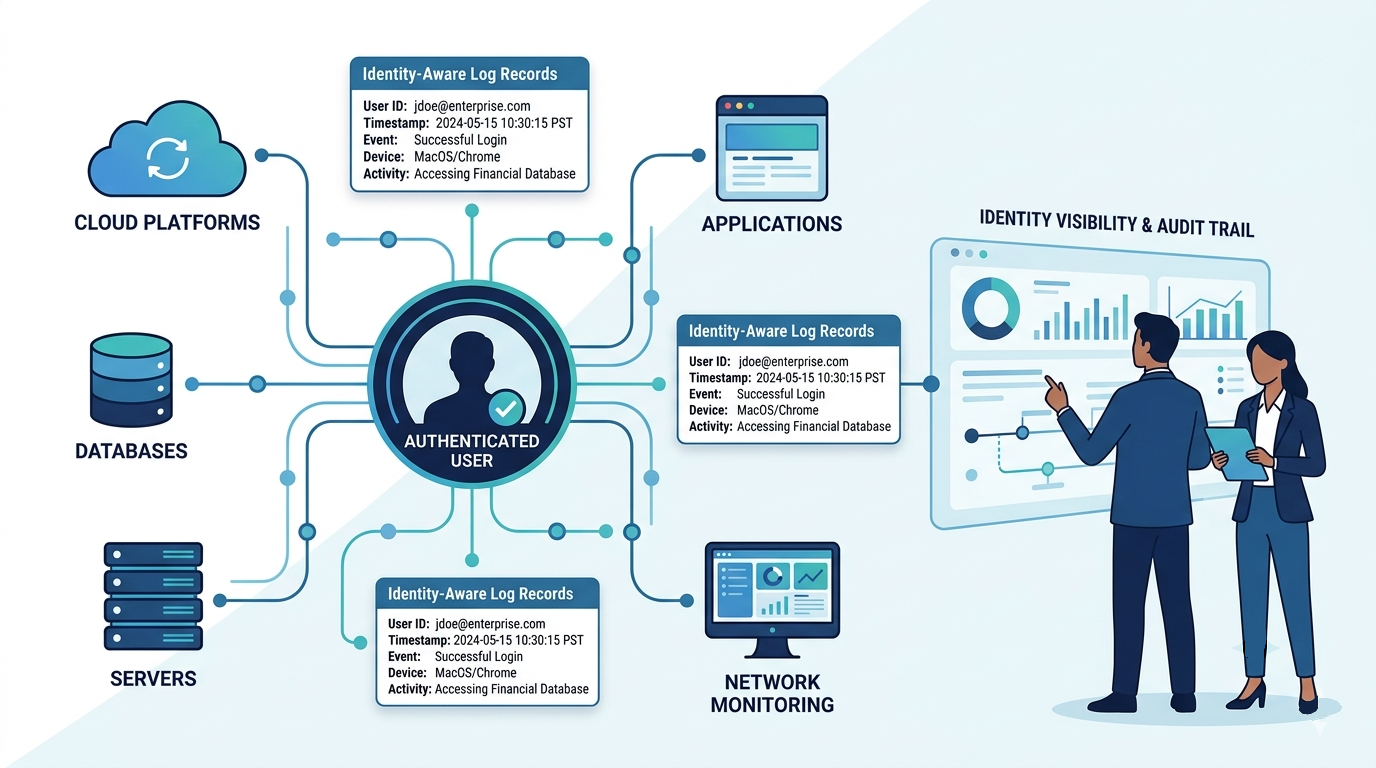
Adding user identity information logs helps organizations connect system activity to specific users, making security investigations, audits, and troubleshooting far more effective. While most environments generate massive volumes of log data, many records still show only what happened instead of who performed the action.
As organizations strengthen their security programs, combining identity visibility with Network Threat Detection provides a clearer understanding of activity across users, systems, and networks. Keep reading to see how effective identity logging improves security and compliance.
Identity Logging at a Glance
Adding user identity information logs gives security teams the context needed to connect actions to specific users, investigate incidents faster, and support compliance requirements.
- Identity-aware logs make investigations faster and audits easier.
- User context helps detect account compromise, privilege misuse, and unauthorized access.
- Combining identity data with Network Threat Detection creates stronger visibility than network data alone.
What is user identity logging and why does it matter?
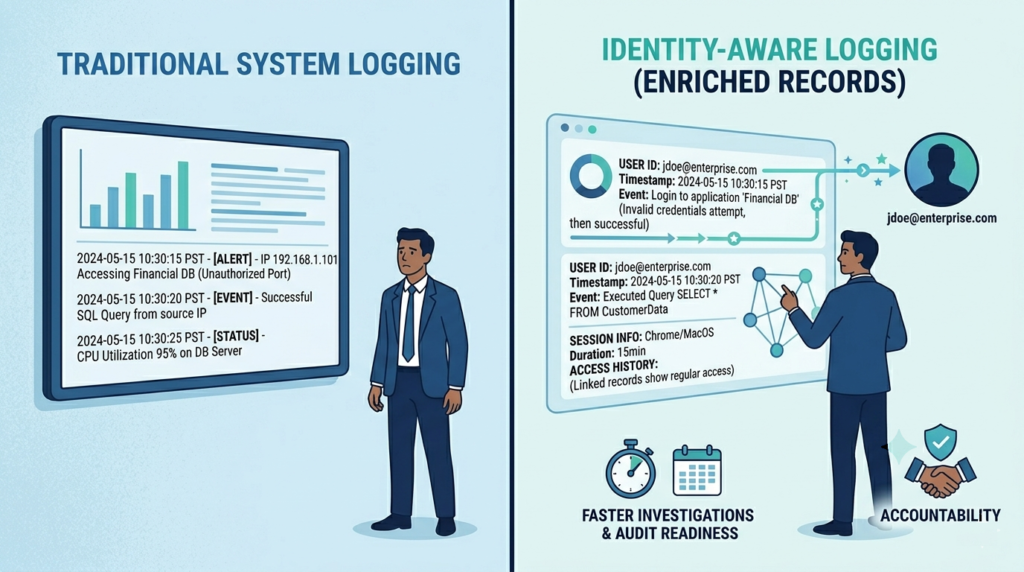
User identity logging adds information about authenticated users to system events. Instead of recording only technical activity, the log also captures who performed the action, when it happened, and where it came from.
Many organizations begin with infrastructure logging. Servers, applications, and network devices generate large amounts of data. While useful, those records often lack the context needed during an investigation. Security teams can see a change, a login, or a database query, but they cannot always identify the person responsible.
We often see this gap during risk assessments. An organization may have years of retained logs, yet answering a simple question such as “Who made this change?” can still take hours. Identity-aware logging closes that gap by attaching user information to important events.
A complete identity trail helps teams:
- Connect actions to specific users
- Investigate suspicious activity faster
- Support internal and external audits
- Reduce insider threat blind spots
- Improve forensic investigations
In practice, network monitoring often detects unusual activity first. Identity data then helps explain which account generated that activity and whether the behavior makes sense.
Identity logging vs traditional system logging
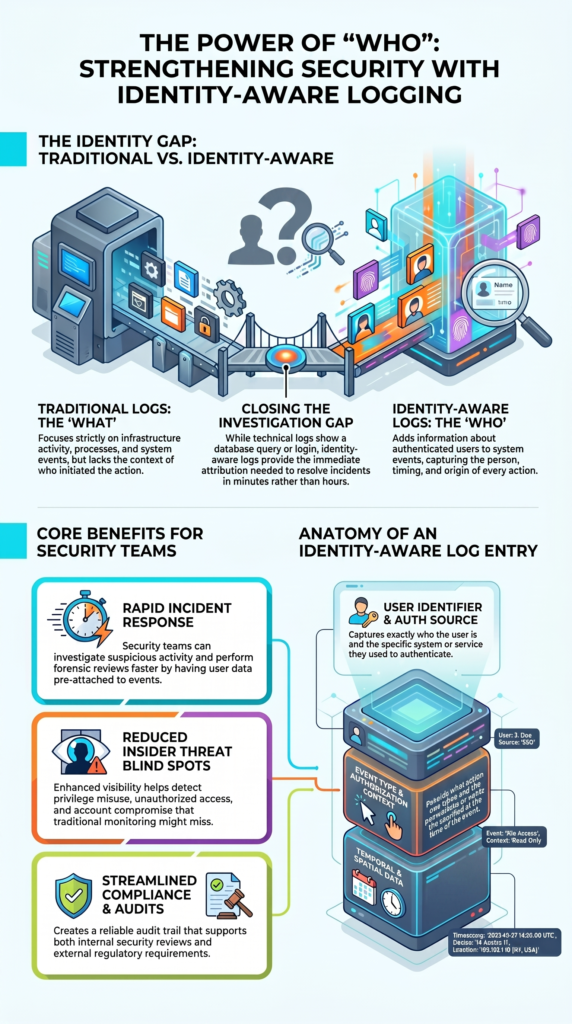
Traditional system logs focus on events, processes, and infrastructure activity. They answer the question: “What happened?”
Identity logging adds user context. It answers: “Who did it?”
When both types of logging work together, investigations become far more efficient. Teams spend less time searching for attribution and more time responding to actual risk.
Core components of an identity-aware log entry
A useful identity-aware log should include:
- User identifier
- Authentication source
- Event type
- Authorization context
- Timestamp
- Device information
- Source location
Together, these details create a reliable audit trail that can be used for investigations, compliance reviews, and security monitoring. Many organizations further strengthen attribution by enriching logs with IP geolocation data, providing additional location context.
What should every identity log capture?
Credits: Tech with Jono
Effective identity logs record enough information to identify a user, understand the action, and reconstruct the event later. Consistency matters as much as completeness.
We’ve worked with organizations that collected large amounts of log data but used different field names across systems. During investigations, analysts spent more time mapping fields than analyzing threats. Standardized logging removes much of that friction.
A practical identity log should capture:
- User identifier
- Authentication method
- Event outcome
- Timestamp
- Source IP address
- Device identifier
- Session identifier
- User role
- Permission context
Many teams also include a user principal name or directory identifier to make investigations easier. Maintaining the security data enrichment context around these fields makes correlation significantly more effective during investigations and threat hunting activities.
As highlighted by the Australian Cyber Security Centre (ACSC)
“To support effective cyber security incident response, organisations should log… the identity of the user or process associated with each event, including the user’s unique identifier (e.g. username or user ID) and, where applicable, their source network address.” – Australian Cyber Security Centre (ACSC)
Standardized schemas allow organizations to correlate activity across applications, databases, cloud platforms, and security tools. That consistency becomes especially valuable during incident response, where investigators need a clear timeline instead of fragmented records.
From our experience building threat models and risk analysis workflows, organizations that standardize identity logging early typically reduce investigation time and improve detection accuracy. Analysts spend less effort finding context and more effort understanding risk.
Which user identity attributes should you log?
The goal is to capture information that helps identify activity without collecting unnecessary personal data. Good identity logging balances security needs with privacy requirements.
We recommend focusing on stable identifiers and authentication details rather than personal information. Usernames may change over time, but a unique user ID often remains the same. Stable identifiers make investigations much easier months or years later.
Recommended fields and their security value
| Attribute | Security value |
| User ID | Reliable identity tracking |
| Username | Easier investigations |
| Session ID | Session correlation |
| Source IP | Origin analysis |
| Device ID | Endpoint attribution |
| Authentication Method | Risk assessment |
| Role/Permission | Privilege monitoring |
Each field provides context that helps analysts understand user behavior and identify suspicious activity. Organizations often strengthen this visibility through data enrichment for contextual analysis. So user actions can be evaluated alongside supporting environmental and security telemetry.
Research from the SANS Institute shows
“At a minimum, ensure that you are logging the source user identifier, destination user identifier (for privilege changes or impersonation), session ID, and authentication method for each access attempt. Without these, you cannot reconstruct an attack timeline.” – SANS Institute
Fields to avoid logging in plain text
Organizations should never store sensitive secrets directly in logs.
Avoid logging:
- Passwords
- API keys
- Access tokens
- Recovery codes
- Encryption keys
- Authentication secrets
Instead, use hashed values, references, or tokenization methods. Logs should support investigations without becoming a source of risk themselves.
How do you add user identity information at the application layer?
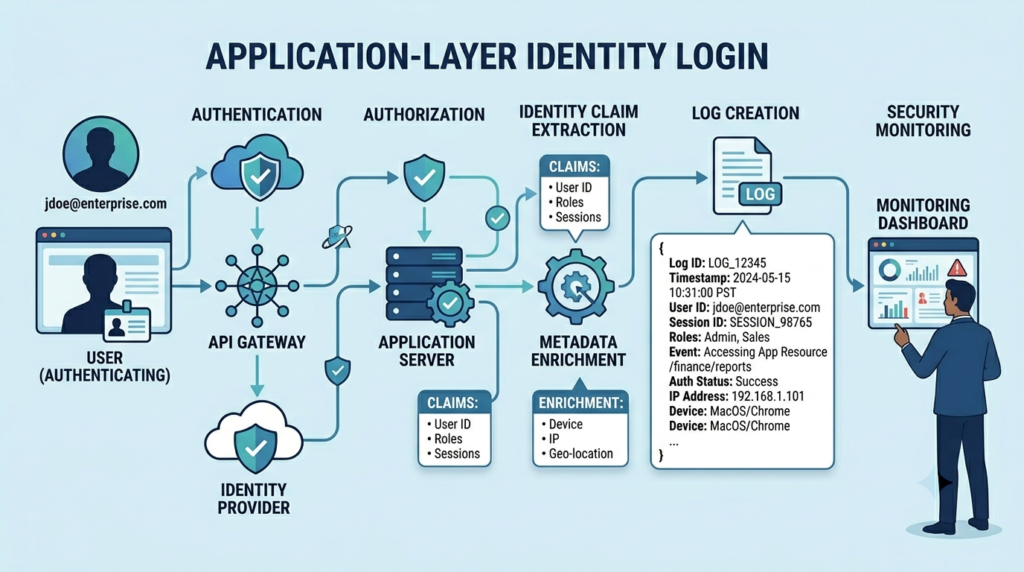
Identity data should be attached to events after authentication succeeds and before logs are written. Timing matters.
During application reviews, we often find logging configured too early in the request process. The application records activity before user information becomes available. As a result, important events lose valuable identity context.
A better approach is to enrich logs after authentication and authorization have completed.
Middleware placement requirements
A common workflow looks like this:
- Authenticate the user
- Validate permissions
- Extract identity claims
- Attach user metadata
- Write application logs
- Forward logs to monitoring tools
This approach keeps user information attached throughout the request lifecycle.
Handling OAuth, SAML, and JWT claims
Modern applications commonly use:
- OAuth
- SAML
- JWT
Useful claims often include:
- Subject identifier
- Email address
- Tenant identifier
- Group membership
- Assigned roles
These values help investigators understand who accessed a resource and what permissions existed at the time.
Logging successful and failed authentication events
Many organizations focus only on successful logins. That leaves a major visibility gap. Failed authentication attempts often reveal attacks before a compromise occurs. Recording both successful and failed events helps security teams detect brute-force attacks, credential stuffing attempts, and account takeover activity much earlier.
FAQ
How long should organizations keep user identity logs?
Organizations should keep user identity logs for a period that supports security investigations, audits, and legal requirements. Many businesses retain identity audit logs, user access records, and user authentication logs for at least one year, while some industries require longer retention periods.
A clear retention policy helps teams investigate incidents, review historical activity, and maintain reliable records of important user identity events.
Can user identity logs help identify compromised accounts?
Yes. User identity logs can help security teams detect compromised accounts by showing unusual login activity, unexpected permission changes, or suspicious access attempts.
Analysts often review user login logs, user session logs, user behavior logs, and identity anomaly logs to identify patterns that differ from normal activity. These records provide valuable evidence when investigating potential account misuse or unauthorized access.
What challenges occur when managing identity logs across multiple systems?
Managing identity management logs across multiple systems can be difficult when different platforms use inconsistent formats and field names. User activity logs, identity metadata logs, and user authorization logs may record similar information in different ways.
These differences can slow investigations and make reporting less accurate. Standardized identity log aggregation and user log analysis processes help improve visibility and reduce confusion.
How can organizations improve the accuracy of identity tracking logs?
Organizations can improve identity tracking logs by using consistent logging standards and validating data at every stage. User identification records, identity confirmation logs, and user validation logs should use the same identifiers across systems.
Regular reviews of identity modification logs, user permission logs, and identity association logs help identify errors, remove duplicate records, and improve the reliability of investigation data.
Why are user session logs important during investigations?
User session logs help investigators understand exactly what happened during a user’s session. These records show when a session started, what actions occurred, and when the session ended.
When combined with user security logs, identity forensic logs, and identity trail logs, they create a detailed timeline. This information helps teams analyze suspicious behavior, verify user actions, and support incident response activities.
Identity-Aware Logging Strengthens Security Operations
Without clear user identity data in your logs, investigations take longer and security teams often struggle to understand who performed specific actions. As compliance requirements and monitoring expectations continue to increase, identity-aware logging helps create stronger visibility across authentication events, network activity, and system access.
If you’re looking to improve identity visibility across your environment, explore how Network Threat Detection helps security teams connect identity context with threat activity. By combining network intelligence, threat modeling, and risk analysis, it provides deeper insight into user behavior and strengthens security monitoring efforts.
References
- https://www.cyber.gov.au/resources-business-and-government/essential-cyber-security/ism/cyber-security-guidelines/guidelines-cyber-security-logging
- https://www.sans.org/reading-room/whitepapers/logging/logging-active-directory-security-37167