

Threat hunting becomes far more effective when it’s guided by evidence instead of assumptions. Using ATT&CK for threat hunting hypothesis generation allows analysts to turn threat intelligence into clear, testable investigations focused on attacker behavior.
Combined with Network Threat Detection, this approach helps security teams reduce noise, prioritize meaningful hunts, and improve detection outcomes across complex environments. Rather than searching endlessly through logs, ATT&CK provides a structured path toward finding genuine threats.
What You’ll Learn
In this guide, you’ll discover how to use the MITRE ATT&CK framework to create focused, intelligence-driven threat hunting hypotheses. You’ll also learn why behavior-based hunting consistently delivers better results than searching for isolated indicators.
- Turn ATT&CK intelligence into clear, actionable threat hunting hypotheses.
- Build hunts around adversary behaviors instead of isolated indicators.
- Prioritize investigations that are more likely to uncover active attacks.
What’s Wrong with Traditional Threat Hunting Approaches?
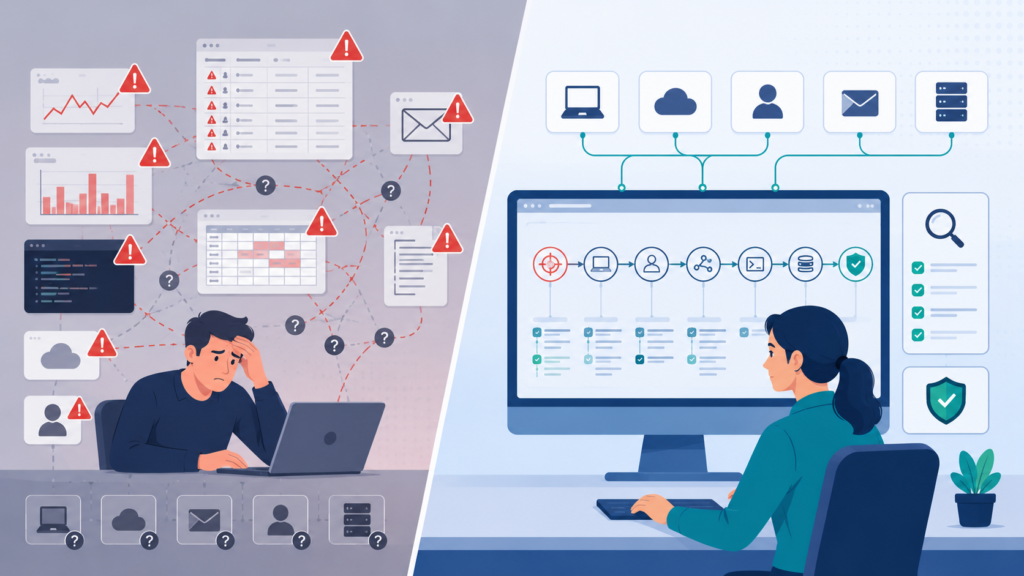
Too often, hunting starts with a tool. A team gets a new piece of technology and says, “Let’s hunt with this.” They run broad queries for PowerShell use or look for odd login times. The results are overwhelming, full of benign administrative activity. It’s noisy, frustrating, and yields little. This approach focuses on artifacts, the what, instead of behaviors, the why.
“the average detection time exceeds six months” and “only 33% of incidents identified internally by organizations, and the remaining 67% discovered through third-party notifications or attacker disclosures”. – Scientific Reports
ATT&CK flips the script. Applying the MITRE ATT&CK framework forces you to start with the adversary’s intent. You begin with a technique, like T1059.001 (PowerShell) or T1021.002 (SMB for Lateral Movement), and then ask the critical question: “If someone were doing this to evade our current controls, what would the evidence look like?” That question is your hypothesis.
We’ve been there, sifting through thousands of generic log entries. It felt like looking for a needle in a stack of needles. When we adopted ATT&CK, our first hypothesis was simple: “Adversaries may use scheduled tasks (T1053.005) for persistence, and they might name them to blend in with legitimate OS tasks.”
That focus let us craft a query that looked for specific anomalies in scheduled task creation, not all scheduled tasks. The difference was immediate. We cut out 99% of the noise and found our first real, hidden persistence mechanism within an hour.
- Start with the adversary’s goal, not your tool’s capability.
- Frame your search around a specific ATT&CK technique ID.
- Define what “normal” looks like for that technique in your environment first.
How Do You Build a Hypothesis from an att&ck for threat hunting hypothesis generation?
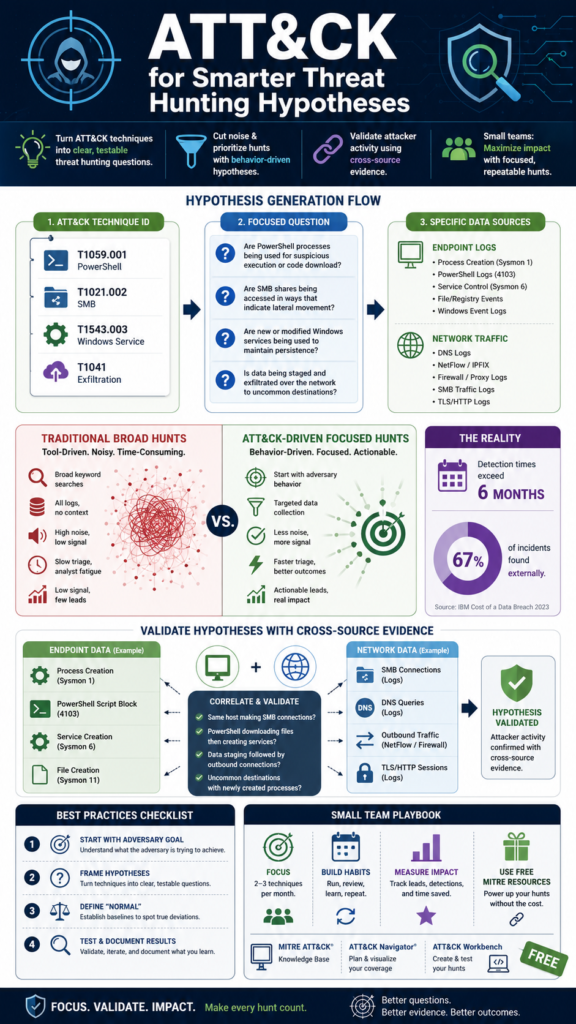
You start with a single technique, not the whole matrix. Pick one that’s relevant to your environment and a known threat. Let’s use T1047 (Windows Management Instrumentation). The ATT&CK page tells you adversaries use it for execution and lateral movement. A weak hypothesis is: “Hunt for WMI use.” That’s useless.
“systematically mapping [network threats] to Enterprise MITRE ATT&CK tactics and their corresponding Cyber Kill Chain stages” to structure threat detection and hunting efforts.” – dimensions
A strong ATT&CK-informed hypothesis is: “Adversaries may use WMI for lateral movement by creating a process remotely on a target host (win32_process.create), and the parent process may be unusual, like coming from a user’s workstation targeting a server.”
This hypothesis is powerful because it’s specific, testable, and based on a known behavior. It tells you exactly what data sources you need, process creation logs with parent/child details and network logs to see the connection, while mapping security controls to the observed technique helps validate whether existing defenses should have detected the activity.
It also tells you what to look for: a specific WMI method call with a suspicious network pattern.
You’re not just looking for WMI; you’re looking for WMI used in a particular malicious way. This is the core of the method. You take the general technique and apply the context of your own network to ask, “What would the suspicious outlier be here?”
Where Should You Focus Your Hypothesis Generation?
Credits: The Cyber Mentors
Focus on techniques that leave multiple traces, especially across different data sources. The best hypotheses are those you can corroborate. Techniques involving network protocols are golden for this. A technique like T1210 (Exploitation of Remote Services) or T1046 (Network Service Discovery) creates evidence on both endpoints and the network.
Your hypothesis might be: “An adversary performing internal reconnaissance will cause a spike in unique connection attempts from a single host to multiple internal IPs on uncommon ports.”
This is where integrating Network Threat Detection becomes a force multiplier for hunting. We use it as a primary data source because it provides an objective, cross-environment view. An endpoint can be compromised and lie. The network tells the truth about the conversation between systems.
When your hypothesis predicts a network behavior, you can write a precise query for our metadata. Did that server, which only talks to three other machines, suddenly initiate connections to fifty? That’s a signal worth investigating. It turns a broad technique into a narrow, observable event.
| Hunting Focus Area | Sample ATT&CK Technique | Strong Hypothesis | Key Data Sources |
| Initial Execution | T1059.001 (PowerShell) | Adversaries may bypass logging by launching PowerShell with the -WindowStyle Hidden flag from a non-admin parent process like explorer.exe. | Endpoint EDR logs, Process command-line auditing. |
| Lateral Movement | T1021.002 (SMB) | Lateral movement via SMB may be detected by successful network authentication from a workstation IP to multiple servers outside its normal pattern. | Network authentication logs (Kerberos), Netflow/SMB session data. |
| Persistence | T1543.003 (Windows Service) | A new Windows service created with a binary path in a user-writable directory (like C:\Users\Public\) indicates potential persistence. | Windows Registry logs, File system monitoring. |
| Exfiltration | T1041 (Exfiltration Over C2) | Data exfiltration may be disguised within periodic, small HTTP POST requests to a new domain with a high entropy name. | Web proxy logs, DNS query logs, Network Traffic Analysis. |
What Does a Successful Hunt with This Method Look Like?
Success isn’t just finding malware; it’s validating or disproving your hypothesis with evidence. Let’s walk through a real example.
Based on intelligence about a phishing campaign, we built a hypothesis around T1566.001 (Spearphishing Link): “Users who click a link may have follow-on execution from an email-attachment-delivered HTA file (T1218.005).”
We didn’t search all emails. We first identified a suspicious domain from our intelligence feed, then hunted for network connections to that domain from our workstations. We found three hits.
Using our Network Threat Detection, we pivoted to see what those workstations did next. One immediately initiated an HTTP connection to an internal server it never talked to before.
That matched a potential lateral movement pattern. The hunt, guided by the hypothesis, moved from initial access to execution to lateral movement in a logical, evidence-backed path. We contained the activity within 90 minutes. The report wasn’t “found malware on a PC.”
It was “confirmed adversary progression from T1566.001 to T1218.005 to T1021.002, as hypothesized.” This creates a feedback loop that improves your next hypothesis.
How Do You Operationalize This into a Hunting Program?
Make it a rhythm, not a project. Dedicate a recurring “hypothesis generation” meeting. Bring recent threat reports, incident summaries, and ATT&CK. The output of each meeting is a documented hypothesis in a simple format: Technique, Hypothesis Statement, Data Sources, and a Simple Query Blueprint.
Maintain a backlog. Prioritize hunts based on threat relevance and data source availability. The easiest hypotheses to test are the ones where you already have clean, parsed logs.
After each hunt, document the outcome. Did you find something? Great. What was the true-positive indicator? Add it to your detection rules. Did you find nothing? Also great. Maybe the hypothesis was wrong for your environment, or your logging has a gap. This process systematically builds your institutional knowledge.
Over time, you’re not just hunting; you’re building a library of proven, tested methods for finding adversaries in your specific network. This turns hunting from an ad-hoc art into a repeatable science.
Can Small Teams Use This Approach Effectively?

They benefit from it the most. A small team has no time for fishing expeditions, especially when protecting mixed IT environments or OT security systems where focused, behavior-driven hunts are essential.
ATT&CK-driven hypothesis generation provides the ultimate focus. You don’t need to hunt for everything. You hunt for the two or three techniques most likely to be used against you this month. Start with the free resources.
Use the MITRE website to pick a technique. Use a single, reliable data source you already have, like your firewall or DNS logs. Build one hypothesis a week and test it. The discipline of thinking like an adversary and formally stating what you’re looking for is more important than any tool.
This method maximizes your limited resources. It prevents alert fatigue by design. You’re only running targeted, thoughtful searches. It also makes your findings more compelling when you need to advocate for more resources.
You can say, “Based on hunting hypothesis X, we found evidence of behavior Y, but we lacked logging in area Z to be conclusive.” That’s a powerful, data-driven argument for investment.
FAQ
Does every hunt need a formal written hypothesis?
Yes, especially when starting. The act of writing it forces clarity of thought. It ensures everyone on the hunt understands the why and the what. Over time, the format becomes second nature.
How is this different from just writing detection rules?
A detection rule is automated and always-on. A hunting hypothesis is manual, exploratory, and often looks for more subtle, low-fidelity anomalies that wouldn’t warrant an alert. Hunting validates and informs better detection rules.
What if our logging is poor? Can we still hunt?
Yes. Start with the data you have. A weak hypothesis based on existing logs is better than no hunt. The process will explicitly reveal your logging gaps, which is a valuable outcome for improving your security posture.
How often should we update our hypotheses?
Continuously. As new threat reports emerge and ATT&CK is updated, your hypothesis backlog should evolve. Review and refresh your priority hypotheses at least monthly.
Sharpening Your Hunter’s Instinct
ATT&CK-based hypothesis generation helps analysts think like attackers by turning vague searches into focused investigations. Every hypothesis, whether confirmed or disproven, improves visibility, strengthens detection strategies, and builds a more proactive defense.
Ready to sharpen your threat hunting? Join Network Threat Detection and see how ATT&CK-driven threat modeling and automated risk analysis help your team find real threats faster.
References
- https://pmc.ncbi.nlm.nih.gov/articles/PMC12595088/
- https://dtic.dimensions.ai/details/publication/pub.1194474592?and_facet_for=80017&and_facet_for=80205&and_facet_researcher=ur.010060620710.46