
Evaluating security tool ATT&CK coverage helps organizations measure detection effectiveness against proven adversary techniques instead of relying on assumptions. This approach becomes even more effective when applying the MITRE ATT&CK framework consistently across detection validation and security assessments.
When combined with a strong Network Threat Detection strategy, ATT&CK mapping reveals blind spots, strengthens defenses, and helps security teams make smarter decisions backed by real threat intelligence. Keep reading to learn how evaluating security tool ATT&CK coverage improves your security posture.
What The Benefits of Measuring ATT&CK Coverage?
Evaluating security tool ATT&CK coverage provides valuable insights that help organizations strengthen their cybersecurity strategy. Here are the key benefits:
- Uncover Hidden Detection Gaps: Identify which MITRE ATT&CK techniques your security tools detect, and which they miss.
- Make Smarter Security Investments: Use ATT&CK-based insights to prioritize upgrades and maximize the value of existing security solutions.
- Create a Shared Security Language: Help analysts, engineers, and executives communicate clearly using a widely recognized cybersecurity framework.
Why Evaluating Security Tool ATT&CK Coverage Matters?
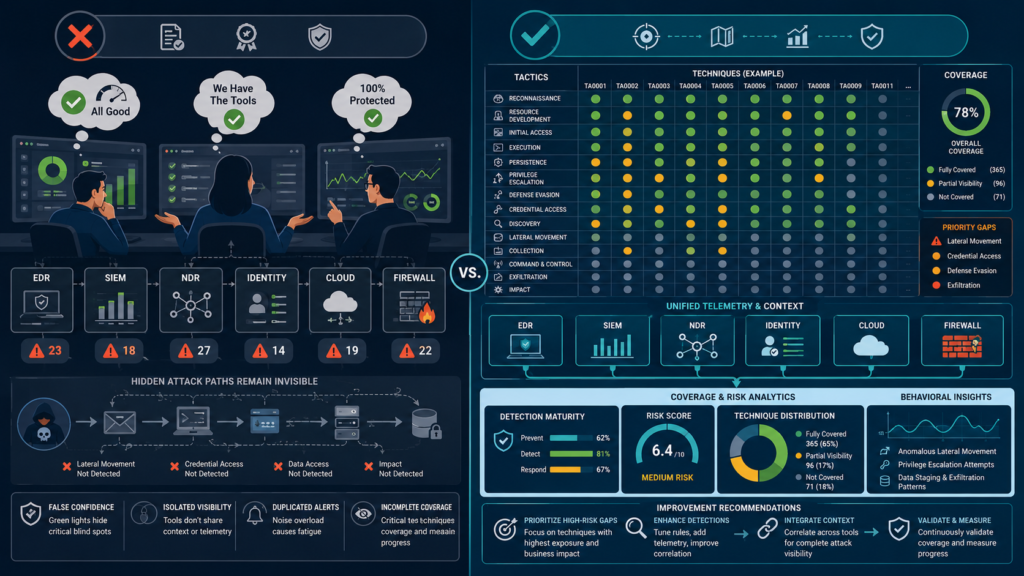
You look at your security dashboard, all green lights and reassuring percentages. It feels safe. But that feeling is often built on vendor claims and generic compliance checklists, not on how you’d fare against a determined attacker moving laterally through your network. These traditional methods miss the context of how attacks chain together.
They tell you if a box is checked, not if you can see the adversary’s playbook in action. We used to rely on those lists too, until a simulated exercise showed us a clear path of undetected behaviors right through our “secure” environment. The disconnect was startling.
The MITRE ATT&CK framework changes that game. It’s not a standard to comply with, it’s a living encyclopedia of the enemy’s techniques. Think of it like studying game film of every opponent you’ll ever face.
“coverage of an ATT&CK technique does not consistently imply coverage of the same real-world threats”. – par.nsf.gov
Evaluating your tools against it means asking, “Can I see this specific action when it happens?” It shifts the conversation from “Do we have a tool?” to “Can this tool detect a real technique?” This evaluation isn’t about passing a test, it’s about stress-testing your visibility.
Incorporating ATT&CK threat modeling into this process helps teams evaluate detection coverage based on realistic attacker behavior instead of isolated security events. You start to see your defenses from the attacker’s perspective, and that viewpoint is everything.
Here’s what a basic coverage gap analysis often reveals:
- Heavy detection around initial access (like phishing), but sparse coverage for post-compromise lateral movement.
- Multiple tools alerting on the same noisy techniques, creating alert fatigue, while quieter, more dangerous techniques go completely unseen.
- A false sense of confidence in endpoint-only visibility, missing critical network-based evidence that endpoints often overlook.
How Do You Start Mapping Tools to ATT&CK?
Credits:The Intel Lab
The task can seem overwhelming at first. Instead of trying to cover every technique in the MITRE ATT&CK matrix, begin with the systems and data that matter most to your business. Then narrow your scope by focusing on the threats most relevant to your industry, such as FIN groups in finance or ransomware actors in healthcare.
Once you’ve defined your priorities, review your detection tools one at a time. For each tool, work through the techniques you’ve selected by checking detection rules, verifying log sources, and testing them in a safe environment to confirm they generate reliable alerts.
Document your findings as you go, including:
- Whether the detection is built in or requires custom tuning.
- Whether the alert clearly maps to the ATT&CK technique or is only generic.
As you complete the assessment, you’ll likely discover both unexpected strengths and important gaps in your coverage. That visibility is the real goal. With a clear map of your current detection capabilities, you can confidently decide where to focus next, whether that means improving existing rules, adding new data sources, or investing in additional security capabilities.
Where Does Network Threat Detection Fit In?
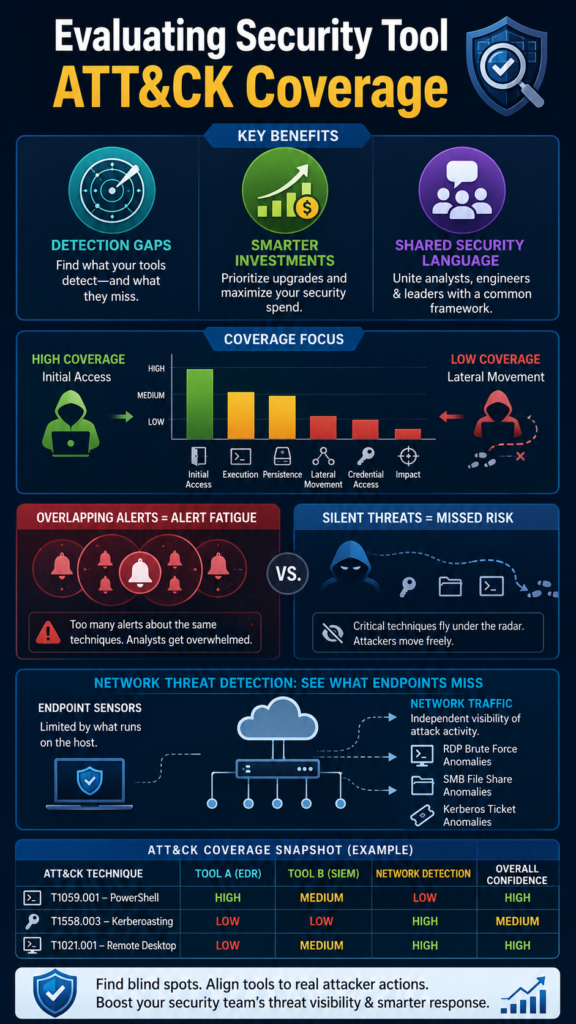
You can’t see everything from the endpoint. An attacker, once inside, often disables or avoids endpoint logging. But their movement across your network leaves a trail. This is where evaluating your network’s visibility becomes non-negotiable. We positioned network threat detection as a foundational layer because it acts as an independent witness.
It doesn’t rely on software installed on a potentially compromised host. It observes traffic and communication patterns, catching what endpoints miss.
Consider techniques like Lateral Tool Transfer or Remote Service Session Hijacking. An endpoint agent might see a strange process, but a network sensor sees the exact source, destination, protocol, and timing of that malicious data transfer.
It provides the connective tissue of an attack. When we mapped our coverage, we saw our endpoint tools had blind spots in credential access and lateral movement. Our network detection layer filled those gaps by spotting anomalous SMB, RDP, and Kerberos traffic that signaled active exploitation. It turned isolated alerts into a coherent attack story.
The evaluation process for network detection is the same: map its capabilities to the ATT&CK techniques. Can it detect suspicious DNS tunneling (Technique T1572)? Can it identify command and control (C2) beaconing (T1071)? By including it in your ATT&CK coverage assessment, you stop treating network data as a separate silo.
What Does a Practical Evaluation Process Look Like?
You need a system, not a one-off project. We treat it as a continuous cycle. It starts with that prioritized list of techniques based on your threat profile.
Then, you gather your tool documentation and, more importantly, your log samples and test results. You don’t just take the vendor’s word for it; you validate. This might involve purple teaming, where your defensive team works with simulated attackers to test detections in real-time. It’s the only way to be sure.
We use a simple table to track progress. It forces clarity and makes gaps visually obvious for everyone, from technical staff to management.
| ATT&CK Technique (Example) | Tool A Coverage | Tool B Coverage | Network Detection Coverage | Overall Confidence |
| T1059.001 – PowerShell | High (Custom Scripts) | Medium (Behav. Analysis) | Low (Sees Execution) | High |
| T1558.003 – Kerberoasting | None | Low (Post-Compromise) | High (Anomalous Tickets) | Medium |
| T1021.001 – Remote Desktop | Low (Logon Events) | Medium (Suspicious Process) | High (Brute Force, Anomalous Hours) | High |
This table shows where you have coverage and where you have critical dependencies. Notice how for Kerberoasting, the network detection provides the primary, high-fidelity signal. That insight directly informs where you invest in tuning and analyst training.
The process isn’t about achieving 100% coverage, that’s unrealistic. It’s about knowing which 20% of techniques pose the highest risk to you and ensuring your coverage there is excellent. You update this map quarterly, or whenever you introduce a new tool or face a new relevant threat.
The operational steps are straightforward:
- Scope and prioritize your subset of the ATT&CK matrix.
- For each tool, document its claimed and verified coverage.
- Test detections through controlled simulations.
- Analyze gaps and overlaps to create an action plan.
- Review and update regularly with new intelligence.
Turning Evaluation Insights Into Stronger Defenses
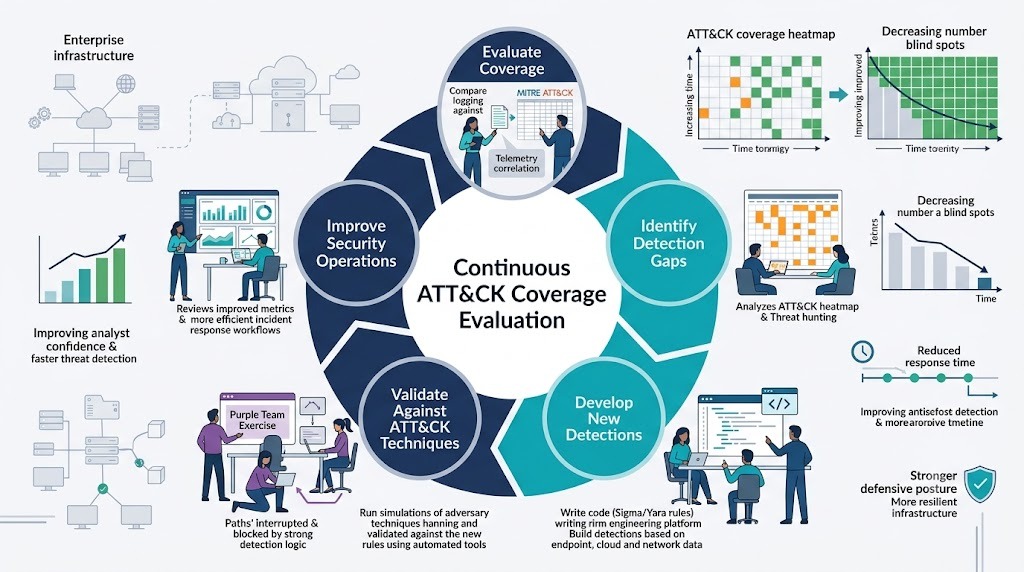
Finding gaps is only valuable if you close them. Your coverage map is now a strategic roadmap. A gap might be closed by tuning an existing tool, writing a new detection rule for a technique it can see but doesn’t currently alert on.
Sometimes, it requires integrating data sources, like enriching an endpoint alert with network context to confirm it. And yes, sometimes it justifies a new investment, but now you’re buying to solve a specific, measured problem, not a vague fear.
“Coverage gaps often emerge because of incomplete detection rules, misaligned configurations, or limited integration with evolving threat intelligence frameworks.” – sciencedirect
The biggest benefit isn’t technical, it’s human. This framework gives your security team a common language. An analyst can now say, “We’re seeing T1588.002 – Obtain Capability: Tool, leading into T1204.002 – User Execution,” and everyone understands the gravity and the sequence. It streamlines investigations and reporting.
When you present to leadership, you can show a chart: “We’ve improved our coverage for credential access techniques by 40% this quarter,” which is far more compelling than talking about abstract “risk reduction.”
We realigned our entire detection engineering effort based on this map. Instead of chasing the latest alert of the day, we work methodically down the list of uncovered high-priority techniques.
Our security posture became proactive. The evaluation process itself fostered deeper knowledge of both our tools and our adversaries. It transformed our team from tool operators to strategic defenders. That shift in mindset is the most powerful outcome of all.
FAQ
Does high ATT&CK coverage guarantee we won’t be breached?
No, and that’s a critical point. No framework guarantees prevention. High ATT&CK coverage means you have a much better chance of detecting an adversary’s activities early in their attack chain. It’s about reducing dwell time and giving your responders a fighting chance, not creating an impenetrable wall.
How often should we re-evaluate our tool coverage?
You should review it at least quarterly. The ATT&CK framework is updated regularly with new techniques, and your own IT environment changes. Major events, like deploying a new tool, a significant breach in your industry, or a company merger, should also trigger a re-evaluation to ensure your coverage map is still accurate.
Is this evaluation only for large enterprises with big budgets?
Not at all. The process scales. A small team can start with just their core detection tool and the top 10 techniques most relevant to them. The principle is the same: know what you can see. For smaller organizations, this disciplined approach is even more crucial to ensure limited security dollars are spent where they matter most.
Can’t we just use the vendor’s ATT&CK coverage claim?
You should start there, but never end there. Vendor claims are a useful starting point, but they are often based on ideal lab conditions. You must validate the coverage in your environment, with your configurations and your network traffic. We’ve found more than one instance where a claimed detection required a specific log source we weren’t collecting.
Ready to Close Your Detection Gaps?
Join Network Threat Detection to see how your organization can continuously evaluate ATT&CK coverage, identify detection blind spots, and prioritize security improvements with automated threat modeling, MITRE ATT&CK mapping, attack path visualization, CVE correlation, and executive-ready reporting.
Built for SOC teams, CISOs, and security analysts, the platform helps you reduce response times, strengthen detection engineering, and stay ahead of evolving threats with continuously updated intelligence.
References
- https://par.nsf.gov/biblio/10640866-how-does-endpoint-detection-use-mitre-att-amp-ck-framework
- https://www.sciencedirect.com/science/article/abs/pii/S0167404825003918?dgcid=rss_sd_all