

Cloud environments change every minute, making it difficult to maintain an accurate inventory of every asset. We have seen how cloud asset inventory management challenges grow as resources scale automatically, identities multiply, and visibility becomes fragmented across accounts and regions.
At Network Threat Detection, we believe continuous visibility is the foundation of stronger cloud security without adding unnecessary complexity. Understanding these challenges is the first step toward better governance and faster response. Keep reading.
The Biggest Roadblocks to a Complete Cloud Asset Inventory
Before exploring each challenge in detail, here are the main reasons cloud asset inventory management becomes difficult as environments grow and evolve.
- Cloud assets are created, changed, and removed automatically, making inventories outdated quickly.
- Visibility gaps across multiple cloud accounts, regions, and services prevent teams from seeing every asset.
- Unclear ownership leaves orphaned resources without accountability or proper governance.
Which data sources should we use to build a trustworthy inventory?
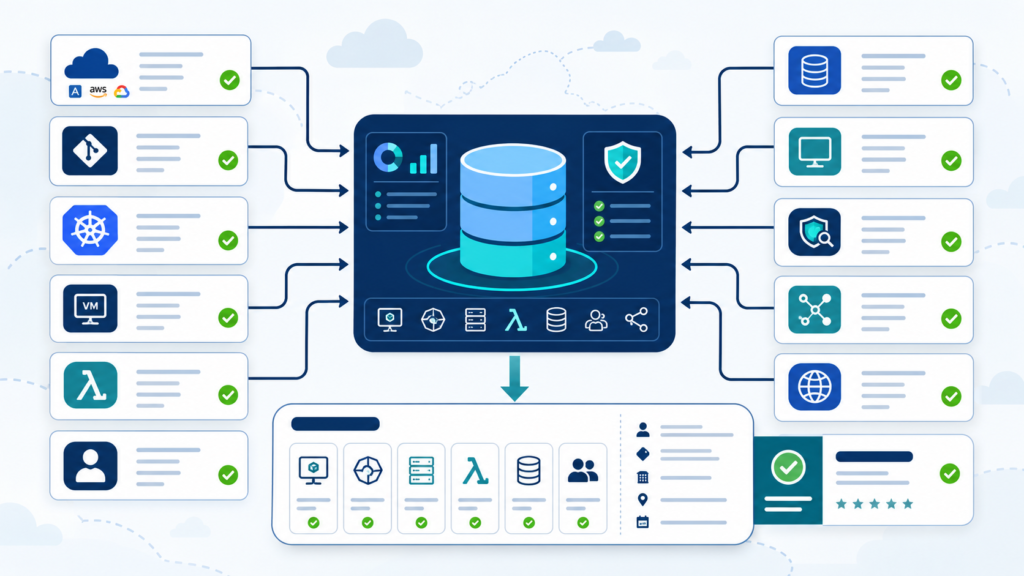
We rely on multiple sources because any single system only tells part of the story. Third-person POV: a trustworthy inventory typically merges resource metadata, configuration state, and access/network signals.
In practice, we combine:
- Cloud provider inventory (resource lists and tags where available).
- Identity and access sources (roles, policies, bindings, service accounts).
- Network configuration (security rules, routing, firewall constructs).
- Application/service mapping (deployments, endpoints, service graphs if available).
- Observability data (logs and metrics that confirm assets are actually in use).
The key is normalization. For example, a database might appear under “managed service,” but its network reachability could be defined elsewhere (rules, endpoint policies, or peering). We map everything into a common asset model: what it is, where it runs, who owns it, and how it can be reached.
With that foundation, Network Threat Detection becomes more effective too, we can correlate alerts to the specific assets and boundaries that created the exposure path.
How do tagging and ownership problems derail our inventory process?
Ownership breakdown is one of the most persistent problems we’ve encountered. Third-person POV: even if discovery works, inventories fail when metadata is unreliable, especially tags, cost centers, and application owners.
We’ve learned that tags often become inconsistent because:
- teams tag “what they remember,” not “what governance needs”;
- tags are skipped for quick experiments;
- tag conventions evolve over time without migration;
- shared services are “owned by nobody.”
So we avoid treating tags as a checkbox. Instead, we implement inventory rules like:
- required tags for new resources (enforced via policy);
- tag validation during deployment;
- automated reminders when tags are missing or conflicting;
- ownership inference using service relationships (where safe and explainable).
For third-person clarity, the goal is to convert inventory into accountability. When ownership is clear, cleanup becomes routine rather than emotional.
And when ownership is unclear, Network Threat Detection can still help by showing which network-facing behaviors are real today, giving us a “ground truth” view while governance catches up.
What’s the hardest part: discovery, normalization, or continuous updates?
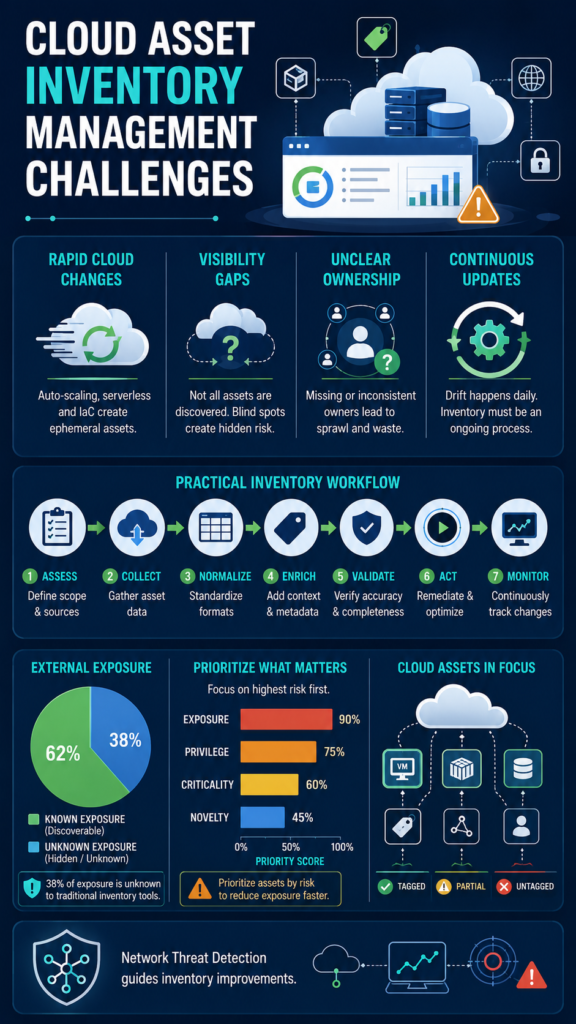
For us, continuous updates are usually the hardest. Third-person POV: discovery can be solved with integrations; normalization can be standardized; but drift keeps returning.
Discovery challenges include API limits, permissions, and region/account coverage. Normalization challenges include inconsistent naming, varying schema fields, and duplicated resources (or layered abstractions like services vs underlying instances).
“Traditional asset management approaches that rely on manual tracking or periodic scans may struggle to keep pace with the rapid changes and scalability of cloud environments” – PROD
Then drift hits:
- auto-scaling creates ephemeral assets;
- serverless workloads change frequently;
- infrastructure-as-code pipelines may bypass manual tagging;
- security settings evolve faster than documentation.
So our practical method is to treat inventory like a pipeline, not a one-time report. We aim for:
- scheduled reconciliation (daily or near-real-time where feasible);
- an audit trail of changes (what changed, when, and by what workflow);
- exception handling for intentionally temporary resources.
Network-focused signals also help. Network Threat Detection is a subtle first option for us because it provides timely “what’s happening now,” which complements slow-moving inventory updates, without forcing a hard sell.
How should we prioritize inventory fixes without overwhelming teams?
Credits: CloudQuery
We use prioritization because “inventory completeness” can’t be the only metric. Third-person POV: teams burn out when they chase every missing tag or every stale record equally.
Instead, we prioritize by impact:
- Exposure first: internet-facing or broadly reachable assets get attention before internal-only ones.
- Privilege first: overly permissive identities or unused high-privilege roles get reviewed early.
- Criticality first: assets tied to business functions or compliance boundaries are handled sooner.
- Novelty first: newly created or newly changed resources that lack ownership are investigated quickly.
We also keep a short feedback loop. If a fix requires 20 steps, it won’t stick. So we define “minimum viable governance”:
- ensure each resource maps to an owner and environment;
- confirm network reachability rules are documented;
- remove or quarantine assets that can’t be explained.
This is where Network Threat Detection can guide our effort. It helps us spot suspicious network behaviors that likely involve specific assets needing inventory accuracy, so we invest time where it matters most.
What does a practical cloud asset inventory workflow look like?
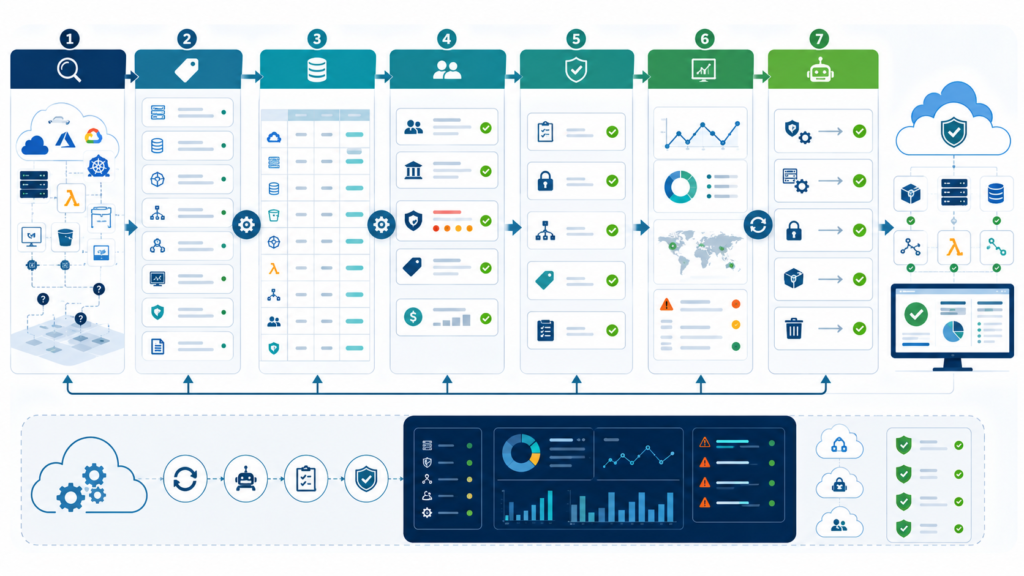
We structure the workflow as repeatable stages. Third-person POV: a good workflow connects discovery to action, not just reporting.
Here’s a practical outline we follow:
- Assess scope: accounts, regions, subscriptions, business units.
- Collect data: resource inventory, identity configs, network rules, and activity signals.
- Normalize: unify naming, map service layers to asset objects.
- Enrich: add ownership candidates, environment classification, and “criticality” labels.
- Validate: check for missing tags, broken relationships, or mismatched network boundaries.
- Act: remediate (tagging, cleanup, policy adjustments) with clear ownership.
- Monitor: continuously reconcile changes; review alerts tied to inventory objects.
We keep the workflow lightweight: the first version targets the highest-risk paths. As teams mature, we expand coverage to lower-risk assets and more detailed evidence.
To ensure “live truth,” we incorporate Network Threat Detection outputs as an evidence layer. It helps us confirm which assets are actively participating in suspicious network patterns, without pressuring anyone into changes immediately.
How does Network Threat Detection improve inventory outcomes?
For us, Network Threat Detection improves inventory outcomes because it adds behavioral context. Third-person POV: configurations can be correct, but behaviors reveal what’s actually exposed or exploited.
When we have partial inventory coverage, network threat signals still:
- highlight which network-reachable assets matter today;
- reveal unexpected service-to-service communications;
- flag anomalies that often correlate with unknown or orphaned resources.
Then we connect alerts back to inventory objects:
- identify the asset involved (service endpoint, instance, or role);
- determine the likely owner (or absence of ownership);
- validate whether network rules match expectations.
Importantly, we don’t use it as a replacement for inventory. We use it as a compass. It subtly directs which inventory gaps to fix first, so teams don’t get stuck in endless “reporting.”
This helps stakeholders trust the inventory process too. Instead of “the spreadsheet says,” it becomes “the activity we saw points to these assets.”
What are common cloud asset inventory management challenges we can expect?
We’ve seen these challenges repeatedly across projects:
- missing or inconsistent tags and ownership
- incomplete account/region coverage
- permissions limitations blocking discovery
- normalization issues (naming, layering, abstraction mismatches)
- inventory drift from automation and ephemeral resources
- difficulty mapping network reachability to asset identity
- audit requirements outpacing operational processes
- cost and cleanup decisions lacking evidence
A third-person summary: the core issue is not just finding assets, but keeping an accurate, governable model that stays aligned with how cloud systems behave. Our best mitigation is to make inventory continuous, evidence-driven, and prioritized. We also avoid one-size-fits-all remediation; we tailor governance to asset criticality.
And we keep a “behavior feedback loop” using Network Threat Detection. It helps us focus on assets that are both real and risky right now, while inventory maturation catches up over time.
Where do we see cost, security, and compliance overlap in inventory efforts?
We treat inventory management as a three-way intersection. Third-person POV: when inventory is weak, costs rise, security posture weakens, and compliance evidence becomes expensive to compile.
Cost: orphaned resources and unused endpoints continue to run. If ownership is unclear, cost optimization stalls.
Security: untracked exposure means fewer guardrails. Privilege sprawl is also common when identities aren’t tied to assets or owners.
“Organizations are aware of roughly 62% of their actual external exposure, with the remaining 38% representing forgotten infrastructure and shadow IT that traditional inventory tools fail to capture.” – Ionix
Compliance: audits need evidence, what existed, what was reachable, and who was responsible. Without consistent inventory records and lineage, compliance becomes manual and error-prone.
Our strategy is to unify the inventory model so the same asset record supports:
- cost accountability (owner + environment + lifecycle);
- security validation (network boundary + access policy);
- compliance reporting (change evidence and control alignment).
Network Threat Detection security tools fits naturally here because it provides security-relevant evidence (what was reachable and how it behaved). That evidence can accelerate compliance narratives, especially when documentation lags.
Which key metrics should we track to measure progress?
We track metrics that reflect usability, not just data volume. Third-person POV: “number of discovered assets” doesn’t guarantee quality, actionability, or risk reduction.
Here are metrics we commonly use:
- Coverage rate: percentage of accounts/regions with reconciled assets.
- Metadata completeness: % of assets with required tags (owner, environment).
- Ownership accuracy: % of assets with a validated owner assignment.
- Drift frequency: how often inventory mismatches reality.
- Remediation throughput: how many issues are closed per cycle.
- Exposure correlation: whether Network Threat Detection findings map cleanly to inventory assets.
- Reduction in orphaned resources: count of unowned/untagged assets over time.
We also add a qualitative review: stakeholders should trust the inventory enough to use it during incidents and change management. If they don’t, the process needs simplification, more automation, better mapping, fewer confusing fields.
One-table cheat sheet: what problem maps to what fix?
| Inventory challenge | What it looks like | Practical fix we can start this week | Success signal |
| Missing coverage | Assets exist but aren’t in the inventory | Expand discovery scope (accounts/regions) and permissions | Coverage rate increases steadily |
| Weak tagging | “Unowned” resources everywhere | Enforce minimal required tags + validation in pipelines | Metadata completeness improves |
| Ownership ambiguity | Teams disagree on who should manage assets | Add ownership inference + exception workflow | Fewer assets remain unassigned |
| Normalization mismatch | Same asset appears differently across tools | Build a unified asset model and mapping rules | Fewer duplicates, cleaner relationships |
| Inventory drift | Inventory contradicts what’s currently running | Schedule reconciliation + track deltas | Drift frequency decreases |
| Network exposure unknown | Risky reachability without clear assets | Use Network Threat Detection to correlate alerts to inventory | Higher exposure correlation to known assets |
| Manual reporting overload | Too much time spent compiling evidence | Automate evidence collection from inventory + logs | Faster audit-ready responses |
What should we do next to improve our cloud asset inventory management?
We start small but systematic. Third-person POV: the best improvements are iterative, build trust first, then expand scope.
Our next steps usually look like this:
- Define the minimum asset model (what fields matter for ownership + exposure).
- Establish discovery scope (accounts/regions) and fix permission gaps.
- Normalize and reconcile on a schedule, not once a year.
- Enforce “minimum viable governance” (tag and ownership requirements for new assets).
- Prioritize remediation using exposure and privilege signals.
- Use Network Threat Detection as an evidence layer to guide which inventory gaps to fix first.
- Measure progress with coverage, completeness, drift, and remediation throughput.
We don’t treat this as a security-only project. Inventory is an operational system that affects cost, compliance, and incident response.
Over time, inventory becomes the shared source of truth, so teams stop debating reality and start executing improvements.
FAQ
How often should we update our cloud asset inventory?
We recommend scheduled reconciliation (daily or near-real-time for critical environments). The goal is to reduce drift so inventory decisions reflect current reality, especially for network-exposed assets.
What if our teams can’t tag resources consistently?
We start with required “minimum tags” for new resources and add validation in deployment workflows. For existing assets, we use ownership inference plus an exception process rather than waiting for perfect tagging.
Does Network Threat Detection replace asset inventory?
No. We treat Network Threat Detection as a complementary evidence layer. It helps confirm which assets and pathways matter now, guiding which inventory gaps to fix first.
What’s the fastest win for improving inventory management?
We usually prioritize coverage and metadata completeness for the most security-relevant boundaries (internet-facing and high-privilege paths). That delivers visible risk reduction without boiling the ocean.
Viewing Cloud Asset Inventory Management Challenges Through a Risk-Based Lens
Cloud asset inventory management challenges are rarely just technical, they’re organizational, operational, and constantly evolving as automation and infrastructure drift reshape modern environments.
If you’re ready to strengthen your cloud asset inventory and identify the risks that matter most, Join Network Threat Detection to see how Network Threat Detection helps teams visualize attack paths, prioritize vulnerabilities, and improve cloud security with continuously updated threat intelligence.
References
- https://mfe-prod.idc.com/getdoc.jsp?containerId=US54299426&pageType=PRINTFRIENDLY
- https://www.ionix.io/writing-center/multi-cloud-asset-mapping-how-to-discover-shadow-it-across-cloud-providers/