
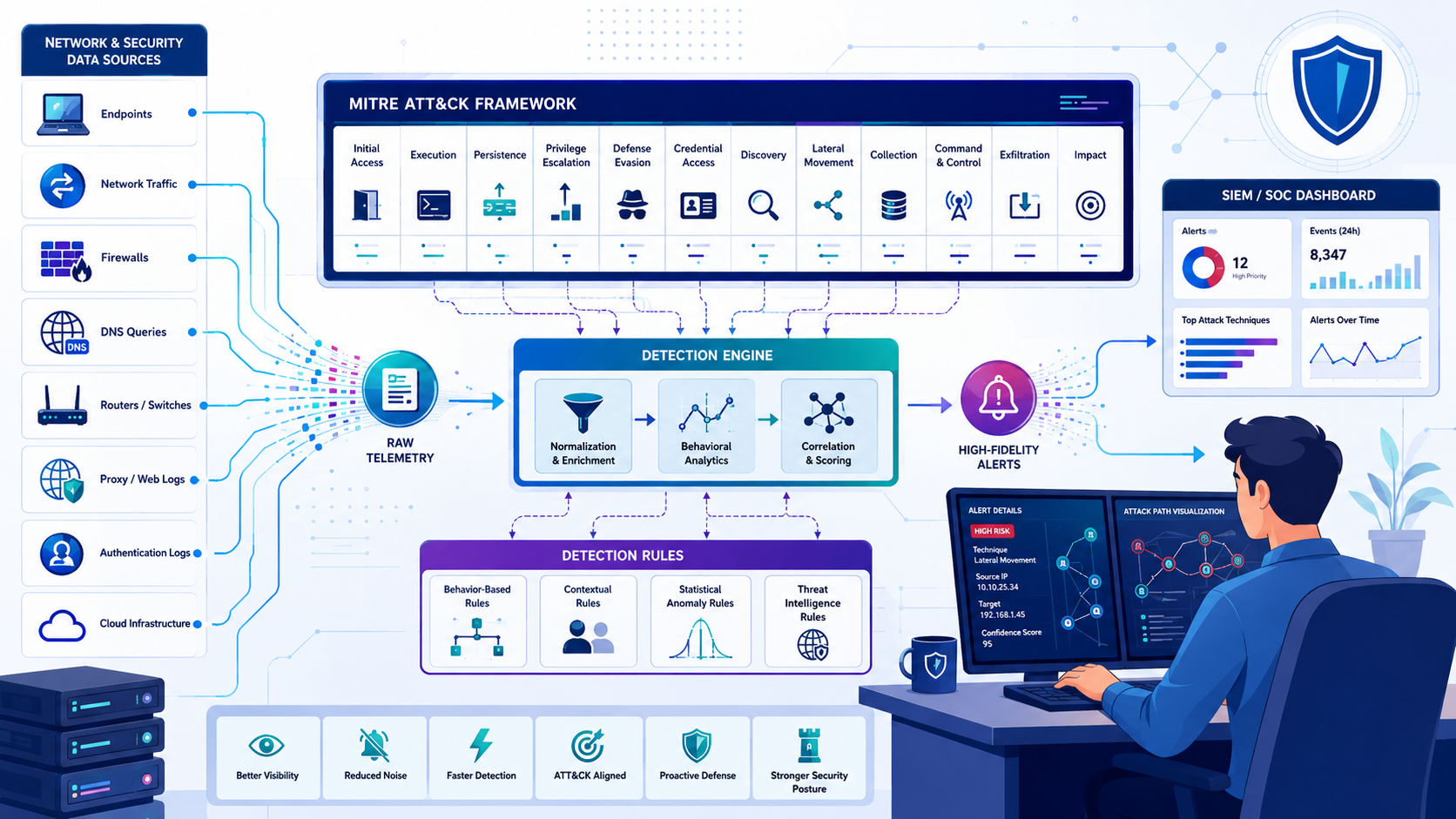
Developing ATT&CK based detection rules helps security teams detect real threats by focusing on adversary behavior instead of noisy anomalies. Rather than creating alerts for every unusual event, this approach aligns detections with proven attack techniques, making investigations faster and more reliable.
As part of an effective Network Threat Detection strategy, ATT&CK-based rules provide clearer context, reduce false positives, and improve overall SOC performance. Keep reading to learn how behavior-driven detection rules can transform your security operations.
Keep Reading to Discover
Learn how an ATT&CK-based detection strategy helps your team create more accurate alerts, investigate incidents with greater confidence, and build a stronger long-term detection program.
- Turn Adversary Behavior Into High-Confidence Alerts
- Give Every Detection Clear Context for Faster Response
- Build a Detection Library That Evolves With Modern Threats
Why Do Generic Detection Rules Fail You?
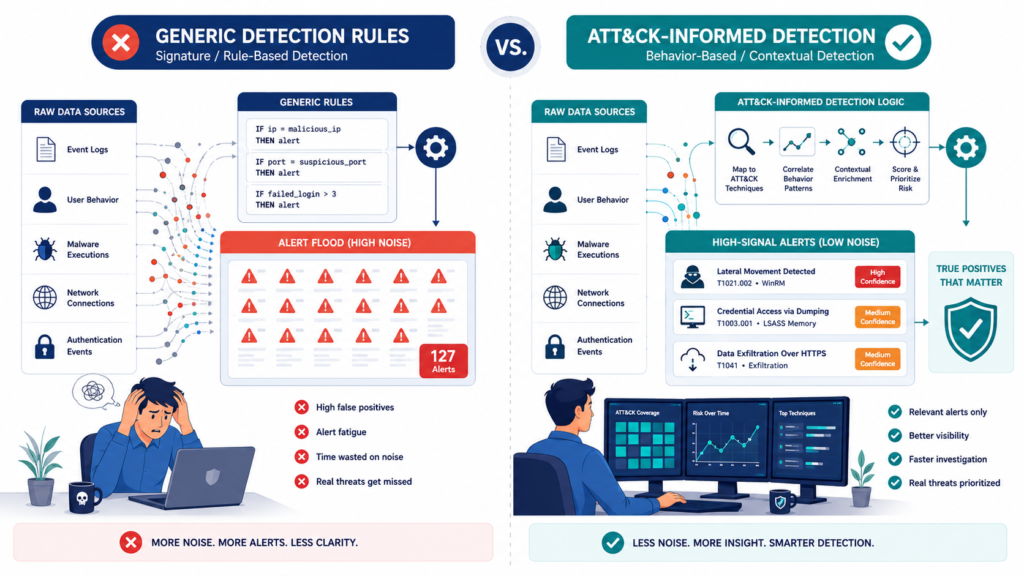
They look good on paper. A rule that alerts on any PowerShell execution with a hidden window, or any new service being created. The logic seems sound. But in a real environment, these rules scream constantly. Developers use PowerShell. Admins create services for legitimate tools.
You’re drowning in false positives, and your team starts ignoring the alerts. This alert fatigue is the silent killer of security operations. We had rules that fired so often we had to suppress them, which meant we were blind by our own design.
“Up to 99% of alerts from conventional NIDS are false positives” – ieeexplore
The ATT&CK framework provides the missing ingredient: context. Instead of detecting “suspicious PowerShell,” you detect for T1059.001, Command and Scripting Interpreter: PowerShell used in a specific way.
You ask, “What are the actual, documented techniques adversaries use with PowerShell?” Maybe it’s downloading a payload from a non-standard port, or using specific obfuscation flags rarely seen in admin work. Your rule logic becomes a hypothesis about adversary behavior, not a guess about what looks weird.
This shift is fundamental. You’re no longer just flagging tools, which are often dual-use. You’re flagging malicious use of those tools.
Common pitfalls of generic rules that ATT&CK helps solve:
- High False Positive Rate: Catching too much benign activity, leading to alert fatigue.
- Low Fidelity: Alerts that don’t clearly indicate malice, requiring extensive investigation to triage.
- Isolated Signals: Rules that fire on single events without connecting them to a broader attack sequence.
How Do You Start Writing an ATT&CK-Based Rule?
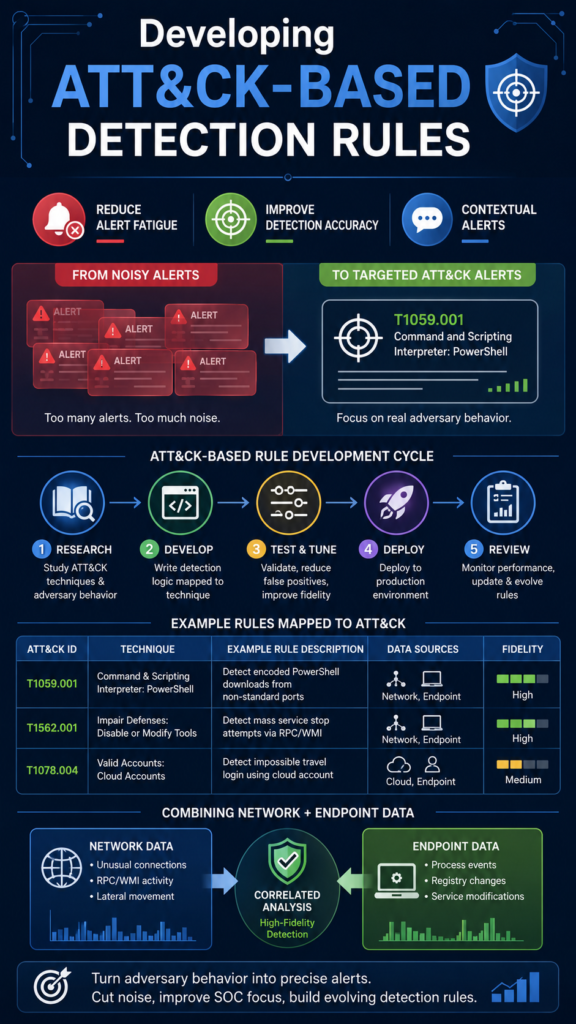
You don’t start at the keyboard. You start with the framework. Pick a technique that’s relevant to your threat landscape and poses a high risk.
You don’t start at the keyboard. You start with the framework. Applying the ATT&CK framework begins by picking a technique that’s relevant to your threat landscape and poses a high risk.
Let’s say T1562.001 – Impair Defenses: Disable or Modify Tools. You read the description, the examples, the reported procedures from real groups. You understand the adversary’s goal: to turn off your visibility.
Now, you think about the evidence. What logs would this action create? On an endpoint, you might see registry modifications, service stops, or process termination. But an attacker might do this from another host.
This is where considering your data sources is critical. We often start with network threat detection because it provides an unbiased, cross-host view.
“Precision of 91.4%, recall of 85.2%, and false positive rate of 4.8%,” confirming both detection effectiveness and operational feasibility. – sciencedirect
For disabling defenses, could we see an unusual spike in RPC or WMI connections from a user’s machine to multiple security servers? That’s a network-based signal of someone attempting to interact with security services at scale.
What Makes a High-Fidelity ATT&CK Detection?
Credits: The Intel Lab
Precision. A high-fidelity detection is one that, when it fires, there’s a very high probability something malicious is happening. It’s about reducing the analyst’s workload by giving them a signal worth investigating. ATT&CK guides you there by encouraging you to be specific.
The technique description for T1071.001 – Application Layer Protocol: Web Protocols doesn’t just say “detect web traffic.” It describes C2 beaconing, the regular, call-home patterns.
So, your rule shouldn’t just look for outbound web traffic. It should look for patterns indicative of beaconing: regular intervals (every 10 seconds, every 5 minutes), consistent packet sizes, communication with newly registered domains, or domains with a high reputation score for maliciousness. You layer these conditions.
One condition might be somewhat suspicious. Three together are highly indicative of the specific technique. We built a rule for DNS tunneling (T1572 – Protocol Tunneling) that didn’t just flag long domain names.
It looked for entropy in subdomains, high volume of requests for nonexistent domains (NXDOMAIN), and requests to domains not in our internal whitelist of business services. The result was an alert that almost always meant “look here now.”
How Should You Structure and Manage Your Rule Library?
Chaos is a rule library with 500 entries called “suspicious_activity_1” through “suspicious_activity_500.”
ATT&CK gives you a natural taxonomy for organization. Your rules should be named and tagged with their primary technique ID. This also makes mapping security controls to specific ATT&CK techniques much more consistent, allowing you to manage detections strategically.
You can look at your library and ask, “What’s our coverage for the Initial Access tactic?” You can quickly find and update all rules related to credential dumping if a new method emerges.
We use a simple table to track our detection rule portfolio. It’s our single source of truth for what we’re watching for and how well it works.
| ATT&CK Technique | Rule Name & Logic (Simplified) | Primary Data Source | Fidelity Score | Last Tested |
| T1047 – WMI | wmi_remote_process_from_temp: WMI process creation from a temp directory on a remote host. | Network (WMI traffic) + Endpoint | High | 2023-10-26 |
| T1547.001 – Registry Run Keys | run_key_from_script_child: New run key created by a process spawned from cscript or wscript. | Endpoint (Process creation, Registry) | Medium-High | 2023-11-02 |
| T1021.002 – SMB/Admin Shares | smb_admin_share_enum: Multiple failed SMB connections to admin shares (C$, ADMIN$) from a single source. | Network (SMB Session Logs) | High | 2023-10-30 |
This structure shows dependencies. Notice how for SMB enumeration, the network is the primary, high-fidelity source. The table also forces us to confront the “Fidelity Score” and “Last Tested” date. A rule that hasn’t been tested in a year is a liability. This system turns rule management from an ad-hoc task into a clear operational process.
It also makes onboarding new analysts easier, they can study the table to understand our detection philosophy.
A manageable rule lifecycle includes:
- Research: Select a technique and define the malicious behavior.
- Develop: Write the rule logic using specific, correlated conditions.
- Test & Tune: Validate in a lab, then monitor in production with care.
- Deploy & Document: Enable the rule and fully document its purpose and mapping.
- Review: Periodically review rule performance and update as techniques evolve.
Where Does Network Data Fit Into Detection Logic?
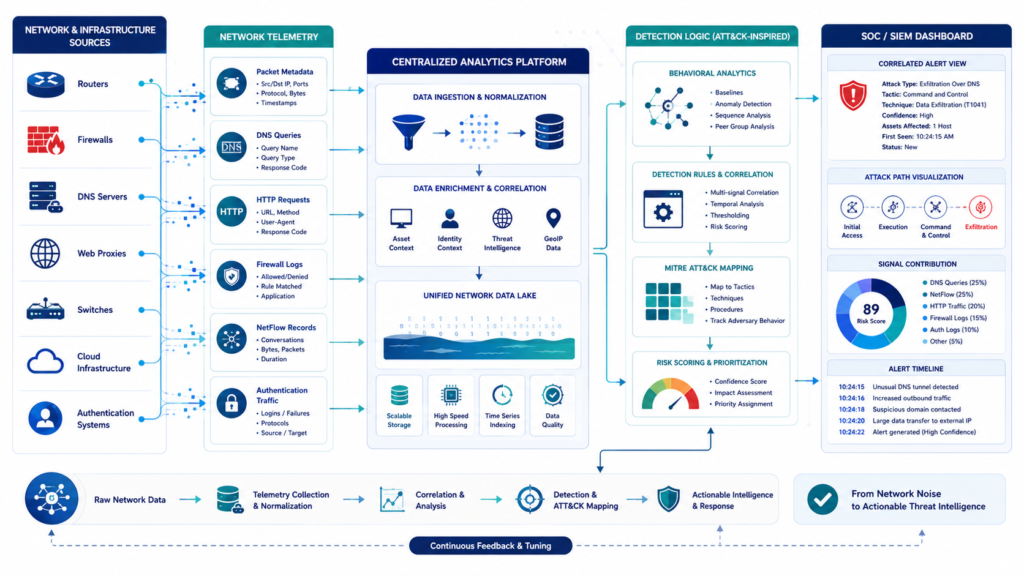
It’s the connective tissue. Endpoint rules see what happens on a single host. But attacks move. An attacker uses WMI from Host A to execute a payload on Host B. The endpoint on Host B sees a strange process appear. The endpoint on Host A might see WMI execution.
But the network sees the explicit connection from A to B on the relevant ports, the protocol used, the timing, and the volume. It links the two isolated endpoint events into a single, malicious sequence.
We often find that our highest-fidelity rules are correlation rules that use network data as the anchor. For example, a rule for T1105 – Ingress Tool Transfer. An endpoint might see a file written to disk. That’s common.
It allows you to write simpler, more reliable logic on each system by using the network layer to provide the crucial context of communication. The same layered detection approach is especially valuable in OT security, where network visibility often provides critical evidence across industrial environments.
If an attacker kills endpoint logging on one host, the network evidence of their activity to and from that host often remains. Building your ATT&CK detections with this layered view in mind from the start results in a more robust and evasive-aware detection program.
FAQ
Isn’t this just creating more rules? We already have too many.
It’s about quality, not quantity. The goal is to replace ten noisy, generic rules with one or two high-fidelity, ATT&CK-based rules. You’ll likely end up with a smaller, more effective rule library. The process often involves retiring old, ineffective rules that contribute to alert fatigue, making your SOC’s workload more manageable, not less.
How do you handle techniques that are hard to distinguish from normal activity?
You get more specific, or you accept a lower fidelity and use it as a supporting signal. For some techniques, you may not be able to write a standalone “smoking gun” rule.
Instead, you write a lower-confidence rule that feeds into a broader correlation, or you use it as a hunting hypothesis. The framework tells you it’s a risk, even if it’s a hard one to detect automatically.
Do we need expensive new tools to do this?
Not necessarily. You can start with the logging you have. The framework helps you get more value from your existing data by showing you what to look for within it. Often, the process reveals you need to enable a specific audit log or forward a new data source, which is a configuration change, not a new purchase. It’s about using what you have more intelligently.
How do you measure the success of these new rules?
Look at key metrics: the False Positive Rate (it should drop), the Mean Time to Triage/Respond (it should decrease as alerts become clearer), and the Number of Confirmed True Positives.
Track how many incidents were caught by ATT&CK-mapped rules versus legacy rules. The qualitative feedback from your analysts, less frustration, more confidence, is also a powerful success indicator.
Developing ATT&CK-Based Detection Rules
Focused ATT&CK-based detections replace noisy alerts with meaningful investigations by aligning rules to real adversary behavior. Start with one technique, refine your detections, and expand coverage over time for lasting security improvements.
Ready to strengthen your detection strategy? See how Network Threat Detection helps teams improve ATT&CK coverage, identify blind spots, and accelerate response: Join Network Threat Detection
References
- https://ieeexplore.ieee.org/document/11572627
- https://www.sciencedirect.com/science/article/abs/pii/S0167404825003918?dgcid=rss_sd_all