

Monitoring DNS query logs helps teams uncover suspicious domain lookups, abnormal query spikes, and C2 communications before threats escalate. In our operations, correlating these logs with endpoint telemetry and threat intelligence transforms fragmented alerts into actionable context.
To eliminate blind spots and automate proactive defense, NetworkThreatDetection.com integrates real-time threat modeling, visual attack path simulations, and continuous intelligence mapped to MITRE ATT\&CK.
Monitoring DNS Query Logs
Monitoring DNS query logs provides vital visibility to strengthen threat detection and incident investigations:
- Early Threat Identification: Helps security teams detect unusual domain requests, repeated failed lookups, abnormal query patterns, and potential malware communications.
- Behavioral Contextualization: Combines behavioral baselines, endpoint telemetry, and threat intelligence to distinguish legitimate business activity from suspicious deviations.
- Targeted Risk Prioritization: Leverages Network Threat Detection’s threat modeling and risk analysis tools to connect observed activity with emerging threats and prioritize response efforts.
Why Does Monitoring DNS Query Logs Matter for Network Security?
The Domain Name System (DNS) translates human-readable domain names into IP addresses that devices use to communicate with network destinations. Whenever a workstation opens a website or an application connects to an external service, DNS may help resolve the destination.
This routine process also creates useful security evidence. DNS query logs can show which domains devices request, when the requests occur, how frequently they repeat, and whether the resolver returns a successful response. Depending on the logging configuration, records may also include query types, client identifiers, response codes, and returned IP addresses.
Consider a workstation that normally accesses a predictable set of business applications. If it suddenly generates hundreds of failed lookups or repeatedly queries unfamiliar domains outside normal operating hours, the change may warrant investigation. The activity could result from a misconfigured application, but it could also indicate automated domain discovery or malware attempting to locate its command-and-control infrastructure.
We focus on understanding these deviations rather than treating every unfamiliar domain as a confirmed threat. Historical behavior, asset importance, and supporting network evidence help analysts determine whether an anomaly represents a meaningful security risk.
Effective DNS monitoring can help organizations:
- Identify requests to known malicious or suspicious domains.
- Investigate potential malware callbacks and C2 communications.
- Detect possible DNS tunneling and domain generation algorithm (DGA) activity.
- Recognize unauthorized DNS resolvers and policy violations.
- Correlate DNS events with endpoint alerts and network connections.
- Prioritize incidents according to their potential business impact.
For a broader perspective, explore the importance of DNS security in network protection to understand how DNS controls contribute to a stronger network security strategy.
What Are DNS Query Logs?
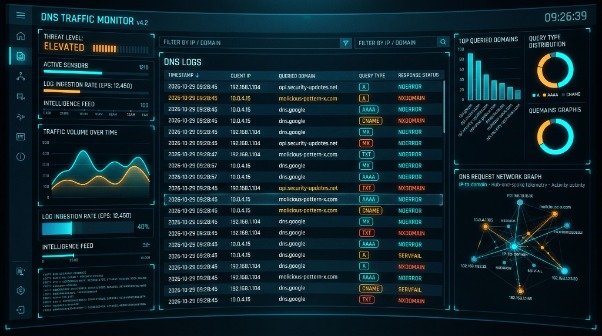
DNS query logs are records of DNS requests and, depending on the logging source, their corresponding responses. These records may be generated by recursive resolvers, internal DNS servers, security gateways, endpoint monitoring systems, or centralized logging platforms.
When an analyst investigates a suspicious connection, DNS logs can help establish which domain a device requested and when the lookup occurred. The information becomes more useful when correlated with other evidence, such as the destination IP address, the process initiating the connection, and the endpoint’s recent activity.
Which DNS Log Fields Should We Monitor?
Several fields are particularly useful when identifying suspicious DNS behavior:
| DNS Log Field | Detection Purpose |
|---|---|
| Timestamp | Establishes when a query occurred and whether requests follow an unusual schedule. |
| Client IP / Device Identity | Identifies the specific host or system generating the request. |
| Queried Domain (FQDN) | Supports reputation checks, threat intelligence matching, and domain-pattern analysis. |
| Query Type | Helps identify unusual requests, such as unexpected TXT, NULL, or MX record activity. |
| Response Code | Highlights failed lookups, repeated NXDOMAIN responses, and resolution anomalies. |
| Returned IP Address | Helps correlate DNS resolution with subsequent outbound network connections. |
| Query Frequency | Reveals sudden bursts of activity, rapid repeated requests, or automated periodic callbacks. |
| Resolver Identity | Identifies unauthorized DNS paths and policy bypass attempts across the network. |
The exact fields available depend on the organization’s infrastructure and logging configuration. We recommend verifying data coverage before building detection rules so that analysts understand what the records can, and cannot. reveal.
What Are the Common Signs of Suspicious DNS Activity?
Suspicious DNS behavior can appear in several forms. Some threats generate a large number of requests, while others use repetitive patterns or unusual domain structures to communicate with external infrastructure.
- Repeated Queries to Suspicious Domains
Repeated requests to domains associated with phishing, malware, or known malicious infrastructure may indicate that an endpoint is attempting to contact a threat actor’s systems.
However, domain reputation alone is not enough to establish malicious intent. Newly registered domains can support legitimate services, and reputation data may be incomplete. Analysts should correlate the domain with the requesting device, query frequency, destination IP, and surrounding endpoint activity before escalating an alert.
- Unusually High NXDOMAIN Responses
NXDOMAIN indicates that a requested domain name does not exist. A sudden increase in these responses can result from configuration errors, broken applications, automated discovery, or malware using a domain generation algorithm.
We recommend comparing the affected endpoint’s failure rate with its historical baseline. A concentrated burst of failed lookups from a server that normally performs predictable DNS requests may deserve closer attention, particularly when other suspicious indicators appear at the same time.
- Long or Random-Looking Subdomains
Attackers may use long or randomly structured subdomains to encode information or generate unique destinations. Repeated requests with these characteristics can be an indicator of potential DNS tunneling or automated domain generation.
Nevertheless, unusual hostnames are not inherently malicious. Legitimate applications may use complex identifiers, tracking systems, or dynamically generated names. Query length, entropy, frequency, parent-domain reputation, and endpoint context should be evaluated together.
- Periodic DNS Requests
Some malware attempts to communicate with external infrastructure at regular intervals. Repeated queries to the same domain at consistent time intervals can therefore provide a useful detection signal.
Legitimate monitoring agents and scheduled applications may produce similar patterns. By correlating query timestamps with process activity and outbound network connections, analysts can determine whether the behavior matches an expected operational process.
- Unexpected DNS Resolver Usage
A device that begins communicating with an unauthorized external resolver may be bypassing established DNS policies. This can create visibility gaps if the organization relies on centralized resolver logs for security monitoring.
Our recommendation is to maintain an inventory of approved resolvers and investigate unexpected changes against documented requirements. Encrypted DNS technologies such as DNS over HTTPS (DoH) and DNS over TLS (DoT) should also be considered because they can affect the visibility available to traditional DNS inspection tools.
How Can Security Teams Monitor DNS Query Logs?

A practical monitoring strategy combines centralized logging, behavioral analysis, threat intelligence, and a consistent investigation process. The goal is not simply to collect more records, but to identify the activity that matters.
1. Establish a Baseline of Normal DNS Behavior
source: Cyber Shield
Identify typical query volumes, commonly accessed domains, expected record types, and approved resolvers across workstations, servers, cloud workloads, and other network assets.
In our approach, device context is important. A development server may routinely contact services that would be unusual for a finance workstation. Establishing baselines by asset role and network segment helps reduce false positives and makes behavioral deviations easier to interpret.
2. Centralize DNS Query Logs
Collect relevant records from approved DNS resolvers and integrate them into the organization’s security monitoring workflow. Consistent timestamps, reliable device identifiers, and suitable retention periods make investigations easier to reconstruct.
Where appropriate, connect DNS logs with a security information and event management (SIEM) platform or another system that supports alerting and correlation. Verify that the collected data includes the fields required for investigations and that access follows organizational privacy and retention policies.
3. Apply Behavioral Detection Rules
Use detection rules that identify unusual query volumes, repeated NXDOMAIN responses, suspicious subdomain structures, and unexpected resolver connections.
Threat intelligence can help identify known malicious domains, while behavioral analytics can highlight patterns that have not yet appeared in threat feeds. We recommend combining both methods rather than relying exclusively on static blocklists.
4. Correlate DNS Activity With Endpoint and Network Data
A suspicious DNS query becomes more meaningful when linked to other events. Analysts can examine endpoint processes, firewall records, proxy logs, authentication events, and network flow data to establish what happened before and after the request.
For example, an unusual domain lookup followed by an unexpected outbound connection and suspicious process execution provides stronger grounds for investigation than the lookup alone.
5. Prioritize Alerts by Risk
Not every anomaly deserves the same level of urgency. A low-confidence alert involving an isolated workstation may require a different response from repeated suspicious activity affecting a critical production server.
Risk assessment should consider indicator confidence, asset importance, activity frequency, and the presence of corroborating evidence. This helps security teams direct their resources toward investigations with the greatest potential impact.
6. Investigate and Refine Detection Rules
When suspicious activity warrants escalation, preserve relevant logs, inspect the affected endpoint, review domain reputation, and determine whether other devices exhibit similar behavior.
Depending on the evidence, response actions may include isolating an endpoint, blocking a confirmed malicious domain, correcting unauthorized resolver configurations, or collecting additional forensic data. After the investigation, refine detection rules using the findings to improve future alert quality.
External Standard: DNS Security and Data Integrity
The Internet Engineering Task Force (IETF) formalized DNS Security Extensions (DNSSEC) through a series of standards designed to support the authenticity and integrity of DNS data.
“DNS Security Extensions (DNSSEC)” provide origin authentication and integrity protection for DNS data. – RFC 4033, Internet Engineering Task Force
DNSSEC and DNS query log monitoring serve different purposes. DNSSEC helps validate DNS data, while query logs provide evidence that analysts can use to investigate unusual activity. Neither one independently prevents every malicious connection.
For a more comprehensive DNS security strategy, organizations should combine appropriate DNS validation, filtering, monitoring, and incident response procedures. Implementing DNS filtering to block malicious domains, C2, and malware demonstrates how proactive filtering directly complements broader detection efforts.
What Emerging Threats Make DNS Monitoring More Challenging?
DNS remains an important part of network communication, which makes it useful to both legitimate applications and threat actors. As defensive controls evolve, attackers may change their domain infrastructure, query patterns, and communication methods to avoid detection.
- DNS Tunneling
DNS tunneling can encode data within DNS queries and responses, potentially creating a channel for covert communication or unauthorized data transfer. Unusual query lengths, repeated TXT record requests, high query volumes, and suspicious subdomain patterns can provide useful indicators.
These indicators require context because legitimate applications may also generate complex DNS traffic. Analysts should examine domain relationships, timing, endpoint behavior, and the volume of information exchanged before determining whether the activity warrants escalation.
- Domain Generation Algorithms
Some malware families use domain generation algorithms to produce large numbers of candidate domains. This can result in clusters of failed DNS lookups as malware attempts to find active command-and-control infrastructure.
Because newly generated domains may lack established reputation records, behavioral analysis can be particularly valuable. Monitoring changes in query frequency, naming patterns, and response codes helps identify activity that static reputation checks may miss.
- Encrypted DNS and Reduced Visibility
DoH and DoT protect DNS communication between a client and its configured resolver. Although encryption improves privacy in transit, it can limit direct query visibility for monitoring systems that rely on traditional DNS inspection.
The appropriate response is not to assume encrypted DNS is malicious. Instead, organizations should document approved resolvers, collect available resolver logs, monitor relevant connection metadata, and correlate endpoint telemetry where permitted.
The Internet Engineering Task Force (IETF) specified DNS over Transport Layer Security (DoT) in RFC 7858 to protect DNS privacy by encrypting queries between clients and resolvers.
“Encryption provided by TLS eliminates opportunities for eavesdropping and on-path tampering with DNS queries in the network.” – RFC 7858, Internet Engineering Task Force
- Rapidly Changing Malicious Infrastructure
Threat actors may rotate domains, change destination IP addresses, and use short-lived infrastructure to make static detection less reliable.
Continuously updated threat intelligence helps analysts recognize known malicious indicators, while behavioral monitoring can identify suspicious activity that has not yet been documented. Combining both approaches provides a more adaptable foundation for network threat detection.
What Threat Technologies Improve DNS Log Analysis?
As DNS traffic grows, manually reviewing every query becomes increasingly difficult. Modern threat technologies help analysts identify anomalies, correlate events, and prioritize investigations according to their potential security impact.
- Automated Risk Analysis
Automated risk analysis can help prioritize suspicious events using factors such as indicator confidence, query behavior, affected asset importance, and supporting telemetry.
We believe the most useful analysis is not simply a list of alerts. It should help analysts understand why an event matters, what evidence supports the assessment, and which investigation steps deserve attention first.
- Threat Modeling and Attack Path Simulation
Threat modeling helps security teams understand how suspicious activity could relate to a wider attack scenario. Analysts can assess whether an affected endpoint might reach sensitive systems, which controls could interrupt an attack, and what additional evidence is required to validate the risk.
Network Threat Detection provides threat models and risk analysis tools designed to enhance network security and address emerging threats. Its capabilities include visual attack path simulations, CVE mapping, and structured reporting that help teams connect technical findings with broader security priorities.
- Threat Intelligence Integration
Threat intelligence provides context about domains, IP addresses, and infrastructure associated with known threats. When this information is correlated with DNS records and endpoint telemetry, analysts can identify potential relationships between otherwise separate events.
However, intelligence must remain relevant to the environment being investigated. Outdated indicators and incomplete reputation data can lead to false positives, which is why our approach emphasizes combining external intelligence with internal evidence and behavioral context.
- Continuous Monitoring and Security Reporting
Continuous monitoring helps organizations identify changes in network behavior as they occur. Structured reporting then communicates what happened, which assets may be affected, and what actions are recommended.
For security operations centers (SOCs), CISOs, and analysts, this combination supports more informed decisions and helps translate technical findings into understandable risk assessments.
What Mistakes Should Organizations Avoid When Monitoring DNS Logs?
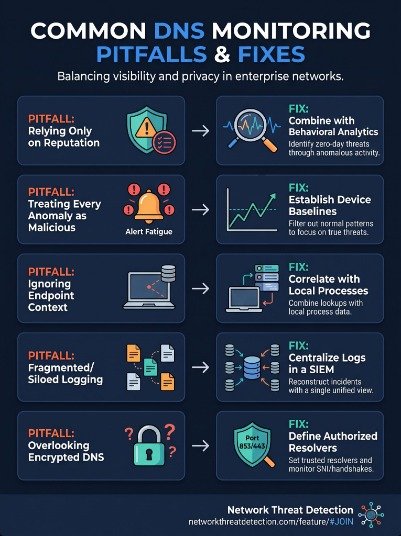
Organizations can weaken their monitoring strategy when they rely on incomplete data or treat every anomaly as an attack.
- Relying only on domain reputation. Newly emerging threats may not appear in existing intelligence feeds. Behavioral analysis can help identify suspicious activity that has not yet been classified.
- Treating every unusual query as malicious. Misconfigured applications, legitimate automation, and software updates can generate unusual DNS patterns. Correlate multiple indicators before escalating alerts.
- Ignoring endpoint context. DNS logs alone may not reveal which process initiated a request or whether the endpoint has been compromised. Integrate additional telemetry where available.
- Failing to centralize logs. Fragmented logging makes it harder to reconstruct incidents and identify patterns across devices. Establish consistent collection and retention practices.
- Overlooking encrypted DNS. Unauthorized resolver usage can reduce visibility for traditional monitoring systems. Define approved resolver policies and assess which telemetry remains available.
- Blocking domains without validation. Broad or premature blocking can interrupt legitimate business services. Verify suspicious activity and consider operational dependencies before applying restrictive controls.
- Neglecting detection quality reviews. Detection rules can become outdated as applications and threats change. Review false positives, missed detections, and incident findings regularly.
- A mature monitoring program combines reliable telemetry, context-aware analysis, and continuous improvement rather than depending on a single indicator or security control.
How Does DNS Monitoring Fit Into a Modern Network Security Strategy?
DNS monitoring is one component of a broader network security architecture. Its effectiveness depends on how well it integrates with endpoint security, access controls, network visibility, threat intelligence, and incident response.
Organizations should know which DNS resolvers are approved, where query logs are available, how suspicious activity is investigated, and how findings are translated into remediation actions. These practices help ensure that DNS anomalies contribute to meaningful security decisions rather than creating unnecessary alert volume.
We recommend treating DNS monitoring as an ongoing process. Security teams should review their detection coverage, validate alert quality, test investigation procedures, and update their threat models as the environment changes.
DNS query monitoring works best when combined with broader DNS security measures, including DNSSEC and filtering, which help validate DNS responses and block access to known malicious domains. By combining these controls with continuous log analysis, security teams can identify suspicious query patterns and respond to potential threats more effectively.
Network Threat Detection supports this broader approach through threat modeling, automated risk analysis, continuously updated intelligence, and visual attack path simulations. These capabilities help teams connect suspicious network behavior with emerging threats, assess potential exposure, and prioritize defensive actions.
FAQs
What is monitoring DNS query logs for suspicious activity?
It is the process of collecting and analyzing DNS requests and responses to identify unusual domain lookups, repeated failed queries, potential malware communications, and other behaviors that may indicate a security threat.
What DNS query patterns may indicate malware?
Potential indicators include unusually high query volumes, repeated NXDOMAIN responses, long or random-looking subdomains, periodic requests to suspicious domains, and unexpected resolver connections. These patterns should be correlated with other evidence before a threat is confirmed.
Can DNS logs detect command-and-control activity?
DNS logs can help identify potential command-and-control activity by revealing suspicious domain requests, repetitive communication patterns, and unusual query structures. Endpoint telemetry, network connection records, and threat intelligence can help validate the findings.
How often should security teams monitor DNS logs?
Organizations with continuous security monitoring should collect relevant DNS logs continuously and use automated detection to flag suspicious behavior. Investigation schedules and retention policies should reflect the organization’s risk profile, operational requirements, and available resources.
Can encrypted DNS hide malicious activity?
Encrypted DNS can reduce the visibility of query contents for monitoring systems that cannot inspect the protected traffic. However, encryption does not make malicious domains safe. Approved resolver logs, endpoint telemetry, connection metadata, and threat intelligence can still help support investigations.
What is the difference between DNS monitoring and DNS filtering?
DNS monitoring observes and analyzes DNS activity to identify suspicious patterns and support investigations. DNS filtering applies policies to allow or block domain requests according to security rules. The two approaches complement each other but serve different purposes.
How does Network Threat Detection help security teams investigate threats?
Network Threat Detection provides threat modeling, automated risk analysis, continuously updated intelligence, and visual attack path simulations. These capabilities help security teams assess potential exposure, understand emerging threats, and prioritize investigations.
Building a More Secure DNS Monitoring Strategy
Monitoring DNS query logs helps security teams identify behavioral changes signaling malware, unauthorized communications, or policy bypass attempts. Analyzing repeated failed lookups, suspicious domains, unusual subdomains, and unauthorized resolver usage turns raw records into actionable context.
To detect emerging threats effectively, teams must combine centralized logs with behavioral analytics, endpoint telemetry, and threat intelligence.
Network Threat Detection strengthens this posture through real-time threat modeling, automated risk analysis, and attack path simulations mapped to recognized frameworks.
Ready to elevate your defense? Explore Network Threat Detection’s features and join us to build a more proactive security architecture.
References
- Arends, Roy, Rob Austein, Matt Larson, Dan Massey, and Scott Rose. “DNS Security Introduction and Requirements.” RFC 4033, Internet Engineering Task Force, March 2005. https://www.rfc-editor.org/rfc/rfc4033. Accessed November 10, 2026.
- Hu, Zi, Liang Zhu, John Heidemann, Allison Mankin, Paul Wouters, and P. Hoffman. “Specification for DNS over Transport Layer Security (TLS).” RFC 7858, Internet Engineering Task Force, May 2016. https://www.rfc-editor.org/rfc/rfc7858. Accessed November 10, 2026.