
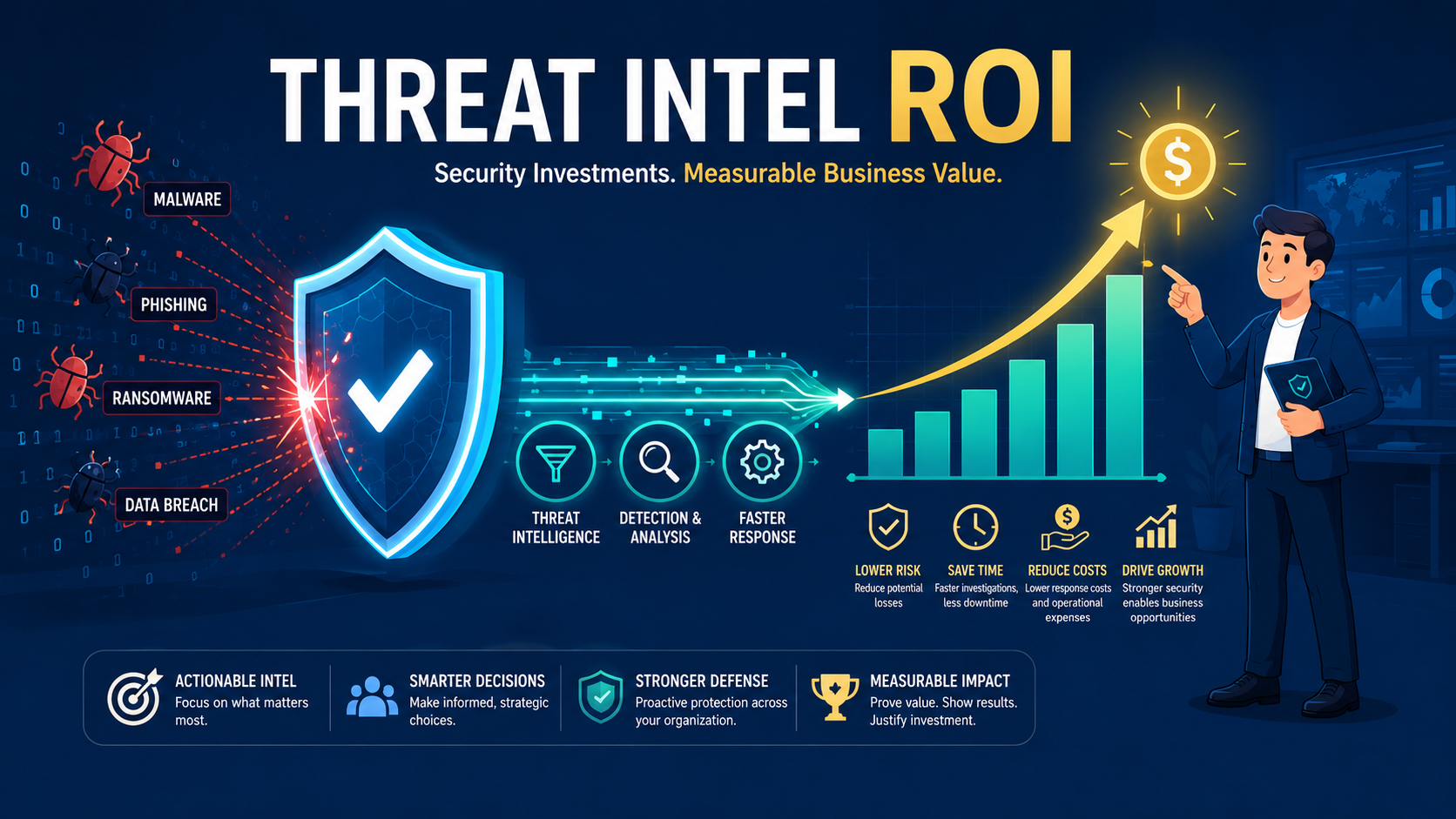
Threat intelligence helps security teams make better decisions, but proving its business value is often difficult. Executives want measurable results, not just fewer cyber risks. That’s why measuring ROI threat intelligence program should focus on outcomes like faster investigations, improved efficiency, and lower incident costs.
Combined with Network Threat Detection, organizations can connect intelligence to real security improvements and demonstrate value with metrics that business leaders understand.
What You’ll Measure to Show Real Value
The most useful metrics show how intelligence helps analysts work faster, improves detection, and reduces the overall cost of responding to security incidents.
- ROI is found in time saved and efficiency gained, not just breaches prevented.
- Start by measuring operational metrics like alert triage time and dwell time.
- The clearest proof often comes from your network detection and response capabilities.
Why Is Measuring Threat Intel ROI So Difficult?

The core challenge is attribution. You’re trying to prove a negative, the attack that didn’t succeed, the breach that didn’t happen. You can’t present an invoice for a million-dollar ransomware payout you avoided.
Leadership sees this as a cost center, a black box where money goes in and… what comes out? Stories about “staying ahead of threats” sound vague when budgets are tight.
We struggled with this. We had feeds, a platform, dedicated analysts. We felt more secure. But when asked for a report, we had nothing but gut feeling and a few anecdotes. The problem was we were measuring inputs (number of feeds, indicators processed) not outputs (time saved, decisions improved).
ROI in this space isn’t about revenue generated, it’s about loss avoidance and operational efficiency. You need to translate security outcomes into business language: time, money, and resource savings.
What Are the Tangible Operational Metrics to Track?
Forget about the amorphous “risk.” Start with the daily grind of your security team. How does intelligence make that work faster and better? Track the metrics that show efficiency gains.
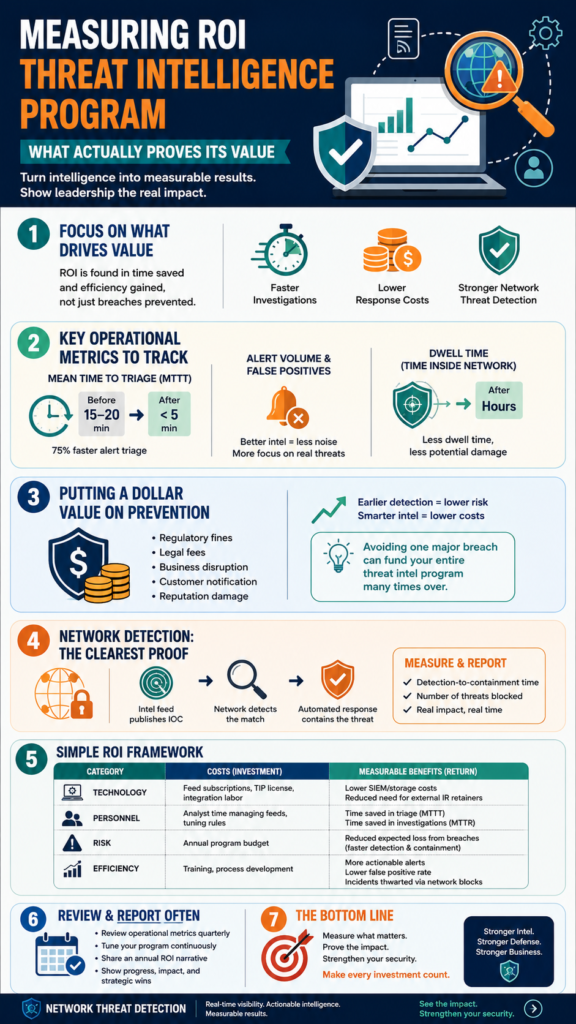
First, measure Mean Time to Triage (MTTT). How long does it take an analyst to decide if an alert is worth investigating? Before we integrated curated intelligence, analysts spent 15-20 minutes per alert looking up IPs and hashes.
After, with context automatically appended, that dropped to under 5 minutes for intel-enriched alerts. That’s a 75% reduction in triage time, a direct productivity boost.
Second, look at alert volume and false positive rates. A good intelligence program, properly tuned, should reduce noise by making better use of threat intelligence feeds that deliver relevant and timely indicators.
Third, track dwell time for incidents discovered via intelligence. If your intel leads you to an attacker inside your network faster, that’s a massive win. Reducing dwell time from days to hours is a quantifiable reduction in potential damage.
Can You Really Put a Dollar Value on Prevention?
Yes, but it requires realistic estimates instead of waiting for a security breach to happen. The goal is to calculate the possible financial impact of an incident and show how threat intelligence helps reduce that risk.
Start by estimating what a major breach could cost your organization. Consider expenses such as:
- Regulatory fines
- Legal fees
- Customer notification costs
- Business disruption
- Reputation damage
Next, compare those costs with the value of earlier detection. For example, if your threat intelligence program helps detect suspicious activity before it becomes a major incident, even a small reduction in risk can represent significant savings over time.
We’ve also found that better intelligence lowers incident response costs. In the past, high-priority alerts often required outside incident response specialists.
With stronger network monitoring and reliable threat intelligence, security teams could investigate and contain many incidents internally. This reduced the need for emergency external support and helped avoid unnecessary spending.
How Does Network Detection Provide the Clearest Proof?
Credits: Adam Goss
Network traffic doesn’t lie. It’s the unbiased record of what actually crossed your wire. When you invest in threat intelligence, one of the first and most measurable returns should be in your Network Threat Detection efficacy. This is where abstract IOCs become concrete events.
“The impact is best expressed through two key performance indicators: Mean Time to Detect (MTTD) and Mean Time to Respond (MTTR). Organizations should track trending reductions in these KPIs over consecutive reporting periods and correlate improvements with the introduction of CTI-driven detections… A sustained downward trend in dwell time following CTI adoption is therefore a persuasive quantitative signal of risk reduction.” – Semantic Scholar
We measure this through detection-to-containment time for network-borne threats. For example, when a new malware variant is reported by our intel feed, we push the IOCs to our network sensors. We then track: how long after the IOC was published did we first see a hit? How long after that hit did we contain it? The timeline is stark.
Before, we might have missed it entirely. After, we see a match, and our automated playbook triggers. We can report: “This quarter, our intelligence-informed network rules identified and blocked 15 unique callback attempts, with an average containment time of 2 minutes.”
That’s a powerful, non-arguable metric. It shows the intelligence is working, in real time, on a critical attack vector.
What About the Intangible Benefits? Do They Count?
They count immensely, but you must make them tangible. Improved strategic decision-making is a key benefit. Combining strategic, tactical, and operational intelligence helps organizations better understand the threat landscape and make smarter security investments.
Maybe intel shows a rise in attacks on a specific cloud service you use, leading you to accelerate a security review you’d planned for next year. That’s ROI, it’s allocating resources more effectively.
Another intangible is team morale and retention. Analyst burnout is a real cost. When your team shifts from chasing false positives to investigating high-fidelity, intel-driven alerts, job satisfaction improves. They feel effective.
Reducing turnover saves recruitment and training costs, which can be quantified. A more experienced, stable team is a more capable team, and that’s a direct return on your intelligence investment.
What Does a Simple ROI Framework Look Like?
You don’t need a PhD in finance. Build a simple table that contrasts costs with benefits, using the metrics you can actually gather. This turns abstract value into a structured argument.
| Category | Costs (Investment) | Measurable Benefits (Return) |
| Technology | Feed subscriptions, TIP license, integration labor. | Reduction in SIEM storage/processing costs due to filtered data. Reduced cost of external IR retainers. |
| Personnel | Analyst time spent managing feeds, tuning rules. | Time saved in alert triage (MTTT). Time saved in incident investigation (MTTR). |
| Risk | Annual program budget. | Estimated reduction in “expected loss” from breaches (based on reduced dwell time & faster containment). |
| Efficiency | Training, process development. | Increase in percentage of actionable alerts. Decrease in false positive rate. Quantifiable incidents thwarted via network blocks. |
Fill this with your own numbers. The “Benefits” column should tell a story of efficiency gains and risk reduction. Even if some numbers are estimates, they’re grounded in operational data.
How Often Should You Review and Report This ROI?

This isn’t a once-a-year exercise. Operational metrics should be reviewed quarterly, at a minimum. This allows you to tune the program while continuously operationalizing threat intelligence across detection, response, and daily security workflows.
“CTI is the fuel that makes internal defenses, like SIEM and SOAR, faster, smarter, and more cost-effective. Avoiding just one major breach can fund an entire CTI program many times over… The ROI Formula: A transparent model to calculate annual risk reduction by measuring breach probability against average impact.” – Reliaquest
Prepare a formal ROI narrative for the annual budget cycle.
Combine the quarterly operational data with any annualized cost-avoidance figures (like IR retainer savings) and strategic wins (e.g., “Our intelligence guided a patching priority that addressed a vulnerability being actively exploited in our sector”). This shows continuous improvement and strategic alignment, not just a static cost.
FAQ
What’s the single best metric to start with?
Start with Mean Time to Triage (MTTT) for alerts enriched with threat intelligence versus those without. It’s easy to measure, directly ties to analyst productivity, and almost always shows immediate improvement.
How do you handle it if the ROI seems negative at first?
This is common in the first 6-12 months due to setup costs and initial noise. Be transparent. Frame it as an investment phase. Show the plan: “We are currently in integration and tuning. Our target is to reduce alert triage time by X% by next quarter.” Track progress toward that target.
Can a small company with one feed even do this?
Absolutely. The framework scales down. Your costs are the feed and maybe an hour a week of tuning. Your benefits are the time you save not chasing false leads and the confidence that your firewall is blocking known-bad traffic. Track your hours reclaimed.
Do vendors help with this?
Some provide dashboards on feed “hit rates” or context. Use that data, but remember their goal is to show value. Your internal operational metrics (time saved, noise reduced) are always more credible and powerful.
The Bottom Line Value
The value of measuring ROI of your threat intelligence program comes from showing consistent operational improvements, not guessing the cost of attacks that never happened. Track metrics such as faster investigations, lower response costs, and fewer false positives to demonstrate measurable business value.
Combined with Network Threat Detection, these results become easier to validate through real-time visibility and actionable intelligence. Ready to strengthen your security program? Explore how Network Threat Detection helps teams reduce risk, improve response times, and clearly demonstrate the value of every security investment.
References
- https://www.semanticscholar.org/paper/Quantifying-the-ROI-of-Cyber-Threat-Intelligence%3A-A-Strada/54d7bda4ad6a9d3bd74b29ca64c414e595face33
- https://reliaquest.com/blog/forrester-tei-total-economic-impact-of-reliaquest