
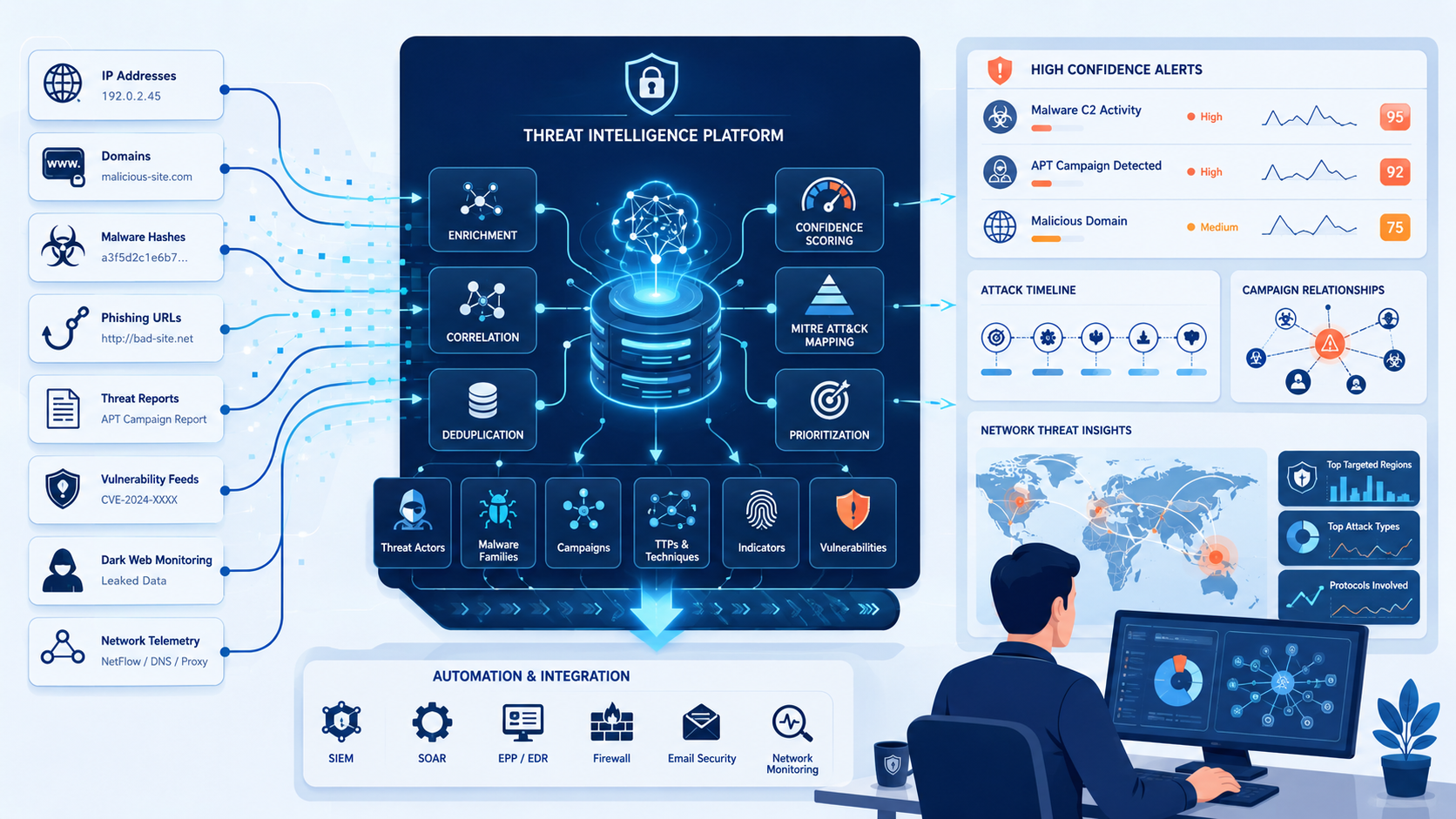
Threat intelligence platform benefits explained, that’s exactly what many security teams want to understand before investing in a Threat Intelligence Platform (TIP). While organizations collect more threat data than ever, the real value comes from turning that information into faster, more informed security decisions.
At Network Threat Detection, we use threat intelligence to add context to suspicious network activity, helping analysts prioritize what matters most and respond with greater confidence. Keep reading to explore the practical benefits of a Threat Intelligence Platform.
Threat Intelligence Platform Benefits Explained: Key Insight
Understanding the benefits of a Threat Intelligence Platform is easier when you focus on the outcomes rather than the technology itself. Here are the biggest advantages security teams gain from adopting a TIP:
- Faster threat prioritization with contextual intelligence.
- More efficient incident investigations.
- Reduced alert fatigue through enrichment and correlation.
How does a threat intelligence platform improve detection speed?
Security experts employ TIPs to monitor and find threats to their systems, networks, and data. A TIP often compiles information from a variety of sources…
“The platform then examines this data to look for patterns and abnormalities that could point to the existence of a threat, frequently utilizing machine learning along with other innovative analytical approaches. Once an issue has been discovered, a TIP can notify security analysts and give them background knowledge about the threat, including the nature of the threat, the attacker’s strategy and tactics, and any other pertinent information that might aid in an effective response.” – Wikipedia
Third-person POV would say TIPs reduce investigation latency by providing analysts with immediate context. First-hand, we’ve noticed investigations start more quickly because the team doesn’t have to manually pivot across multiple sources.
Now, where does Network Threat Detection fit in? In most organizations, we treat Network Threat Detection as the first option when suspicious network behavior appears, because it’s often the earliest, most observable layer.
We use it to validate anomalies and scope where traffic shows malicious patterns. Then the TIP helps interpret what those patterns likely represent (campaign stage, likely toolset, and expected follow-on activity).
We don’t hard-sell it, just note that in real incidents, network visibility is often the fastest path to clarity.
What benefits come from reducing alert noise and false positives?
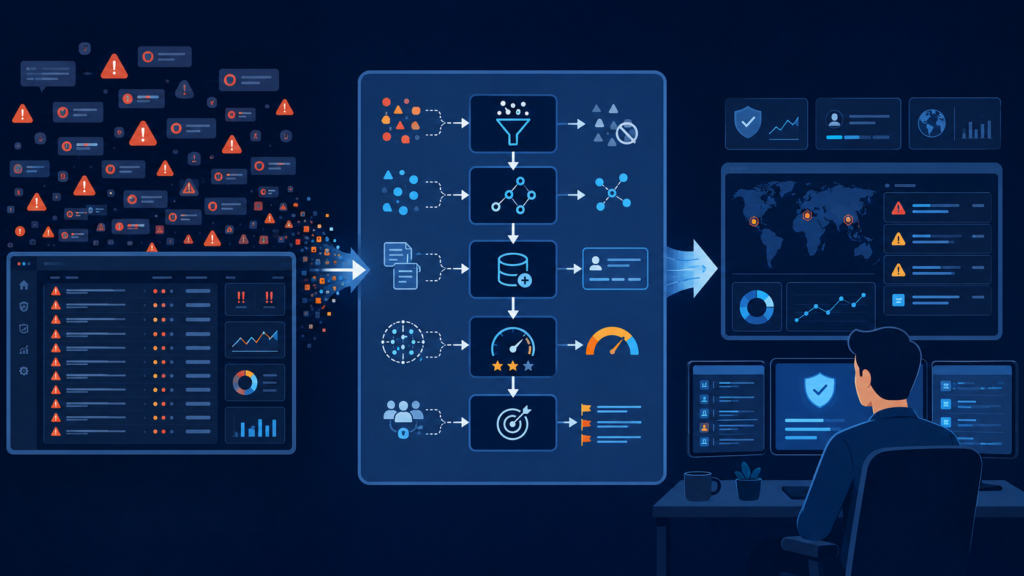
We’ve seen detection gains come from two areas: enrichment and workflow integration. A TIP usually aggregates threat feeds and historical intelligence, allowing security teams to make better use of threat intelligence feeds by correlating external indicators with internal observations before enriching them with relationships such as:
- campaign or actor associations
- malware family context
- targeting patterns (industry/region)
- confidence/credibility signals
“The threat alert fatigue or alert overload problem has become critical in recent years. In practice, the volume of threat alerts is higher than the volume of alerts that SOC analysts can investigate…[The proposed solution] provides additional insights to the SOC analysts to investigate the threat alerts, which improves the time taken to respond to threats after detection. Through this effort, [it] improves the productivity of the SOC analysts and provides a significant contribution to handle the “threat alert fatigue.”” – MDPI
A Third-person POV frames this as improved signal quality. Our own experience is that analysts spend less time asking, “Is this real?” and more time asking, “What does this mean for us?”
Here’s a practical way benefits map to outcomes:
| TIP capability | What we get | Typical result |
| Indicator enrichment | More context per alert | Less manual research |
| Correlation across sources | Fewer duplicates | Cleaner triage queues |
| Confidence / relevance cues | Better prioritization | Faster escalation decisions |
| TTP mapping | Behavioral understanding | More accurate hunting |
This is where we’ve felt fewer “dead-end” investigations and improved consistency across analysts.
How does a threat intelligence platform help incident response?
During incident response, speed and clarity matter more than perfect certainty. A TIP provides a structured way to connect the dots:
- What indicators show up, and whether they map to known campaigns
- What infrastructure has been used before
- Which tactics are consistent with observed behavior
Third-person POV would say TIPs support faster investigation and more consistent decision-making. First-hand, we’ve used TIP context to shorten the “early uncertainty window.” Instead of building hypotheses from scratch, we can confirm or discard possibilities using enrichment.
Also, TIPs help with investigation questions that naturally come up:
- Is this activity isolated or part of a larger push?
- Does the evidence align with initial access, credential access, or lateral movement?
- What’s the likely next step attackers attempt?
For Network Threat Detection events, we often start by confirming the suspicious traffic and then rely on TIP intelligence to explain what it likely represents and how far the threat may have progressed.
How does threat intelligence improve threat hunting?
Threat hunting succeeds when we know what to look for, not just which indicators to match. A TIP supports hunting with:
- known TTPs (tactics, techniques, procedures)
- historical patterns linked to adversary behavior
- enriched context for internal telemetry
Third-person POV might call this “hypothesis-driven hunting.” We’ve found it reduces guesswork. Whether intelligence comes from commercial sources or open-source threat intelligence, broader visibility helps analysts build stronger hunting hypotheses. For example, instead of hunting only for domains or hashes, we can hunt for:
- unusual beaconing patterns associated with common tool behavior
- DNS patterns aligned to known infrastructure styles
- lateral movement clues that match prior campaign workflows
In practice, Network Threat Detection can surface the suspicious behavior first (e.g., anomalous flows or suspicious protocol patterns). Then the TIP helps us understand whether those behaviors match a known adversary approach and where to look next (host activity, authentication anomalies, or endpoint behaviors).
This combination tends to improve coverage without expanding analyst workloads.
How can our security team prioritize risk more effectively?
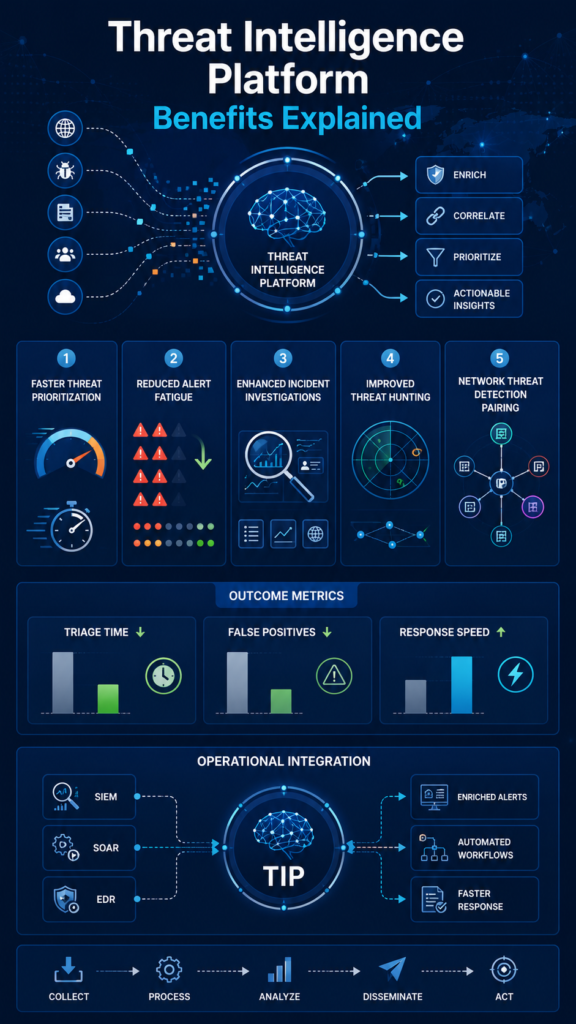
Not all threats are equal, and TIPs help us avoid treating every indicator as “top priority.” We prioritize using intelligence signals that often include:
- relevance to our industry and exposed assets
- whether indicators are tied to active campaigns
- exploitability and likely impact
- confidence levels from multiple sources
Third-person POV describes this as risk-based prioritization. In our experience, it changes behavior in triage meetings: alerts that are less relevant get deprioritized without being ignored, while high-relevance intel moves faster into investigation and remediation.
These platform benefits become especially noticeable as analysts spend less time sorting low-value alerts and more time focusing on genuine security risks.
We also use TIP context to guide what controls to tune. For instance, if intelligence indicates a campaign’s typical delivery vector, we adjust detection coverage accordingly (email, web, DNS, authentication, or lateral movement monitoring).
This is not about chasing everything, it’s about making our limited time cover what matters most.
How do threat intelligence platforms strengthen security controls?
A TIP becomes most valuable when intelligence flows into operations. Common integrations include:
- SIEM correlation and alert enrichment
- SOAR workflows for automated response steps
- EDR context for endpoint investigation
- DNS/email security enrichment for faster action
Third-person POV would say TIPs operationalize intelligence. We’ve found the practical benefit is consistency: the same enriched context appears everywhere analysts work, reducing “tribal knowledge” dependency.
We also benefit from standardized reporting: we can track coverage improvements over time (e.g., how many incidents were enriched correctly, which intel types drove actionable detections, and how response timelines changed).
If you start with Network Threat Detection as our earliest confirmation layer, we can then route enriched intelligence into the right controls, so we don’t stop at detection; we drive decisions and actions.
What’s the connection between threat intelligence and vulnerability management?
Credits: Adam goss
Threat intelligence isn’t only about indicators; it’s also about whether a vulnerability is being exploited and by whom. A TIP can support:
- tracking vulnerabilities with “in-the-wild” context
- prioritizing patching based on threat relevance
- validating which systems are exposed and likely targets
Third-person POV frames this as risk-informed remediation. We’ve experienced it as better patching prioritization and fewer wasted cycles on low-risk vulnerabilities.
Instead of “patch everything in the backlog,” we can ask:
- Is this vulnerability actively used in campaigns we care about?
- Are there network patterns or exploit indicators tied to our assets?
- Do we see related suspicious activity in our telemetry?
When Network Threat Detection spots suspicious traffic that aligns with exploit behavior, the TIP helps confirm likely context and accelerates escalation to vulnerability owners.
How does network visibility pair with network threat detection?
In real environments, network events are often the earliest hints of compromise. We typically treat Network Threat Detection as the first option to validate suspicious activity because it provides fast, continuous visibility. That can include:
- unusual sessions and protocol behavior
- suspicious DNS patterns
- command-and-control-like traffic characteristics
Third-person POV would describe it as improving early warning. First-hand, we’ve found the workflow improves dramatically when TIP intelligence is available immediately:
- we confirm suspicious behavior in the network layer
- we enrich it with campaign/actor context
- we guide what to investigate next (hosts, identities, lateral movement paths)
This reduces “unknown unknowns.” We don’t rely on a single alert; we validate behavior with network telemetry and interpret it with intelligence context.
That pairing also helps teams communicate: network evidence plus intelligence context is easier to explain internally.
What should we look for when choosing a threat intelligence platform?
We recommend evaluating TIPs by how well they turn intelligence into action, not just how many feeds they provide. In third-person terms, criteria often include integration depth, enrichment quality, operational automation, and usability.
From our perspective, we shortlist platforms that offer:
- strong enrichment (actor/campaign/TTP mapping)
- correlation with internal telemetry and assets
- workflow-friendly outputs for SIEM/SOAR/EDR
- support for both indicator-based and behavior/TTP-based operations
- flexible governance and analyst workflows
We also value speed and clarity: if the TIP adds steps that slow analysts down, it won’t stick.
A gentle reminder: start with what you already have. If Network Threat Detection is already deployed, ensure the TIP can enrich and accelerate those alerts rather than creating parallel, disconnected processes.
What does “success” look like after we adopt a TIP?
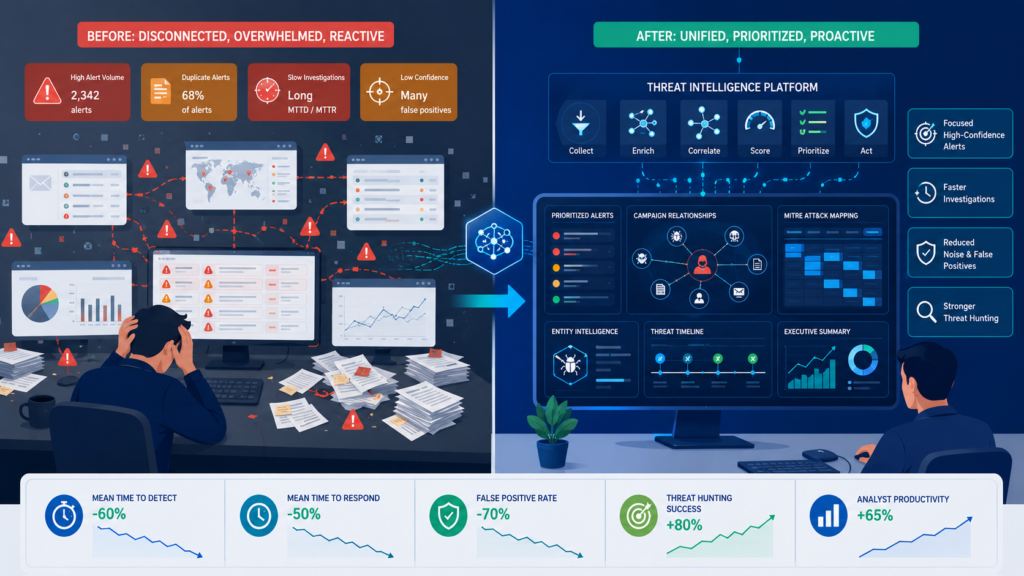
Success varies by maturity, but we’ve seen consistent improvement indicators, such as:
- reduced time spent on initial triage
- fewer false positives reaching deeper investigation stages
- improved investigation depth and consistency
- faster containment decisions during incidents
- better prioritization of patching and hardening actions
Third-person POV might call this “measurable operational impact.” In practice, we track metrics like:
- Mean time to triage (MTTT)
- Mean time to respond/contain (MTTR/MTTC)
- % alerts enriched and actionable
- number of investigations that convert from “alert-only” to “confirmed malicious” outcomes
- time saved per analyst incident workflow
We also track feedback quality: when analysts label helpful enrichments, the TIP becomes more aligned with what works in our context.
FAQ
What is a threat intelligence platform used for?
A threat intelligence platform is used to collect, enrich, correlate, and operationalize threat data so security teams can prioritize, investigate, hunt, and respond faster.
How is threat intelligence different from threat feeds?
Threat feeds provide raw indicators or updates. A threat intelligence platform typically enriches and correlates that data with context (campaigns, actors, TTPs) and integrates it into workflows like SIEM/SOAR/EDR.
Does a threat intelligence platform replace our Network Threat Detection?
No. We generally use Network Threat Detection as an early validation layer (first option for suspicious network behavior), and the TIP adds context that helps interpret and act on what the network layer shows.
Will a TIP reduce false positives?
Often, yes, when it enriches alerts with context and correlates indicators effectively. The main benefit is improved signal quality and better prioritization, which reduces unnecessary investigations.
Better Context, Better Security Decisions
A Threat Intelligence Platform helps our teams turn raw threat data into actionable security decisions through faster triage, smarter prioritization, stronger investigations, and more effective threat hunting.
Paired with Network Threat Detection as the first option for validating suspicious network activity, it provides the context needed to respond with confidence. Ready to strengthen your security operations? Join Network Threat Detection to explore real-time threat modeling, automated risk analysis, and continuously updated intelligence.
References
- https://en.wikipedia.org/wiki/Threat_Intelligence_Platform
- https://www.mdpi.com/1424-8220/25/14/4272